The Fragile Crescent

On April 30, I gave a lecture at Harvard University, where I am Olin Institute Senior Fellow, and where I’ve spent the past month. The subject: “After Iraq: The Future of the United States in the Middle East.” Below is an excerpt from the lecture.

The objective of the United States is to protect and advance its interests at the lowest cost, and from the greatest distance. That is easiest done when there is a stable structure of states with which to interact. A state is a convenient address a place to which you can dispatch diplomats or cruise missiles, to which you can sell arms or issue threats. In short, a state is an entity with which a state can conduct business, usually at arm’s length.

The states of the Middle East are the legacy of the Anglo-French partition of the Ottoman empire that followed the First World War. The United States has regarded these successor states, however constituted, as basic building blocks of order. Washington did not draw the map of the Middle East, but it has been adamant that the map not be altered. At times, certain Middle Eastern leaders, acting in the name of this or that ideology, have attempted to wipe a state off the map. Nasser’s Egypt absorbed Syria, Saddam’s Iraq absorbed Kuwait, and Asad’s Syria absorbed Lebanon. In each case, the United States used its influence or power to put the map back.

It has been axiomatic in Washington that the foundation of the pax Americana is the maintenance of a partition largely finalized back in 1922. The United States is even committed to putting Palestine back on the map, from which it disappeared in 1948. If only the map could be completed, so the thinking goes, the Middle East, like Europe, would cease to be preoccupied with identity, and move to more productive pursuits.

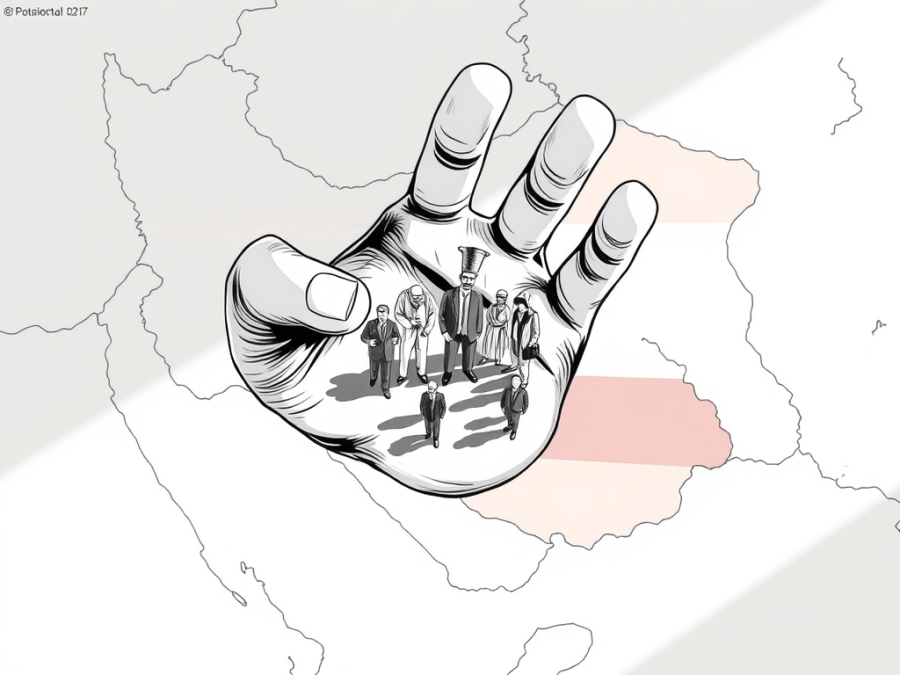
Not only has this “final status” eluded the United States. The irony is that the United States itself has delivered a massive blow to the map. In Iraq, it meant to destroy the regime and leave the state intact, but the state collapsed with the regime. The ramifications throughout the region are profound, if uneven.

They are not as significant for the states that draw upon a strong sense of territorial or ethnic or linguistic nationhood—Egypt, Turkey, Iran. But what I call the “Fragile Crescent” has felt the shocks acutely.

The British and French divided this part of the Ottoman empire, but not into its smallest conceivable parts. In fact, many of the successor states in this area were mini-empires in their own right, modeled on the late Ottoman system, governed on the same principles, and often by the same elites. Iraq, in particular, was a scaled-down version of the Ottoman empire. David Fromkin in his book A Peace to End All Peace wrote: “The Allies proposed a post-Ottoman design for the region in the early 1920s. The continuing question is whether the peoples of the region will accept it.” But precisely because the design was not entirely post-Ottoman, it somehow did function and most people grudgingly accepted it.

Now that design has been given a blow, and large pieces of the remaining order are threatened with further fragmentation. Put differently, the dissolution of the Ottoman empire has resumed.

There are three specific impacts of the Iraq war that are rendering parts of the political map an anachronism.

The first is the Shiite revival in Iraq and beyond, also known as the “Shiite Crescent,” a phrase coined by Jordan’s King Abdullah in a loquacious moment. The idea—a Sunni one, not a Shiite one—is of a Shiite band of population running from the Arab Gulf states through Iran, southern Iraq, leap-frogging Sunni parts of Iraq and Syria, and extending into Lebanon a trans-border, trans-ethnic belt of allegiance with Iran at its center.

The “Shiite Crescent” is one part hype, one part reality. There isn’t a contiguous belt of Shiites like the one shown in newspaper graphics; Shiites outside Iran and Iraq are still surrounded by a Sunni sea. Nor are Shiites driven by a need to reconfigure the map. In key states in the “Shiite Crescent”—Lebanon, Iraq, Bahrain—Shiites are not minorities: they seek to capture the state whole, not break it into parts. Still, wherever the Sunni-Shia rift runs through a state, that state is vulnerable. The “Shiite Crescent” may be a hyped Sunni slogan, but it highlights the growth of an allegiance that is both sub-state and supra-state, and that erodes the state order from without and within.

The second impact gets less attention: the Kurdish crescent. The Kurdish revival is as deep as the Shiite, but it is potentially far more subversive of the state order, because Kurds, unlike Shiites, are everywhere a minority. Iraq’s Kurds already have a de facto state, and it is a going concern, which is unlikely to maintain more than a formal tie with the rest of Iraq, if that. The autonomy of Iraq’s Kurds is a long-standing American commitment, which the Kurds are reinforcing through an extensive public relations and lobbying effort.

The more successful Iraq’s Kurds are—the more state-like they become—the more this affects Kurds in Turkey, Iran, and Syria. The rather expansive map of “greater” Kurdistan is a logo map—that is, a mental map inculcated via its representation on everything from keychains to commemorative plates. You will not find “Shiite Crescent” keychains, because the notion is Sunni, not Shiite, and Shiism is not a territorial nationalism. But Kurdistan is another matter: Kurdish nationalism has a strong territorial component, and it won’t be put back in a bottle.

The third and last impact involves the movement of millions across borders: the refugee crescent. These are mostly Iraqi Sunnis who have fled the chaos of their country to Syria or Jordan, and who are waiting out the war. Their numbers are already substantial, and they could increase dramatically in various scenarios. As the Palestinian case demonstrates, refugees put more than a material stress on host states. They throw the legitimacy of the status quo into question. While populations are being separated in Iraq, a great mixing is taking place in Syria and Jordan, with outcomes that cannot be predicted.

In sum, the map has been undermined. The choice the United States will face with greater frequency and urgency is whether or not to sustain its traditional support for that map. Past challenges came from aggressive states encroaching on smaller ones, and aggressors could be cajoled, deterred, and punished. But transformation within states, in which the main actors are movements, insurgents, refugees, and secessionists, is another matter.

We have a natural proclivity to dwell on those problems that we somehow might fix or tweak with the tools we have. Iran’s nuclear ambitions are a classic case. So is the Israeli-Palestinian issue. I have not discussed those problems this afternoon they are already being discussed elsewhere and everywhere. But it is precisely because the United States has so few of the tools it needs to deal with this sort of “new Middle East,” that its strategic and policy implications are not being discussed anywhere. Perhaps now would be a good time to start.

Postscript: For my pre-war discussion of this same issue, go here.

Israel’s summer wars

“The Israelis tend to launch their wars of choice in the summer, in part because they know that European and American universities will be the primary nodes of popular opposition, and the universities are out in the summer. This war has nothing to do with captured Israeli soldiers. 

—Juan Cole at his blog, Informed Comment, July 23, 2006.

The Winograd Commission, the Israeli body established to investigate the political and military management of the war in Lebanon, released its interim report today. The material includes the minutes of a crucial Israeli General Staff meeting in the lead-up to the war. They shed new and damaging light on its conduct, and they confirm the obvious: Professor Cole is supremely well-informed about Israel’s inner workings. It’s uncanny.

Chief of Staff: Good morning. At the top of the agenda, I want us to take up a crucial issue, related to the timing of our planned operation in Lebanon. We’ve already considered several key factors: the preparedness of our troops, the situation on the ground in Lebanon, coordination with the Americans. But there’s a paramount matter that I want to revisit before we present the plan to the Cabinet. It’s the academic calendar in foreign universities.

Neutralizing anti-Israel professors has always been a key ingredient of our strategy. We all know how vastly influential they are: just think of Juan Cole, Rashid Khalidi, Norman Finkelstein. So part of our strategic doctrine in past years has been to launch operations in summer, when academics are non-operational. Even the French work harder in summer. That’s partly why two of my predecessors chose June to launch the Six-Day War and the 1982 Lebanon war.

But it’s an issue I feel we should revisit. We take a slice of our strategic doctrine from the Americans. Our own intelligence was surprised three years ago, when the Pentagon informed us that Operation Iraqi Freedom would be launched in March, smack in the middle of the academic year. All our early estimates assumed that the Americans would hold off until after the last graduation ceremonies in June.

For our discussion today, I’ve invited Gentleman C, head of Middle East 101, the Mossad unit that tracks American and European academics. I think we’d all benefit greatly from his insights in planning the timing of our operation.

Gentleman C, why don’t you give us a quick summation of your analysis?

Gentleman C: On the table before each of you, you’ll find a comprehensive study compiled by Middle East 101, looking at the academic year factor in Israel’s wars since 1948. What we’ve done is a statistical comparison of the amount of anti-Israel verbiage expended by American and European professors in all of Israel’s wars. I draw your attention to Table 8. You’ll see that in every war, our military operations have taken less incoming criticism during summer months. We call this the “Away From My Desk” effect. Professors on summer break are less likely to write op-eds and show up in the media. There aren’t any students to attend their campus teach-ins, and there’s no student press to cover them.

Bottom line is that summer remains an ideal time to launch a war. The operational readiness of academe is at its lowest.

Director of Military Intelligence: May I? I have a lot of respect for my opposites in the Mossad, and especially Middle East 101. They do fine work. And I take my beret off to their targeted character assassination of Juan Cole. If it weren’t for the Mossad’s clandestine efforts, Cole would be at Yale. As you know, it’s vitally important to keep people like Cole outside the 200-kilometer-radius security zone we try to maintain around New York City.

Chief of Staff: Here, here.

Director of Military Intelligence: That said, we in Military Intelligence don’t share the Mossad’s assessment of the “Away From My Desk” effect. It may be true that the professors manage to fire off more rounds of criticism during the academic year. But these are mostly short-range projectiles—teach-ins and classroom agitprop that don’t have a range beyond the campus. Most academics are too preoccupied during the school year to get off medium- to long-range op-eds in the New York Times or The Nation. They’re too busy preparing lectures, fixing syllabi, keeping office hours, or quashing rivals in faculty committees.

We think that during the summer, the quality and range of attacks against us actually increase. You’ve got professors with lots of time on their hands, and the more senior, tenured ones are looking for distractions from their bigger projects. In particular, we think a summer war could expose us to sustained assault by academic bloggers.

GOC Southern Command: I thought sustained blogging by a professor was pretty much tantamount to a suicide bombing.

Director of Military Intelligence: There’s ample evidence for that. But we’re talking about a group of highly ideological and thoroughly indoctrinated fanatics. They’re quite willing to sacrifice career prospects in order to advance the cause. The tenured ones, of course, think they’ve already died and gone to heaven. They spend most of the year in classrooms full of near-virgins. It’s almost impossible to deter a tenured professor.

We think the ideal time for an operation is the very first month of the fall semester, in September. This is crunch-time for professors, who’ve got to get all their courses up and running, make sure textbooks are in the stores, solve scheduling conflicts, and suck up to new deans and chairpersons. About the only thing professors manage to put on paper in September is their signatures on drop/add forms, and maybe the occasional petition.

GOC Home Front Command (with alarm): September? We’re not going to launch a war of choice right in the middle of the Jewish holidays, are we?

Gentleman C: With all due respect, I think my friend from Military Intelligence underestimates the travel factor in summer. Middle East 101 tracks the movements of professors throughout the world. The highest-caliber ones are the most likely to disappear in summer for weeks on end, on “research” trips to London or Provence. We know from intercepts, and satellite surveillance shared with us by the Americans, that a lot of them aren’t even near a library or archive. Their spouses have real jobs and need real vacations. We’ve seen major blogs shut down entirely for the better part of the summer.

Director of Military Intelligence: Maybe, but a lot of these professors travel in summer to the Middle East—Beirut, Damascus, Amman. If we launch a summer operation, they’ll suddenly become on-site resources for the media. If they have to evacuate Lebanon, that becomes a story in itself. Let’s not forget how Rashid Khalidi got started: Beirut, summer of 1982.

Gentleman C (with irritation): Well, who was it who let Khalidi escape from Beirut?

Director of Military Intelligence (raising voice): Oh? Who authorized Edward Said to make a visit to Israel? You didn’t have to be a prophet to predict the outcome of that.

Chief of Staff: Gentlemen, please, let’s not get sidetracked by past mistakes. Lord knows we’ve made plenty of them—bungling the recruitment of Joel Beinin, letting Ilan Pappe do cushy reserve duty, and the list goes on. Look, I’d like to continue this discussion all morning, but we do have other issues on the agenda, like the extent of air power we’ll need to dislodge Hezbollah. I see the Commander of the Air Force is looking at his watch. Too bad we can’t solve the campus problem with air power.

Commander of the Air Force (dryly): Don’t say can’t. We haven’t tried.

Chief of Staff: Well, I’m going to conclude this discussion. My view is that we should stick with what’s worked for us in the past. We’ll propose to go in summer. If we ever do a complete overhaul of doctrine, we can reconsider. But I think Gentleman C has made a compelling case, and the empirical data speak for themselves. Agreed?

Director of Military Intelligence: Let the minutes show that I think otherwise.

Chief of Staff: Duly noted. Oh, and by the way, Gentleman C, what’s your assessment of what Juan Cole might do when we move?

Gentleman C: There’s some debate in our shop as to whether he’ll stick to Iraq, or blog furiously about Lebanon. If he Lebanonizes his blog, it’ll be a problem for us, but it’ll take some heat off the Americans. They’ll be grateful, and we can trade on that for things we need. Like bunker-busters.

Chief of Staff: Splendid. Juan Cole might turn out to be one of our biggest assets. “The work of the righteous is done by others.” (Laughter around the table.)

Geopolitics of the Jews

Over the winter, I gave a short address to the Conference of Presidents of Major American Jewish Organizations, at a meeting in Jerusalem. I took the assignment seriously, and offered these thoughts, more to highlight problems than offer solutions. In this week between Holocaust Memorial Day and Israel’s Independence Day, I share them for wider reflection.

The title of our panel is “Looking Back, Looking Ahead: The Geopolitical Situation of the Jewish People.” This is a moving target: the geopolitical situation of the Jews hasn’t ever been stable. As a people, our geopolitics are one part our preferences, and two parts historical forces. These forces never rest. Seventy years ago, the Jewish world was centered in Europe. Now we mostly just fly over it. The United States and Israel are today the poles of the Jewish world, because some Jews sensed tremors before the earthquake. When the earth opened up and Europe descended into the inferno, parts of the Jewish people already had a Plan B in place. We are living that Plan B.

Today the Jewish people is in an enviable geopolitical position. It has one foot planted in a Jewish sovereign state, and the other in the world’s most open and powerful society. One is tempted to say that never in their long history has the geopolitical situation of the Jews been better. Jews did have sovereignty before, in antiquity, but they did not have a strategic alliance with the greatest power on earth. And since it is difficult to imagine a better geopolitical position, the Jewish people has become a status quo people. Once we were revolutionaries; now we don’t need the world to change. Of course we would like an improvement in Israel’s standing with some of its neighbors—what dreamers call “peace.” But we are generally confident or complacent enough to prefer the status quo to the risks of changing it.

Yet as we all should know, history stops for no man, and for no people. I was trained as a historian, and while this gives me no powers of prophecy, I can assure you of one thing. What is, will not be. Balances of power will change. Identities will be recast. Eventually, too, the map of the Middle East will be redrawn.

When we worry, we tend to focus on apocalyptic scenarios. But I invite you to think for a moment about five long-term trends that could erode the status quo, but that fall short of a mushroom cloud. I will proceed from the far to the near, and I will focus on the Israeli side of the equation.

First, U.S. influence in the Middle East could wane. Perhaps you have read the article by Richard Haass, president of the Council on Foreign Relations, entitled “The New Middle East.” He wrote: “Less than twenty years after the end of the Cold War, the American era in the Middle East… has ended….  The second Iraq war… has precipitated its end.” I think this is premature—America’s era in the Middle East will end one day, but it hasn’t ended yet, and it will take more than Iraq to end it. But Haass’s statement is indicative of a spreading mood. Add this to technological change that could reduce American dependence on Middle Eastern oil, and it is possible that in twenty years’ time, America will be less interested and engaged in the Middle East. What is our Plan B then?

Second, Europe could be subtracted from the sum power of the West. The trends there, of low birth rates, Muslim immigration, multiculturalism—if they are not stopped or reversed, they could have the effect of de-Westernizing Europe. Europe, even without Jews, is part of a cultural and strategic continuum, linking Israel to America. Without that link, Israel would become still more encircled by Islam-inflected hostility. So what is our Plan B then?

Third, Iran could gain regional power status. In fact, the imperial ambition of Iran may be a long-term trend independent of the nature of its regime. Iran could become Israel’s regional rival, even if it postpones its nuclear plans and drops Ahmadinejad. Iran is already using every ounce of its leverage to establish its dominance in Iraq and its influence elsewhere in the Persian Gulf. If Iran emerges as a power on par with Israel—a power intent on drawing Israel into a long cold war of attrition—what is our Plan B?

Fourth, the Arab states around us could succumb to the same sort of disease that is causing Iraq to hemorrhage internally. That disease is the lack of legitimacy. When you look at a map of the Middle East, you are looking at a gerrymandered hodgepodge, drawn a century ago to serve the interests of the long-defunct empires of Britain and France. If Iraq breaks up—and I believe it will—other states could begin to crumble. In some places, it might be Shiites against Sunnis; elsewhere, Islamists against nationalists. This could engulf states on Israel’s borders, and Israel could find itself opposite not one Hezbollah but many. So what is our Plan B?

Fifth, and closest to home, there is the possibility that the two-state solution will become passé, because the Palestinians will fail as a nation. By failure I mean they will not have the cohesion necessary to translate their identity into nation-statehood. Many in Israel presently speak as if the creation of a Palestinian state is essential to Israel’s own legitimacy and even survival. But what if such a state proves to be impossible? A binational state, Israeli-Palestinian, is anathema, so what is our Plan B?

Now one would have to be a grim pessimist to believe that all five of these trends could merge into a perfect storm. But one would have to be an incurable optimist to believe that that we won’t be lashed by any of these storms. And what I am arguing is that we should anticipate conditions that will make storms more frequent than they have been in the last few decades.

We have had a remarkable run these last thirty years. Israel has flourished under the pax Americana. There has been no general Arab-Israeli war since 1973, and peace prevails on most of Israel’s borders. The country’s population has grown, foreign investment has poured in. Israel has expanding relations with the up-and-coming powers in the world. And American Jewry has gained stature and influence, in part by mediating for Israel. This has been a long and productive peace.

But when Herzl wrote The Jewish State, Europe was also thirty years into its long peace. He knew it would not last, that its foundations were weak. He planned accordingly. We should recognize that the status quo in the Middle East won’t last indefinitely, and we have to plan accordingly. I haven’t said what I think has to be done—what alliances to make, what targets to strike, what borders to redraw. But I do say that Israel will have to make alliances, strike targets, and redraw borders—and they won’t necessarily be the familiar ones.

This is going to create stress in the world, and even within the Jewish people. So your tasks will multiply, and they will become more urgent. If you got into this business ten years ago, thinking it would be all gala dinners on the way to a new Middle East, I apologize on behalf of history. The man was on the mark who said that the trouble with our times is that the future just isn’t what it used to be.

See the response of Saul Singer to this post.

Spanish translation here.