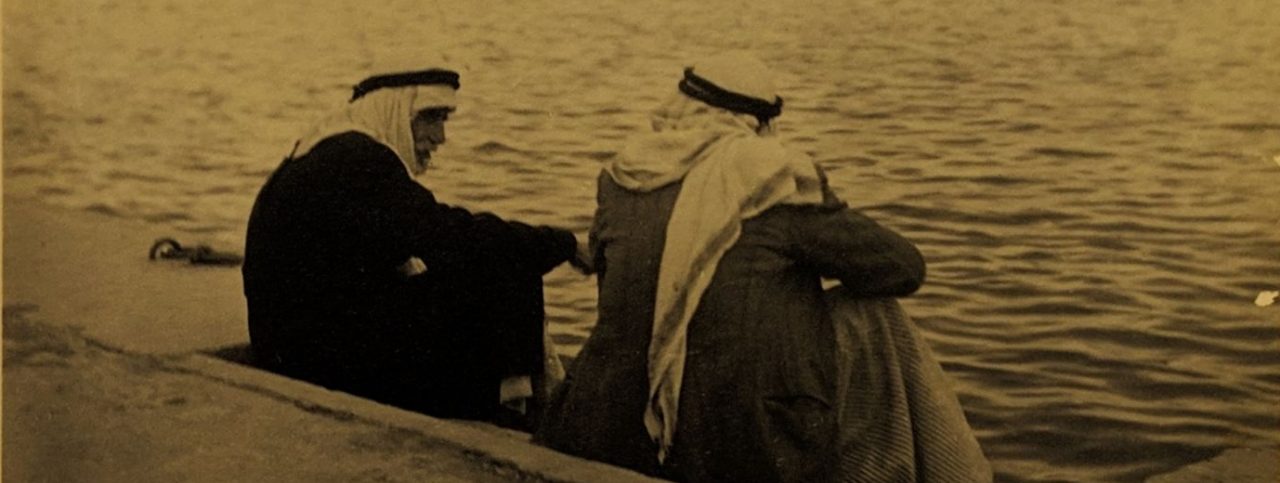
Khalidi file at Princeton

Last year, Rashid Khalidi came to Princeton to deliver a job talk. His aim: to win the newly-established Robert H. Niehaus ’77 Professorship of Near Eastern Studies and Religion. He didn’t get it. Last month, Princeton announced the appointment of Muhammad Qasim Zaman, a McGill-schooled specialist on Islam from Brown University.

But Khalidi, it turns out, has friends in Princeton’s history department, and they began to push for his appointment there. People tell me that Jeremy Adelman, chair of the department, bulldozed Khalidi through the history faculty (against opposition), and a favorable recommendation has gone up to the so-called Committee of Three (the Faculty Advisory Committee on Appointments and Advancements). Its recommendation will go to the university president.

An odor arises from this procedure, on this account: the department didn’t conduct a search. In very rare cases, involving candidates of immense distinction, university departments do recruit without searches. But Khalidi doesn’t have such standing, and the proof has already been provided by Princeton itself, which passed him over for the Niehaus Chair.

So Khalidi’s admirers in Princeton are already dropping the university to the abject level of Columbia, which brought him to the Edward Said Chair without a search. One suspects that these admirers know that if a search were conducted, Khalidi might not make the cut, and so they’ve chosen the back-door route.

Until now, I’ve always regarded Princeton as a more demanding setting than Columbia (and I’m an alumnus of both). Columbia has a culture of cutting corners and under-the-table dealing, in which friend recruits friend. This is why it exploded in scandal less than two years ago. Princeton’s history department now seems to have been infected with the same virus. I urge the Committee of Three at Princeton to hold the line against this latest assault on the university’s integrity. The way is simple: it should send Khalidi’s file back, and insist on a publicly-announced search for the position.

Juan Cole’s next book

The Yale search committee that’s come up with Juan Cole as a finalist claims not to be interested in his blog, according to a report in the Yale Daily News:
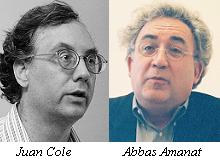
Frances Rosenbluth, a member of the search committee for the professorship, said the committee considered only [Cole’s] scholarly writing—not his blog or his political views—when they named him a finalist for the slot.

They must have ended up reading a lot of older material. Cole has been blogging for four years. Just before he started blogging, he finished up a collection of recycled essays. His last original book-length work, on Baha’i history, appeared in 1998. As I wrote in February, “Cole has turned into a journalist. Academics would be right to wonder how anyone can blog with this intensity and still produce any sustained scholarship. I certainly wonder, and I say that as an academic blogger of long standing. The price of blogging is paid in scholarship.”

Or is it? Nikki Keddie, professor emerita at UCLA and a mentor of Cole’s over several decades, saw what I wrote, and got all indignant. She posted a testimonial to Cole’s scholarship, which she capped with this revelation:

He is planning to use his extensive contemporary research, reflected in his blog, for another book.

Well! You thought he was just blogging like the rest of us. You thought he was just trawling the web and reading the papers. But not Juan Cole! He was really in the midst of four years of “extensive contemporary research”! This journey has taken him deep inside contemporary Iraq (without actually going there), and through the Washington labyrinth of the neocons and Likudniks (without actually meeting one). At some point (after how many more years?), this research, now merely “reflected” in his blog, will yield… a book! A nugget of scholarship! Something to set alongside the hundreds of books about Iraq, terrorism, and the Middle East that have been conceived, researched, written, and published since Cole became a blogger.

I’m not holding my breath. But let’s assume that Cole’s blog is a kind of rough draft of his next book. Then its controversial content is a legitimate issue that Yale should consider in weighing his candidacy. When the University of Michigan tenured Cole, it could claim to do so strictly on the basis of his refereed writing. But Yale would be foolish to put on blinders and completely disregard Cole’s writing over the past four years, the vast bulk of which is self-published. Indeed, if Keddie’s claim about Cole’s blog is true—that it’s a book-in-progress—ignoring it would be downright irresponsible. What it says about Cole’s politics should be irrelevant. What it says about his professional competence and judgment should be crucial.

Inside job at Yale?

In February, I wrote that I would be shocked if Yale appointed Juan Cole to a professorship in the Yale Center for International and Area Studies. Now that he’s been declared a finalist, I see I’m not alone. The appointment has been the subject of three hard-hitting pieces in the Yale Daily News, the New York Sun, and the Wall Street Journal. They raise all the obvious objections to Cole that I’ve been raising for a long time. The question that sticks in my mind is this: how did Cole get this far in the first place? Here’s one possibility.

One member of the search committee is Yale history professor Abbas Amanat, who also runs Yale’s equivalent of a Middle East center. Amanat is a distinguished scholar, whose judgment normally would be important in such matters. However, he has had an extra-academic relationship to Cole, which may well constitute a conflict of interest between personal obligation and institutional responsibility.

The sum of it is that Amanat and Cole belonged to a small group of dissident Baha’is who left (or were eased out of) the organized “Faith” in the 1990s. In the bitter polemics surrounding this affair, Cole defended Amanat against charges that he had abandoned his belief. “He has never disavowed being a Baha’i,” Cole attested of Amanat, “and has been an important mentor to younger Baha’i scholars in the Middle East studies field.” Cole wrote that Amanat “has feelings about the Faith that prevent him from doing so [i.e., renouncing his belief], despite what he described to me as his ‘liminality.'” Cole also composed a detailed apologia for Amanat, defending him against what Cole called the “Inquisition” of the Baha’i administration.

It is perhaps interesting to note that Amanat and Cole are also politically aligned. The Yale Daily News gave this account of an Iraq war “teach-in” held at Yale in January: “Cole said the decisions of the U.S. government upon entering the war were misguided. Abbas Amanat, a professor of history who concluded the event, reenforced the themes in Cole’s speech.” Amanat’s views on Iran are likewise indistinguishable from Cole’s. And immediately after 9/11, Amanat followed Cole in locating the “ultimate rallying point for the Arab and Muslim worlds” in U.S. policy toward Palestine.

Given all these personal and political intersections, one wonders whether this is yet another case of friend-brings-a-friend. Such a culture created the morass at Columbia, where Edward Said managed to assemble a small faculty of personal allies. It would be unfortunate were Yale to allow scholars with like allegiances, like interests, and like minds to nest in its Middle East programs.