 David Horowitz has published a book with the title The Professors: The 101 Most Dangerous Academics in America. These sorts of lists used to get academics in a lather, but they’ve become so commonplace that the novelty has worn off. (Some profs are even wearing their inclusion as a badge of honor. As one of them put it, “I suspect most [of us] are either pleased or insouciant .”) Horowitz might make it more interesting by putting the 101 names on his website, so that the rest of us can rank them. Democracy now.
I haven’t seen the book, which presumably fills out the case against each professor. But I’ve gone through the list to see who’s made it from Middle Eastern studies. Despite the field’s small size, it’s amply represented. Below are the professors of Middle Eastern studies in Horowitz’s 101 “most dangerous,” with my own vote in italics. (Please note: I’ve skipped profs who may write a lot about the Middle East, but who aren’t members of the guild. That includes the likes of M. Shahid Alam, Noam Chomsky, Richard Falk, Norman Finkelstein, etc.)
- Baylor University: Mark Ellis. Concur.
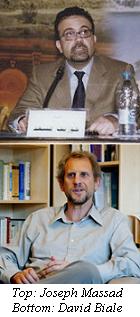
- Columbia University: Lisa Anderson, Gil Anidjar, Hamid Dabashi, Joseph Massad. I’d take out Anderson, perhaps also Anidjar, and would replace them with Rashid Khalidi and Mahmood Mamdani.
- Duke University: Miriam Cooke. Concur. And by the way, she writes her name in lower case, thus: miriam cooke. Go figure.
- Georgetown University: John Esposito, Yvonne Haddad. Concur.
- Stanford University: Joel Beinin. Concur.
- University of California, Berkeley: Hamid Algar, Hatem Bazian. Concur, and I would add Beshara Doumani.
- University of California, Irvine: Mark LeVine. LeVine is more amusing than he is dangerous. I’d drop him. But as long as we’re in California, I would add Asad AbuKhalil at Cal State Stanislaus, Sondra Hale at UCLA, and Stephen Zunes at the University of San Francisco. From outside of the guild, I’d add Saree Makdisi at UCLA.
- University of Kentucky: Ihsan Bagby. I’d never heard of him before I saw his name here. Drop.
- University of Michigan: Juan Cole. Concur.
- University of Southern California: Laurie Brand. Nah. Only dangerous to herself.
I’d have no trouble filling up another list of “dishonorable mentions,” but it wouldn’t differ much from the names on this petition, so I won’t bother.
Are these professors dangerous? The jacket of Horowitz’s book says he “exposes 101 academics–representative of thousands of radicals who teach our young people–who also happen to be alleged ex-terrorists, racists, murderers, sexual deviants, anti-Semites, and al-Qaeda supporters.” With a few possible exceptions, I don’t think that those listed above fit neatly into any of these categories. They’re fellow travellers and apologists who’ve already been exposed. At this point they’re as dangerous as potholes, easy to avoid if you’re paying attention or someone has warned you in advance.
The more serious problem is that Middle Eastern studies are mediocre. I haven’t seen a citation analysis, but my guess is that no one in Middle Eastern studies would come even close to the top 101 in the humanities and social sciences. No wonder provosts and deans look upon Mideast departments as places more pregnant with embarrassment than achievement.
 There are excitable mobs in every great Muslim city, and the Danish cartoons have given them an excuse for riot and pillage. But is there more to it than that? Who is playing the role that Ayatollah Khomeini played in the Rushdie affair, fanning the flames in specific directions?

You must be logged in to post a comment.