Ivory Towers and Twin Towers, 20 Years Later

• This article appears in the Spring 2022 issue of the Middle East Quarterly.

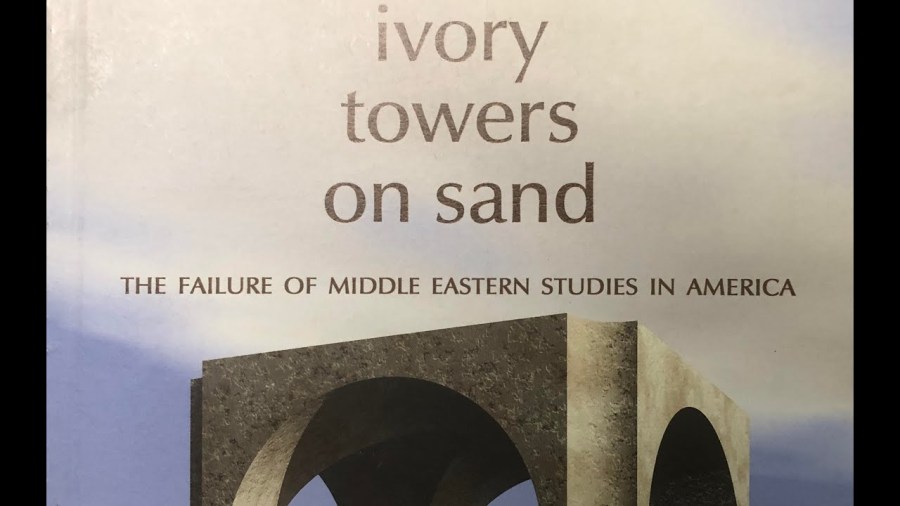
In 2001, my book Ivory Towers on Sand: The Failure of Middle Eastern Studies in America became a part of a much bigger and heated discussion over what made the United States vulnerable on 9/11. The main argument in the book was that Middle Eastern studies in America had consistently missed the most important developments in the region. One of them was the rise of very radical forms of Islamist extremism. That claim is why the book took off.

The book does not argue that academics or anyone else could or should have predicted 9/11. Even the greatest experts cannot predict such things. Winston Churchill once said, “It is not given to human beings … to foresee or to predict to any large extent the unfolding course of events.” In fact, nearly all the events that have transformed the Middle East since I started to study it, were surprises: the 1973 Yom Kippur War, Anwar Sadat’s visit to Jerusalem, the Iranian revolution, the Soviet invasion of Afghanistan, the Iraqi invasion of Kuwait, 9/11, and the “Arab Spring.”

However, the book does show that when events failed to conform to academic models, the academics disregarded or distorted the evidence. Still worse, they poured scorn on anyone who dared to propose another way forward. Every intellectual endeavor, to stay credible, has to correct itself. This was the problem: not that Middle Eastern studies got some big things wrong, but that they would not acknowledge it and then revisit their assumptions. This was the greater sin.

New Experts for Old

So much for what preceded 9/11. What has happened since, and what is happening now?

The market share of academics in interpreting the Middle East for Americans is now much smaller than it was right after 9/11. Up until then, studying the Middle East and writing about it were very much a niche industry. The lead producers were university-based academics and a few specialized think tanks. If you were smart and ambitious and did not have a stake in some Middle Eastern fight, you usually specialized in something else. Sure, the Middle East erupted every so often, but it did not stay on the front burner or the front pages for long.

Following 9/11, Americans demanded to know “why they hate us,” and “how do we change them.” At the time, the academic experts were swamped with invites from television producers, newspaper editors, and senior officials. They performed unevenly, to say the least. That was because the academics tended to sound one repetitive note: America is to blame. This was not so much an analysis as an ideological profession of faith.

But very quickly, the whole ecosystem changed. The main effect of 9/11 was to make the Middle East a matter of very wide concern. That meant that smart people who had not given the Middle East much thought made themselves into experts—some, quite credibly.

Not only did the region-specific think tanks grow large. The all-purpose, general think tanks built out large shops to deal with the Middle East. These alternative experts drove the academics out of the limelight. Generally, the non-academic voices ignored the “blame America” narrative and searched for deeper causes. And they discovered a whole world of rage and grievance that the academics had overlooked.

Especially impressive was the way top journalists rode 9/11 to become some of America’s leading interpreters of the Middle East. There is, today, a large shelf of books about al-Qaeda, Osama Bin Laden, Afghanistan and Iraq, Islamism and the “Arab Spring,” written by journalists. Many made the best-seller lists and won prizes.

Then there were the military commanders, diplomats, and intelligence officers who served on front lines from Afghanistan to Iraq to Syria. Before 9/11, few of them had much on-the-ground experience in the region. They took an over-the-horizon view. But the wars cycled several million Americans through the Middle East, and many of them developed a high-resolution knowledge of politics, society, and culture. If one looks today at the people summoned to comment on the region, the proportion who had their boots on the ground is very high, and it is likely to stay that way for years to come.

In sum, very little of what the public reads or hears about the Middle East today comes from academics. This is evident in the 9/11 documentaries that have been broadcast in the general media on this twentieth anniversary. Among the quotable talking heads, academics are almost entirely absent. They mostly write for and speak to each other in a narrow circle, or for the slightly wider circle of the farther left.

If one wants more proof, ask this: Does anyone in the field, any credentialed professor of Middle Eastern studies, enjoy any broad name recognition in America? The answer is an obvious “no.” The last one was the late Bernard Lewis. Lewis had two New York Times bestsellers right after 9/11: What Went Wrong and The Crisis of Islam. They were quick, readable syntheses that filled an immediate void and that flew off the shelves.

But Lewis, and to some extent also Fouad Ajami, were the exceptions that proved the rule: The academic study of the Middle East does not produce high-profile public intellectuals.

America has not looked to academics for its ideas about the region in a long while.

A Classroom Monopoly

And yet, Middle Eastern studies still matter, not because of what the academics say or write but because of what they teach.

The most prestigious universities are no longer the beacons on a hill they once were, but their degrees are still coveted. One still gets mileage from a Princeton degree, or one from Harvard. These are the most durable brands in America, some predating American independence. So it is not surprising that young people still compete ferociously to get into these schools. And from there, they will go on to make policy, form opinion, and command U.S. power in the world.

The best guess is that the indoctrination in these places is as bad as ever. It is a “guess” because the classroom is not public domain. But if academics teach in the classroom what they say and write in the public domain, then it is still a closed circle. Back around 9/11, there were maybe half a dozen universities where a student could find enough balance to get a credential worth having. Today, one would not need all the fingers of one hand.

Previously, the government might have been able to balance things in institutions subsidized by the taxpayer, such as university Middle East centers. Now, that is doubtful. Higher education has an effective lobby in Washington, and the White House and Congress do not care much because, in relative terms, the money is quite small. So yes, by all means, let us have accountability for biased outreach programs. And let us have universities disclose foreign funding as required by law. But let us not delude ourselves because this will not make much of a dent.

What does seem to work, at least in certain cases, is shaming. Of course, much of academe is shameless, and in those places, the game is long lost. But even in this era of rampant “wokeness,” there are university administrations that care about quality. Calling out error and bias in these settings—as Middle East Forum’s Campus Watch does—has some value. It is not going to reverse the trend. It is not going to stop it. But it might slow it down.

Taking the Initiative

But criticism can only do so much. Just as important is creating alternatives. For example, on the disciplinary level, there is the alternative to the Middle East Studies Association, named the Association for the Study of the Middle East and Africa, or ASMEA. The Middle East Quarterly also makes room for dissenting views. In the field of international relations, including the Middle East, there is the Alexander Hamilton Society. And there are some initiatives at individual universities and colleges.

Creating alternatives is labor-intensive because it involves swimming against the prevailing currents in academe. Success requires cunning, tact, and money. And there is no packaged formula: Every campus is a planet unto itself. What flies on one will crash on another.

But this is the only way left open. We are not going to witness a revolution in Middle Eastern studies. A generation or more will have to die out before that has a chance of happening. The objective must be more modest: to create some space for alternative views and free debate on the Middle East. To some extent, that has been achieved over the past twenty years. The challenge of the next twenty years is to enlarge that space and fill it.

Discussion

Editor’s note: The following is excerpted from a Campus Watch webinar interview by Winfield Myers, September 10, 2021.

Campus Watch: You mentioned the disappearance of star professors of the caliber of Bernard Lewis. With all due respect to journalists and other non-academic commentators, has anyone really filled those shoes? Has the quality of information that is available to the public today regarding the Middle East, regardless of its source, increased or decreased over the past twenty years?

Kramer: My overall impression is that it has probably increased in terms of firsthand familiarity with the situation on the ground. Hundreds of people were sent out to “cover” the region, and they accessed information that even people like Bernard Lewis couldn’t access.

For example, prior to 9/11, the bookshelf on Saudi Arabia was virtually empty. Academics didn’t work on it, either because they couldn’t get access, or they were afraid that if they wrote something uncomplimentary about Saudi Arabia, it would forever block their universities from ever getting any Saudi funding. After 9/11, journalists began to pick up the story, and now we have a very impressive accounting of Islamic extremism in Saudi Arabia, the leading actors in the Saudi royal house, and so on.

So yes, there’s more out there, in absolute terms of quantity. What we don’t have is what the likes of Bernard Lewis and Fouad Ajami provided: the longer historical perspective. That was something that could only be done by academic scholars. No one is doing it for a wider public today. So we get a lot of reportage of a very high quality. But we haven’t had a major book or even a major article in a mass circulation outlet like The Atlantic or The New Yorker putting things in the broader historical perspective.

CW: To what practical extent does foreign funding, particularly but not exclusively from Saudi Arabia, impact the agenda of Middle Eastern studies? Does this funding play the same role that it did twenty or twenty-five years ago?

Kramer: There is still some money coming in. But I think the more interesting development isn’t so much the funding of Middle Eastern studies, but the satellite campuses that have been created by American universities in some of the Persian Gulf states. These universities are internationalizing and creating dependent relationships on certain governments.

I think that many gulf states play a positive role overall in Middle Eastern politics. The Abraham Accords represent a signal breakthrough. But I’m always wary of partnerships between institutions that pride themselves on promoting the pursuit of truth and the free and open exchange of ideas, and governments for which these things are anathema, or at least not priorities.

If you’re in the Middle Eastern studies department in a university that is avidly pursuing a relationship with a moneyed Middle Eastern state, you’re likely to pull your punches. The effect is not so much to generate scholarship that is sympathetic to these countries but to take unbiased study of those countries off the agenda. No one who wants to advance a career is going to focus on these countries if that’s going to alienate their dean or provost.

So you get black holes of research, which no one ventures to fill. It’s the non-academics who have managed to keep up our understanding of what goes on in these black holes. I don’t think that’s going to change anytime soon. We’re just going to have to live with the fact that the flow of foreign money is a force that constricts the range of study of the Middle East in the American academy.

CW: Does anything remain of the role of the liberal Arabists of old? Is that still a viable school of thought within Middle Eastern studies? If so, how does it affect views about Israel’s existence?

Kramer: The liberal Arabists were pushed out of Middle Eastern studies a while ago. One of the last of them was Malcolm Kerr from UCLA, later president of the American University of Beirut, where he was assassinated. He wrote a very sharp critique of Edward Said’s Orientalism.

There was some degree of fair-mindedness about the liberal Arabists. They had their biases and prejudices, and they certainly regretted the creation of Israel. But they understood that Israel had to be accommodated, provided it made far-reaching concessions to the Arabs and the Palestinians.

But these liberals were pushed aside long ago. The people who determine the pace of Middle Eastern studies today tend to be radical leftists. And they aren’t focused on the terms of accommodation with Israel. They seek to delegitimize it completely; they lend their support to BDS [Boycott, Divestment and Sanctions movement], and they champion the “one-state solution” in a form that would end Israel. If only there were still some liberal Arabists around, we could have a meaningful dialogue with them. But instead, we’re stuck with radicals, many of whom come from radical political traditions within the Middle East. The Middle East Studies Association resembles nothing so much as a semi-official union of academics in some benighted dictatorship in the Middle East.

CW: Just to segue into that, you have over the years noted the increase in the share of those professors whose origins are in the Middle East—not simply by ancestry, but who were themselves born there, and who have come to the United States to work. Do you see that trend continuing? Are we going to continue to import faculty at the rate we have over the past twenty or thirty years?

Kramer: I don’t know. I don’t have the statistical basis on which to answer that.

As a general matter of principle, people coming from the Middle East to teach in American universities could be a huge asset. Fouad Ajami, an immigrant from Lebanon, was one of my undergraduate teachers, and later my close friend. He made a major contribution to America’s understanding of the Middle East.

There is potentially huge value here. The problem is when people bring along, in their baggage, the very same ideas in which they were indoctrinated in their countries of origin. Ajami was a good example. As a young man, he was indoctrinated as a Nasserist. But through his long engagement with American values, American mores, American politics, and Americans, he had a change of heart.

And so it’s really a question of acculturation. We want an amalgam of people with regional knowledge. Sometimes the knowledge of individuals who come from the region can’t be surpassed. But are they acculturated to the values that America generally shares, such as openness, tolerance, and the free exchange of ideas? That’s a problem for those who remain embedded in another culture and have not adapted to the norms that make intellectual life in America tolerable.

CW: You have written that when you received your PhD in 1981, so grim was the situation that you didn’t bother applying for jobs in the United States. That was forty years ago. It doesn’t seem to be getting any better in hiring. The gates are still controlled by the people who are as hostile to someone with your viewpoint as they were when you came out of Princeton. Do you agree with that? Can anything be done about such ideological homogeneity?

Kramer: I hate to end on a pessimistic note. But I have a hard time even getting invited to speak on American campuses today.

I come back to the point I made in my remarks, about creating alternatives. I see shoots coming up from the ground that have the potential to create alternatives even within an academic setting. And remember, while the top tier institutions are the same as when I was a graduate student, once you get down to second and third tier, there’s a lot of room for entrepreneurs to try new approaches.

I said earlier that no one can make predictions about the Middle East. I don’t think anyone can make predictions about Middle Eastern studies and be sure that they’ll come to pass. So, I’ll just end on an optimistic note and say that, hopefully, in another twenty years on the fortieth anniversary of Ivory Towers on Sand, I’ll be able to report on more progress.

Declaring Israel united it

Take a close look at the photograph above. You recognize it, right? That’s Independence Hall in Tel Aviv, the site where, on May 14, 1948, David Ben-Gurion proclaimed Israel’s declaration of independence, bringing into existence the Jewish state of Israel.

But take a closer look. That’s not Ben-Gurion on the dais. Behind the black spectacles, sitting about where he sat, is Menachem Begin, who on May 14, 1948 was the underground commander of the Irgun. And two seats to his right is Yitzhak Shamir, who on that day was commander of the Lehi underground. They weren’t in the room on May 14, and they never signed the declaration. Is this photoshopped? Alternative history?

Not at all. This is a photograph of the declaration ceremony as reenacted on Israel’s 30th anniversary in 1978. By then, Ben-Gurion was dead, Begin was prime minister, and Shamir was speaker of the Knesset. Begin and Shamir came to celebrate a declaration made (and partly written) by their 1948 nemesis, Ben-Gurion. 

Why? Because, as I argue in my “last word” on Israel’s declaration, at this link, the text remains unsurpassed in its capacity to unite. Its words capture the spirit not of a person or a party but of a people.

(I also respond to two distinguished legal authorities, Eugene Kontorovich and Yonatan Green, who last week assessed my earlier installment on the legal status of the declaration as a de facto constitution.)

That brings to a conclusion a series that began back in April. If you want to reread the entire series, all the links are here. (And if you liked the writing, please give credit to the legendary Neal Kozodoy, who weighed every word and whose judgment never fails me.)

Photo credit: Dan Hadani Collection, Pritzker Family National Photography Collection, National Library of Israel.

Ardeshir Zahedi: legend and lesson

PAHLAVI Iran’s last ambassador to the United States, Ardeshir Zahedi, who died on Thursday at the age of  93, was nothing short of legendary. He was arguably the most flamboyant foreign ambassador in the history of Washington, an icon of 1970s excess. There isn’t a superlative that wasn’t used to describe him: charming, elegant, extravagant, glamorous, handsome, suave, courtly, energetic, generous, devil-may-care.

All of this celebrity served a clear purpose. Zahedi persuaded Americans that the richer Iran became, the more stable it became, and that selling it arms on a massive scale would spread that stability. He so charmed and mesmerized America that it failed to see the weaknesses of his master, Mohammed Reza Shah. Zahedi even created space for the Shah to beat the revolution—had the Shah wished to do so.

Zahedi’s life is more than a juicy story. It demonstrates the vulnerability of American policy to foreign manipulation. The United States is often accused of interfering in the domestic affairs of other countries. As Zahedi’s case shows, it works both ways.

An unlikely diplomat

Zahedi was born around 1928 in Tehran. His father had been a general, Fazlollah Zahedi, who hailed from a wealthy landowning family. Zahedi the father had been close to the founder of the Pahlavi dynasty, Reza Shah, and a faithful servant of his son and heir, Mohammad Reza Shah. He was a complete insider.

In 1946, when Ardeshir was about 18, his father sent him to America to study. He enrolled at Utah State University in Logan, Utah, where he graduated in agriculture in 1950. It was a popular destination for Iranian students of agriculture and engineering, and far from politics. In summers, he would travel around America, one time as far as Alaska, working menial jobs. Zahedi knew America up close, which later would serve him well. 

It was in Utah that he first met the Shah, who passed through on a visit. On Zahedi’s return to Iran, he reinforced his tie to his monarch. In 1953, a popular movement forced the Shah into exile. It was General Zahedi who carried out the coup to restore him, becoming prime minister; his son, Ardeshir, also played a key role on the ground. 

This made young Ardeshir a favorite of the Shah, and effectively a member of the royal court. Zahedi belonged to one of the so-called “thousand families,” Iran’s traditional oligarchy, with a seat near the throne and direct access to the monarch. For a time he was even married to the Shah’s daughter. 

The Shah sent Zahedi to Washington as ambassador when he was only 32. He had no diplomatic experience, but he had the Shah’s daughter, and the Shah’s confidence. When he protested to the Shah that he had no understanding of diplomacy or the foreign ministry, the Shah reassured him:  “I am personally in charge of foreign policy…. And since you have studied in America, you know America and the Americans quite well.”

Learning the ropes

Iran’s problem in America was simple: the Shah’s regime looked increasingly out of step with American values. In the 1950s, the United States had no problem backing despots. But by the 1960s, the world had moved on. Some in America began to worry that monarchs and dictators supported by America were a liability. The Soviets could exploit spreading discontent, and the only way to stop that was to promote American-style democracy. 

Zahedi arrived in the spring of 1960. Time Magazine put the Shah on its cover in September 1960, under the headline “Struggle for Stability.” It warned of a “new discontent, among the country’s swelling city masses,” and concluded: “Iran can no longer be governed by the simple kingly fiat: ‘I have given orders. Let them be carried out.’”

But instead of making the counter-case, Zahedi got sidetracked in a war against dissident Iranian students in the United States. Then he got into a scrape with Robert Kennedy, attorney-general, over an audience the president’s brother gave to some dissident students. It led Robert Kennedy to cancel a stopover in Iran that he had planned during an Asian visit. 

From that point, Zahedi was more a liability than an asset at the Kennedy White House. The Shah pulled him, sending him off to London instead. Zahedi had learned a lesson he would apply later: in Washington, a foreign ambassador doesn’t tangle with the president’s people. And an ambassador doesn’t tangle with student dissidents. Better to ignore them, and let the secret police handle them.

Zahedi went on from the London ambassadorship to become foreign minister. He did much to improve Iran’s relations with Arab countries, by retracting a long-standing Iranian claim to Bahrain. Then, in early 1973, the Shah sent him back to Washington as ambassador. Within months, the world had turned upside-down.

Celebrity diplomat

The October 1973 Arab-Israeli war led to an Arab oil embargo, and sent the price of crude oil skyrocketing. The “Great Oil Shock,” as it would be called, saw the price of oil quadruple. While the industrialized world reeled, Iran’s coffers overflowed. The Shah already had delusions of grandeur; now he imagined he could turn Iran into a regional superpower.

Zahedi’s mission had become even clearer. America was hurting, and much of the hurt came from the recession that lasted from 1973 to 1975. Popular anger was directed against price-gouging Arabs, and most Americans didn’t distinguish between Arabs and Iranians. And while the Shah didn’t join the boycott, he band-wagoned in pushing price hikes. How could Iran stay aligned with the United States? By appearing friendly and stable. Enter Zahedi.

His return to Washington was well-timed, because Zahedi already had a friend at the very top: Richard Nixon. Nixon had been vice president in the 1950s, when the CIA had helped restore the Shah. Zahedi had met him back then; after Nixon’s defeat in 1960, Zahedi hadn’t turned away, but kept Nixon close. That paid off from 1969, and Zahedi could count on a warm welcome from the Republican establishment when he arrived in 1973. 

But Zahedi wouldn’t rely only on a few well-placed friends in the foreign policy firmament. He knew that in America, foreign policy depended on domestic support. Iran had no natural domestic constituency in America, so he would have to build one. It would have to include leaders in journalism, entertainment, business, and education. The astonishing thing about Zahedi’s second ambassadorship is just how easy it was to line them up.

He did it by a hugely successful campaign of branding. Zahedi was astute enough to grasp something fundamental about Washington. The 1960s had liberated the city. The Kennedys had brought glitz and glamor to Washington, and helped to meld the world of politics and entertainment. The opening of the Kennedy Center for the Performing Arts in 1971 finally gave Washington a first-class venue, and the stars began to appear. Zahedi set out to break the Embassy Row mold of the discreet ambassador and the buttoned-down diplomatic reception. He would turn Iran into a splashy luxury brand, by turning himself into a celebrity. 

Zahedi, when he returned, was no longer an amateur. He oozed charm, described well by another Iranian (the historian Abbas Milani):

I once saw him work a room. His performance was a work of art, with an infinite variety of nuanced gestures, nods, smiles, embraces…. To some ladies, he offered a nod; others got a handshake; a few received a perfunctory, but discernible, bow toward their slightly raised hands; still fewer had their fingertips kissed.

As this suggested, he cultivated the image of a ladies’ man. He had returned to Washington a bachelor, having parted with the Shah’s daughter. (That amicable divorce had no impact on his relations with the Shah.) Pearl Bailey, the actress and singer, who was a regular performer at the embassy, wrote in her memoirs:

Ardeshir and his entourage would sweep into places and heads would turn at the entrance of this imposing figure. The ladies all vied for his attention; they did not hide their intentions. Zahedi was Washington; the Iranian embassy was the place to be.

It was the place because Zahedi turned the embassy into a non-stop party venue, no expense spared. In the recollection of television news celebrity Barbara Walters, 

Zahedi believed in large parties with hundreds of guests, flowing champagne, mounds of fresh Iranian caviar, and a bulging buffet with every kind of treat from hummus to hamburgers. You could eat your fill, mingle and mix, or just stand around and watch. There was plenty to watch. There were belly dancers to clap to, musicians to listen to, bands to dance to, politicians to talk to, and movie stars to ogle.

Zahedi wanted to stand out, and his invitations went beyond the normal run of Cabinet secretaries, senators, congressmen, and Supreme Court justices. He imported celebrities: Liza Minelli, Gregory Peck, Andy Warhol, and most famously, Liz Taylor, with whom he reputedly had a fling. (Henry Kissinger was the matchmaker; Zahedi would later describe the relationship as “platonic.” According to Taylor’s biographers, she was keen, but Zahedi dropped her.)

Then there was the embassy itself. It was constructed in a modernist style in the 1950s, on a prime location on Massachusetts Avenue. Zahedi’s contribution was to bring in a high-end interior designer from London, to add glitz to a restrained building. He installed a mix of European furniture and massive Iranian carpets. But the centerpiece was the Persian Room, under an enormous domed ceiling. This was encrusted “with a kaleidoscope of mirrored mosaics, glittering medallions and tendrils cascading thirty feet down the walls.” Attendees of soirees reported that it was amazing at night when lit by candles, their reflections repeated thousands of times.

The social columns regaled the uninvited with tales of Zahedi’s parties, dwelling on the caviar and the champagne, the Hollywood stars and the dancing on table tops. The numbers also tell the story. In 1977, for example, the embassy hosted 7,000 guests for social events. This included 2,000 in October 1977 to celebrate the Shah’s birthday. (That party caused a two-hour delay for Washington commuters, and the city police chief had to issue a statement the next day.)

The diplomacy of distraction

People magazine called him “the Sun King of the capital social whirl.” But the point of it all was serious: to anesthetize Washington, to distract from the glaring defects of the Shah’s regime. 

Just why was Iran, supposedly our friend, working in tandem with the Arabs to jack up oil prices? Just why was Iran, our friend, being cited in Amnesty International reports for systematically detaining and torturing thousands of political prisoners? Just why was Iran, our friend, running agents of its secret police, the SAVAK, in the United States? And why was Iran, our ally, buying up every piece of military hardware it could put its hands on?

It was this last aspect that gave rise to a large question. Between 1972 and 1977, Iranian purchases of U.S. arms increased more than sevenfold, and Iran became the largest single purchaser of U.S. military equipment. In 1975, Iran imported more weapons than Saudi Arabia, Iraq, the UAE, Qatar, Oman, Bahrain, Kuwait, Afghanistan, Pakistan, and India, combined. Some strategists became alarmed: what was all this weaponry for? As one wrote,“in Iran’s case, arms transfers can cause more instability than they are designed to prevent.” Could an incautious Iran even drag America into a war?

One might think that the journalists, at least, would ask some very hard questions, and a few did. But Zahedi succeeded in anesthetizing much of the media too. He did it in two ways. First, journalists figured high on his invite and gift list—not just invitations to dinner, but to Iran junkets. Barbara Walters was at the top of all these lists; he once even sent her a Cartier watch (which she returned). 

But he understood something else: there were journalists and there were journalists. A 1975 Washingtonian article declared the rise of the “mediacracy,” a new aristocracy based upon media visibility. These weren’t your run-of-the-mill correspondents; they were themselves creations of television. And they needed high-level access for on-camera interviews. Who topped the list of desirable interviewees? The Shah of Iran. America remained fascinated by monarchy and wealth, and the Shah combined both.

Zahedi became the access man for American journalists who wanted to interview the Shah. Zahedi didn’t give many interviews of his own; the Shah didn’t trust anyone but himself to represent Iran’s views in the prestige American media. So Zahedi decided whom he would see, and on which terms. Naturally, the would-be interviewers did everything to remain in Zahedi’s good graces.

The results were sometimes unsatisfactory, and Zahedi could find himself ordered to block transmission of an interview already given. This happened, for example, in 1974, when Mike Wallace interviewed the Shah for “60 Minutes.” Zahedi was told that Wallace’s questions were “impertinent, unfriendly, and provocative.” “We would prefer this interview not be televised,” Zahedi was instructed. Even Zahedi couldn’t meet this request. But most interviewers showed the Shah more deference.

Did the trading in access and excess work even on skeptical journalists? Some resisted it. The syndicated columnist Joseph Kraft reportedly urged the Shah to recall Zahedi after the election of Jimmy Carter. Zahedi was too “Republican,” and he had turned the Iranian embassy into a Playboy club. But other journalists saw the point of Zahedi’s charm offensive. Philip Geyelin, a Washington Post columnist, put it this way: “If you come away with a nice feeling, the next time you hear the Shah attacked, you say, ‘Well, they’re nice people.’” Sally Quinn, also of the Washington Post, said: “People felt good about the ambassador, so they had a positive image of the country.” 

Toppled by revolution

As late as March 1978, as Iran’s regime tottered, the gossipy Washington Dossier ran a cover featuring Zahedi and Beverly Sills, the soprano. The occasion was a party he hosted for her, prior to her opening in a Washington run of The Merry Widow. It was business as usual for Zahedi, even thought the streets of Iran were beginning to seethe.

But nothing better exemplified the extent of Zahedi’s achievement. Right up to the revolution, America was in the fog about Iran. If the Shah had been willing and able to do so, he probably could have used force to keep his throne. Key figures in the administration and the media would have looked the other way. Zahedi’s campaign had built up a bank of good will that could have been used by the Shah in the crisis.

Indeed, as the revolution gained steamed, Jimmy Carter, prompted by his national security adviser Zbigniew Brzezinski, called Zahedi to the White House and urged him to go back to Iran and buck up the Shah. Who but Zahedi could best convey the message that the United States would back him? 

That’s a long story, but when Zahedi arrived in Tehran, he discovered the well-kept secret that the Shah was battling cancer, and wasn’t up to the fight. Zahedi did all he could to persuade the Shah not to leave the country. To no avail. As Zahedi put it later: “Defeat is always bitter, but losing without a fight is the bitterest kind of defeat.”

The revolution led to Zahedi’s downfall. He fled his embassy; staff sympathetic to the revolution emptied the champagne bottles. Zahedi pulled all his strings to find refuge for the Shah, whom he accompanied around the globe. Such shelter as the Shah found, he owed to Zahedi’s machinations. Zahedi now suffered all the indignities of having been the Shah’s “last ambassador.” He even had to endure an FBI investigation in 1979, to see whether the gifts he had dispensed constituted bribery. 

Zahedi later settled in a villa inherited from his father in Switzerland. Even into his nineties, he continued to write the occasional Washington Post op-ed, assuming the posture of an Iranian patriot, who argued that pressure on Iran was counter-productive. He published a partial memoir in Persian and English, and shipped his papers to the Hoover Institution at Stanford, assuring his place in the work of future historians.

And the embassy? The State Department is in charge of minimal maintenance, but the building shows forty years of neglect, inside and out. It has become a modern ruin, unlikely to be inhabited anytime soon, and not by the likes of Ardeshir Zahedi.

A cautionary tale

Ardeshir Zahedi deserves admiration. He performed a miracle of acculturation, much like a hugely successful new immigrant. The weak learn the ways of the strong, so as to capture some of their strength. Zahedi mastered Washington’s ways. No American ambassador in Tehran ever read Iran like Zahedi read America. To Zahedi, America was an open book, whose pages he expertly flipped.

But admiration should be tempered with concern. The vulnerabilities Zahedi exploited back then haven’t been plugged, because they can’t be. America can be charmed, dazzled, and seduced, because its political system mingles celebrity and money with policy. Washington is full of foreign diplomats and agents who come to their offices every morning looking for ways to divert the foreign policy process of the United States. For them, the Zahedi story isn’t just a bit of 1970s nostalgia. It’s a playbook. 

It’s happened more than once, and it could happen again. And as the Iranian instance shows, it could happen when America can least afford it.

Martin Kramer is the Walter P. Stern fellow at The Washington Institute for Near East Policy. He is writing a book on influential ambassadors from the Middle East.