Over the last few weeks, the French press has been full of reviews of the Louvre’s retrospective of the French neoclassical painter Anne-Louis Girodet (1767-1824), in the Hall Napoléon. Over the next year, the exhibition will travel (under the title Girodet: Romantic Rebel) to the Art Institute in Chicago, the Met in New York, and the Museum of Fine Arts in Montreal. Try to see it, because it includes a flamboyant work that speaks to historians of the Middle East, and that has a contemporary resonance for the United States as it faces insurgency in Iraq.
In the summer of 1798, a French expeditionary force under Bonaparte occupied Egypt, destroying the Mamluk regime at the Battle of the Pyramids. The French cast themselves as liberators, but they eventually incurred the wrath of the ulema of al-Azhar, who tapped a wellspring of popular resentment. On October 21, 1798, the ulema put themselves at the head of a revolt, preaching to the faithful that “jihad is incumbent upon you.” The French resolutely put down the uprising in 36 hours, at a cost of a couple of hundred French lives, and a couple of thousand Egyptian ones. The Egyptian chronicler Jabarti described the French thrust in these words:
The French entered the city like a torrent rushing through the alleys and streets without anything to stop them, like demons of the Devil’s army… And the French trod in the Mosque of al-Azhar with their shoes… They treated the books and Qur’anic volumes as trash, throwing them on the ground, stamping on them with their feet and shoes. Furthermore they soiled the mosque, blowing their spit in it, pissing, and defecating in it… They are enemies of the Religion, the malicious victors who gloat in the misfortune of the vanquished, rabid hyenas, mongrels obdurate in their nature.
The French, of course, saw it differently. And while Bonaparte’s Egyptian venture ultimately ended in retreat, the First Empire later commissioned a slew of paintings to celebrate it. Girodet, a disciple of David, received the commission to portray the Cairo uprising on an epic scale. His Revolt of Cairo was first displayed at the 1810 Salon, the competitive exhibition of French academic painting. Today it resides in the museum at Versailles.
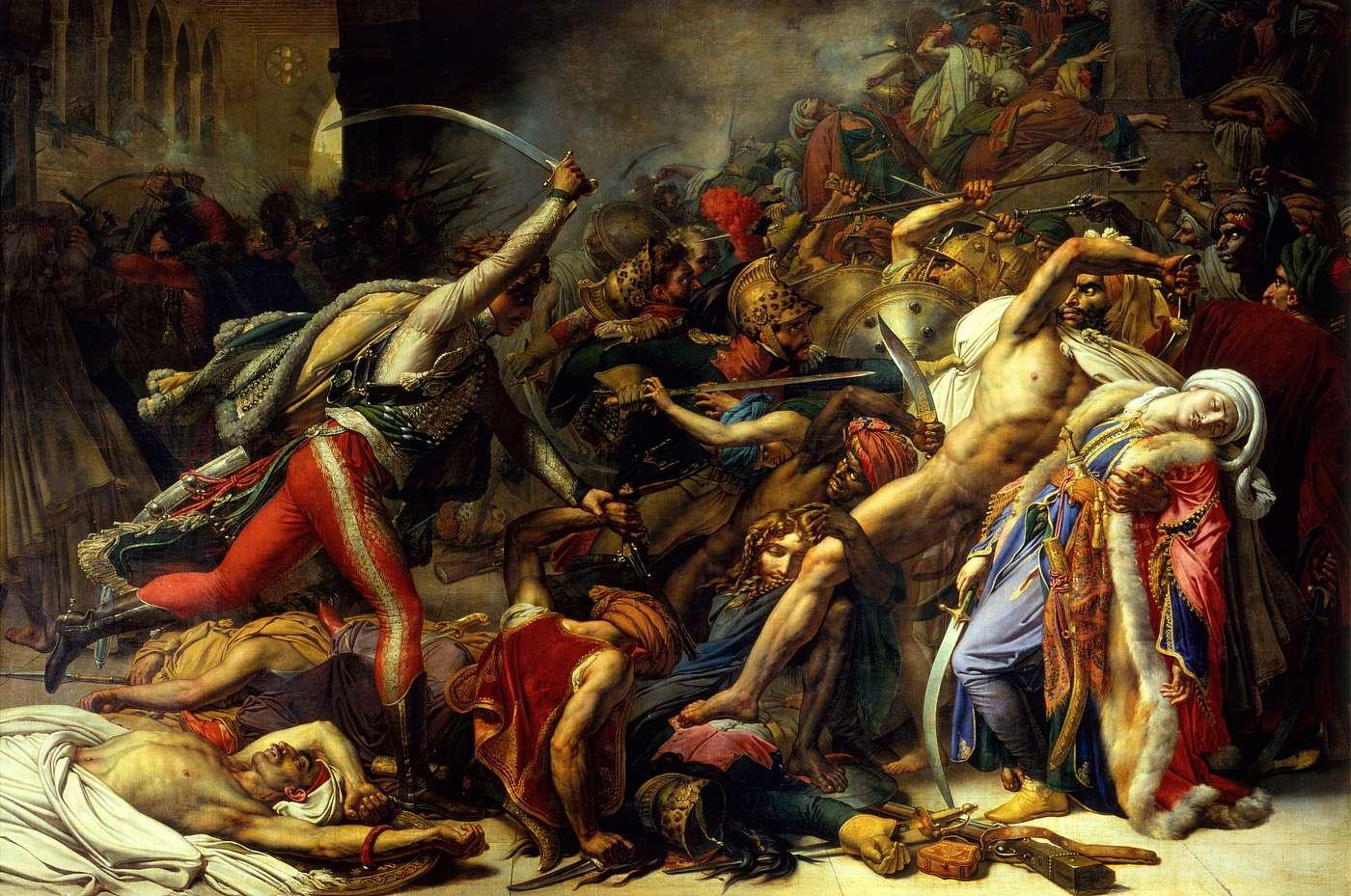
Take a close look at the painting. (You may also click here for a larger, detailed view.) It depicts a moment of the battle when French troops had stormed the inner sanctum of the Azhar mosque. To the left is a French hussar, sword raised above his head, bearing down on the insurgents with a steely resolve. To the right are the insurgents, centered on the naked figure (identified by contemporary viewers as an “Arab”) whose sword is raised in defense. In his left arm, he grasps a wounded Mamluk in lavish garb; at his feet is a black man, with a short bloodied sword in one hand, and the pale severed head of a French hussar in the other. It’s a tumultuous work. As one art historian has written, “To be fully appreciated the Revolt must make you smile. Death and decapitation cannot override (or suppress) the picture’s sheer glee. The painting is absurd, and also inflated, bombastic, extreme. In the Revolt of Cairo, the logic of the world we live in is fantastically suspended.” (And Girodet, for all his care in detailing clothes and arms, played loose with the identity of the insurgents: the revolt was led by ulema, not Mamluk holdovers, and no Arab bedouin joined it.)
I’ve just quoted art historian Darcy Grimaldo Grigsby of Berkeley, and to fully appreciate Girodet’s work, consult her book Extremities: Painting Empire in Post-Revolutionary France, where she devotes sixty riveting pages to the Revolt of Cairo. Sure, there’s the customary dwelling on the homoeroticism of the painting–it can’t be missed, and Girodet reportedly had liaisons with Mamluks who found their way to Paris and who posed for him.
But there’s more. Girodet, Grisgsby argues, subverted the very political purpose he was commissioned to serve:
Girodet prominently displays the ‘orientals’ and eclipses the French hussar’s face by a cast shadow. The painter thus deprives his primary French protagonist not only of highest rank–there is no general here–but also of individual celebrity. He is neither Murat nor Bonaparte but an anonymous French soldier and the picture refuses to grant him the stature of portraiture. He remains, moreover, despite his tightly fitting clothing, a flattened pattern of rotating limbs…. Boots, pants, jacket, cape, we dress him like a paper doll… In the Revolt of Cairo, the naked warrior, unlike the spinning hussar, is irresistably charismatic…. In Girodet’s painting of colonial warfare, it is the insurgents not the French colonizers who are aligned with the classical narratives of passion, loyalty, and courage so revered within the French tradition.
So much for Edward Said. Even this officially-commissioned work, to commemorate a (short-lived) French victory, has the power to subvert. But to appreciate that, you need a sense of irony.
The American reception of Girodet’s painting is bound to be colored by America’s experience in Iraq. Conquest, insurgency, decapitation–there’s too much here not to evoke Iraq. Personally, I find that analogies between Iraq and Vietnam or World War Two don’t speak to me, and when I need an analogy as a crutch, I go back to the history of the Middle East itself. The French occupation of Egypt seems to me especially relevant. That brief intervention ended in military failure, but as the Syrian Sadek al-Azm has written, it “made a clean sweep of all that had become irrelevant on our side of the Mediterranean–the traditional Mamluk and Ottoman conduct of warfare, the supporting production systems, local knowledges, and forms of economic, social, legal, and political organization.” The French left in defeat, but their ideas became thoroughly embedded in the minds of those who resisted them.
Will the U.S. “moment” in the Middle East produce a similar transformation? In a paradoxical way, this doesn’t depend upon success in stabilizing Iraq, which may prove to be a mission impossible, just as holding Egypt was beyond the capabilities of Bonaparte. In the longer term, the more lasting impact may result not from anything the United States succeeds in building, but from the combined destruction of Saddam’s regime and the constant reiteration of the democracy message. Egyptian dissident Saad Eddin Ibrahim has put it this way:
It was a jolt of the French Expedition back in 1798 that was the beginning of the Liberal Age, the Arab awakening after not decades, but centuries, of stagnation…. Egyptians resisted the French Expedition and finally got it out; Napoleon was expelled out of Egypt in less than three years, like you–probably Americans would be expelled out of Iraq–but the three years of the French Expedition were really the beginning of the so-called New Arab Renaissance.
“I don’t mean to compare Bush to Napoleon,” Ibrahim has said, but “over the past 200 years, it seems that it is usually such external jolts that enable the seeds of change to materialize, for the pregnant to give birth.” We can’t know how the Iraq intervention will appear two centuries hence (and it probably won’t leave behind anything quite like Girodet’s Revolt of Cairo). But let’s not presume to know how history will judge it.
Girodet: Romantic Rebel: Art Institute, details here; Met, here; Montreal, here.
 Members of the Middle East Studies Association (MESA) are
  Juan Cole, who doesn’t get the television time that he used to, has been reduced to appearing on webcasts from makeshift studios. It’s a completely apt setting for his nutty theories.

You must be logged in to post a comment.