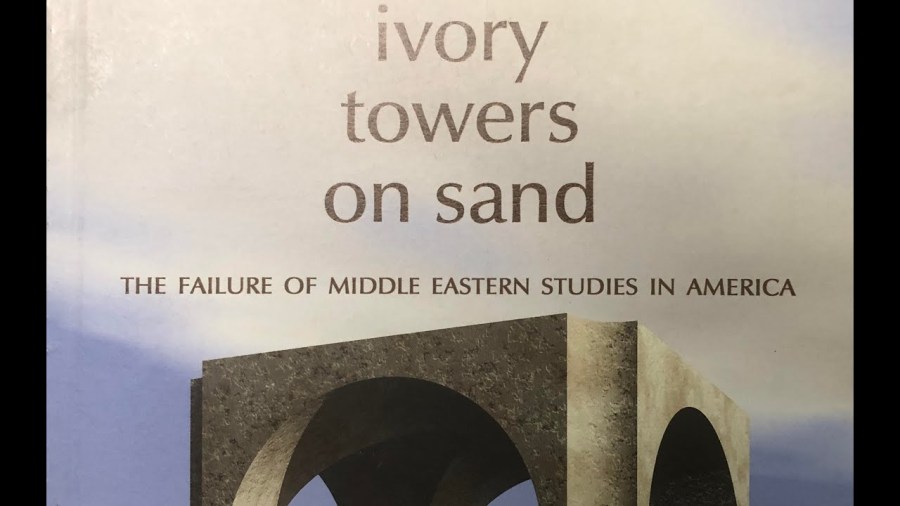
This week marks twenty years to the launch of my book Ivory Towers on Sand: The Failure of Middle Eastern Studies in America. That’s a whole generation. Someone who sat in second grade on 9/11 (like the elementary school kids visited by President Bush that morning in Florida) may be finishing a Ph.D.
This is an invitation to that generation to read Ivory Towers and consider the controversy it stirred. The establishment in the field would prefer to forget both the book and the controversy, which is precisely the reason they should be revisited. There is no progress without contention, and the debate stimulated by my book was a good thing. The fact that there hasn’t been a comparable dust-up in twenty years doesn’t speak well for Middle Eastern studies. Like the Middle East itself, there was a glimmer of “spring,” followed by a return to a long “winter.”
Over the years, I’ve occasionally issued assessments of the field, usually because someone invited me to do so. This happened as recently as last month, on the anniversary of 9/11. None of these “updates” was as comprehensive or timely as the original book, but they do suggest where I thought I saw continuity and change over the years. Even I find surprises in rereading them.
So here’s the library I’ve assembled for this anniversary. Begin by reading (or rereading) the book. It can be downloaded here in its entirety. It’s not long; its brevity actually made it more effective.
• 2001 (October 16): At the book launch, held at The Washington Institute for Near East Policy, I highlighted what seemed to me the book’s significance. Read my remarks here.
• 2005 (March 6): When a huge controversy broke out at Columbia University, implicating Middle Eastern studies professors, I placed it in a wider context, in an address to Columbia students. Read my remarks here.
• 2005 (April 1): Much to my astonishment, the Center for Center for Contemporary Arab Studies at Georgetown University invited me to speak at a conference on the state of the field. Read my remarks here. (I didn’t mince words.)
• 2005 (April 5): On this date, Brandeis University inaugurated a new Middle East center. I spoke at the inauguration, spelling out what was wrong, and how the new center might help to fix it. Read my remarks here.
• 2007 (April 12): The Manhattan Institute, a New York think tank, asked me to revisit the state of the field. Listen to my remarks here.
• 2007 (November 7): At Harvard University, graduate students used to take a course on approaches to Middle Eastern studies. I had a Harvard affiliation at the time, and the instructor asked me to come to class and reflect on my book and its impact. Read my remarks here.
• 2016 (October 28): After 9/11, two of my mentors, Bernard Lewis and Fouad Ajami, created an alternative to the Middle East Studies Association. The Association for the Study of the Middle East and Africa continues as an essential venue for solid scholarship. In 2016, I delivered the plenary address at the annual conference in Washington, on the pathology of Middle Eastern studies. Read my remarks here, or watch me deliver them here.
• 2021 (September 10): On the twentieth anniversary of 9/11, the Middle East Forum, under the leadership of Daniel Pipes, asked me to give a current assessment. Among other points, I emphasized that if I wrote a book on the subject today, almost no one would care. Watch to see why.
As I reread myself, it strikes me how much I’ve wavered between optimism and pessimism over the years. It’s hard to get a comprehensive read on something as amorphous as an academic field. But I’m quite sure I did just that twenty years ago. Is there anyone out there willing to attempt it again?

 Martin Kramer on the Middle East
You must be logged in to post a comment.