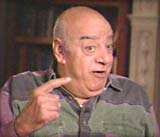
 The other week, the Egyptian playwright Ali Salem was scheduled to come to Israel, to collect an honorary doctorate from Ben-Gurion University. He’s one of Egypt’s most famous humorists, who’s made bold to visit Israel time and again, and who wrote a best-selling book in Arabic about his first visit. After the Oslo agreement, he packed up his old car, drove from Cairo through Sinai to the border, and crossed into Israel. His account is an engaging tale of discovery, humor, and hope.
I was delighted at news of the honor, having played a small part in making Ali Salem better known in the world. I arranged for the publication of his book in English translation, and ran an excerpt in the Middle East Quarterly. The translation inspired the reworking of the book into a play, scheduled for production in Washington in the season after next. Ali himself spent a stretch of time at The Washington Institute for Near East Policy, where we saw one another daily, and I paid tribute to him in one of my first postings on this site. His willingness to accept the honor conferred by Ben-Gurion University was just another example of his personal courage in the service of peace.
But in Egypt, only one man is allowed to show (or feign) courage, and only the top ranks of officialdom people innoculated long ago with the Nasserist antidote to Israel are licensed to interact with real Israelis. Egyptian authorities thus decided that this comic, awkward, and gentle man would pose a threat to the security of the great “republic” of Egypt, were he to collect his honorary degree in Israel. When he tried to cross the border into Israel by land, the authorities turned him away. So he went to the Cairo airport, but they wouldn’t let him board a flight either. This Kafka-esque predicament sounds like fine fodder for a satirical play. (In fact, the Washington theatrical production of his book will include the episode, according to its artistic director.)
Fouad Ajami once called this “the orphaned peace,” and so it remains. I first visited Egypt exactly thirty years ago, for a summer of Arabic study, and every time I’ve gone back, including last month, I’ve asked myself what Egypt would look like if it hadn’t laid down the burden of war. I’ve shuddered at the thought. But no one in Egypt is allowed to celebrate the peace. It remains a shameful accommodation to Egypt’s limitations. And this is Ali Salem’s offense: he has made a virtue of necessity. Those who’ve thrown him out of the writers’ union are armchair warriors, a lot like computer gamers, who do battle without paying any price in blood and treasure. Anti-normalization is a poor man’s war, and these are poor men. (Some are on display here, in a recent televised debate over normalization that included Ali Salem.) Ali has said that he is not angry over being grounded, just sad sad for Egypt, in which he has such pride. Of course, he is right.
To Ali Salem, doctor honoris causis, my congratulations.
Addendum. For more flavor of Ali Salem’s politics, see this essay for Time Magazine, and this NewsHour interview. And for his style of political humor, read this.


You must be logged in to post a comment.