
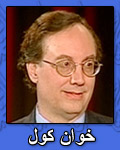
Juan Cole responds to the suggestion that his command of Arabic is less than commanding, after opting for English during an Iraqi elections roundtable on Al-Jazeera:
I know three kinds of Arabic Modern Standard, Lebanese dialect and Egyptian dialect. My Arabic is not free of solecisms because I didn’t start it until I was an adult, and sometimes something from one of the three slips into the other. But I did live in the Arab world nearly six years altogether, and do speak the language.
No one doubts that Cole speaks it. But speaking Arabic, and speaking it on television, involve very different levels of proficiency. A few Westerners, like the French scholar Gilles Kepel and the former U.S. diplomat Christopher Ross, have no problem going on television and gabbing away in the language. I won’t mention names, but I’ve heard that a few more non-Arab Americans can do it, and there are a couple of people on my own hallway who learned Arabic as adults and speak it on Al-Jazeera regularly. Cole prefers not to, and he gives this explanation:
I said I preferred to speak English because the subject required exactitude. I have given more than one interview in Arabic, including on Radio Sawa Iraq. In this instance I felt it was important to have absolute control of nuance, which can only be had in one’s mother tongue.
Three things can be said about that. First, it’s not clear why a give-and-take on Iraqi elections would require an absolute control of nuance, especially if you’re just a pundit with nothing at stake. Second, what’s the point of achieving absolute control of nuance, if it means turning over the reformulation of your entire message to some guy who writes subtitles in Arabic? What if he dents your credibility in the eyes of Arab viewers?
Third, and perhaps most telling, why does Cole think that absolute control of nuance is limited to one’s mother tongue? I know quite a few Arabs whose command of English is better than their command of Arabic, because they’ve taken the trouble to master it. The late Elie Kedourie once caught Arnold Toynbee in some bit of nonsense similar to Cole’s, and he dismissed it as “nativism.” Kedourie:
This nativism cannot possibly account for the rise of such languages as Arabic or English to the status of world languages. Innumerable people received these languages as a result of conquest or commerce or migrations and have learnt to speak and to write them with ease and elegance, and to express, through their medium, the most difficult and elusive ideas, and the most complex and evanescent feelings.
Talking about electoral politics would be the least of it. Kedourie, by the way, spoke the Baghdadi Jewish dialect at home, French as a youngster at school, and only later developed an English that was elegant and precise. His English style was my model, and my own mother tongue is English.
Three factors explain why so few American Middle East experts have paid Arabic the compliment of achieving a high level of expression. First, the language is difficult. Second, there are plenty of polyglot Arabs willing to translate and interpret, at minimal cost. Third, perfect Arabic is less important to career advancement than mastering all the right academic jargon and professing all the right disciplinary dogmas with absolute control of nuance. The first two factors are beyond anyone’s control, but the last can be affected, if government refocuses the Title VI subsidy program for area studies back on languages. I urge Cole, as president-elect of the Middle East Studies Association, to join me in supporting just that.
Finally, Cole offers this supposed behind-the-scenes testimonial from Fouad Ajami:
When we were bantering before the show in Arabic, and I explained how I felt to Fouad Ajami and the others [about speaking in Arabic on television], Fouad quipped that my Arabic was better than some (highly westernized) Arab rulers.
Leave it to Cole to retail a tongue-in-cheek quip made by the quip-master at the expense of American-schooled or London-loving Arab rulers as a compliment to himself. Really.
 Juan Cole has taken some

You must be logged in to post a comment.