
The war is underway, and most of the rationales for and against it are based on predictions. No one reasonably expects professors of Middle Eastern studies to predict military outcomes. But political outcomes, especially in the long term, are supposed to be their forte. And so here, for the record, are the predictions of four chaired professors of Middle Eastern studies, at leading American universities. At the end of the day, events will prove two of them right, and two of them wrong.
John Esposito is a University Professor (his university’s highest professorial honor) at Georgetown. His prediction, looking five years past a war:
It is likely that the Arab world will be less democratic than more and that anti-Americanism will be stronger rather than weaker. A military attack by the United States and installation of a new government in Iraq will not have fostered democratization in the Arab world but rather reinforced the perception of many… that the United States has moved… to a war against Islam and the Muslim world. To move to a military strike before exhausting nonmilitary avenues, and without significant multilateral support from our European and Arab/Muslim allies, as well as from the United Nations, will have inflamed anti-Americanism, which will have grown exponentially in the region and the non-Muslim world.
That’s a grim prophecy, although the very first part may already be falsifiable: could Esposito now name an Arab country that might be less democratic in five years—given that not one of them is democratic now?
In the opposite corner is Bernard Lewis, professor emeritus at Princeton, past member of the Institute for Advanced Study, and best-selling author. He makes the opposite prediction:
I see the possibility of a genuinely enlightened and progressive and—yes, I will say the word—democratic regime arising in a post-Saddam Iraq. They will have been fully inoculated against the Fascist-style governments that otherwise seem to prevail.
Lewis again, with a bit more caution, but a steady optimism:
Clearly, Iraq is not going to turn into a Jeffersonian democracy over-night, any more than did Germany or Japan. Democracy is a strong medicine, to be administered in gradually increasing measures. A large dose at once risks killing the patient. But with care and over time, freedom can be achieved in Iraq, and more generally in the Middle East.
Do you prefer that your experts on “the Arabs” have Arabic names? Then take your choice. In one corner: Rashid Khalidi, who in September will become the Edward Said Professor at Columbia University. His prediction:
Irrespective of its cost or length, this war will mark not the end, but the beginning, of our problems in this region. Because, however much Iraqis loathe their regime, they will soon loathe the American occupation that will follow its demise. No expert on Iraq… believes that the creation of a democracy in Iraq will be a swift or simple matter; some believe it is not possible as a consequence of an American military occupation…. So we will not have democracy in Iraq. We will have a long American military occupation that will eventually provoke resistance…. Via a lengthy and bloody occupation of Iraq, via the establishment of U.S. bases there, via the direct control of Iraqi oil, we will be creating legions of new enemies throughout the Middle East.
In the other corner: Fouad Ajami, the Majid Khadduri Professor at Johns Hopkins. Ajami argues that the United States should aim high: “The driving motivation of a new American endeavor in Iraq and in neighboring Arab lands should be modernizing the Arab world.” His prediction: an American commitment will be decisive.
In the end, the battle for a secular, modernist order in the Arab world is an endeavor for the Arabs themselves. But power matters, and a great power’s will and prestige can help tip the scales in favor of modernity and change…. [U.S. victory] would embolden those who wish for the Arab world’s deliverance from retrogression and political decay…. It has often seemed in recent years that the Arab political tradition is immune to democratic stirrings. [But] the sacking of a terrible regime with such a pervasive cult of terror may offer Iraqis and Arabs a break with the false gifts of despotism.
So there you have them: the divided opinions of America’s leading authorities on the Middle East. Needless to say, they can’t all be right, so some of these predictions are going to come up losers. Will anyone remember? Possibly. But here is a safe prediction: it won’t matter, certainly not to the professional standing of the professors. Another professor (Robert Vitalis, head of the Middle East Center of the University of Pennsylvania), has put things in precisely the right perspective. The future, he maintains, “is unknowable.”
Administration figures are in fact gambling but there are real and predictable consequences to their betting wrong. Consequences for them personally I mean. This is not the case for virtually any op-ed writer or trusted ally of the Saudis or scholars who, from their perches in Palo Alto and Morningside Heights (or Center City), tell us what is really going to happen. There are no costs to them to being wrong, which is in part why so many pretend to be able to see the future with such remarkable acuity. Even after getting it wrong time and time again in the past 10 years.
How very, very true.
(Palo Alto and Morningside Heights…. Has Professor Vitalis been reading my Ivory Towers on Sand?)
ASIDE: Edward Said, who disagrees with Bernard Lewis and Fouad Ajami, now claims that neither “has so much as lived in or come near the Arab world in decades.” Anyone with an ear to the ground knows that both of them show up somewhere in the Arab world every year. And I believe it’s been thirty years since Said left Morningside Heights to spend one of his sabbaticals in an Arab country. The amazing thing is that in the very same article, Said makes this admission: “In all my encounters and travels I have yet to meet a person who is for the war.” New York Times/CBS reports: “74% [of polled Americans] now approve of the U.S. taking military action against Iraq, up from 64% among these same respondents two weeks ago.” Perhaps it is Professor Said who ought to get out more.
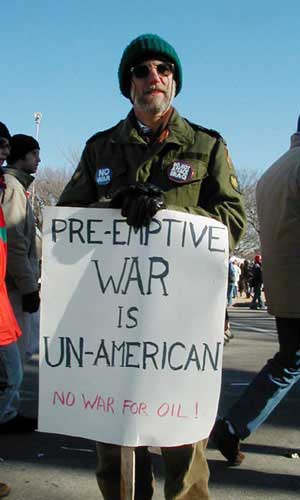 Leave it to a professor of Middle Eastern studies to infiltrate the crudest interpretation of American motive into Chicago’s leading daily.

You must be logged in to post a comment.