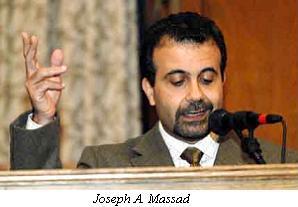
Two weekends ago, Columbia University hosted a Palestinian film festival. I have nothing against such festivals, which have been held over the past year in Seattle and Chicago. Some of the films are worthy examples of the art. But of course, Columbia’s faculty can be counted upon to give a legitimate exercise the flavor of a hate-fest. This time, it was the turn of Joseph Massad, an assistant professor in the department that sponsored the festival. According to the Columbia Daily Spectator, Massad, speaking on a festival panel, praised the films as “weapons” and “likened Israeli Prime Minister Ariel Sharon’s cultural views to those of Nazi Minister of Propaganda Joseph Goebbels.”
All this is standard procedure for Massad, who throws out Nazi analogies with reckless abandon. (When the Campus Watch website named him, presumably for doing just that sort of thing, he called it “a Gestapo file.”) This week, Massad has cropped up on the pages of Al-Ahram Weekly, and he has outdone himself. The article is a rant against the anti-Israel left in Europe (e.g., Derrida, Bourdieu), for not being anti-Israel enough. Alas, too many of the left’s culture heroes only demand an end to Israeli occupation. They fail to see that Israel itself, in any borders, is a racist entity. The Jews, not being a nation by (Massad’s) definition, cannot have nationalism. They have only racism, implemented through colonialism. In this one op-ed, Massad manages to repeat the words “racist” and “racism” twenty-two times. Talk about Goebbels.
So here are the highlights. Israel is “a racist Jewish state,” the “offspring” of “the foundational racism of Zionism.” The “European Jew is a colonizer who has used racist colonial violence for the last century against the Palestinian people.” Israel was founded “by armed colonial settlers.” “Zionist Jewish colonialism” was a “commitment to European white supremacy in Jewish guise.” “Jewish colonists were part of the British colonial death squads that murdered Palestinian revolutionaries between 1936 and 1939.” There has been an “ideological and practical collusion between Zionism and anti-Semitism since the inception of the movement.” Zionism “has always been predicated on anti-Semitism and on an alliance between Zionists and anti-Semitic imperialists.” Zionism itself had an “anti-Semitic project of destroying Jewish cultures and languages in the diaspora.”
Heard enough? Too bad. “Israeli colonialism and racism operate with the same force, albeit with different means, inside the Jewish state as they do in the territories Israel occupies.” Israel’s racism manifests itself in “the racist curricula of Israeli Jewish schools, the racist Israeli Jewish media representations of Palestinians, the racist declarations of Israeli Jewish leaders on the right and on the left, and the Jewish supremacist rights and privileges guiding Zionism and Israeli state laws and policies.” “The ultimate achievement of Israel,” concludes Massad, is “the transformation of the Jew into the anti-Semite, and the Palestinian into the Jew.”
On any blind reading, you would discount these as the blurtings of a rabid fanatic, obviously consumed by a hatred of Israel and its people so venomous and manic that it has destroyed any capacity for sober historical judgment. You would be right.
Yet Massad, in the dens he inhabits, is not considered a fanatic at all. Quite the contrary: he is the flower of Columbia University and American Middle Eastern studies. He completed his doctorate at Columbia; Columbia University Press published it; and Columbia University now employs him (to teach, inter alia, Israeli politics and society). The Middle East Studies Association (MESA) awarded him its prize for outstanding dissertation, and the resulting book has been reviewed favorably by MESA’s current president-elect. Massad also recently passed his three-year review at Columbia, and is now on leave writing what I have heard described as his “tenure book,” the opus he hopes will make Columbia his oyster. It’s entitled The Persistence of the Palestinian Question, and its core argument is—you guessed it—Israel is a racist state.
It will be fascinating to see how Rashid Khalidi, the new Edward Said Professor of Middle Eastern Studies at Columbia, and designated head of its Middle East Institute, deals with the Massad phenomenon. (Khalidi earlier endorsed Massad’s first book as “one of the best of the new crop.”) And I eagerly look forward to Massad’s “tenure book”—or, to borrow from his own stock of analogies, his Mein Kampf.
POSTSCRIPT: I noticed that Khalidi’s endorsement of Massad’s only book describes it as “well-written.” So here’s a sample, from chapter one:
Whereas the genetic moment of every national interpellation secures the subsequent claims made by popular nationalism anchoring the political and popular concept of the nation, every retelling of the story of the nation becomes in fact a moment of sublation (incorporation and transcendence), wherein the newly constituted Jordanian identity sublates its predecessor in an interminable process, and whereby the new Jordanian identity is reinscribed as the one that had always already existed as it does today.
Also don’t miss Massad’s recent exchange with Israeli “new historian” Benny Morris, in which Morris turns the tables and shows “surprise” at Massad’s racism. “I resent your accusation of racism,” Massad huffed—and immediately retaliated by calling Morris a “racist Orientalist.” Is there a pattern here?
UPDATE: One of the things I did learn from Orientalism was that the most effective way to damn someone is to quote him. Said, in his walk through the valley of orientalist texts, left no quote unturned. I recently deployed this technique in dealing with Columbia’s Joseph Massad, who wrote an anti-Israel article in the Ahram Weekly full of self-incriminating hyperbole. All I had to do was quote him.
Now Massad has replied, also in the Ahram Weekly, in an article loaded with sweeping assertions. According to Massad, I am “keen to defend Israel’s prerogative to kill and bomb anyone who stands in its way.” I seek to “extend Israeli violence to the U.S. academic arena.” I have “not yet eliminated anyone physically,” but I and my “young dupes” have the “express aim of imploding freedom.” I am guilty of “virulent anti-Arab racism.” And so on.
What disappoints me about this rambling text of 2,300 words is that Massad does not quote me even once. Of course, nowhere have I written that Israel has the “prerogative to kill and bomb anyone,” but surely I must have written something worth quoting, even out of context, which would damn me. Massad, alas, has failed to master the ingenious technique of Orientalism, despite reading and rereading it. (He’s also failed to learn from Said that you lie low until you have tenure, but that’s another matter.)
It’s just another reminder that the unique and irreplacable Edward Said will have no successors. The Beirut Daily Star once likened one of Said’s Beirut lectures to “an American rock concert for the learned and the not-so.” An apt comparison—and when Said is gone, we’ll be left with the Edward impersonators.


You must be logged in to post a comment.