
Mecca: You don’t know what you’ve got ’til it’s gone

Today is Eid al-Adha, culmination of the pilgrimage to Mecca, now marred by yet another tragedy that has left hundreds dead in a stampede. (Earlier, it was a crane collapse.) In a new photo gallery, I offer some commentary on the stupendous transformation of Mecca in our time. If you haven’t followed it closely, and (like me) you don’t have any plans to visit Mecca anytime soon, the images (and the numbers) may astound you. The effect on Islam? Unpredictable. Follow this link.

Mecca photo gallery

The original truck people

This post first appeared at the Commentary blog on August 31.

Austrian authorities on Thursday discovered an abandoned truck on a highway near the Hungarian border, packed with the decomposed bodies of 71 dead migrants, including four children. While migrants have perished at sea in the multitudes, this tragedy has put Europe on notice: The horrors from which the migrants flee, and that regularly play themselves out in the middle of the Mediterranean, will soon become commonplace in the heart of the continent unless something changes.

Now how addled and obsessed must one be, to use this event as a stick to beat Israel? About as addled and obsessed as Juan Cole, professor at the University of Michigan and popular blogger on the edge of the left. See as evidence this post: “Austrian Truck Tragedy echoes Palestinian Story, reminding us of 7 million still stateless [Palestinians].”

What is that Palestinian story? It is a 1962 novella by the Palestinian writer Ghassan Kanafani entitled Men in the Sun. The allegorical storyline is about three Palestinians who flee the misery of Lebanon’s refugee camps to Iraq, in the hope of reaching the Xanadu of Kuwait. They are smuggled across the desert from Basra in the empty barrel of a water tanker truck. But because of a delay at the Kuwaiti border, the three suffocate to death. (The novella was made into a film in 1972.)

I won’t make an issue of the “seven million still stateless” Palestinians. (The upper-end estimate is closer to five million.) And far be it from me to quibble with anyone’s free associations. But Cole tops off his with this statement, which purports to be historical: the Palestinians’ “home has been stolen from them by the Israelis and they were unceremoniously dumped on the neighbors or in the West Bank or in the Gaza Strip. They are stateless. They are the original truck people.” (My emphasis.)

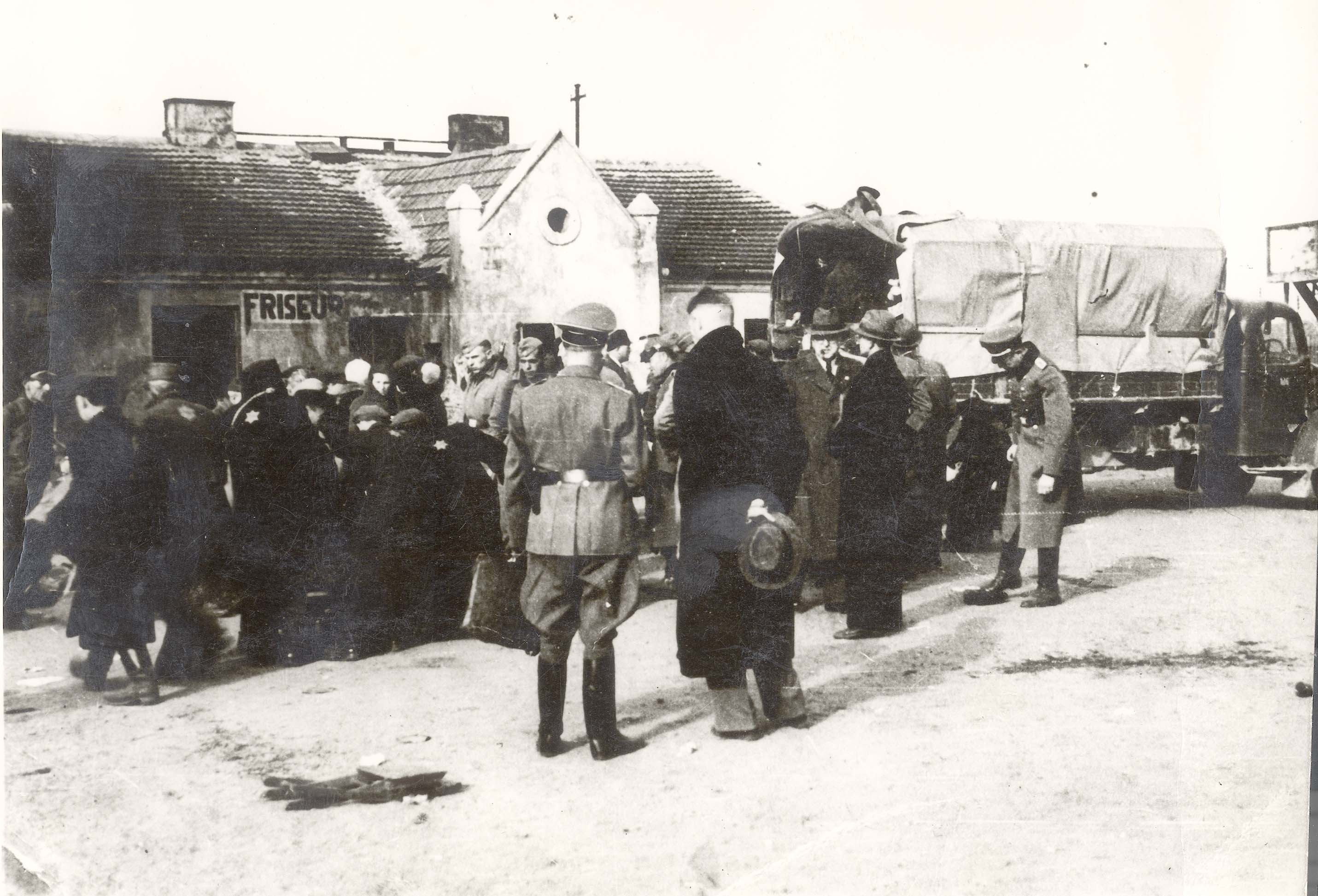
This concluding dramatic flourish, identifying the Palestinians as “the original truck people,” jolted me. The first people made stateless, dispossessed, stripped of their humanity, and packed into sealed trucks where they died horribly, all in the very heart of Europe, were many thousands of Jewish victims of the Nazi extermination machine.

As anyone who has read even one history of the Holocaust knows, before there were gas chambers there were mobile gas vans. These were air-tight trucks which could be packed with as many as sixty persons, who would be killed by cycling the carbon monoxide exhaust back into the cargo area. Himmler ordered the invention of the method to spare the Germans in SS killing squads the damaging psychological effects of shooting thousands of victims, one at a time. The trucks were deployed primarily to kill Jews, who were loaded into them without separation by gender or age. I will spare readers the horrific testimonies of the operators of these trucks, and the documentary evidence of how technicians worked to perfect them. I’ll only quote this argument, made by a technician, for keeping the cargo area lit:

When the back door is closed and it gets dark inside, the load pushes hard against the door. The reason for this is that when it becomes dark inside the load rushes toward what little light is left. This hampers the locking of the door. It has also been noticed that the noise [i.e., screams] provoked by the locking of the door is linked to the fear aroused by the darkness. It is therefore expedient to keep the lights on before the operation and during the first few minutes of its duration. Lighting is often useful for night work and for the cleaning of the interior of the van.

Hundreds of thousands died in these trucks, at least 150,000 in Chelmno alone. According to that same technician, three vehicles succeeded in killing 97,000 persons in the six months prior to June 1942. However, it turned out that the mobile gas vans were subject to breakdown on the back roads where they operated away from sight, and even then they proved impossible to keep secret. (Passersby could hear the screams.) Gas chambers located in extermination camps finally replaced the vans.

Of course, one mustn’t confuse botched human trafficking with planned genocide. But part of what is so shocking about the Austrian truck tragedy is the earlier precedent of men, women, and children packed into trucks and asphyxiated to death in the heart of Europe. If the horror on the Austrian motorway should evoke anyone’s fate, it is that of six million exterminated Jews, not five million living Palestinians. To anyone who knows history, death trucks on European highways recall why the “original truck people,” the Jews, needed the refuge finally secured by the creation of Israel.

Deportation of Jews from Wloclawek, Poland to the Chelmno Death Camp, April 1942.

Does Israeli intelligence favor the Iran deal?

This post first appeared at the Commentary blog on August 24.

J.J. Goldberg at the Forward has been running a campaign to persuade Americans that Israel’s intelligence community is at odds with Prime Minister Benjamin Netanyahu over the Iran deal. Not only the preponderance of retired professionals, but also currently serving ones, dissent from Netanyahu’s read of the deal. Netanyahu can’t silence the former, but he’s given a “gag order” to the latter—to no avail. Military intelligence has even produced a “surprising,” “game-changing” assessment that undermines him completely, according to which the “upsides [of the deal] aren’t perfect,” but “the downsides aren’t unmanageable…. The disadvantages are not too calamitous for anyone to cope with them.” Military intelligence sees “an imperfect but real opening in Iran. It believes that opportunities are being lost.” Netanyahu’s own “diagnosis doesn’t match his own intelligence.”

It’s all polemical and politicized nonsense.

A real expert, Emily Landau (at the Institute for National Security Studies in Tel Aviv) has already taken Goldberg to the woodshed about the retired professionals (Goldberg has a weird predilection for calling them “spooks”). Landau, without naming the names of these “experts,” points out that Iranian politics and nuclear issues are well beyond the expertise of most of them. Not everyone with a pension and an opinion is equal. And most of those who think that Israel should back off a fight over the deal still think it’s a bad one. They just argue that it’s inevitable anyway, so why provoke Barack Obama? This isn’t support for the deal, it’s resigned acquiescence. (The military correspondent of The Times of Israel did a parallel debunking, after the White House began to tweet similar claims.)

But what about the “game-changing” assessment by those who serve now? Goldberg is referring to an analysis prepared by Israel’s military intelligence branch (Aman), which was presented to Netanyahu and the political echelon. The main points of the analysis appeared immediately in the Israeli press. To read Goldberg, you’d think that this document is an endorsement of the Iran deal, and that the deal’s flaws are equally balanced by its advantages. Neither Goldberg nor I has seen this document. But even a cursory reading of the press reports (here, here, and here) shows that it’s not what Goldberg claims it is.

Yes, the intelligence assessment is that Iran won’t be able to build a bomb under the terms of the agreement. (That is, if Iran doesn’t cheat—the assessment says the mechanisms for inspection are flawed.) Iran might even show short-term restraint over support for terror, to consolidate its gains from sanctions relief. But the estimate also holds that when the agreement expires, Iran will be only weeks away from a nuclear breakout. In the meantime, Iran gains undeserved legitimacy from the deal, which provokes Arab states to stock up on conventional weapons and accelerate their own nuclear programs. Some of these programs could be militarized over time. The bottom line of the assessment, as reported in the press, is that the risks of the deal outweigh the opportunities. (This formula appears in more than one press report. Goldberg omits it.)

The reason that this “game-changing” assessment isn’t turning the world upside-down is simple. It isn’t “game-changing.” Goldberg’s headline announces that it’s the report “That Bibi Fears,” for “defying the gag order.” But I doubt that Netanyahu experienced even a moment’s discomfort upon hearing it, and it hasn’t been “game-changing” or even especially noteworthy in Israel. Leave it to Goldberg to cherry-pick a few bullet points from the assessment and inflate the whole thing into some sort of insurgency. He’s counting on readers of the Forward not to know any better.

He also elides an important point about the authors of the brief. At one point, Goldberg writes that earlier Israeli press reports flagged “trepidation within the military” among officers who “feared retribution.” The link at “press reports” leads to just one, a piece by Ha’aretz military correspondent Amir Oren. In that piece, Oren attacks the head of military intelligence, Maj. Gen. Herzl Halevi (pictured, far right), and the chief of the research division, Brig. Gen. Eli Ben-Meir, for backing Netanyahu. Oren accuses the two generals of “falling into line toward the right. Eating with their mouths closed, in unison. Hiding any disturbing thoughts.” (Oren doesn’t explain how he’s accessed these thoughts.) Oren claims that “there are those in the Intelligence Corps, including those in the research division dealing with Iran, who have a very positive view of the nuclear agreement.” But Halevi and Ben-Meir have “concealed them from the public,” and in doing so, are “in breach of their national duty.”

Oren (and his newspaper) never stop grinding their axe against the prime minister, but even Oren admits that the top heads of military intelligence are on board with Netanyahu (“falling in line,” in his demeaning words). Indeed, they’re the ones (he alleges) who are silencing “those” analysts further down the chart. (Who or how many are “those,” if they exist? Anyone’s guess.) Yet Goldberg would have us believe that these same two generals have just delivered an assessment that blows away Netanyahu’s case against the deal.

Well, the “eruption of dissent” is imaginary, and so is the “gag order.” Debates in Israel’s intel community not only occur, they’re encouraged (there’s even an officer in military intelligence who’s a designated “devil’s advocate”). Likewise, it’s vital for Israeli planners to think about the day after a done deal on Iran, and how Israel can make the most of it. But that’s all it is. Goldberg’s latest job is a conspiracy theory for the gullible. You don’t have to be an intel officer to know that it’s a red herring.

Addendum: Yossi Melman, Israel’s best-regarded intelligence correspondent (and no admirer of Benjamin Netanyahu), has written this in response to Amir Oren, and it could just as well be taken for a reply to Goldberg:

There is almost no expert or researcher, junior or senior, serving in military intelligence, the Mossad, the general staff or the different branches of the IDF, the National Security Council, or the Ministry of Intelligence Affairs, who thinks that the agreement reached between the powers and Iran is positive. The grades they give to the agreement range from “awful” to “not good” to “bearable” to “we can live with it.” But there is no enchantment with the agreement, even if it has some positive clauses…. There is also almost total consensus that it was possible to achieve a better agreement…. In this respect, there is a convergence of opinion, with different emphases, among the political echelon led by the prime minister, the intelligence community, and retired senior officials, that a different agreement would have been preferable to the one that was signed.

Melman has heard criticism of Netanyahu’s tactics vis-à-vis Obama, but that’s already politics. On the agreement itself, according to Melman, the views cover a narrow range, and are close to unanimous.