During these days in April, fifty years ago, Israel was engulfed in turmoil.
On April 1, 1974, the Agranat Commission, a national commission of inquiry established to investigate the failures of intelligence and preparedness leading to the Yom Kippur War, published its initial findings. It laid most of the blame on IDF Chief of Staff David (“Dado”) Elazar and Director of Military Intelligence Eli Zeira, leading to their immediate resignations. But the commission found no fault with Prime Minister Golda Meir and Defense Minister Moshe Dayan. The commission concluded that “reasonable conduct” for a government minister effectively equated to merely rubber-stamping the advice provided by military commanders.
Protests erupted over the lenient treatment of Israel’s political leaders, particularly Dayan. As the minister of defense in 1967, he had garnered laurels for the victory. Now, holding the same office, he was evading responsibility for the catastrophe. The protests overwhelmed Meir, who was already burdened with guilt and remorse. On April 10, she resigned, automatically precipitating the government’s collapse. After a new government was established in June, Meir retired from politics, and Dayan exited the cabinet, his prospects for leading Israel irreparably damaged.
In the six months from October 1973 to April 1974, Israel had struggled to regain its footing. After the initial Arab offensive, Israel turned the tables on two Arab armies backed by the Soviet Union. In November, Israel concluded a prisoner exchange with Egypt, and by January, it reached a separation of forces agreement in the Sinai. (Similar agreements with Syria were secured in May.) At the end of December, Israel conducted delayed elections, which were originally scheduled for October. Meir led Labor to an electoral victory, albeit with a diminished majority. Meanwhile, throughout that winter, the commission of inquiry meticulously gathered testimony from Meir, Dayan, Elazar, Zeira, and fifty-four others across 140 sessions.
First meeting in Jerusalem of the Agranat Commission, November 27, 1973. Credit: Sa’ar Ya’akov, National Photo Collection, Government Press Office.
As Abba Eban, then Foreign Minister, later recalled,
the imminent publication of the Agranat report brooded over our scene like a hot, humid sky waiting to explode. When the cloudburst came, all the elements of stability in our society were flooded away. If the intention in appointing the committee had been to bind up the nation’s wounds, the exact opposite occurred.
Israel could only move forward if the leaders responsible for the catastrophe departed. Only then, and despite the pain of huge losses, could Israel begin to rebuild and heal. Meir’s resignation finally made that possible.
The numbing of Israel
Compare the situation today. We are also six months into an October war, the one that began on October 7, 2023. The IDF is still fighting, not against two armies but against two terrorist groups. Over a hundred innocent Israeli hostages are still being held in Gaza by Hamas. Tens of thousands of citizens are displaced from northern Israel by Hezbollah fire, and cannot safely return to their homes. The government hasn’t established a commission of inquiry, and no official body has collected testimony under oath. There’s been no official assignment of responsibility, and no one has resigned. All this, we are told, must await the elusive “total victory.” Much of the public is still numb. Reconstruction and healing can’t begin.
Prime Minister Benjamin Netanyahu, on whose watch the October 7 debacle occurred, has effectively stopped the political clock: he will only explain himself “after the war.” In the meantime, he says that Israeli elections would be a victory for the enemy and, in any case, “elections have a date, it’s in a few years.”
When asked about his responsibility, he avoids mentioning the obvious parallel of Yom Kippur and promotes other, more remote analogies: “Did people ask Franklin Roosevelt, after Pearl Harbor, that question? Did people ask George Bush after the surprise attack” of 9/11? His preference is self-explanatory: FDR continued in office for over three years after Pearl Harbor, and George Bush, over seven years after 9/11.
First shoots
Golda Meir wasn’t enthusiastic about the idea of a commission of inquiry, and even told her government that “heads would not roll.” But she understood that Israel needed an accounting. Despite her formal exoneration, she accepted the verdict of an angry public, despite having won an election after the war.
Benjamin Netanyahu isn’t enthusiastic either but sees no need for an accounting. Après moi, le déluge could be his motto; and though the deluge actually occurred on his watch, he predicts a worse outcome if it sweeps him away. (One outcome, certainly worse for him, involves battling criminal charges in court.) So, whereas there was a public accounting and a course correction in 1974, today, neither has occurred.
Still, one enduring lesson of both October wars is that even when nothing seems to be happening, something is stirring. Political protests are sprouting from the ashes. Just as in the spring of 1974, so too in the spring of 2024, demonstrations are swelling in size and volume. Alongside these protests, the wider public’s demand for accountability intensifies. Those who occupied the nation’s top positions on October 7 will have to account for their actions or, more precisely, their inaction, sooner than they’d like. Israel’s very survival depends on rooting out the sources of catastrophic failures, lest such failures become normalized or, worse, routine.
That’s how Israel picked itself up in 1974. That’s what it must do in 2024.
Header image: Protestors call for the resignation of the government and Moshe Dayan, April 1974. Credit: Dan Hadani Collection, The Pritzker Family National Photography Collection, The National Library of Israel.
In September 1973, Egypt’s leaders were looking for a name for their plan to launch a surprise attack against Israeli forces across the Suez Canal. According to the Egyptian chief of staff, Saad El Shazly, they wanted “something more inspirational than our planning title, The High Minarets.” Once the assault was set for October 6, falling in Ramadan, “Operation Badr named itself.”
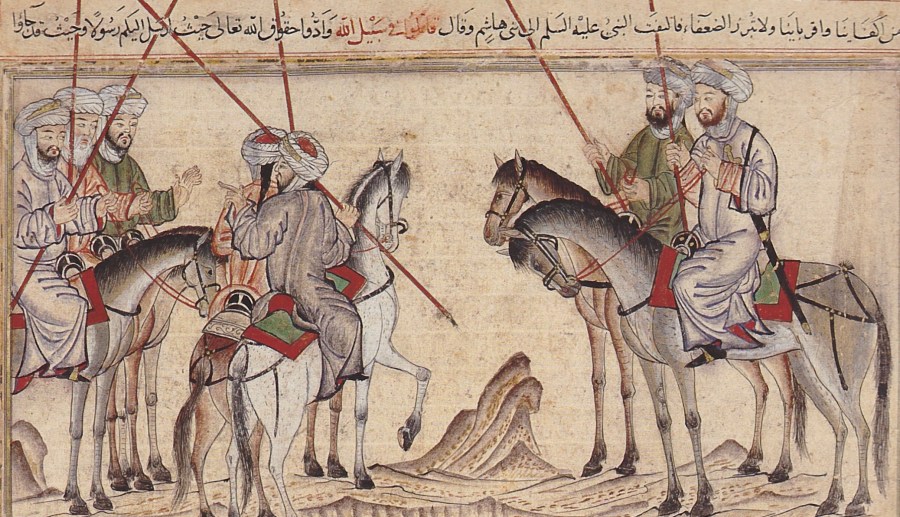
This 17th of Ramadan marks 1,400 years since the battle of Badr (624), the first military confrontation between the Muslims and their opponents—in this case, the grandees of the Prophet Muhammad’s own tribe of Quraysh. He had fled their persecution in Mecca less than two years earlier (the hijra, 622), along with his followers, in order to regroup and recruit in Medina, to the north.
At Badr, southwest of Medina, Muhammad led a contingent of 313 Muslims, outnumbered three to one, to a decisive victory over the polytheists of Mecca. The Muslims killed many, took others prisoner for ransom, and secured much booty. Angels supposedly helped out. It’s considered a turning point in the fortunes of nascent Islam, demonstrating Muhammad’s skills as a commander as well as the divine favor enjoyed by the believers.
Badr received its most memorable cinematic treatment in the 1976 epic The Message, starring Anthony Quinn and bankrolled in good part by the then-dictator of Libya, Mu‘ammar Qadhafi (watch here). The movie roughly adhered to the traditional accounts of the battle: the preliminary duels by champions, the general melee, the cut-and-thrust, and the spirit of Muslim triumph. (Quinn didn’t play Muhammad, who couldn’t be depicted on film; he played Hamza, Muhammad’s companion and uncle. Ali, the Prophet’s son-in-law and later caliph, also couldn’t be depicted; the double-pointed sword on screen is wielded by him, but you won’t see him.)
Badr did much to signal the character of Islam going forward. Bernard Lewis, historian of Islam (and my mentor), summarized that character in theses words:
The founder of Christianity died on the cross, and his followers endured as a persecuted minority for centuries…. Muhammad did not die on the cross. As well as a Prophet, he was a soldier and a statesman, the head of a state and the founder of an empire, and his followers were sustained by a belief in the manifestation of divine approval through success and victory. Islam was associated with power from the very beginning, from the first formative years of the Prophet and his immediate successors.
Thus did Islam find its validation in military success, which became its hallmark for a millennium. Its first decisive victory occurred at Badr, during Ramadan of the second year of the hijra, corresponding to March 624.
“Proven fact”
Or so I was taught. In my student days (back in the 1970s), every Islamic history syllabus started with the biography of Muhammad by a Scottish scholar, W. Montgomery Watt, in its two-volume or abbreviated version. His work, published in the 1950s, gave a coherent account that seemed well-grounded. But he achieved that only by giving the benefit of the doubt to the Muslim sources.
Why doubt? The Qur’an, the earliest source, is an opaque book of revelation, not a history. The earliest biography of the Prophet wasn’t set down until over a century after his death. The versions we have were redacted still later. The traditions regarding Muhammad were collated at about that time, and were demonstrably colored by biases and politics far removed from seventh-century Arabia. Worse still, the later the accounts, the more detailed they became, rendering them even more suspect.
Even Watt had to acknowledge that there had been “shaping” of the facts by their recorders, but he wouldn’t admit their invention: “At least the material in the early biographies is to be accepted as true,” he insisted, and “most of the background material, culled from a large number of varied works, is sound.” Otherwise, he’d never have filled two volumes.
In 1961, the French Marxist scholar Maxime Rodinson published a materialist biography of Muhammad, but he too relied on the standard Muslim sources. Consider, for example, what he wrote about Badr:
We also have certain facts upon which all the traditions are agreed. The first Arab compilers differ (slightly) as to the names of those who took part in the battle of Badr, as well as the circumstances, the preparations and the consequences of the fighting. They conflict with one another on all these points, each reflecting the party-struggles of his own day. But such disputes can only take place because everyone agrees that the battle did in fact take place, on its date (at least approximately) and with its result. We must therefore consider it as a proven fact, and endeavor to see how to place it in the total chain of cause and effect.
Just as I was finishing my studies, such “proven facts” came under a full-scale assault by revisionist historians, who insisted that the story of early Islam as told in Muslim sources was entirely spurious. Islam, they claimed, arose gradually in a setting far removed from early seventh-century Arabia; the later Muslim accounts of its birth were a kind of back-filling. As one leading revisionist historian, Patricia Crone, put it, “The entire tradition is tendentious… and this tendentiousness has shaped the facts as we have them.” My fellow grad students who’d chosen early Islam as their field had entered a maelstrom of controversy. (Not that the modern history of the Middle East was less tumultuous. All this coincided with the Iranian revolution and Edward Said’s Orientalism.)
The historicity of Badr also came in for its share of doubt. A fragment of Arabic papyrus suggested that a full century after the battle, Muslims didn’t place it in the month of Ramadan. If it had been slipped into Ramadan by late-eighth-century fixers, perhaps the whole thing was made up. This is the conclusion spread a decade ago by Tom Holland, a British writer of popular histories who took in the revisionist scholarship and sharpened its edges. The canonical account of Badr essentially duplicated
the themes that the Greek poet Homer, a millennium and a half earlier, had explored in his great epic of warfare, the Iliad. The one features angels; the other gods. Why, then, should we believe that the account of the Prophet’s first great victory is any more authentic than the legend of the siege of Troy?… What if the entire account of the victory at Badr were nothing but a fiction, a dramatic just-so story, fashioned to explain allusions within the Qur’an that would otherwise have remained beyond explanation?
Over the last fifty years, early Islamic history has been turned into just such a game of “what ifs,” without the guardrails of the traditional sources. It’s a highly technical discipline, and I don’t pretend to grasp all of the current work. It does seem that the wave of hyper-skepticism has receded; Crone, a staunch revisionist, decided that “the chances are that most of what the tradition tells us about the Prophet’s life is more or less correct in some sense or other.” But to my untrained eye, the study of earliest Islam seems to have grown ever more speculative.
The Badr of memory
Islam’s formation wasn’t the chosen specialty of my teacher, Bernard Lewis. He only touched on it in more general works, such as his 1950 overview, The Arabs in History. There he largely adhered to the consensus that the Muslim sources preserved more than a kernel of truth. “There were many disagreements among scholars as to the authenticity of this or that tradition,” he later recalled, “of this or that narrative, but the broad outline of the Prophet’s career, as also the actions and achievements of his companions and successors, was generally accepted.”
But when Lewis came to revise that book many years later, everything had changed. “In certain subjects,” he wrote in 2006, “our knowledge diminishes from year to year with the progress of scholarship and research, as one generally accepted view after another is attacked, leaving a terrain strewn with demolished or endangered hypotheses and assumptions.”
Yet Lewis still believed the Muslim sources should be taken seriously. “The past as remembered,” he wrote,
the past as perceived, the past as narrated, is still a powerful, at times a determining, force in the self-image of a society and in the shaping of its institutions and laws, even if the factual base on which this image rests is shown by historians, centuries later in distant countries, to contain more fantasy than fact.
Lewis thus shows us the relevance of Badr in our own time. In his famous 1976 article “The Return of Islam,” Lewis noted the Egyptian choice of Badr as a code name for Egypt’s 1973 war plan. Indeed, Egypt continues to this day to name large-scale military exercises after Badr. (In the Egyptian setting, that’s a double-barreled pointer, to 624 and 1973.)
But Egypt hardly has a lock on Badr. On the 21st anniversary of the 9/11 attacks, Al Qaeda drew a comparison between Badr and 9/11, which it called “Badr September.”
Truly, September 11th was a day unlike any before it. It was a day of distinction [between truth and falsehood], akin to the great [battle of] Badr, when God crushed the tyrants of disbelief of that time. Similarly, on this day in September, God crushed the head of the present era’s idol, America, and weakened its foundations through Al Qaeda’s knights of the jihad. Thus, [September 11] was a kind of Badr in one of its many dimensions and meanings…. Just as no one at the time imagined that… the final countdown of Quraysh, Persia, and Byzantium began on Friday, the 17th of Ramadan of Year Two, so no one imagined that America and its allies would begin their decline on Tuesday, September 11. But what follows will be the rise of the world’s oppressed, as is God’s unchanging law in history.
Like much in history and myth, the memory of Badr is so elastic that it’s been invoked across the entire range of contemporary politics—by Egypt’s military, the biggest Arab beneficiary of American military aid, and by Al Qaeda, America’s deadliest Arab enemy. It’s also the name of an Iranian-backed militia in Iraq, a Taliban battalion in Afghanistan, and rockets fired off by the Houthis in Yemen and the Palestinian Islamic Jihad in Gaza. To name something after Badr is to associate it with resistance and faith, the weak against the strong, the few against the many.
It’s also more evidence, if more were needed, for the consciousness of history that permeates the politics of the Middle East. When the novelist William Faulkner wrote that “the past is never dead; it’s not even past,” he intended it as a general proposition, but it particularly describes the Middle East. “The Muslim peoples,” wrote Bernard Lewis, “like everyone else in the world, are shaped by their history, but, unlike some others, they are keenly aware of it.” That’s true, even if the history isn’t.
For Muslims, this year’s anniversary of Badr isn’t special. By the Islamic lunar calendar, it’s 1,443 years to the battle, not 1,400. But the entire world now lives in an era when Badr again matters, and it’s the rest of us who need the reminder. Perhaps that’s because more battles of Badr may lie ahead.
Above: The battle of Badr from the movie The Message, directed and produced by Moustapha Akkad.
Header image: Muslims consult before the battle of Badr, in an illustrated 14th-century manuscript of the Jami‘ al-Tawarikh of Rashid al-Din, Khalili Collection.
Everywhere about us was the sense of the pioneer, and of courage, which is never remote in Israel.
—J. Robert Oppenheimer, December 1958
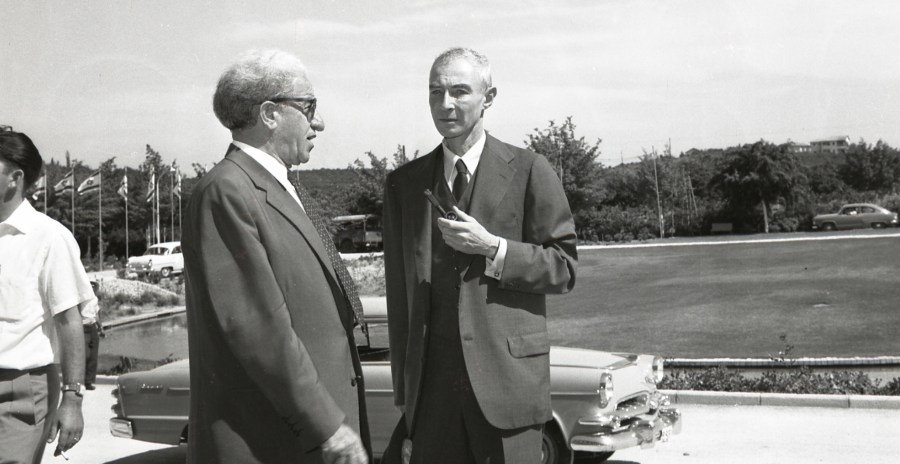
On April 26, 1967, the Board of Governors of the Weizmann Institute of Science convened in Rehovot, Israel. The new president of the Institute, Meyer Weisgal, lieutenant of the late Chaim Weizmann, had a scoop for the press. “Had fate not intervened,” reported the newspaper Ma’ariv, “the president standing before the Board might have been the ‘father of the atomic bomb,’ Dr. Robert Oppenheimer.”
Weisgal revealed that six months prior to Oppenheimer’s death, he had conducted “secret” talks with the famed physicist, offering him the presidency of the Weizmann Institute. (At the time, Weisgal was trying to fill the vacancy at the top with someone other than himself.) In Weisgal’s telling, Oppenheimer accepted the offer, provided the Institute met certain conditions. “Conditions accepted,” Weisgal had replied. But “fate,” in the form of throat cancer, had stolen Oppenheimer away. He died on February 18, before anyone learned of the plan.
Weisgal repeated his account in a bit more detail in his memoirs, published in 1971:
I asked Oppenheimer if he would consider accepting the presidency of the Institute. We talked about it, alone, and then with his wife, Kitty. Shirley [Weisgal’s wife] and I visited them a number of times and continued the conversation. Finally he said: “I will accept the job on the following conditions. One, I must come back to the United States three months every year because I don’t want to give the impression of running away after what has happened; two, I will not do any entertaining. You will have to do it for me but I will be present whenever you call me; three, I will want to continue to do some physics.” I accepted all three conditions and we made a date to meet a few months later when I would again be in New York. When I returned and called his secretary I was given the shocking news that he was dying of cancer. No one could see him. A few months later he died. His funeral was one of the saddest experiences in my life.
(After Oppenheimer died, and one or two other candidates fell through, Weisgal reluctantly assumed the presidency of the Institute.)
It’s a remarkable story. But is it true? It’s not mentioned in any study of Oppenheimer. You won’t find it in Kai Bird and Martin Sherwin’s Pulitzer Prize-winning biography of Oppenheimer, American Prometheus (on which the 2023 Oscar-winning movie is based), or in Mark Wolverton’s A Life in Twilight: The Final Years of J. Robert Oppenheimer. I’ve found no other evidence for it, either in Oppenheimer’s private papers or in the archives of the Weizmann Institute. At this point, the sole source for the story is Weisgal.
In the absence of corroboration, Weisgal’s account can’t be verified. But is there any sense in which that account might be plausible? Does any evidence suggest that Oppenheimer might have thought to write one last chapter in his life, as president of the Weizmann Institute in Israel?
The pursuit begins
Any answer must begin with Meyer Weisgal, an irrepressible impresario and charming schmoozer whose contributions to Zionism and Israel haven’t received their due. Elie Wiesel found him to be “high in color, picturesque, even flamboyant,” a “trouble-shooter” and “amateur in all things” who “brings to mind a character of the Renaissance.” Isaiah Berlin called him “a man of farouche independence of character, whom nothing can bend or divert from the fixed purposes of his life, his Zionism.”
In these years, Weisgal pursued one paramount goal: winning international recognition for the young Weizmann Institute as a powerhouse of science. After Chaim Weizmann’s death in 1952, Weisgal took over the management on an “acting” basis. He was not a scientist, but he could map scientific excellence and sell it to Jewish donors who knew no physics, chemistry, or mathematics. Experience had also taught him to identify a Jew in distress. That description fit Oppenheimer perfectly in the early 1950s, when the architect of the Manhattan Project, now director of the Institute for Advanced Study in Princeton, lost his security clearance in the midst of the Red Scare.
Weisgal sought to draw Oppenheimer to the Weizmann Institute as early as June 1954, on a visit to Princeton. “The very day I was to meet him,” he recalled, “the New York Times carried a seven column news story: ‘Oppenheimer Declared Security Risk.’” At that first meeting, Weisgal invited Oppenheimer to visit Israel in the fall. Oppenheimer demurred; he doubted he’d be allowed to leave the country. But Weisgal didn’t give up: “If you find it impossible to arrange to come to Israel this year, the invitation is hereby extended without statute of limitation. Any time or any season, no matter for how long or how short a stay, you will, I assure you, be a most honored and welcome guest in Israel and the Weizmann Institute.”
Weisgal kept inviting Oppenheimer every year, and his persistence finally paid off. In May 1958, Oppenheimer made his first trip to Israel, to help inaugurate a new building for nuclear science in Rehovot. (I recently published his Rehovot speech for the first time, here.) In November, the Weizmann Institute Board of Governors elected Oppenheimer a member, and in December he delivered another speech at an Institute fundraiser in New York City. (I republished part of that speech as well, here.) Oppenheimer returned to Israel a second time in 1965, for a meeting of the Board of Governors. During the intervening years, Weisgal continued to cultivate Oppenheimer. They addressed one another in increasingly familiar terms in their letters, and Weisgal befriended Oppenheimer’s wife, Kitty.
So it’s not hard to document Oppenheimer’s growing ties to the Weizmann Institute from 1954 to 1965. It’s amply attested in the press and in his own papers.
A Jewish spark?
There is also some anecdotal evidence that Israel stirred a sense of solidarity in Oppenheimer. Weisgal described him as “strangely alien to Jewish life and all its implications, but Rehovot and Israel fascinated him…. During one of our conversations, he spoke to me about his impressions of Israel. I don’t remember his words but I remember clearly that his voice was choked and there were tears running down his face.” Prime Minister David Ben-Gurion, who met with Oppenheimer during his 1958 visit, told the Israeli cabinet that “when I briefly met Oppenheimer in Rehovot, I had the impression, though I can’t be sure, that some sort of Jewish spark lit up the man.”
It might be argued that Weisgal and Ben-Gurion were primed to detect even the faintest hint of sympathy. One finds firmer evidence in the actual words spoken by Oppenheimer in an interview he gave to a Ma’ariv writer (and future politician) Geulah Cohen, during his 1965 visit. (Although it was published in Hebrew, the Weizmann Institute archives preserve a copy of the text in the English, which I’ll presume to be his words and not a translation. I’ll quote it directly.)
“I should like to confess,” Oppenheimer told his interviewer, “I am not a believer. Not that I am an atheist or that I claim that there is no God. I am an agnostic, I do not know.” Question: did he believe the return of the Jews to Zion and sovereignty “are prerequisites for the fulfillment of the Jewish destiny?” “I’m not sure about that from a cultural point of view,” Oppenheimer answered.
After all, Judaism was preserved, and thrived even in Exile, but—who knows, it may be possible for Judaism to contribute even more within this sovereign framework. Please understand me. I greatly esteem the deep feelings you have here, and I even envy them. But I don’t share them myself. Anyway, I’m here, and not just because I like long air-flights. What I meant to say before was only that I do not think that the Law which will save the world must necessarily come from Zion.
So the reader was left hanging: Oppenheimer was not a Jew by belief or a Zionist by ideology, yet here he was.
Hope and nostalgia
Perhaps there is a further hint in the two public speeches Oppenheimer delivered for the Weizmann Institute in 1958. On both occasions, he spoke of Israel as a preserve of a certain spirit that had gone missing in the West. “As an outsider coming from America,” he said in his Rehovot speech,
I can say that the whole world sees in Israel a symbol, and not just a symbol of courage, and not just a symbol of dedication, but of faith and confidence in man’s reason, and a confidence in man’s future, and in the confidence in man, and of hope. These are all now largely and sadly missing in those vast parts of the world which not so long ago were their very cradle.
Israeli society, he told his New York audience a few months later, was “forced by danger, by hardship, by hostile neighbors, to an intense, continued common effort.” As a result, “one finds a health of spirit, a human health, now grown rare in the great lands of Europe and America, which will serve not only to bring dedicated men and dedication to Israel, but to lead us to refresh and renew the ancient sources of our own strength and health.”
This notion that Israel preserved a sense of purpose that had been lost in the West also arose in Oppenheimer’s conversation with Ben-Gurion, as reported by Ben-Gurion nine years later, just after Oppenheimer had died. Ben-Gurion was interviewed on the NBC television program Meet the Press. The interviewer asked: “Can you tell us why any American Jew should leave this rich, prosperous country to come to the Negev?”
Ben-Gurion said he’d already put just that question to Oppenheimer: would American Jewish scientists come to Israel? “McCarthy is gone,” Ben-Gurion had told him, “and a Jew is not being discriminated now. Will they come?”
[Oppenheimer] said yes. I said, why? He said, I will tell you. There are two types of human beings. One, this is the majority, who wants to take, to get. There is another type, yet a minority, who has a great deal to give, to create. And this is the meaning of life. There is no meaning of life in America, in England and France, that’s what he said. I asked is there meaning of life here in Israel? He said before I came I was told there is and when I came I saw there is.
The intimacy of science in the small state of Israel also seemed to appeal to Oppenheimer. He explained this in his New York speech:
Part of the nostalgia which touches the foreign visitor to Israel lies in the sense that in Israel still, despite its great growth, there is a human community of manageable size. Men can talk together as friends, and need not deal with one another through committees, delegations, memoranda, and the inevitable proliferation of pigeon holes and clerks.
By contrast, “we in the super powers, in one way or another, are entangled in this problem of size.” Israel, he imagined, would eventually face the same problem as its needs grew. But “as of today Israel still has a reprieve from the curse of bigness, and serves to remind us what a small band of devoted men can do when they can understand one another as friends, and can build a common purpose on a common experience and shared knowledge.”
The resort to the word “nostalgia” is telling here, although it isn’t clear whether Oppenheimer was harking back to a lost Arcadia before the world war, or the “devoted” (but still very large) community he built during the war at Los Alamos. In any event, this ideal of “quiet intimacy” stood in clear contrast to the “big science” of the post-war, and Israel seemed to embody it.
Israel also lavished attention on Oppenheimer, and this may have had an effect. On that 1958 visit, not only did he meet publicly and privately with Ben-Gurion. He was received by Israel’s president, Yitzhak Ben-Zvi, and met the foreign minister, Moshe Sharett. In 1965, he was received by Levi Eshkol, Ben-Gurion’s successor as prime minister. On that visit, Oppenheimer was flown to Eilat by military plane, accompanied by Ernst David Bergmann, the head of Israel’s Atomic Energy Commission, along with Shimon Peres, then director-general of the defense ministry. (“Yesterday, I flew over the Dead Sea,” he told Geulah Cohen. “I saw Sodom and I thought how easy it was to live then, in a world where all the evil was limited to one place.”)
And it wasn’t just the political elite that embraced him. An observer in 1958 wrote that Oppenheimer had “captured the heart and mind of Israel…. Wherever he appeared he was surrounded by autograph hunters. His lectures on purely scientific subjects were crowded to capacity. Men and women, young and old, literally fought for admission.”
That Oppenheimer warmed to Israel over time seems indisputable, although the reasons appear idiosyncratic. They seem wholly unrelated to Judaism or Zionism; nor did Oppenheimer ever adduce the Holocaust.
That it happened at all was due primarily to the mediation of Meyer Weisgal, “To know him,” said Oppenheimer, “and above all in his beloved Rehovot, is one of the very good things of this world.” This was no small irony. Elie Wiesel once wrote of Oppenheimer that “he remained at a distance from Yiddishkeit.” But in allowing Weisgal to befriend him, he closed some of the gap. Weisgal hailed from the other side of the Jewish world. “Like most Jews,” Weisgal wrote in his memoirs, “I was born in Kikl,” a typical Polish shtetl, and he perfectly preserved its qualities. One interviewer called him “one of the few genuine shtetl Jews still extant.”
Weisgal’s genius was that he could lay a bridge between shtetl and science for others to cross. Thus, for example, did Oppenheimer find himself addressing that Weizmann Institute fundraiser in New York, where “the applause was most voluptuous when artists sang chasidic tunes in Yiddish.”
A departure and a vacancy
That brings us back to Weisgal’s specific claim that he’d successfully recruited Oppenheimer to join him in Rehovot, to preside over the Weizmann Institute. It was one thing for Oppenheimer to be of occasional service to the Institute or broadly sympathetic to Israel. But the commitment alleged by Weisgal went far beyond both.
It obviously depended on some seating changes. First, Oppenheimer had to become a free agent. That happened in the spring of 1965, when he decided he would end his reign as director of the Institute for Advanced Study after 19 years. His term would conclude in June 1966. When Oppenheimer attended the Weizmann Institute’s Board of Governors meeting in October 1965, everyone in the room knew he’d called it quits. (It had been reported in the Israeli press too.)
In 1958, Oppenheimer had come as a guest. In 1965, he had responsibilities. Weisgal convened the meeting in crisis mode, prompted by a cash crunch that would require “a radical reorganization and financial retrenchment.” The government might step in, but only if the research agenda focused more on its needs. Oppenheimer conveyed the urgency to the press: “I came because Mr. Weisgal phoned me and told me that this was going to be a very important meeting.” According to another press report, Oppenheimer plunged into the deliberations, making ten interventions and dissecting the planned budget.
His interview in Ma’ariv, his first to an Israeli newspaper, raised his profile still further. General interest in him also ran high: his visit corresponded with a Tel Aviv production of Heinar Kipphardt’s play about him (one he detested). His name was in the newspapers every day.
And there was that flight to Eilat. Oppenheimer didn’t need Bergmann and Peres to show him around the scruffy desert town. This was quality time on a military aircraft, spent with the two leading architects of Israel’s nuclear program, while flying close to Israel’s secret equivalent of Los Alamos: Dimona. Perhaps in future, a classified document will reveal more about this day trip. But public word of it was clearly meant to show official interest in Oppenheimer.
Still, setting Weisgal in motion required a second seat change. That occurred when Abba Eban, who had served as the titular president of the Weizmann Institute since 1959, announced his impending departure. (He would become Israel’s foreign minister in January 1966.) The vacancy at the top sent Weisgal into full search mode; this time he resolved to find a scientist for the position.
According to his memoirs, he didn’t start with Oppenheimer. He first tried to recruit Victor Rothschild, 3rd Baron Rothschild, whose name nearly said it all, except that he was a zoologist and therefore a scientist too. But Victor kept eluding him (indeed, his authorized biography is entitled The Elusive Rothschild) and so Weisgal moved on to Oppenheimer. This time he succeeded.
“The shocking news…”
Or did he? Weisgal, when he first revealed the story, placed the negotiation six months before Oppenheimer died—that is, during the summer of 1966. This is where the trouble begins.
The previous February, Oppenheimer had been diagnosed with throat cancer. In March he underwent an operation and cobalt radiation therapy. (Word of his illness reached Chaim Pekeris, a mathematician and physicist at the Weizmann Institute and a personal friend. Pekeris wrote to him in April about the “sad news,” wishing him a speedy and full recovery.) In July Oppenheimer seemed better, and he informed the Weizmann Institute that he would attend the next board meeting in Israel, scheduled for the end of April 1967. Kitty would accompany him. He died well before that.
So is it plausible that in 1966, Oppenheimer, grappling with an aggressive cancer while growing visibly weaker, said yes to the Weizmann Institute and life in Israel? Not only is there no corroboration for Weisgal’s account. In Weisgal’s own (apparent) last letter to Oppenheimer, written on July 25, there is no hint of any pending or urgent business:
I shall not be back in the States until sometime in October. May I get in touch with you then? I was very happy to see among my correspondence that you are coming to our meeting next spring. That will be wonderful.
Neither is there the expression of concern over Oppenheimer’s health that one would expect from a close associate. Weisgal, back from fundraising abroad, breezily complained about the need “to extract money from unwilling pockets,” told him that the Weizmann Institute had installed a swimming pool, and ended with his “warmest personal regards” in a matter-of-fact way. Weisgal seems not to have known of Oppenheimer’s condition. (He basically admitted as much in his memoirs: “When I returned and called his secretary I was given the shocking news that he was dying of cancer…. A few months later he died.”)
If it didn’t happen the way Weisgal said it did, might he have imagined or fabricated the whole thing? Here, too, there is a problem. According to him, one other person was privy to the “secret” negotiation: Kitty Oppenheimer. “We talked about it, alone, and then with his wife, Kitty.” When Weisgal first told his story in 1967, and published it in his memoirs in late 1971, she was still alive. (She died of an embolism in October 1972.) Would he have risked being contradicted by Oppenheimer’s widow? That, too, seems improbable.
In sum, Weisgal has left us a mystery. There are intermediate scenarios that might fill in the gaps, but they are all speculative. One might as well quote Oppenheimer, from his Ma’ariv interview: “I don’t believe it is ever possible to describe complete truth: man always compromises.” Or Weisgal from his memoirs: “Everybody has his own version of history, of the truth, of what really happened.”
In mid-October 1966, Meyer Weisgal was elected president of the Weizmann Institute. (“It was, at best, another stop-gap measure,” he wrote.) If there ever was an Oppenheimer option, it had vanished.
Need for revision
Oppenheimer “had his ‘Bar Mitzva’ very late, actually through his association with the Weizmann Institute.”
So wrote Amos de-Shalit, a nuclear physicist and Weisgal’s number-two, to the Institute’s representative in Europe in April 1967. “As you may know, four months before his death he actually agreed to take on the position of a President of the W.I.” De-Shalit and Weisgal thought to memorialize Oppenheimer by naming a lab after him. That would require a donation of a million dollars. “It must be done fast,” wrote de-Shalit.
I am sure we are not the only laboratory which intends to set up a memorial for Oppenheimer, and being outside the US, we cannot be second or third. To people who did not know of Oppenheimer’s return to Judaism it would smell too much of‘me too.’
In fact, no one would have known of Oppenheimer’s “return to Judaism,” because it never happened in the way that phrase is commonly used. But if bar mitzvah is understood in the sense of assuming responsibilities as a member of the Jewish people, it’s not an unreasonable description of what Oppenheimer underwent “very late” in his life. If so, then the usual portrait of Oppenheimer as utterly alienated from his Jewish origins needs some revision, at least for his last years.
There has been much discussion of Oppenheimer’s fascination with the Bhagavad Gita, which he’d studied with a Berkeley Sanskritist. There are virtually no references to his knowledge of the Hebrew Bible. There is a passage in the Ma’ariv interview that fills that empty space, in a modest and belated way.
Only a few days ago in California, I awoke unusually early in the morning, on a day I was due to lecture at the University. I was shivering with fear. I picked up a Bible and began to read Ecclesiastes. Suddenly I felt the blood returning to my veins, warming my heart. I had discovered Ecclesiastes. It is a tremendous book. A marvelous book! It contains a combination of the two elements essential to life in our world—the idea of Man’s duty, that all is determined, that Man has no choice, that he must fit himself into the closed circle of regulation. And, also, it has a lofty humor: From your little place in the world, you look out, in sadness tempered with a smile, perhaps even a chuckle. It is a chuckle which seems to say: ‘You will have to fit into the circle anyway, so better smile and go round with it willingly, but do not for a minute think that it is you who powers the circle.’
Oppenheimer had “discovered Ecclesiastes” at the age of 61, in tandem with his discovery of Israel. What else might he have discovered, if given more time, of the people, the tradition, and the land of his forebears? One can only imagine.
Main sources: Meyer Weisgal, Meyer Weisgal… So Far; An Autobiography (London: Weidenfeld and Nicolson, 1971), 359-60 [the claim about Oppenheimer]; Ma’ariv, April 26, 1967 [first version of the same claim]; Ma’ariv, October 29, 1965 [Geulah Cohen’s interview with Oppenheimer]; Weizmann Institute Archives, file 14-75(5) [English version of Cohen interview, typescript]; Lawrence E. Spivak, prod., Meet the Press, March 5, 1967 (New York, NY: NBCUniversal, 1967), video file (29 min.) [Ben-Gurion recalls Oppenheimer on Jewish scientists]; J. Robert Oppenheimer, Science and Statecraft (New York: American Committee for the Weizmann Institute of Science, 1958) [Oppenheimer’s 1958 speech to New York fundraiser for Weizmann Institute]; J. Robert Oppenheimer Papers, Manuscript Division, Library of Congress, box 287, folder 7 [Oppenheimer’s 1958 speech in Rehovot; also here]. Acknowledgement:Special thanks to the Weizmann Institute Archives (Mati Beinenson).
Image header: J. Robert Oppenheimer (right) and Meyer Weisgal at the Weizmann Institute, May 20, 1958; photograph by Boris Carmi, Meitar Collection, The Pritzker Family National Photography Collection, The National Library of Israel.


 Martin Kramer on the Middle East
You must be logged in to post a comment.