The Washington Institute for Near East Policy has issued its last call for submissions for the 2012 fifth annual Washington Institute Book Prize. The prize is awarded to three outstanding new books that have illuminated the Middle East for American readers. Gold Prize is $30,000, Silver Prize is $15,000, and Bronze Prize is $5,000. The competition is open to new books published in the United States for the first time between May 1, 2011, and May 1, 2012. Read about past winners here.
Only publishers may submit books, so if you’re the author of an eligible book, get on the phone to your publisher now. Deadline is May 1.
And this year, the Institute has put out a two-minute promotional clip describing the prize and the 2011 winners. (Click here if you don’t see it embedded below.)
“When people criticize Zionists, they mean Jews. You’re talking anti-Semitism!”
—Martin Luther King, Jr.
Aptly quoting Martin Luther King, Jr. is a common way to make a point or win an argument, and it’s no surprise that his new memorial in Washington includes an “Inscription Wall” of quotes carved in stone. It’s also no surprise that the quote about critics of Zionists didn’t make the cut for inclusion in the memorial. Still, it’s been put to use on many an occasion, most recently by Israeli Prime Minister Benjamin Netanyahu last year, in his address to the Knesset on International Holocaust Remembrance Day. A few years back it even cropped up in a State Department report on antisemitism. So I was perplexed to see it categorized as “disputed” on the extensive page of King quotes at Wikiquote—for better or worse, the go-to place to verify quotes. Indeed, as of this writing, it’s the only King quote so listed.
The attempt to discredit the quote has been driven by politics. In particular, it’s the work of Palestinians and their sympathizers, who resent the stigmatizing of anti-Zionism as a form of antisemitism. Just what sort of anti-Zionism crosses that fine line is a question beyond my scope here. But what of the quote itself? How was it first circulated? What is the evidence against it? And might some additional evidence resolve the question of its authenticity?
A repugnant suggestion
King’s words were first reported by Seymour Martin Lipset, at that time the George D. Markham Professor of Government and Sociology at Harvard, in an article he published in the magazine Encounter in December 1969—that is, in the year following King’s assassination. Lipset:
Shortly before he was assassinated, Martin Luther King, Jr. was in Boston on a fund-raising mission, and I had the good fortune to attend a dinner which was given for him in Cambridge. This was an experience which was at once fascinating and moving: one witnessed Dr. King in action in a way one never got to see in public. He wanted to find what the Negro students at Harvard and other parts of the Boston area were thinking about various issues, and he very subtly cross-examined them for well over an hour and a half. He asked questions, and said very little himself. One of the young men present happened to make some remark against the Zionists. Dr. King snapped at him and said, “Don’t talk like that! When people criticize Zionists, they mean Jews. You’re talking anti-Semitism!”
For the next three-plus decades, no one challenged the credibility of this account. No wonder: Lipset, author of the classic Political Man (1960), was an eminent authority on American politics and society, who later became the only scholar ever to preside over both the American Sociological Association and the American Political Science Association. Who if not Lipset could be counted upon to report an event accurately? Nor was he quoting something said in confidence only to him or far back in time. Others were present at the same dinner, and Lipset wrote about it not long after the fact. He also told the anecdote in a magazine that must have had many subscribers in Cambridge, some of whom might have shared his “fascinating and moving” experience. The idea that he would have fabricated or falsified any aspect of this account would have seemed preposterous.
That is, until almost four decades later, when two Palestinian-American activists suggested just that. Lipset’s account, they wrote, “seems on its face… credible.”
There are still, however, a few reasons for casting doubt on the authenticity of this statement. According to the Harvard Crimson, “The Rev. Martin Luther King was last in Cambridge almost exactly a year ago—April 23, 1967” (“While You Were Away” 4/8/68). If this is true, Dr. King could not have been in Cambridge in 1968. Lipset stated he was in the area for a “fund-raising mission,” which would seem to imply a high profile visit. Also, an intensive inventory of publications by Stanford University’s Martin Luther King Jr. Papers Project accounts for numerous speeches in 1968. None of them are for talks in Cambridge or Boston.
The timing of this doubt-casting, in 2004, was opportune: Lipset was probably unaware of it and certainly unable to respond to it. He had suffered a debilitating stroke in 2001, which left him immobile and speech-impaired. (He died of another stroke in 2006, at the age of 84.) Since then, others have reinforced the doubt, noting that Lipset gave “what seemed to be a lot of information on the background to the King quote, but without providing a single concrete, verifiable detail.” For just these reasons, the quote reported by Lipset was demoted to “disputed” status on King’s entry at Wikiquote.
To all intents and purposes, this constitutes an assertion that Lipset might have fabricated both the occasion and the quote. To Lipset’s many students and colleagues, the mere suggestion is undoubtedly repugnant and perhaps unworthy of a response. But I’m not a student or colleague, nor did I know Lipset personally, so it seemed to me a worthy challenge to see whether I could verify Lipset’s account. Here are the results.
One Friday evening
Bear in mind Lipset’s precise testimony: King rebuked the student at a dinner in Cambridge “shortly before” King’s assassination, during a fundraising mission to Boston. It’s important to note that Lipset didn’t place the dinner in 1968. King was assassinated on April 4, 1968, so “shortly before” could just as well have referred to the last months of 1967.
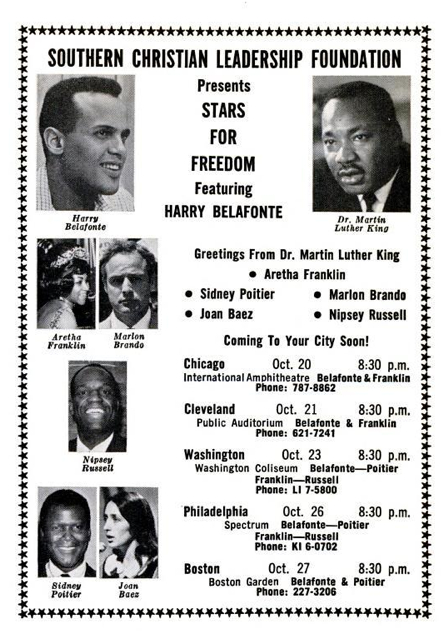
In fact, King did come to Boston for the purposes of fundraising in late 1967—specifically, on Friday, October 27. Boston was the last stop in a week-long series of benefit concerts given by Harry Belafonte for King’s Southern Christian Leadership Conference (SCLC). Here’s an advertisement for that tour, from the magazine Jet.
In the archives of NBC, there is a clip of King greeting the audience at the Boston concert. The Boston Globe also reported King’s remarks and the benefit concert on its front page the next morning. Greetings by Martin Luther King, Jr., sandwiched between an introduction by Sidney Poitier and an act by Harry Belafonte, before 9,000 people in Boston Garden—it’s difficult to imagine any appearance more “high profile” than that.
And the dinner in Cambridge? When King was assassinated, the Crimson, Harvard’s student newspaper, did write that he “was last in Cambridge almost exactly a year ago—April 23, 1967.” That had been a very public visit, during which King and Dr. Benjamin Spock held a press conference to announce plans for a “Vietnam Summer.” War supporters picketed King.
But in actual fact, that wasn’t King’s last visit to Cambridge. In early October 1967, when news spread that King would be coming to Boston for the Belafonte concert, a junior member of Harvard’s faculty wrote to King from Cambridge, to extend an invitation from the instructor and his wife:
We would be anxious to be able to sit down and have a somewhat leisured meal with you, and perhaps with some other few people from this area whom you might like to meet. So much has happened in recent months that we are both quite without bearings, and are in need of some honest and tough and friendly dialogue…. So if you can find some time for dinner on Friday or lunch on Saturday, we are delighted to extend an invitation. If, however, your schedules do not permit, we of course will understand that. In any case, we look forward to seeing you at the Belafonte Concert and the party afterwards.
Two days later, King’s secretary, Dora McDonald, sent a reply accepting the invitation on King’s behalf: “Dr. King asked me to say that he would be happy to have dinner with you.” King would be arriving in Boston at 2:43 in the afternoon. “Accompanying Dr. King will be Rev. Andrew Young, Rev. Bernard Lee and I.”
Who was this member of the Harvard faculty? Martin Peretz.
This requires a bit of a digression. In October 1967, Peretz was a 29-year-old instructor of Social Studies at Harvard and an antiwar New Leftist. Four months earlier, he had married Anne Farnsworth, heiress to a sewing machine fortune. (Here are the Peretzes in Harvard Yard, just a few years later.) Even before their marriage, the couple had made the civil rights movement one of their causes, and Farnsworth had become a top-tier donor to the SCLC. A year earlier, Peretz had informed King that a luncheon with him was “one of the high points of my life”—and that “arrangements for the transfer of securities are now being made.” As Peretz later wrote, “I knew Martin Luther King Jr. decently well, at least as much as one can know a person who had already become both prophet and hero. I fundraised for his Southern Christian Leadership Conference.” Much of that charity began in the Peretz home.
But as Peretz noted in his invitation, “much has happened in recent months,” necessitating “some honest and tough and friendly dialogue.” Peretz was then (as he is today) an ardent supporter of Israel. The Six-Day War, only four months earlier, threatened to drive a wedge between those Jews and African-Americans, allied in common causes, who differed profoundly over the Middle East. The culmination came in August, when the radical Student Nonviolent Coordinating Committee (SNCC) issued a newsletter claiming that “Zionist terror gangs” had “deliberately slaughtered and mutilated women, children and men, thereby causing the unarmed Arabs to panic, flee and leave their homes in the hands of the Zionist-Israeli forces.” The newsletter also denounced “the Rothschilds, who have long controlled the wealth of many European nations, [who] were involved in the original conspiracy with the British to create the ‘State of Israel’ and [who] are still among Israel’s chief supporters.” Peretz, who a few years earlier had been a supporter of SNCC, condemned the newsletter as vicious antisemitism, and Jewish supporters of the civil rights movement looked to King and the SCLC to do the same.
It was against this background that King came to dinner at the Peretz home at 20 Larchwood Drive, Cambridge, in the early evening of October 27, 1967. A few days later, King’s aide, Andrew Young, thanked the couple
for the delightful evening last Friday. It is almost too bad we had to go to the concert, but I think you will agree that the concert, too, proved enjoyable but I am also sure a couple of hours conversing with the group gathered in your home would have been more productive.
In fact, the evening’s significance would only become evident later, after King’s death. For the dinner was attended by Peretz’s senior Harvard colleague, Seymour Martin Lipset, and it was then and there that Lipset heard King rebuke a student who echoed the SNCC line on “Zionists”: “When people criticize Zionists, they mean Jews. You’re talking anti-Semitism!” Peretz would later assert that King “grasped the identity between anti-Israel politics and anti-semitic ranting.” But it was Lipset who preserved King’s words to that effect, by publishing them soon after they were spoken. (And just to run the contemporary record against memory, I wrote to Peretz, to ask whether the much-quoted exchange did take place at his Cambridge home on that evening almost 45 years ago. His answer: “Absolutely.” I’ve written twice to Andrew Young to ask whether he has any recollection of the episode. I haven’t yet received a response.)
Corroborated
Little more than five months after the Cambridge dinner, King lay dead, felled by an assassin in Memphis. (Peretz delivered a eulogy at the remembrance service in Harvard’s Memorial Church.) There’s plenty of room to debate the meaning of King’s words at the Cambridge dinner, and I’ve only hinted at their context. But the suggestion that King couldn’t possibly have spoken them, because he wasn’t in or near Cambridge when he was supposed to have said them, is now shown to be baseless. Lipset: “Shortly before he was assassinated, Martin Luther King, Jr. was in Boston on a fund-raising mission, and I had the good fortune to attend a dinner which was given for him in Cambridge.” Every particular of this statement is now corroborated by a wealth of detail. We now have a date, an approximate time of day, and a street address for the Cambridge dinner, all attested by contemporary documents.
So will the guardians of Wikiquote redeem this quote from the purgatory of “disputed”? Let’s see if they have the decency to clear an eminent scholar of the suspicion of falsification, suggested by persons whose own sloppy inferences have been exposed as false.
Update, 2016: This post has been amalgamated into a larger published article on King’s approach to the Six-Day War, here.
On January 30, I made this presentation to a Herzliya Conference panel entitled “Short-Term Scenarios for the Middle East” (short-term being defined as the next three years). I didn’t actually present any scenarios, for the reason explained in my very first sentence. But I did ask what I think will be the most salient questions (except for Iran, which I’m not touching). Among the panelists was Ed Djerejian, former United States ambassador to Syria and Israel. I’ve always found him to be a feisty good sport, and he stood by the quote of him that I brought. But the session was run by Chatham House rules, so you only get my side of the story. (Other panelists: Sir Mark Allen, Riad al Khouri, and David F. Gordon. Moderator: Shmuel Bar.)
Short-term scenarios are obviously more dangerous than long-term ones—dangerous, that is, to whoever formulates them. Consider that a year ago at this conference, Husni Mubarak was under siege but clinging to power. Bashar Assad was claiming that he had nothing to worry about, and the London School of Economics was still proud to have Saif al-Islam Qadhafi as an alumnus.
It’s been a humbling year for prognosticators, and in this age of the internet, it’s easy to go back and retrieve embarrassing predictions. I allude to those that exaggerated the power of the Facebook youth, downplayed the appeal of the Muslim Brotherhood, or described the Salafis in Egypt as a “tiny minority.” Some people have been so stung by their own predictions that they’ve vowed to abstain from making them again. Tom Friedman of the New York Timesdid that three weeks ago: “The Egyptian uprising is the equivalent of elephants flying…. If you didn’t see it coming, what makes you think you know where it’s going? That’s why the smartest thing now is to just shut up and take notes.” Whether Tom will keep his New Year’s resolution remains to be seen. But it’s now commonplace for chastened analysts just to admit that “no one knows” what will be in the Middle East.
That’s actually preferable to another approach: discounting the short-term altogether, especially as it looks so messy, and taking comfort in the long term. Ambassador Djerejian and I go back a long way, so he won’t mind if I quote something he said last September (at min. 4:30) to make my point. (You see, Ed, you’re not in office any more, but I’m still stalking you.)
I think in the long arc of history, what’s happening in the Arab world is akin to what we, the United States, stand for, both in terms of our values and our national security interests. But in the short term, there are going to be some detours, some bad actors are probably going to come to power in some of these countries, extremists will try to hijack this popular uprising. But I think in the long term, the fact that they are going to have broader political participation, more viable uncorrupt economies, is a good thing, and we have to support these movements.
Now I’m not going to pick on Ed. What he said reflects the Washington consensus: while the short-term is unpredictable and full of bumps, things will stabilize in the long term, and to our advantage. In this approach, short-term scenarios full of detours and bad actors can be disregarded, since long-term trends will correct for them—and these trends smile upon us. The most irresistable one is the spread of freedom, conceived in the American way.
I happen to believe that if things go awry in the short term, there will be hell to pay later, and I’m not alone. I respect the long-term scenario-building of the National Intelligence Council. But there’s a reason they redo their 15-year projections every five years. Still, I’m not going to burden you with short-term scenarios. That’s partly because, as long as I’ve been studying, following, and living in the Middle East, the crucial events have been flying elephants or, if you will, “black swans”—developments beyond all but the most far-fetched scenarios. Instead, I’ll pose a few questions about the future. Your answers are the scenarios.
Is the “wave of revolutions” over? We’re now a year into events, and there seems to be a pattern. The wave hit the presidents-for-life in the so-called “republics” hardest. It swept some of them away. But the monarchies seem to have weathered the storm. When I was at The Washington Institute in November, I attended a session with the Tunisian Islamist guru Rashid Ghannouchi, and he said this: “Today, the Arab world is witnessing revolutions, some of which have succeeded and some of which are about to succeed. The republics have almost completed [this process], and next year it will be the turn of the monarchies…. The young people in Saudi Arabia do not feel they have fewer rights than those in Tunisia or Syria.” When the Institute published this, the Saudis went ballistic, and Ghannouchi claimed his remarks had been distorted. But he said it, and presumably people are thinking it. The answer to this question is especially important to everyone who depends on Persian Gulf oil.
Is there an alternative to Islamism? Islamists are taking every ballot box by storm, usually by a margin twice that predicted by the “experts.” There are those who believe this advantage won’t last. Elliott Abrams last week wrote that “time is part of the antidote to extremism,” and anticipated that Islamists would mellow during that time and do worse in the second and third free elections. But if so, someone else will have to do better, so who might that someone else be? Who has the formula for beating the Islamists at what is becoming their game? The answer to this is especially important to Israel: Islamists may be prepared to play with the West, but to them Israel is forever unclean.
Is the map of the Middle East going to change? We’ve already seen some map changes result from the ballot box: the split between the West Bank and Gaza was prompted by an election, and the split of Sudan into two, by a referendum. What about Libya and Syria? And Iraq? In 2016, the Sykes-Picot agreement, which drew the map of the Middle East according to British and French interests, will be a century old. It survived decolonization. Can it survive democratization? (For those who like the 1989 analogy to the “Arab Spring,” I remind them that 1989 changed the map of Europe.) The world wants to see democracy in the Middle East, but it doesn’t want the map to change. There may be a contradiction between these two desires.
So instead of the customary three scenarios, I’ve asked three questions. Your answers are your scenarios—short-term ones, because we’ll have answers to all three questions within the next three years.
And that brings me to my last point. President Obama has often mentioned the imperative of being on the “right side of history.” He’s said that on Egypt, “we were on the right side of history.” Qadhafi, he said, was on the “wrong side of history.” And the Middle East, he said, “will be watching carefully to make sure we’re on the right side of history.” The danger here is the assumption that events unfold in accordance with certain laws, and the most we need to do is position ourselves. This thinking provides an excuse for inaction—the belief that there is a predestined path to history, from which there are, at most, “detours.”
But there is no “long arc,” because people have choices they’ve yet to make, and those choices will affect outcomes. On the three questions I’ve asked, there may be policies that the United States, Europe, and even Israel can implement, to tilt the odds in favor of certain scenarios and against others. And since we too have to live with the consequences, why not? Let’s hope that, despite having plotted the ‘long arc” of the “right side” of history, we haven’t entirely given up on making it.

 Martin Kramer on the Middle East
You must be logged in to post a comment.