Shoddy and inaccurate?

Juan Cole, the University of Michigan professor and blogger, fancies himself a fact-checker who uncovers hidden truths via the Arabic press. He attempted this most recently in a post entitled “Did the Muslim Brotherhood Threaten to Kill ‘All Jews’?”

His target was a report from Cairo by the Israeli journalist Eldad Beck, written for the Israeli daily Yedi’ot Aharonot (Ynet). The English-language version of Beck’s report, referenced by Cole, carried this headline: “Cairo rally: One day we’ll kill all Jews.” It described a rally held on November 25 and organized in cooperation with the Muslim Brotherhood at Al Azhar Mosque in Cairo. The report included this line: “Time and again, a Koran quote vowing that ‘one day we shall kill all the Jews’ was uttered at the site.” Some newspapers and many blogs recycled Beck’s report.

Cole sprang into action. First, he unearthed a short Arabic press report of the same event, “clearly written by a reporter on the scene,” and announced this discovery: “It does not say anything about the speakers or the crowd threatening to kill all Jews, and I don’t believe any such threat was made.” Cole then added that no Qur’anic verse speaks of killing the Jews: “The Qur’an doesn’t call for all Jews to be killed, and neither did the Muslim Brotherhood last Friday.” Beck, he declared, “clearly does not know what he is talking about”; his reporting of the rally was “shoddy and wholly inaccurate.” Cole capped his reprimand with an accusation: “If Beck had simply said that the Muslim Brotherhood crowds want Jerusalem back for Islamdom and evinced hostility toward Israelis, he would have been right. But his breathless exaggeration slides over into Islamophobia.”

Cole thought he’d exposed a case of journalistic incompetence, but I wondered. Eldad Beck is a serious correspondent. He did a degree in Arabic and Islamic studies at the Sorbonne, and is renowned for traveling to Arab and Muslim countries on a European passport to report from places Israeli journalists dare not tread (e.g., Lebanon, Syria, Iraq, Iran, Afghanistan, Pakistan). Cole referenced Beck’s report in English, but it originally appeared in Hebrew, and I suspected the Hebrew original might be more precise. So I consulted it.

It’s a more detailed report than the English translation of it. In the key passage, Beck wrote the following (my own translation from the Hebrew):

Brotherhood speakers and their guests from “Palestine” called explicitly for a jihad to liberate all of Palestine. Again and again, the quote was referenced, according to which “the day will come and we will kill all the Jews until even the stones and trees will say to us: ‘a Jew hides behind us, kill him!'”

So that’s it. Beck had heard speakers recite a well-known canonical hadith (a saying attributed to the Prophet Muhammad), about an event that will signal the imminence of Judgement Day. It goes like this (with only the slightest variations depending on the hadith collection):

The Prophet (peace and blessings be upon him) said, “The Hour will not come until the Muslims fight the Jews and kill them. When a Jew hides behind a rock or a tree, it will say, ‘O Muslim, O servant of Allah! There is a Jew behind me, come and kill him!'”

Note that Beck didn’t attribute this “quote” to the Qur’an. That (erroneous) attribution was apparently introduced into the English translation by a Ynet translator. And Beck did label it a “quote.” Precisely.

In the comments section of Cole’s post, someone actually did speculate that perhaps the “hiding Jew” hadith was recited at the rally. Cole dismissed this: “The Arabic accounts don’t report that one [hadith] chanted at al-Husayn [Square, i.e., Al Azhar].” Well, those accounts (actually, Cole linked to only one) are incomplete. At least two speakers at the Azhar rally recited the hadith.

One was Abd al-Rahman al-Barr, a member of the Muslim Brotherhood Guidance Bureau. If you know Arabic, you can watch him recite it, at minute 8:10 of this clip filmed inside the mosque. (Clicking will take you right to the moment.)

And he wasn’t the only one: Shaykh Muhammad Mukhtar al-Mahdi, professor at Al Azhar and head of the Islamic Law Society, did so too at minute 8:05 of this clip, also filmed inside the mosque. (Clicking will take you directly to that moment.)

So Beck did hear the hadith recited at least twice, and he reported that fact.

In response to that same reader who guessed at the “hiding Jew” hadith, Cole made another off-base rejoinder. “There are thousands of hadith,” he huffed in a comment on the comment. “Most Muslims don’t accept the weak or obscure ones.” Well, it’s true that there are thousands of hadiths, but Islamic scholarship has a methodology for determining the weak ones. The “hiding Jew” hadith is included in the most canonical hadith collections (Bukhari and Muslim) as sahih, “authentic,” and is classified as marfu’, “elevated”—a hadith traceable in an unbroken line back to the Prophet Muhammad. It’s rated triple-A. Nor is it obscure. In fact, it’s one of the most quoted Jew-related passages in the Islamic canon. It figures most notably in the Hamas covenant (art. 7), and you can watch the late Osama Bin Laden recite it too (min. 45:17).

As to the substance, I suppose there is some difference between Muslim extremists vowing to “one day kill all Jews,” and their quoting an end-of-times prophecy that Muslims will one day kill the Jews with the help of rocks and trees that will betray the stragglers. I’m just not sure how much of a difference it is. In any case, though, the hadith predates the State of Israel by well over a millennium, so it certainly can’t be attributed to Israeli provocation. Those who invoke it—the Muslim Brotherhood, Hamas, Bin Laden—root their hatred of Israel in a much deeper stratum of Islamic animosity toward the Jews. Those who downplay that sort of Judeophobia just help to perpetuate it.
Yes, worry about the Islamists

A presentation made by Martin Kramer at the book launch of Reuel Marc Gerecht’s The Wave: Man, God, and the Ballot Box in the Middle East, November 7, 2011. Posted retroactively at Sandbox.

Reuel is an old friend, a fellow student of the same teachers, so I’m delighted that he’s added another contribution to the shelf. But I know I was invited to dissent, so let’s begin.

Reuel’s thesis is that we should be glad to see the old authoritarian order implode, because it could never evolve; and we shouldn’t fear the inevitable triumph of Islamism through the ballot box, because this new order can evolve—eventually in the right direction.

Now I agree that the old order couldn’t evolve—Reuel is quite right. The old regimes can only perpetuate themselves, for some amount of time, until they weaken and someone figures out how to topple them. Of course, this isn’t an entirely new revelation. You can find it in Ibn Khaldun.

I also agree that the Islamists are going to have their moment. If Palestine and Turkey and Tunisia put Islamists in power through the ballot, you can bet it will happen in Egypt and Libya and Syria, when that day comes. So we have to weather this change, and do what little we can to forestall a worst-case scenario. I suppose that in order to do that, we also have to be seen as embracing change. If I were writing speeches for Barack Obama, I too would compare the makers of the “Arab Spring” to Boston’s patriots and Rosa Parks. And I suppose we have to say, as a State Department official said the other day, that if Egyptian elections are free and fair, and the Muslim Brotherhood wins, the United States will be, quote, “satisfied.”

But this is where I part with Reuel. I wouldn’t really be “satisfied” at all, but Reuel would. In fact, his book might have been subtitled “How I Learned to Stop Worrying and Love the Islamists.” What is it about former intel hands that they have this I-know-something-you-don’t approach to Islamists? I’m thinking about Graham Fuller, ex-CIA, Alastair Crooke, ex-MI6, Ephraim Halevy, ex-Mossad—each of them in his own quirky way tells us we can get what we want from Islamists, if we talk to them, stroke them, maybe even pay them off. Of course, this has a long history going back to the early Cold War. We used the Islamists against the Soviets, and many thought we should use them against Al Qaeda. Reuel is ex-CIA, and half the time, I thought he was winking at me, telling me: don’t worry, we’ve got their number. If Islamists win elections, it’ll be all right, because we’ve planted this democracy chip in their brains, they can’t get it out, and they’ll end up coming to Papa. (He even writes at one point that they have America in their bloodstream.)

Well, we shall see. Here’s a quote: “We are going to have a republic, a democracy. Every group is emphasizing the words ‘democratic’ and ‘republic’ as much as ‘Islamic.’”

That wasn’t said this year in Tunisia or Egypt. It was said in February 1979 by an Iranian revolutionary at a rally at Princeton University, where I heard it myself—I recently went back to the Daily Princetonian to see if I remembered it correctly. Reuel is wrong when he writes that “there was never any deception on the part of Khomeini.” There was a massive deception campaign, and it worked. I think we’re again witnessing campaigns of deception, and they’re working again.

Can movements that don’t practice democracy internally, that believe they answer to a power above the will of the people, that divide humanity between believers and unbelievers, build and sustain democracy? In saying yes, Reuel has written a very American book—a flattering paean to the power of an American idea. All I can say is, I hope he’s right. But let’s acknowledge that, however Americans try, they always seem to come up with some variation on modernization theory, which says the world wants what Americans want, in the way Americans want it. And let’s admit that this almost always sets up America for a fall.

Let me end, as I should, with a comment on the implications for Israel. Reuel has a passage that left me bewildered, coming as it does from an old intel hand: “Some Muslim autocracies have signed peace treaties with Israel. They may not guarantee all that much, but the signed paper does exist.”

Well, if that’s all you have to say about Israel’s relations with Egypt and Jordan, you aren’t an insider. The political, security, and intelligence relations with Egypt and Jordan have been intense and game-changing for Israel. There were no public expressions of warmth, but under Mubarak, no mobs stormed the Israeli embassy either. Israelis aren’t so daft as to think that some “evolution” of Egypt under the Muslim Brotherhood is going to produce an improvement on what Israel had.

Reuel writes that “Israel’s security will be lasting only when Muslim peoples, not their ever-less popular governments, accept the Jewish homeland.” I don’t know what “lasting” means, but I do know that whether it’s governments or peoples, this acceptance is a function of Israeli power to defeat them. The governments appreciated that power. How does Reuel think Muslim peoples are going to reach the same understanding? Will Israel have to defeat them too? Will it have to do to Islamism what it did to Arab nationalism in 1967?

I’m also perplexed by his polisci Tom Friedman–style bromide, that “democracies eventually bring lasting peace, dictatorships don’t.” That was fine when the set of democracies included the United States and its dependencies. I believe the Middle East, with the Muslim Brotherhood setting the tone, is destined to disprove this slogan. That is, if Israel’s wars in 2006 and 2008—with those Arabs who’d cast the most ballots, Lebanese and Palestinians—didn’t disprove it already. Only Israel’s power, and fear of it, guarantees the peace. Whether Israel’s adversaries do or don’t drop ballots in boxes doesn’t make the slightest difference.

And the idea, in the afterword, that the Hashemite monarchy should turn over power to the Palestinians, is bizarre—because there’s no exploration whatsoever of its implications. We’re simply told that we must be consistent. As Emerson said, “A foolish consistency is the hobgoblin of little minds, adored by little statesmen and philosophers and divines.” We’re being pushed here to a foolish consistency. But if we’re going to be consistent, why not be so in the way Middle Easterners expect? That is, you reward your friends and punish your enemies. That’s how you win and keep friends. Given American values, standing by dictators might not always be advisable. But given American interests, neither is the overthrow of every single U.S. friend, ally, and proxy.

So we’re indebted to Reuel for a provocative book, which I enjoyed from beginning to end. I hope it sells well, gets him his fifteen minutes, and then disappears without a trace. No need to thank me, Reuel. What are friends for?

October 1973: Panorama and myopia

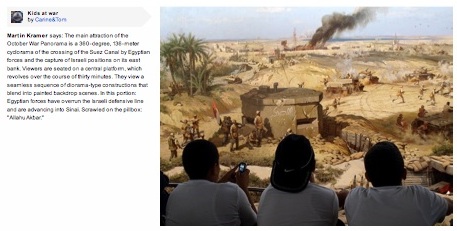
Another anniversary of the October 1973 Arab-Israeli war has passed. I’ve taken the occasion to experiment with a feature of the Flickr photo sharing site, allowing me to “curate” my own selection of photographs taken by others—in this instance, of the October war “panoramas” in Cairo and Damascus, which celebrate the Egyptian and Syrian “victories” over Israel. Click here.

It’s often said that the myth of the October “victory” made accommodation with Israel thinkable, by erasing the stigma of the 1967 defeat from Egyptian and Syrian consciousness. But a much more persuasive case can be made that Israel’s turning the tide of the 1973 war finally compelled Arab acceptance of Israel. Israeli forces overwhelmed Arab armies on two fronts, even from the most disadvantaged opening position. The lesson was not lost on the leaderships of Egypt and Syria, and it underpins their avoidance of war with Israel in the decades since.

In teaching the young only part of the story of 1973, these “panoramas” show much less than 360 degrees of the truth—and in some small way, erode the foundations of such peace as the Middle East enjoys. (They are also monuments to blind leader-worship, now challenged by the revolution in Egypt and the uprising in Syria.)

I’ve selected the most interesting photographs of these two attractions, put them in my preferred order, given them my own introduction, and put each image in its context. Again, to visit the gallery, click here. (Download pdf to print here.)