Oppenheimer on Israel

In May 1958, J. Robert Oppenheimer travelled to Israel to celebrate a new institute for nuclear science at the Weizmann Institute of Science in Rehovot.

This event became a landmark in the relationship between Oppenheimer and the Weizmann Institute, between the “father of the atomic bomb” and Israel. It’s been little noted, because Oppenheimer is generally considered to have been distant from his Jewish origins and disconnected from Zionism and Israel.

Kai Bird and Martin Sherwin, in their Pulitzer Prize-winning biography of Oppenheimer, American Prometheus (on which the 2023 movie is based), make much of the testimony of Isidor Isaac Rabi, a dedicated Jew, physicist and 1944 Nobel laureate who had been an adviser to the Manhattan Project. “Oppenheimer was Jewish, but he wished he weren’t and tried to pretend he wasn’t.” And this: “I don’t know that he thought of himself as being Jewish. I think he had fantasies thinking he was not Jewish.” Bird and Sherwin conclude that Oppenheimer had “a lifelong ambivalence about his Jewish identity.” As for Israel, they make no mention of the Weizmann Institute, and refer to the 1958 visit as one stop tacked on to a European tour. The Weizmann event is mentioned in a passing manner in Mark Wolverton’s A Life in Twilight: The Final Years of J. Robert Oppenheimer, again as an add-on to Europe.

However ambivalent Oppenheimer may have been about his Jewish identity, his relationship with the Weizmann Institute and Israel gained momentum in the late 1950s and early 1960s, when he would travel to Israel again. Indeed, there’s even an overlooked mystery to be resolved, but I’ll save it for a later post. In this post, I’ll bring the words spoken by Oppenheimer at the Weizmann Institute on May 20, 1958.

Oppenheimer speaks with David Ben-Gurion at the Weizmann Institute, May 20, 1958; photograph by Moshe Pridan, National Photo Collection, Government Press Office.

The text may help to explain a remark made by Israeli prime minister David Ben-Gurion to the Israeli cabinet, after he’d met with Oppenheimer at the latter’s request. Ben-Gurion said he “had the impression that some sort of Jewish spark lit up the man.”

That impression may have originated in Oppenheimer’s speech. Ben-Gurion certainly heard it. The prime minister delivered the keynote at the same dedication, and sat with Oppenheimer in the front row. Oppenheimer, in his own speech, made several references to Ben-Gurion’s remarks. (When Oppenheimer said “It is not only the Prime Minister of Israel who has his difficulties,” he was referring to Ben-Gurion’s admission that he didn’t understand much about physics.)

What’s the source for Oppenheimer’s text? Oppenheimer spoke from notes, but he didn’t have a copy of the speech as he delivered it. “I gave my notes on the ceremonial talk to your press officer,” he wrote to Meyer Weisgal, his host, “and have no record at all of what I said.” At Oppenheimer’s request, the Weizmann Institute sent him a tape with the extract of his speech, secured from the Voice of Israel, which had broadcast the proceedings. The following text is a transcription of the delivered speech, from Oppenheimer’s papers. While the Jerusalem Post reported a few portions of his remarks the day after he spoke, the speech is published here in full for the first time.

I’ve appended an extract from another speech that Oppenheimer gave for the Weizmann Institute on December 2, 1958, at its annual fundraiser at the Waldorf-Astoria Hotel in New York. There Oppenheimer reflected on his visit to Israel the previous May. It complements the Rehovot speech.

Some of the persons mentioned by Oppenheimer in the two speeches:

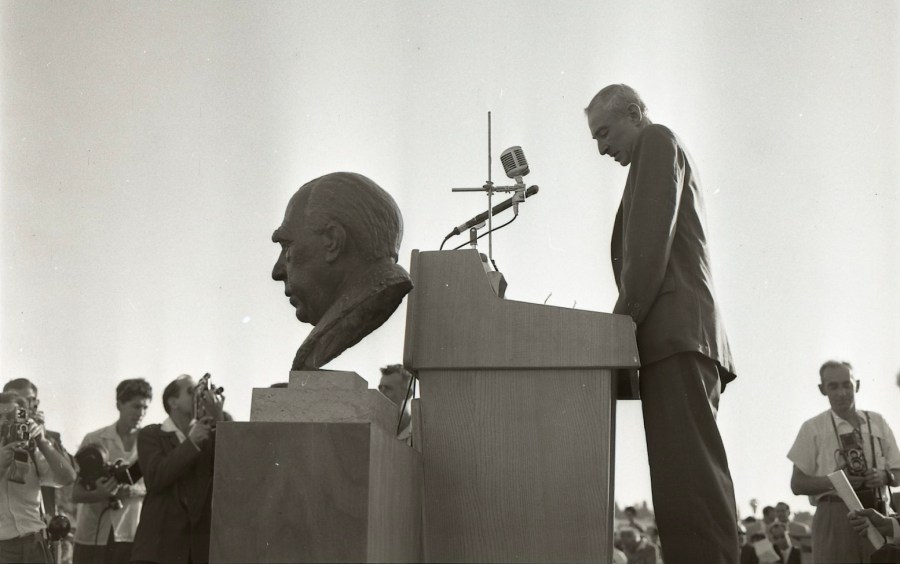
  • Niels Bohr, Danish physicist and 1922 Nobel laureate. Although baptized a Lutheran, his mother came from a distinguished Jewish family, so he fled Denmark during the Nazi occupation. He later assisted Oppenheimer in the Manhattan Project. Bohr had already lent his prestige to the Weizmann Institute during an earlier visit in 1953, and he also spoke at the 1958 dedication, for which the Institute commissioned his bust.
  • Meyer Weisgal, Zionist author and fundraiser, and confidant of the late Chaim Weizmann. At this time, he was chairman of the executive council of the Weizmann Institute. He would become the person in Israel closest to Oppenheimer.
  • Benjamin Bloch, physicist by training, administrator of the Weizmann Institute, and a friend of Bohr and Oppenheimer. (Felix Bloch, the Swiss-American physicist and 1952 Nobel laureate, also attended the 1958 dedication, but Oppenheimer’s reference to “Dr. Bloch” clearly refers to Benjamin.)
  • Abba Eban, Israeli statesman. In late 1958, he was at the end of his service as Israeli ambassador to the United States and chief delegate to the United Nations, and had been named the next president of the Weizmann Institute.
  • Ernest (later Lord) Rutherford, New Zealand-British physicist and 1908 Nobel laureate, a friend to Chaim Weizmann in Manchester.

Header image: J. Robert Oppenheimer speaks at the Weizmann Institute before a bust of Niels Bohr, May 20, 1958; photograph by Boris Carmi, Meitar Collection, The Pritzker Family National Photography Collection, The National Library of Israel.

Oppenheimer’s Rehovot speech, May 20, 1958

Mr. President, Mr. Prime Minister, Professor Bohr, Mrs. Weizmann, Mr. Weisgal, my colleagues, Ladies and Gentlemen. It is a multiple pleasure, as it is a deep honor, to participate in this celebration. We are celebrating many things. I will speak of three. This is physics; this is Israel; this is for Bohr.

This wholly living and beautiful monument is a monument to the physics that has occurred here in the past, to the brilliant work well done. It is to be a future center, famous for all of us as is Bohr’s Institute in Copenhagen, not only for those who live here, but as a center for scholars and students from the whole wide world. It is a source of celebration and honor for the physicists here in this Institute in this country, for Mr. Weisgal and Dr. Bloch, and for the many who have given generously to make this center, and this building. And even here in Rehovoth, even in the amazing development of the Weizmann Institute which is so young, and has come against many obstacles so wonderfully far, this new center is, to anyone who comes for the first time, a most impressive and almost unbelievable structure and hope.

Physics is of course only a small part of learning; and we all know that even in an Institute like this not all physics can be done; though we also know that the scientists here will be friendly and hospitable to all progress in all fields everywhere. But we may be provincial for a minute. Physics, although it is only one of the sciences, has some lessons to teach; it has a very special part; it sets a very special example. It exemplifies—above all this physics of the microcosm—two traits of human experience; great novelty and adventure, great harmony and order. One cannot live in it without recognizing how limited even the greatest human experience of the past has been, without having a sense of the openness of the future. One cannot live in it without recognizing how limited and rather poor is the human imagination, without the guide of nature. And still it is a world of highest harmony and order, words which the Prime Minister used, although he is not a scientist, as a physicist would like to see them used—words which stood for Einstein for a kind of wonder and awe at the fact that this is not a world of chaos, that it is a world of beauty, that, in the marvelous phrase of Thomas Jefferson, nature is “fit for man’s comprehension.”

It is in no way an accident, or trivial, and for me perhaps it is the second most exciting part of the celebration, that it is here in Israel. I cannot speak to you who have fought, who have worked for more than ten years, to bring this country into being, who are destined to continue to do it, of what that means; I cannot be maudlin about it. But as an outsider coming from America, I can say that the whole world sees in Israel a symbol, and not just a symbol of courage, and not just a symbol of dedication, but of faith and confidence in man’s reason, and a confidence in man’s future, and in the confidence in man, and of hope. These are all now largely and sadly missing in those vast parts of the world which not so long ago were their very cradle.

And then this is for Bohr, who is not only a friend, a revered and honored friend of many of us but in many ways he laid the corner stone of this building, this Institute, and this hope. Five years ago he laid the actual physical corner stone of the building. He has laid as well the corner stone for that edifice of understanding to whose cultivation this building is dedicated. For the past half a century, since the Manchester days, when he was with Rutherford and Weizmann, Bohr has been the inspiration and guide to those who hoped to learn new truth about nature, and also to those who hoped from this to learn afresh our understanding of man himself, of his understanding, of his power, of his limits, of the nature of his knowledge, and the nature of his destiny. This sculptured head, this image of Bohr is here; it will be in the great hall of the Institute; it will be in one place. But, believe me, Bohr’s image is in the heart of every physicist.

New knowledge lends to man new power. This is nothing to stress here. The life of Israel would not be possible without it. It would not be possible to fight the difficulties, the adversities of nature, and the adversities which have been added by men; and I need not labor it. But among these powers there are powers of destruction, far too deadly to be used if human society is to endure at all. Professor Bohr was among the very first to understand this, and to think deeply about it, and to act with the highest and most enduring responsibility. In this too, he is for us a revered leader. He has written a most modest account of his views and his actions in an open letter to the United Nations. He has never let these thoughts wander too far from the center of his attention. For we live in a world in which the nations will have to learn to unite, to open their frontiers and their barriers to each other, and to lose those powers of making war, which are today an intolerable menace, and for whose use even today, some states are wholly lacking in incentive.

In this connection I have a hope, a confident hope, of another great role for Israel. The vastness, the variety of our world is beyond our compass. Our knowledge of nature and man doubles every decade, for the most part far beyond the reach of any total common understanding. It is not only the Prime Minister of Israel who has his difficulties. It is all of us. In all ways the pace of change is not attuned to the familiar pattern of man’s life. In this we have a heavy double duty: to be faithful to our own ways; to be open and friendly to the ways of others, as Israel has been, in welcoming to her land men of such varied cultures, tongues, customs and traditions. We must love and cherish what is our own, what we know: our own land, or the life of Israel; or our own work, the life of physics. Only so do we really live, do we live a life in depth and fullness. Yet we must lend a ready ear and give a welcoming hand to other cultures, and to other ways, strange ways, to art, to sciences, to learning, too vast, too rapidly growing and changing, for us to be quite at home with it. My hope and wish is that Israel may show to all the world, by its own great example, that there can be harmony between these two complementary needs and duties. This new Institute, guided by Bohr’s spirit, and the example of his own life, will be a source of pride and joy to Israel, and to physics, and yet be open to all other worlds, in fraternity, and in friendship.

Source: J. Robert Oppenheimer Papers, Manuscript Division, Library of Congress, box 287, folder 7.

An Israeli newsreel covers the ceremony (in Hebrew).

Oppenheimer’s Waldorf-Astoria speech, December 2, 1958 (excerpt)

Just one month ago, Mr. Eban, the new President of the Weizmann Institute, the Ambassador of Israel to Washington, and the Chief Delegate of Israel to the United Nations, spoke for the Weizmann Day Assembly at the Weizmann Institute in Rehovot. I was not there to celebrate and listen, but I have Mr. Eban’s thoughtful text. I am reminded of an earlier day, last May, when, as a member of a small group of visiting physical scientists, I also spoke in this same memorial square. We were there to celebrate the opening of the new Institute for Nuclear Sciences, the penultimate structure in the building program of the Institute, now happily complete.

It was a sunny and heartening occasion, bringing to all our minds the many themes which Weizmann’s name and his Institute have come to symbolize. Mrs. Weizmann was there, to make the past present; and the President and Prime Minister of Israel, attesting the place that the cultivation of science plays in the life of Israel. Niels Bohr was there; he had laid the corner stone of this building, attesting the interest of scholars and scientists throughout the world in this Institute, which has already seen so many beautiful contributions to our understanding of nature, and whose future seems to all of us so full of promise. Meyer Weisgal was there; to know him, and above all in his beloved Rehovot, is one of the very good things of this world.

We were in a garden, in land recently restored but already old in beauty. Everywhere about us was the sense of the pioneer, and of courage, which is never remote in Israel. Everywhere about us was the memory of Weizmann, with his double devotion to learning and to his people. Many of our colleagues of the Institute were well known to us, even those of us who had not before visited Rehovot: familiar figures at Geneva, Paris, Princeton, and wherever else that scholars are at work. For here at Rehovot we saw a happy blend that is characteristic of science and of Israel, and a hope for our time and the future: a warm love and pride in the Institute, in things local and close in geography and culture, and a wide-ranging, outgoing concern and appreciation for the whole international enterprise that is contemporary learning. Here we heard again the voice of a people long confident that virtue is possible on this earth, and has its place here, and that history is man’s high story, and our part in it marked by duty and touched with hope.

Indeed, for myself I learned not only of the land I was visiting, but of things relevant to the older, richer, larger societies of the Western world; for the Institute at Rehovot that day would have been intelligible and sympathetic to the men of the Enlightenment, or to the founding fathers of the United States—to Franklin perhaps most of all, or to Jefferson. In this society, forced by danger, by hardship, by hostile neighbors, to an intense, continued common effort, one finds a health of spirit, a human health, now grown rare in the great lands of Europe and America, which will serve not only to bring dedicated men and dedication to Israel, but to lead us to refresh and renew the ancient sources of our own strength and health.

Source: J. Robert Oppenheimer, Science and Statecraft (New York: American Committee for the Weizmann Institute of Science, 1958), pp. 3-4. The speech was republished five years later by Jacob Baal-Teshuva, ed., The Mission of Israel (New York: Robert Speller & Sons, 1963), pp. 94-95. Drafts of the speech are preserved in the J. Robert Oppenheimer Papers, Manuscript Division, Library of Congress, box 287, folder 6.

Yom Kippur to Iraq: Wars in Years Ending in ’3

This year, 2023, marks two significant anniversaries: the twentieth anniversary of the 2003 Iraq War and the fiftieth anniversary of the 1973 Yom Kippur War. The commemorations of these two anniversaries unfolded on two parallel tracks, which never intersected.

The reason for this divergence is not hard to understand. What common ground could they possibly share? The 1973 war began with a surprise attack by two Arab states against Israel, aiming for limited political objectives. In contrast, the Iraq War was a well-telegraphed American offensive against Iraq, undertaken with the ambitious goal of regime change.

If we draw parallels between Israel and the U.S., then Israel found itself caught in an unwanted war, while the U.S. actively initiated a war it desired. When comparing Egypt and Syria with Iraq, the former launched the offensive, whereas Iraq played a strictly defensive role. The 1973 war involved local Middle Eastern states in conflict, whereas the Iraq War saw the world’s sole superpower confronting an Arab state.

At first glance, drawing comparisons between the wars of 1973 and 2003 might appear unlikely to yield any meaningful insights. However, I wish to attempt the comparison anyway, as there are some underlying similarities that may be relevant to a broader spectrum of conflicts. These parallels could offer lessons for the future, although it’s well-known that deriving practical lessons from history is a perilous proposition.

Past as precedent

The first similarity is that both wars were influenced by earlier conflicts in which Israel and the United States emerged victorious. Israel’s Six-Day War in 1967 resulted in a swift and decisive victory, bringing large Arab territories under its control. Similarly, the United States’ Gulf War in 1991 was a clear win, with the U.S.-led coalition easily liberating Kuwait from Iraqi occupation.

These swift and relatively easy victories bred a sense of exaggerated self-confidence, bordering on hubris, among the victors. In Israel’s case, this led to the belief that no sane Arab state would dare attack it after the humiliating and comprehensive defeat they suffered in 1967. For the U.S., the ease of victory in 1991 fostered the expectation that Iraqis wouldn’t fight back against occupation. These assumptions set up Israel for the shock of the combined Egyptian-Syrian attack and the U.S. for the unanticipated Iraqi insurgency.

Intel and bias

A second similarity involves intelligence failures, rooted in a reluctance to acknowledge information that contradicted the prevailing narratives about the enemy. In Israel’s case, signs of Egyptian and Syrian war preparations were interpreted away as the intelligence assessments ascended the chain of command. Only at the last minute did incontrovertible evidence reach the decision-makers, but by then it was already too late.

In the Iraq case, a similar selective perception led to the exaggeration of unreliable reports about Iraq’s possession of weapons of mass destruction. It was only after the U.S. invasion that the reality became apparent: Iraq did not possess such weapons. In both instances, Israel and the U.S. were misled by deception campaigns: Egypt and Syria fooled Israel into believing their war preparations were just exercises, while Saddam Hussein misled the West into thinking he possessed WMD. (He was under the mistaken belief that such weapons would deter an attack against Iraq.)

Both intelligence failures underwent scrutiny in post-war analyses, which arrived at similar conclusions: preconceived biases had distorted the analysis of the collected information. As a result, Israelis overlooked actual threats, while Americans perceived threats that were non-existent.

Tainted victory

A third similarity is the perception of failure despite achieving military victory. Israel arguably secured its greatest military triumph in the 1973 war: it swiftly repelled and encircled the enemy on both fronts, ending the conflict with more territory than at its outset. Yet, the 1973 war is remembered as a low point in Israeli history, its successes overshadowed by the initial surprise attack and the high number of Israeli casualties.

Similarly, the Iraq War is perceived by many in America as a strategic failure. Despite the U.S.’s rapid overthrow of Saddam Hussein’s regime and the subsequent “surge” that curbed the insurgency, the conflict led to a prolonged and costly occupation, inadvertently strengthened Iran’s position in the region, and contributed to the emergence of ISIS.

The political price

This leads to the fourth similarity: both wars had profound consequences for the politics of Israel and the U.S. In Israel, the 1973 war eroded public confidence in the Labor party, ending its quarter-century of dominance. In the U.S., the Iraq War and its aftermath deeply polarized public opinion, undermining the Republican establishment along with its neoconservative wing, and spurred a reevaluation of America’s role in the world.

The effects in both cases were not immediate. Despite the public disaffection over the 1973 war, the Labor party under Golda Meir won the parliamentary election two months later, with the government lasting until 1976. (Meir herself resigned from the prime ministership in 1974, succeeded by Yitzhak Rabin.) Similarly, George W. Bush was reelected in 2004, continuing his presidency for another four years.

However, in the longer term, the wars significantly undermined the standing of both Meir and Bush. When historians and experts are surveyed, these leaders frequently rank in the bottom third among prime ministers and presidents, respectively. Moreover, the wars set the stage for the ascendancy of outsiders (and outliers) from the opposition: Menachem Begin in 1977 and Barack Obama in 2008.

Painful reassessments

The fifth similarity lies in how Israel and the United States reassessed their approaches to the Arab world following each war, albeit in opposite directions. Prior to the war, Israel had favored maintaining the status quo, valuing the certainty of territorial control over the uncertainties of peace. The war, however, convinced Israel that peace, even if it required territorial concessions, could bolster its security.

Conversely, the United States had been inclined to break the status quo in pursuit of a “freedom agenda” and the promotion of democracy. The Iraq War and its aftermath led America to conclude that the risks of this approach far outweighed its potential benefits. The 1973 war diminished Israel’s pessimism about peace, while the Iraq War dampened American optimism about promoting democracy. Both events became significant conceptual watersheds.

What’s to be learned?

The lessons drawn from these similarities might seem obvious. Indeed, wars often stem from hubris, particularly the belief that past military successes can be easily replicated. Intelligence failures frequently serve as a prelude or even a necessary condition for war. It’s possible to achieve a military victory yet still feel as though the war was lost. Wars can significantly reshuffle domestic politics, especially when the costs are perceived as excessively high. And certainly, wars prompt the overhaul of previous strategies, necessitating reassessments. These truths apply not only to the wars of 1973 and 2003 but also to many other conflicts that did not share an anniversary this year.

But are these lessons ever truly learned? We find ourselves in the midst of another war in the Middle East, between Israel and Hamas. Already, the initial similarities are evident: Israel lowered its guard, basing its confidence on previous rounds with Hamas which supposedly left Hamas deterred; meanwhile, intelligence, filtered through biases, rendered Israel blind.

And it’s likely that we’ll soon witness the rest unfold. Israel will prevail militarily, but its people already perceive the Hamas war as a new low point. The nation’s political and military leaders likely will pay a steep price for perceived failures. And there will probably be a reassessment of the strategy that aims to bypass the Palestinians entirely in the pursuit of regional peace.

These similarities have yet to fully materialize. Perhaps I’ll revisit them in 2033, when we will be marking not just two, but three war anniversaries.

From a roundtable discussion marking the Iraq War anniversary, annual conference of the Association for the Study of the Middle East and Africa (ASMEA).

Header image created by DALL-E, OpenAI’s image generation model.

How Hamas deterred Netanyahu

When the history of Israel’s policy toward Hamas is investigated, one question will loom large: why did Israel allow Hamas, an implacable enemy, to grow alongside its jugular?

This development occurred almost entirely during Benjamin Netanyahu’s tenure. Hamas rose to power in Gaza in June 2007, and Netanyahu emerged as prime minister from elections in February 2009, a position he has occupied for thirteen of the last fourteen years.

The promise

During the 2009 election, Netanyahu criticized Tzipi Livni, the leader of the rival Kadima party then in power, for failing to bring down Hamas. On February 3, he visited the southern city of Ashkelon following a rocket attack from Gaza. Israel had concluded Operation Cast Lead against Hamas a few weeks earlier, and the Knesset elections were just a week away. Netanyahu recorded the following video message:

We’re here at the entrance to Ashkelon. This morning a Grad rocket landed here. That says it all. By chance, by a stroke of luck, there was a miracle, and the children who showed me the shrapnel weren’t harmed.

But we can’t rely on miracles. We need action to eliminate the threat. Only one action will do this, and that’s to topple the Hamas regime in Gaza.

I’ve sounded the alarm regarding Hamas for several years now, cautioning that rockets would be fired from Gaza towards Ashkelon. Tzipi Livni and Kadima scoffed at the idea. They downplayed these warnings, accused us of being alarmists and of instilling fear in the populace. It turns out that we foresaw what they, in their short-sightedness, could not.

And not only did they not see the danger. When it became evident, they showed weakness. They practiced restraint, they agreed to a truce, they allowed Hamas to arm itself with more and more rockets. Ultimately, when they finally took action (and the IDF did an outstanding job), Tzipi Livni and the Kadima government halted the IDF before it could finish the mission.

So I want to say here and now, we won’t stop the IDF, we’ll complete the task. We’ll topple the regime of Hamas terror, we’ll restore security to the residents of Ashkelon, Ashdod, Sderot, Be’er Sheva, and Yavne. We’ll restore security to all the inhabitants of Israel.

Neutralizing Hamas didn’t seem like a difficult proposition in 2009. The group had very limited capabilities at the time, and its performance against Israeli forces during Operation Cast Lead proved to be lackluster. “They are villagers with guns,” said an Israeli soldier to a reporter. “We kept saying Hamas was a strong terror organization, but it was more easy than we thought it would be.”

Netanyahu won the election and became the prime minister, yet he made no attempt to topple Hamas once in office. This stance can be partially understood by reconstructing some of Netanyahu’s rationales, as evidenced in his widely available memoirs, Bibi: My Story, published in 2022. These memoirs reveal that Hamas effectively deterred Netanyahu from carrying out his promise, even as he declared that he had deterred Hamas.

“Bigger fish to fry”

Netanyahu first faced an expectation to keep his promise of bringing down Hamas in November 2012, during Operation Pillar of Defense, an air offensive against Hamas and Palestinian Islamic Jihad. Early on, Israel killed Ahmad Jabri, a leading commander in Hamas. Hamas launched barrages of rockets on Israel, leading to an exchange that culminated in a ceasefire. Netanyahu’s thinking during this crisis is revealed in his memoirs::

Since we had achieved our major objective, knocking out the top Hamas commander Jabri right at the start of the campaign, there was no point in continuing. But ending these kinds of operations is much harder than starting them. The public invariably expects the government to continue the battle and “flatten Gaza,” believing that with enough punishment the Hamas regime would collapse.

Yet that would only happen if we sent in the army. The casualties would mount: many hundreds on the Israeli side and many thousands on the Palestinian side. Did I really want to tie down the IDF in Gaza for years when we had to deal with Iran and a possible Syrian front? The answer was categorically no. I had bigger fish to fry.

“You’re the political echelon, I’m not”

The operation bought time, but by 2014 the situation in the south had deteriorated. In a security cabinet meeting on January 19, Netanyahu authorized a “strategic discussion devoted to the possibilities of toppling Hamas in Gaza.” However, when the cabinet reconvened on February 16, he shifted the focus to operational matters, excluding strategy. This met with resistance from both the chief of staff and the national security adviser, who argued that operations were inherently linked to the overarching strategy. Acknowledging this, Netanyahu committed to addressing strategic goals in a future meeting.

In the cabinet meeting of March 13, several cabinet members complained to Netanyahu that they still hadn’t discussed a long-term strategy. Gilad Erdan, home front minister, complained that “over the year that I’ve been a member of this cabinet, I haven’t gained even a shred of information that would enable me to make decisions about long-term policy.” Netanyahu promised that a discussion of strategy toward Gaza would take place at the next meeting.

In the discussion held on March 23, three options were considered: gradual escalation, a large-scale but limited military operation, and toppling Hamas. Reflecting on this a year later, Yair Lapid, then the finance minister, stated that the purpose of the discussion was “to show why it wasn’t worth it to conquer Gaza.” The head of the IDF’s operations directorate commented on the session: “It wasn’t really a strategy discussion, because it set no strategic objectives.”

The conflict with Hamas continued to escalate, culminating in July in Operation Protective Edge, a fifty-day clash between Israel and Hamas. Israel entered the battle without a long-term strategy. This frustration became immediately apparent in the security cabinet on July 8, the first day of the operation. The following quotes from the protocol, as detailed in the State Comptroller’s report on decision-making during the operation, illustrate the cabinet’s frustration:

  • Yair Lapid (finance minister): “We never even held a discussion on whether we want the Hamas regime in Gaza to continue.”
  • Yuval Steinitz (minister of strategic affairs and intelligence): “We focus on tactics and run away, time after time, year after year—it’s already nine years that we’re running—from the strategic reality that’s forming right before our eyes.”
  • Yossi Cohen (national security adviser): “I define the problem for you, you should define the goal. You’re the political echelon, I’m not. It’s your job to define the goal.”

“Not worth it”

This time the open calls for toppling Hamas came from coalition partners, especially cabinet ministers Naftali Bennett and Avigdor Lieberman. In his memoirs, Netanyahu recalled that Bennett in particular,

advocated a full-scale ground invasion to “conquer Gaza.” That could only be done with the wholesale destruction of Gaza, with tens of thousands of civilian deaths. After destroying the Hamas regime, Israel would have to govern two million Gazans for an indefinite period. I had no intention of doing that, especially since I had my gaze fixed on Iran, a much greater threat.

Netanyahu needed back-up against such formidable political rivals, so he called in the troops:

Midway into the conflict, I convened the cabinet and asked the chief of staff to lay out the invasion plans and assess the toll in lives. Then I asked the Defense Ministry to assess the resources needed for the postwar administration of Gaza.

The briefing, which was leaked within a week, portrayed toppling Hamas as the worst possible option. It predicted the deaths of hundreds of soldiers and thousands of Palestinian civilians, and the abduction of other soldiers. Peace treaties with Egypt and Jordan might be jeopardized. The occupation of Gaza would cost Israel tens of billions of shekels annually, and eliminating 20,000 Hamas fighters and their arsenal would likely take no less than five years. (Whether the prime minister’s office influenced the content of this briefing warrants further investigation.)

Some cabinet ministers reportedly found the briefing unduly “pessimistic,” but Netanyahu made the call:

I believed the cost in blood and treasure was not worth it. My clear impression was that all the cabinet ministers agreed with my assessment, though they were reluctant to say so publicly.

He then gave himself points for standing up to “hypocrisy”:

In war, people expect their leaders to make the right decisions. Yet some allow themselves to irresponsibly take contrarian positions which they know are wrong. I decided against a full-scale ground invasion.

Who deterred whom?

Although an investigation might turn up more evidence, it doesn’t seem that toppling Hamas ever returned to the agenda after Operation Protective Edge. Occasional flare-ups ended in standoffs, Israel claiming each time that it had restored deterrence.

On December 12, 2019, a radio journalist asked Netanyahu whether refraining from toppling Hamas was a mistake. “We are preparing,” he said. “When you are a commander, you have to decide how to conduct the war. I won’t begin it one minute, even one second, before conditions are optimal.” He didn’t explain what constituted “optimal” conditions, which apparently never materialized over fourteen years.

It is important to note the motive that Netanyahu did not offer. He did not provide the grander strategic rationale of building up Hamas as a counterweight to the Palestinian Authority (PA). Over the years, some of his supporters and critics have claimed that leaving Hamas in place constituted an ingenious or diabolic strategy to avoid negotiations with the PA. But Netanyahu himself never said so.

In his memoirs, he speaks instead about Israeli casualties (“many hundreds on the Israeli side,” “the cost in blood,” “the toll in lives”), the burden of occupation (“tie down the IDF in Gaza for years ,” “govern two million Gazans for an indefinite period”), and the cost in Palestinian lives and property (“many thousands on the Palestinian side,” “the wholesale destruction of Gaza, with tens of thousands of civilian deaths”), for which Israel would be condemned.

In short, to judge from his memoirs, Netanyahu only strategized over Iran (the “bigger fish”). Hamas was a distracting sideshow; toppling it wasn’t part of the grand Iran strategy, and “not worth” the cost “in blood and treasure.” This is classic deterrence, and Hamas achieved it, even as Netanyahu boasted that he’d deterred Hamas.

Courage vs. caution

David Ben-Gurion will always be synonymous with May 14, 1948, the day he declared Israel’s independence. On that Friday, he displayed extraordinary political courage. Ben-Gurion was determined to overturn the status quo and create a state. Despite warnings against declaring independence from the United States and his generals’ assessments that the chances of victory were only fifty-fifty against Arab armies, Ben-Gurion took that chance. He forged ahead regardless of the cost. Israel’s very existence today is a testament to his unwavering resolve, demonstrated under circumstances far from “optimal.”

Benjamin Netanyahu will always be synonymous with October 7, 2023. His approach was one of political caution, aiming to maintain power and the status quo with minimal cost. He promised to topple Hamas when it appeared electorally advantageous, but abandoned this pledge when it seemed politically risky. When his generals painted a pessimistic picture, he readily embraced it. His associates may even have leaked it, to justify his restraint. Netanyahu’s belief that leaders should wait for “optimal” conditions before taking decisive action effectively became an excuse for inaction.

Now he has been forced to wage a war he did everything to avoid, following the worst catastrophe in the annals of modern Israel. “This is our second War of Independence,” Netanyahu has declared. He has secured his place in history by undoing a small part of the first one.

Election banner, 2006: “Strong Against Hamas: Only the Likud [and] Netanyahu.”

Header image created by DALL-E, OpenAI’s image generation model.