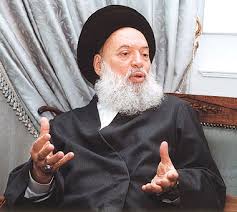
Ayatollah Fadlallah dies

Ayatollah Sayyid Muhammad Husayn Fadlallah has passed away in Beirut at the age of 74. He had been in poor health for some years, suffering from diabetes and heart problems. Fadlallah became famous (and, to his enemies, notorious) in the 1980s, for his role in channeling the message of Hezbollah to thinking young Shi’ites and to the world. He played a complex game, and it long fascinated me. I published a first short piece on him in 1985, and I explored him further in a 100-page study, finished in 1992 and accessible here.

In the years since I followed him, Fadlallah’s presence diminished. First, Hezbollah acquired a political leader, Sayyid Hasan Nasrallah, with a powerful presence of his own. Hezbollah became less reliant on Fadlallah, at least as a mobilizer within Lebanon. Second, Fadlallah drifted even further into the stratosphere of grand ayatollah-hood, well above party politics, including those of Hezbollah. Third, some rival Shi’ite clerics, especially in Iran, thought he was getting too big for his breeches, and worked to cut him down through nasty accusations of theological deviation. Fourth, the removal of Saddam Hussein from power breathed new life into the religious academies in Najaf in Iraq, and its clerics, such as Ayatollah Ali Sistani, again began to loom large among Arabic-speaking Shi’ites. Fifth, Fadlallah’s poor health began to drag him down. His forte had always been the pulpit sermon, delivered in a controlled but fiery style, but in recent years, there wasn’t much flicker in his performances.

He was a permanent stop on the circuit for foreign dignitaries, some of them pursuers of Islamist “moderation.” They would see him (after stringent security checks), get their photo taken with the wise man, and come away pondering his elliptical comments. Last year Jimmy Carter turned up (photo), much to the chagrin of the State Department, and Noam Chomsky paid his respects last May (photo). Within Lebanon, he built a substantial empire of charitable institutions such as schools and clinics, many of them funded by wealthy Shi’ites outside the country. The institutions will long outlive him.

When I first published on Fadlallah in 1985, I wouldn’t have put a nickel on his dying a natural death. That same year, he was the target of a car bombing that missed him and killed over eighty persons. But Fadlallah was an expert in planting seeds of doubt, and over the years he dropped off the hit lists of Hezbollah’s enemies. Still, without him, Hezbollah would have had a much tougher row to hoe in the early years. He wasn’t responsible, as far as I know, for any one act of violence, but he justified quite a few of them after the fact. Up until today, he was on the U.S. Treasury Department’s list of “specially designated nationals.”

Needless to say, when it came to Israel, he was uncompromising. I do think I treated him fairly and respectfully in my long study, and I made sure he received it—especially the subsequent Hebrew edition, which appeared as a monograph with his portrait on the cover. At the peak of his powers, he was truly formidable. It’s unlikely that Lebanon will be home to another figure quite like him again.
A Zero-Sum Game

This is Martin Kramer’s contribution to a roundtable on “Obama in the Mideast” organized by Lee Smith for Tablet Magazine. Other contributers: Elliott Abrams, Ramin Ahmadi, Andrew Exum, Dore Gold, Robert Malley, Lokman Slim, and Jacob Weisberg. Read in full here and here.

“Power is no longer a zero-sum game. No one nation can or should try to dominate another nation. No world order that elevates one nation or group of people over another will succeed. No balance of power among nations will hold.” Thus spoke Barack Obama to the U.N. General Assembly last September. This must rank with George W. Bush’s “bring ’em on” as an invitation to America’s adversaries to defy it. Bush later expressed regret that he said his words, noting that “in certain parts of the world they were misinterpreted.” Obama likewise may rue having spoken his.

In the Middle East, power is a zero-sum game, domination by a benevolent hegemon creates order, and the regional balance of power is the foundation of peace. It’s the pax Americana, and while it may be stressful to uphold it, the alternative is more stressful still. And as the impression of American power wanes, we are getting a foretaste of “post-American” disorder. A struggle has begun among the middle powers—Iran, Turkey, and Israel—to fill the vacuum. Iran floods Lebanon with rockets, Turkey sends a flotilla to Gaza, Israel sends an assassination squad to Dubai—these are all the signs of an accelerating regional cold war. Each middle power seeks to demonstrate its reach, around, above, and behind the fading superpower.

The response in Washington is to huff and puff, imposing settlement “freezes” and “crippling” sanctions. This is the illusion of power, not its substance. The Obama Administration is bringing the United States out of the Middle East, to a position from which it believes it can “contain” threats with diplomacy, deterrence, and drones. As the United States decamps, its allies will feel insecure, its enemies emboldened. The Middle East’s stress test has begun.

Obama’s Mideast priorities

On April 22, I appeared on a panel organized by The Washington Institute for Near East Policy, entitled “The Obama Administration and the Middle East: Setting Priorities, Taking Action.” Fellow panelists: Thomas Friedman, William Kristol, and David Makovsky. The proceedings have just been published, and they can be downloaded here. Below, my initial statement; go to the full proceedings for more.

I’m at a distinct advantage because I’m on a panel with partisan journalists, and I’m an academic. I’m entirely objective. [Laughter.] And I’m interested very much in ideas. You see, I don’t have any sources whispering in my ear. I just have to read texts and what people say and reach my best understanding of them.

This has been an interesting conference because we’ve heard a lot of reassurances, especially from General [Jim] Jones last night, that all of the administration’s priorities are in proper alignment. And I don’t want to question anyone’s good faith, but the fact is there are a lot of mixed messages coming out of this administration. And no one really knows whether this mixing reflects a clever strategy or is just a sign of confusion.

President Obama himself does it. A good example was his visit to Israel during the presidential campaign back in mid-2008. While in Sderot, he said, “A nuclear Iran would be a game-changing situation, not just in the Middle East but around the world. Whatever remains of our nuclear non- proliferation framework I think would begin to disintegrate.” That was a very powerful statement. And I call that “Obama 1.0.” We heard echoes of it last night in General Jones’s speech as well.

But then Obama, on the same trip, went off to Jordan and met with King Abdullah. And he came back and appeared on Meet the Press, where he said the following:

I think King Abdullah of Jordan is as savvy an analyst of the region and player in the region as there is. And one of the points he made and that I think a lot of people made is that we’ve got to have an overarching strategy recognizing that all these issues are connected.

If we can solve the Israeli-Palestinian process, then that will make it easier for Arab states and the Gulf states to support us when it comes to issues like Iraq and Afghanistan. It will also weaken Iran, which has been using Hamas and Hizballah as a way to stir up mischief in the region. If we’ve gotten an Israeli-Palestinian peace deal, maybe at the same time peeling Syria out of the Iranian orbit, that makes it easier to isolate Iran so that they have a tougher time developing a nuclear weapon.

Ladies and gentlemen, that is the Obama policy formulated then, down to the letter. And I call it “Obama 2.0” because look at the shift that took place. The game-changer in the Middle East is no longer Iranian nuclear capabilities, but the peace process. This shift is one in which Iran essentially becomes subordinate to the peace process.

To my knowledge, Obama has not repeated the phrase “game-changing” since he made it in 2008 to describe the effect of Iranian nuclear weapons. In 2008, he said it was an extraordinary priority to stop Iran. Last month, he said it’s one of our highest priorities to make sure that Iran doesn’t possess a nuclear weapon. And the other day, Adm. Mike Mullen said that Iran has been a priority of this administration from the outset. So stopping Iran has gone from being an extraordinary priority to one of our highest priorities to a priority.

And then Bill [Kristol] had a very interesting piece the other day—I see it in front of him—about Admiral Mullen saying the following: “Iran getting a nuclear weapon would be incredibly destabilizing. Attacking them would also create the same kind of outcome.” Now, obviously, if the outcome from doing something and from doing nothing is the same, that’s a pretty powerful argument for doing nothing. But of course, it isn’t the same outcome. I’ll leave it to Bill to explain, perhaps, why this is what he has called a false equivalence—unless you’ve decided that a nuclear Iran is not a game-changer, but instead just a really big hassle.

Now, I admired Obama 1.0 for what I thought was a very clear-sighted vision. A nuclear Iran does change the game for the Middle East and for the world, as he said. Obama 2.0 seems to me very confused about priorities. And that’s because an Israeli-Palestinian deal, for whatever merits it has and whatever limitations it’s obviously going to have, doesn’t change the game. It rearranges the pieces on the board, possibly to give one a slight advantage.

For example, the spat over housing in Jerusalem looks to me like something totally out of proportion. Excuse me for saying so, but the controversy over Ramat Shlomo—1,600 building units in Jerusalem—made Obama look like the captain of a ship rearranging 1,600 deck chairs on a vessel headed straight toward an iceberg. And that’s how I would describe the first year of the Obama administration. We’re on a ship. The iceberg is straight ahead. Everyone can see it. And the administration has been busy rearranging the deck chairs. [Applause.]