Chas Freeman and 9/11

How important has resentment of Israel been to Al Qaeda’s terrorism? Here is one side of the argument, by an American who knows Saudi Arabia well:

The heart of the poison is the Israel-Palestinian conundrum. When I was in Saudi Arabia, I was told by Saudi friends that on Saudi TV there were three terrorists who came out and spoke. Essentially the story they told was that they had been recruited to fight for the Palestinians against the Israelis, but that once in the training camp, their trainers gradually shifted their focus away from the Israelis to the monarchy in Saudi Arabia and to the United States. So the recruitment of terrorists has a great deal to do with the animus that arises from that continuing and worsening situation.

And here is the opposing view, by an American who knows the Kingdom equally well:

Mr. bin Laden’s principal point, in pursuing this campaign of violence against the United States, has nothing to do with Israel. It has to do with the American military presence in Saudi Arabia, in connection with the Iran-Iraq issue. No doubt the question of American relations with Israel adds to the emotional heat of his opposition and adds to his appeal in the region. But this is not his main point.

So now you’ve heard two sides of the debate. Who made the first statement? Charles “Chas” Freeman, former U.S. ambassador to Saudi Arabia and the Obama administration’s nominee to head the National Intelligence Council (NIC). Who made the second statement? Charles “Chas” Freeman, former U.S. ambassador to Saudi Arabia and the Obama administration’s nominee to head the National Intelligence Council (NIC).

The first quote dates from January 2004, the second from October 1998. The difference between them is 9/11, when it became the Saudi line to point to Israel’s conflict with the Palestinians as the “root cause” of the September 11 attacks. The initial promoter of this approach in the United States (well before Walt and Mearsheimer) was Saudi billionaire Prince Alwaleed. “At times like this one,” Alwaleed announced a month after 9/11, “we must address some of the issues that led to such a criminal attack. I believe the government of the United States of America should re-examine its policies in the Middle East and adopt a more balanced stance towards the Palestinian cause.” That statement led then-mayor of New York Rudy Giuliani to return a $10 million check Alwaleed had just presented to him for a special “Twin Towers” relief fund.

Since 9/11 Freeman hasn’t repeated his 1998 assessment (“nothing to do with Israel”), instead sticking with his Saudi-pleasing spin of 2004 (“the heart of the poison is the Israel-Palestinian conundrum”). It’s not hard to figure out why. When the 9/11 Commission interviewed him in 2003, it noted that his position as president of the Middle East Policy Council “requires regular trips to the Persian Gulf for fundraising. While there, he meets with many senior Saudi officials.” In 2006, Freeman finally went the extra mile, offering this explanation for 9/11:

We have paid heavily and often in treasure for our unflinching support and unstinting subsidies of Israel’s approach to managing its relations with the Arabs. Five years ago, we began to pay with the blood of our citizens here at home.

Freeman was now touting precisely the sort of nonsense he had previously dismissed out of hand. And he hit paydirt for doing it: within months, Prince Alwaleed wrote a check to Freeman’s Middle East Policy Council for $1 million. Here is a photo of Freeman, supplicant, visiting Alwaleed in the latter’s Riyadh HQ.

Does Freeman really believe that Israel’s actions caused Bin Laden’s terror? Who knows? He’s put forward two completely contradictory explanations. One would like to believe that in his heart of hearts, he still knows what he knew in 1998, that Bin Laden’s “campaign of violence against the United States, has nothing to do with Israel.” One would like to believe that in 2006, he was cynically shilling for the Saudis when he blamed 9/11 on “our unflinching support and unstinting subsidies of Israel’s approach.” Because if he wasn’t just cynically shilling, he’s gone off the rails. (Actually, there is a third Freeman explanation for 9/11, so bizarre that I don’t know quite how to categorize it. Parse this: “What 9/11 showed is that if we bomb people, they bomb back.”)

If Freeman’s gone off the rails, he obviously shouldn’t be taken out of mothballs to coordinate U.S. intelligence. But that’s so even if he was just cynically shilling. “An ambassador,” said Sir Henry Wotton, “is an honest man sent abroad to lie for his country.” In America, an ex-ambassador is all too often an honest man hired from abroad to lie to his own country. Freeman may have an impeccable record of past service, just as his old buddies attest. But if the National Intelligence Council and its products are to earn the respect of the American people, the NIC chair cannot be suspected of ever having deliberately twisted the truth into something else for our consumption, especially on a crucial issue of national security and at the behest of foreign interests.

Chas Freeman doesn’t pass that test.

Update, March 9: Some have argued that the two opening quotes in this post are actually consistent with one another. So I offer the full context of the first quote from 1998, which demonstrates that on that occasion, Freeman was actively deflecting the thesis that Bin Laden’s appeal rested on Israel and U.S. support for it. He was chairing a panel, and a member of the audience asked a question.

Q: I’m astonished that nobody has mentioned the name Osama bin Laden. And it astonishes me also that we do nothing, apparently, to indicate that we are not a colony of Israel, when his whole appeal depends on demonstrating and reminding Muslims the world over that the United States is identified with Israel. If we do not develop a firm disagreement with Israel, we are going to suffer repeated casualties and deaths, including Foreign Service personnel.

AMB. FREEMAN: Perhaps I could begin by saying that Mr. Osama bin Laden is a renegade from his family and from Saudi Arabia; his family has disowned him, and the kingdom has certainly dissociated itself from him. Mr. bin Laden’s principal point, in pursuing this campaign of violence against the United States, has nothing to do with Israel. It has to do with the American military presence in Saudi Arabia, in connection with the Iran-Iraq issue. No doubt the question of American relations with Israel adds to the emotional heat of his opposition and adds to his appeal in the region. But this is not his main point.

So Freeman was actively deflecting an argument he himself would later make. It is interesting that this one-time-only absolution of Israel occurred while Freeman was playing host to a panel featuring Martin Indyk, at the time Assistant Secretary of State for Near East Affairs. Maybe that explains it.

Pointer: See subsequent post, Chas Freeman and preemptive cringe.

Update, late afternoon, March 10: “Director of National Intelligence Dennis C. Blair announced today that Ambassador Charles W. Freeman Jr. has requested that his selection to be Chairman of the National Intelligence Council not proceed. Director Blair accepted Ambassador Freeman’s decision with regret.”

Southwest Asia

The appointment of Dennis Ross as “Special Advisor to the Secretary of State for The Gulf and Southwest Asia” (announcement here) has caused some puzzlement, in part because the geographic focus of his title seems fuzzy. This is especially so for “Southwest Asia.”

On the face of it, “Southwest Asia” looks like a geographic reference, and it has always had a few enthusiasts among geographers. It’s also been favored by those who deem it less Eurocentric than “Middle East” or “Near East.” (Maybe it is, but since Asia as a continent is a European idea, calling any region “Southwest Asia” hardly solves the problem.) Once there was even a maverick academic program, at SUNY Binghamton, called the Program in Southwest Asian and North African Studies (SWANA for short). But “Southwest Asia” got no traction in American academe, and even the SUNY program eventually swapped SWANA for MENA (Middle East and North Africa).

So when did “Southwest Asia” finally get its big break, and begin to turn up in high places as a near-synonym for the Middle East? “From the moment of the Soviet invasion of Afghanistan in December 1979,” wrote U.S. diplomat and strategist John C. Campbell, “Washington began to talk of ‘Southwest Asia’ instead of the Middle East as the area of crisis and of American concern.” Cold War strategists wished to emphasize that the region was crucial not because it was east of us, but because it was immediately southwest of the Soviet Union, which had a plan to push through to the Indian Ocean and the Persian Gulf. The sooner Americans started thinking about the region as “Southwest Asia,” the sooner they would grasp the nature of the threat.

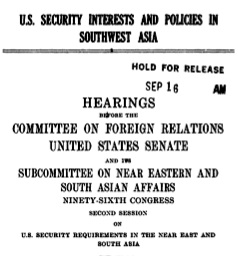
National Security Adviser Zbigniew Brzezinski effected the shift in labeling. Two days after the Soviet invasion, he warned President Jimmy Carter that “the collapse of the balance of power in Southwest Asia… could produce Soviet presence right down on the edge of the Arabian and Oman Gulfs.” Carter, reeling from the combined effects of the invasion and the Iran hostage crisis, opened a dramatic television address to the nation some days later with these words: “I come to you this evening to discuss important and rapidly changing circumstances in Southwest Asia.” Carter proceeded to warn Americans of “a threat of further Soviet expansion into neighboring countries in Southwest Asia.” A month later, the Senate Foreign Relations Committee jumped on board, and held a series of landmark hearings later published as “U.S. Security Interests and Policies in Southwest Asia.”

“A new name has been devised to cover these counties on which attention has been concentrated during the past 12 months,” wrote the military historian Sir Michael Howard in Foreign Affairs a year later. “Southwest Asia: Pakistan, Afghanistan, Iran, Iraq, and the oil-bearing states bordering what now must tactfully be termed simply ‘the Gulf,’ all constituting a politically seismic zone of incalculable explosive potential.” Campbell later gave a similar definition: “‘Southwest Asia’ includes everything from the eastern fringes of the Arab world to the western limits of the Indian subcontinent.” (Campbell also added that “roughly, it is Zbigniew Brzezinski’s ‘arc of crisis.'” Brzezinski had coined that phrase a year before the Soviet invasion, and it figured prominently in a January 1979 story in TIME magazine, whose cover showed a Soviet bear looming over the Persian Gulf. TIME explained that Brzezinski’s “arc of crisis” consisted of “the nations that stretch across the southern flank of the Soviet Union from the Indian subcontinent to Turkey, and southward through the Arabian Peninsula to the Horn of Africa.”)

This “Southwest Asia,” then, wasn’t a geographic reference at all, but a strategic one with a Cold War application. Not surprisingly, both the CIA and the Pentagon quickly picked up the term and ran with it. The CIA established a Southwest Asia Analytic Center, which produced papers like “The Soviets and the Tribes of Southwest Asia.” The Defense Department acted similarly, applying “Southwest Asia” (SWA) to a large area centered in the Gulf, but extending far beyond it. “Southwest Asia” is now the core of CENTCOM’s “Area of Responsibility” (AOR), which runs from Kazakhstan to Kenya.

Which brings us back to the Ross appointment at the State Department. “Southwest Asia” isn’t much used at State, which still prefers “Middle East” and hasn’t even given up entirely on “Near East.” (“Southwest Asia” is regularly used only in the Department’s Bureau of International Narcotics and Law Enforcement Affairs, where it includes Afghanistan, Pakistan, Bangladesh, Nepal, India, and Sri Lanka.) After the Ross announcement, journalists wanted to know exactly what Ross’s own area of responsibility covered. In particular, did it include Afghanistan and Pakistan, the original entry point to “Southwest Asia” of the Cold War strategists? Hadn’t responsibllity for both countries already been given to Richard Holbrooke, named only a month earlier as Special Representative for Afghanistan and Pakistan?

At first, even the acting State Department spokesman, Robert Wood, didn’t know just what “Southwest Asia” included, which made for an embarrassing exchange at the Department’s daily press briefing. (Question: “You guys named an envoy for Southwest Asia. I presume that you know what countries that includes.” Wood: “Yes. Of course, we know. I just—I don’t have the list to run off—you know, right off the top of my head here.”

But the next day, Wood had an answer:

MR. WOOD: Let me give you my best—our best read of this. From our standpoint, the countries that make up areas of the Gulf and Southwest Asia include Bahrain, Iran, Iraq, Kuwait, Oman, Qatar, Saudi Arabia, UAE, Yemen, and those are the countries.

QUESTION: Not—not Afghanistan and Pakistan?

MR. WOOD: Look, Ambassador Ross will look at the entire region, should he be asked to, including Afghanistan. But this is something that would be worked out. You were—you asked the question yesterday about Ambassador Holbrooke and whether there was going to be some kind of, I don’t know, conflict over who is working in—on that particular issues in that country.

Look, Ambassador Ross and Ambassador Holbrooke will work together where necessary if they need to, if there’s some kind of overlap. But that’s, in essence, the State Department’s geographical breakdown of Southwest Asia.

QUESTION: Okay. So it does not—it is not the same breakdown as the military uses?

MR. WOOD: No, the military uses a different breakdown, but I’d have to refer you to them for their specific breakdown.

QUESTION: So it doesn’t include Jordan? It doesn’t include—

MR. WOOD: I just gave you the breakdown as I—as the State Department breaks it down.

QUESTION: So if Ambassador Ross is special envoy—special advisor for Gulf and Southwest Asia, what is the difference between Gulf and Southwest Asia?

MR. WOOD: Look—

QUESTION: For me, this is Gulf.

MR. WOOD: Well, it may be for you. For others, it may be different. I’d have to—I’ve given you what the Department’s position is with regard to the geographic makeup of the region.

Why did the State Department construe “Southwest Asia” so narrowly—so much so that it really is indistinguishable from “The Gulf”? That’s a matter for speculation. One report says Ross did have Afghanistan and Pakistan on the list of countries he thought belonged in the package. Holbrooke reportedly insisted they both be dropped, and got his way.

But it’s already clear that last week added yet another layer of confusion to the terminology the United States inflicts on the region to suit its own political, diplomatic, and strategic requirements. There is a “Near East” and a “Middle East” and a “Greater Middle East” (GME) and a “Middle East and North Africa” (MENA) and a “Broader Middle East and North Africa” (BMENA). And now, alongside the Defense Department’s greater “Southwest Asia,” we have the lesser “Southwest Asia” of the State Department as scaled down for Ross. (This is not to be confused with the “Southwest Asia” of the State Department’s own Bureau of International Narcotics and Law Enforcement Affairs. Not a single country in that bureau’s “Southwest Asia” is identical to Ross’s.) Of course, labels tend to slip and slide across the map over time, depending on circumstance. It’s just remarkable to see them slip and slide at one time, in one building.

Meanwhile, in Iran, there is no confusion, only outrage that the appointment of Ross mentions “The Gulf,” as opposed to the Persian Gulf. Iran has waged a persistent campaign to keep the Persian adjective firmly fastened to the Gulf. But the Iranian government won’t take offense at Iran’s inclusion in “Southwest Asia”—to the contrary. Last year a leading Iranian journalist wrote a column entitled “There Is No Middle East.” The message:

The people of Southwest Asia and North Africa should not use the appellation Middle East to describe their home region because it was coined by European imperialists. The use of such non-indigenous terms only serves to reinforce mental slavery and subjugation…. The vocabulary that we use influences our thought patterns. If Muslims use Eurocentric vocabulary, even when speaking our own languages, it will undermine our sense of identity. A better substitute for the Middle East/North Africa would be Southwest Asia/North Africa, which could be abbreviated as SWANA.

Don’t Persians know that the naming of Asia is owed to… the Greeks?.

Reposted from Middle East Strategy at Harvard.

••

Below: Jimmy Carter delivers his January 4, 1980 televised address concerning the Soviet invasion of Afghanistan. (There is a brief preface on the Iran hostages.) His White House diary records this as an “Address to the Nation on the situation in Southwest Asia.” Notice the prop in the opening shot: a globe positioned so as to show the region. Toward the end of this segment, the camera pans across a map.

Gaza errors (or lies)

Henry Siegman, who must spend every waking hour hating Israel, has a piece in the London Review of Books, which is never complete without an Israel-bashing tirade. This one is called simply “Israel’s Lies.” Siegman spends a lot of time faulting Israel for the breakdown of the previous six-month cease-fire with Hamas, reached through Egyptian mediation in June 2008. In one passage, he accurately reports the quid pro quo of the cease-fire:

[The cease-fire] required both parties to refrain from violent action against the other. Hamas had to cease its rocket assaults and prevent the firing of rockets by other groups such as Islamic Jihad… and Israel had to put a stop to its targeted assassinations and military incursions.

Correct. But only a couple of paragraphs earlier, he set up the cease-fire as an entirely differently deal—and accused Israel of violating it:

Israel, not Hamas, violated the truce: Hamas undertook to stop firing rockets into Israel; in return, Israel was to ease its throttlehold on Gaza. In fact, during the truce, it tightened it further.

Therefore according to Siegman, Israel violated the cease-fire before Hamas fired a single rocket, by reneging on its supposed commitment to ease sanctions. Rashid Khalidi, writing in the New York Times, went even further: “Lifting the blockade,” he wrote, “along with a cessation of rocket fire, was one of the key terms of the June cease-fire between Israel and Hamas.” (My emphasis.)

None of this is true.

First of all, contra Khalidi, Israel did not agree to “lifting” of the “blockade,” only to easing it. At the time, the Economist reported the cease-fire thus (my emphasis):

The two sides agreed to start with three days of calm. If that holds, Israel will allow some construction materials and merchandise into Gaza, slightly easing an economic blockade that it has imposed since Hamas wrested control of the strip.

And Israel did just that: it slightly eased the sanctions on some construction materials and merchandise. Siegman falsely claims that Israel “tightened” its “throttlehold” on Gaza after the cease-fire, and that this is confirmed by “every neutral international observer and NGO.” Untrue. The numbers refuting him appear in the last PalTrade (Palestine Trade Center) report on the Gaza terminals, published on November 19, as part of its “Cargo Movement and Access Monitoring and Reporting Project.” The report says the following (my emphasis):

Following the announcement of the truce ‘hudna’ on June 19, 2008 and took effect on June 22, a slight improvement occurred in terms of terminals operation times, types of goods, and truckloads volume that [Israel] allowed to enter Gaza Strip.

This is exactly what Israel had agreed to permit. Here is the table from the PalTrade report, comparing average monthly imports before the Hamas coup (June 12, 2007), between the coup and the “truce,” and then after (i.e., during) the “truce” (through October 31). (If you can’t see the table below, click here).

As is obvious from this table, Israel did ease sanctions during the cease-fire. The average number of truckloads per month entering Gaza during the cease-fire rose by 50 percent over the period before the cease-fire, and Israel also allowed the import of some aggregates and cement, formerly prohibited. (No metal allowed, of course—it’s used to make rockets.) Israel did not allow more fuel, but the PalTrade report notes that fuel brought from Egypt through the tunnels “somewhat made up the deficit of fuel that entered through Nahal Oz entry point.” (For Israel’s own day-by-day, crossing-by-crossing account of what went into Gaza during the cease-fire, go here. This account also puts the increase of merchandise entering Gaza at 50 percent.)

Why do the Khalidi and Siegman errors (or lies, if made knowingly) matter now? If you believe Khalidi’s claim that the last cease-fire included “lifting the blockade,” you might say: why shouldn’t Israel agree to lift it in this one? Or if you believe Siegman’s claim that Israel tightened the sanctions at the crossings during the cease-fire, you might say: Israel shortchanged the Palestinians once, so the next deal on the crossings has to have international guarantees. But in both cases, you’d be relying on entirely bogus claims.

Israel has a compelling strategic reason to keep the sanctions in place. (I say sanctions and not blockade, because Israel doesn’t control the Egyptian-Gazan border, and so cannot impose a true blockade.) Israel’s sanctions are meant to squeeze the “resistance” out of the Hamas regime—and, if possible, to break its monopoly on power in Gaza. Unless these goals are met, at least in part, it’s lights-out for any peace process. And as long as sanctions don’t create extreme humanitarian crises—as opposed to hardships—they’re a perfectly legitimate tool. It was sanctions that ended apartheid in South Africa, kept Saddam from reconstituting his WMD programs, got Qadhafi to give up his WMD, and might (hope against hope) stop Iran’s nuclear program.

Hamas owes everything not to its feeble “resistance,” but to the tendency of the weak of will or mind to throw it lifelines. It’s now demanding that the sanctions be lifted, and the usual chorus is echoing the cynical claims of a tyrannical and terrorist regime that shows no mercy toward its opponents, Israeli or Palestinian. Supporters of peace shouldn’t acquiesce in another bailout of its worst enemy. It’s time to break the cycle, and make it clear beyond doubt that the Hamas bubble has burst. The way to do that is to keep the sanctions in place.