In his memoirs, Bernard Lewis, the late, great historian of the Middle East (and my mentor), wrote this:
I had occasional encounters with the historic process through meetings which made policy. Over the years, in my innumerable visits to the Middle East I had meetings with kings, presidents, prime ministers, other high officials, as well as with ambassadors of different states. We talked of various things, and from time to time I gave my opinions—sometimes in response to a request, sometimes not.
In a new lecture (delivered at Tel Aviv University), I put flesh to the bare bones of this statement. I name some of those kings, presidents, prime ministers, and other high officials; reconstruct a few of Lewis’s interactions with them and put them in context; and, finally, ask whether they made any difference.
Some of the central players in the story: Israeli prime minister Golda Meir, American politician Henry “Scoop” Jackson, Mohammed Reza Shah of Iran, Turkish president Turgut Özal, former Jordanian crown prince Hassan, U.S. vice-president Dick Cheney and president George Bush, Libyan dictator Mu‘ammar Qadhafi, and Israeli prime minister Benjamin Netanyahu. I also treat the much-discussed matter of Lewis and the Iraq war. To watch the lecture, click hereor watch below (one hour, illustrated).
As I said in the lecture, this is a work in progress. If you have any information that fills a gap in my presentation, please send it along.
Israel is celebrating its 75th birthday. Many have noted the cloud over this anniversary. The Associated Press ran its story on Israel’s Independence Day under this headline: “A deeply divided Israel limps toward its 75th birthday.” The New York Times led with this headline: “Political chaos unsettles Israel as it looks to honor the fallen and its independence.”
To put this in perspective, I’d like to recall another anniversary that I witnessed, and that took place under a cloudless sky.
Fifty years ago, in 1973, I’d been living in Israel with my parents and brothers for nearly two years. In May, Israel was set to celebrate its “silver” 25th anniversary. Israel’s self-confidence at that moment couldn’t have been higher. Its smashing victory of June 1967 was still fresh in the collective memory. Israel sat astride the Middle East like a colossus, from the Suez Canal in the south, to the outskirts of Damascus in the north. The country was booming: in every year since 1969, per capita income had grown by 20 percent.
The leaders of the day, who included Prime Minister Golda Meir and Defense Minister Moshe Dayan, decided that the best way to mark Israel’s 25th anniversary would be a giant military parade in Jerusalem.
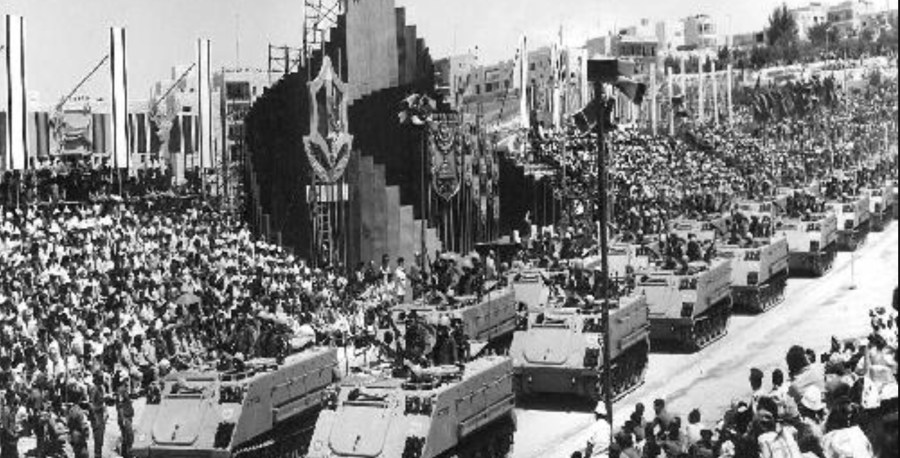
My father, who was a resourceful man, managed to get us tickets to the main reviewing stand. So I sat with my family on that glorious day, watching the full might of Israel unfold before 300,000 spectators.
Thousands of soldiers marched by, from every branch of the military. Tanks and armored personnel carriers rumbled before us, spewing smoke as their tracks rattled over the asphalt. (Some of those tanks were Soviet, captured in 1967 from Arab armies.) Fighter jets and attack helicopters roared overhead in perfect formation. In the main reviewing stand were not just the leaders of Israel, but the surviving founders of this tiny superpower—most notably, David Ben-Gurion, the Old Man himself, then 86.
It’s a day I’ll never forget: a day of unsurpassed pride in the power of Israel.
Highlights of the 1973 military parade in Jerusalem.
And also, as we would learn, a day of unsurpassed hubris. No one in that crowd imagined that five months later, Israel would be plunged into a desperate struggle for survival. On the next Yom Kippur day, October 6, the armies of Egypt and Syria launched a combined surprise attack on Israel. Israel’s flexing of its muscles hadn’t deterred them at all.
Israel survived that war, but the country was shaken to its foundations. Israelis had been arrogant in thinking themselves invincible. Their leaders had been wrong to dismiss the resolve and the capabilities of the Arabs. And Israel had paid a terrible price: almost 2,700 dead and more than 7,200 injured, thousands of them permanently incapacitated and maimed. They included many who had paraded in Jerusalem only months earlier.
The war also brought down a political elite that had run the country since independence, including both Golda Meir and Dayan. It marked the beginning of the end for the Labor Party. And there would never be a military parade on Independence Day again.
Why do I tell this story now? Israel has the most to fear not from doubt, but from hubris. An Israel that questions itself has a better chance than an Israel that puffs with pride. An Israel that looks strong on the outside can conceal weakness within. But an Israel that fearlessly probes its weaknesses can emerge stronger.
So I’m actually reassured by the apprehensive and pensive mood on this 75th anniversary. Israel has so much to celebrate. We owe it to our children and grandchildren to explain the inexplicable: how a tormented people rose from the slag heap of history, and rebuilt itself as an independent state and a prosperous nation, against all the odds. Along the way, it welcomed millions of refugees, defeated and made peace with enemies, and became a military and economic powerhouse.
But Israelis must also remain vigilant. That not only means standing up to enemies, but questioning the judgment of their own elected politicians. The leaders I saw in the reviewing stand on that day in 1973 had been in power for a long time, and thought they shouldn’t be doubted. The leaders of today’s Israel have been in power a long time, and think the same. The duty of citizens doesn’t end with elections. Perpetual vigilance is crucial, because as we discovered fifty years ago, even the most seasoned statesmen and politicians can make tragic mistakes.
Happy birthday, Israel!
If you never watched it, this is a great time to view my seven-part lecture series on Israel’s Declaration of Independence, at this link.
Header image: From the 1973 parade, Central Zionist Archives, PHKH/128915.
You shouldn’t feel guilty if you’ve found the crisis in Israel confusing. How many votes should the Knesset need to override the Supreme Court? Who should sit on the appointments panel for judges? Some American Jews have dived into these debates, weighing in for this side or that. What self-respecting Jewish lawyer could resist kibbitzing on these questions? It’s been a field day for Alan Dershowitz, and all the people who want to be the next Alan Dershowitz.
You needn’t bother with these details, because it’s simpler than that. In eleven minutes, I explain the real reasons for the crisis, and point to a text that can help resolve it. This is an excerpt from a webinar jointly sponsored by the Association for the Study of the Middle East and Africa (ASMEA) and Scholars for Peace in the Middle East (SPME). At this link or below.

 Martin Kramer on the Middle East
You must be logged in to post a comment.