Martyrs get tenure at Columbia?

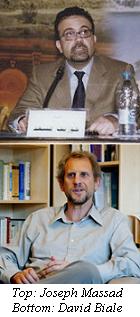
Yesterday the press reported that Columbia University has promoted Joseph Massad to associate professor. Massad, a Palestinian extremist and protégé of the late Edward Said, was the prime culprit in last year’s student abuse scandal. His most famous contribution to the store of human knowledge is his ingenious discovery that Zionism isn’t just racism, it’s antisemitism. Read his latest excretion, a review of Steven Spielberg’s Munich, and ask yourself how in the world Columbia entrusted him to teach the Israeli-Palestinian conflict. If Edward Said hadn’t been pulling all the strings on Morningside Heights, Massad probably would have ended up teaching in a community college. Now he’s one step away from tenure at a leading university.

If he’s ultimately tenured, who will bear the responsibility? In December, David Biale, Emanuel Ringelblum Professor of Jewish History at University of California Davis, published an article on campus controversies in J., a Jewish newspaper based in San Francisco. I don’t have the patience to rebut every claim or factual error in this text; Professor Biale really should stick to Jewish history. But there’s one claim that relates to Massad’s tenure, and that demands elucidation. Professor Biale writes:

When Palestinian professor Joseph Massad at Columbia University addressed an Israeli student in a fashion that certainly deserved censure, those eager to find an anti-Semitic conspiracy ended up turning him into a martyr and guaranteeing him tenure. Colleagues at Columbia have told me that their prior doubts about this instructor were drowned out by the din of external propaganda.

This is a very serious charge—not against the makers of “external propaganda,” but against Columbia University. If Professor Biale believes that mere “martyrdom” is sufficient to get someone tenure at Columbia—that Columbia, like Hamas, puts shahids on a permanent pedestal—he should step forward immediately to deplore Columbia for betraying the basic principles of academic integrity. I propose he begin by announcing publicly that he won’t lend his name to any appointment or promotion procedure at Columbia. He should urge others to do the same.

However, yesterday’s report indicated that Massad’s tenure isn’t guaranteed, which means that it may not be too late to block him. If Professor Biale and his “colleagues at Columbia” relieve me of the responsibility of making the case against Massad, I’ll be glad to defer to them. I merely await their explicit assurance. I’m particularly eager to learn who these “colleagues” are, and what sort of “doubts” they’re willing to express.

Should they not have the courage to step forward, preferring to stay securely locked behind their office doors, they should keep silent about “external propaganda.” It will be the only thing standing between Massad and tenure. I’m quite willing to conduct it, and I’ll expect Professor Biale’s tacit support.

Update: David Bernstein (The Volokh Conspiracy and a law prof at George Mason) thinks I don’t give enough credit to community colleges: “I can’t imagine any self-respecting community college would give [Massad] a job.” He’s probably right.

Bernstein has gone back to Massad’s review of Munich, which compares Spielberg’s latest to the film Exodus:

Here is how Massad describes [Exodus‘s] plot: “Exodus tells the story of the Zionist hijacking of a ship from Cyprus to Palestine by a Zionist Haganah commander.” This is analogous to saying that Schindler’s List was a movie about Jews taking a working vacation in Poland.

We’re all familiar with Holocaust denial; no respectable university would hire a Holocaust denier for its faculty. So why would any elite university like Columbia retain, much less promote, someone who similarly intentionally falsifies Jewish history (indeed, in this case, the history of Holocaust survivors) for political ends?

I think this is a perfect opportunity for Professor Biale to show a bit of grit. I urge him to come forward with an authoritative critique of Massad’s distortions of Jewish history. Isn’t this precisely why he was tenured (and chaired)? To counter falsehood with truth? As Professor Biale teaches the Holocaust, he has a unique responsibility, and far more authority than any blogger. (Read his many credentials.) Come forward!

Danish cartoons: a proposal

National Review Online asked me and others for short contributions to a symposium on the Danish cartoon controversy. They didn’t use mine for whatever reason (maybe it was the tongue-in-cheek proposal at the end), so I offer it below.

There are excitable mobs in every great Muslim city, and the Danish cartoons have given them an excuse for riot and pillage. But is there more to it than that? Who is playing the role that Ayatollah Khomeini played in the Rushdie affair, fanning the flames in specific directions?
Seek the answer in the palaces, not the streets. Some Muslim governments have come under intense pressure from the Transatlantic alliance. They have reacted by seeking to drive a wedge between the United States and Europe. Iran needs a divided West to avoid sanctions over its nuclear program. Syria needs it to escape accountability for the Hariri assassination. Hamas and its Muslim Brotherhood allies need it to break an embargo of the new Hamas principality. Egypt and Saudi Arabia need it to escape Western demands for reform.

Since the United States refuses to be intimidated, the focus has been on Europe. And for embattled regimes, the cartoon affair has been an Allah-send. The palace-dwellers aren’t interested in Danish apologies or expressions of media regret. They want to be paid off in political coin for dousing the fire. Until they are, Danish and other embassies will burn. Syria and Iran especially need a Europe cowed into meek submission, which may be why the worst violence rocked Damascus and Beirut.

Europe must stand firm and united, lest it become a tributary of despots and fanatics. European states should close their embassies in Damascus and Beirut, in solidarity with the Danes. The Danish government should emulate Iranian President Mahmoud Ahmadinejad. Under fire for his Holocaust remarks, he announced Iran would convene a conference to delve into the historicity of the Nazi genocide. Denmark should offer to convene a conference in Copenhagen, comparing histories of religious tolerance and free speech. For the main event, I propose a disputation between Sheikh Yusuf al-Qaradawi and Christopher Hitchens. May the best civilization win.

Update: The French scholar of Islamism, Olivier Roy, has reached the identical conclusion: “Il est évident que ces manifestations sont entièrement manipulées par les autorités.” Full interview here.

Why Hamas?

The Boston Globe runs an important story by Thanassis Cambanis, co-chief of the newspaper’s Middle East bureau, on why so many observers wrongly predicted that Fatah would beat Hamas. Cambanis points to one factor I emphasized in an earlier Sandbox entry: the misleading opinion polls conducted by Palestinian pollster Khalil Shikaki. According to Cambanis, Shikaki and the much-quoted Bir Zeit University profs

work closely with foreign academics (and indeed many were trained in the West) and frequently confer with Israeli colleagues and international NGOs. Perhaps because of the cosmopolitan, secular milieu in which they operate, many of them have underplayed the emergence in the last decade of a potent strain of Islamism growing in popularity among the public they study.

More broadly, Cambanis points to “the tendency of the largely secular Palestinian elite to underestimate the strength of Islamism. Influential Palestinian analysts predicted that Hamas could never win a majority, because its extremist religious views–and its commitment to unending war with Israel–would not resonate with the Palestinian public.”

Cambanis now questions the post-election spin offered by this very same elite, who argue that the Hamas victory is primarily an anti-corruption protest–that Hamas prevailed despite its Islamist platform. “I think most people don’t expect Hamas to create an Islamic state,” Shikaki is quoted as saying. But Cambanis watched the campaign run by Hamas, and he thinks it wasn’t about Fatah corruption at all. It was about the virtue of Islam as a moral and social order. The headline of his article: “A Vote for Islam.”

An important and largely overlooked poll confirms the impression that secularism has been vastly eroded in the Palestinian territories (as well as in Egypt and Jordan). The Center for Strategic Studies at the University of Jordan in Amman published the results a year ago, under the title: “Revisiting the Arab Street: Research from Within.” The pollsters drew all sorts of dubious conclusions from their data (I visited the center last spring and heard them first-hand). But one set of findings was impossible to spin, and should have constituted a flashing red light.

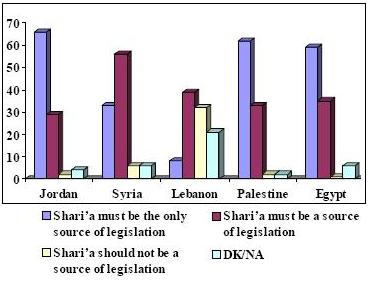
The pollsters asked Muslim respondents what role Islamic law, the shari’a, should play in legislation. The results were astonishing:

Asked whether Shari’a should be the only source of legislation, one of the sources of legislation, or not be a source of legislation, most Muslims believed it should at least be a source of legislation. Support was particularly strong in Jordan, Palestine, and Egypt, where approximately two-thirds of Muslim respondents stated that the Shari’a must be the only source of legislation; while the remaining third believed that it must be “one of the sources of legislation.” By comparison, in Lebanon and Syria, a majority (nearly two thirds in Lebanon and just over half in Syria) favored the view that Shari’a must be one of the sources of legislation.


Even more remarkable, responses didn’t vary with level of education: “Pooled data from Jordan, Palestine, Lebanon, and Egypt indicate that 58% of respondents with low education, 59% of those with moderate education, and 56% with higher education believe that Shari’a must be the o source of legislation in their countries.”

This is the force driving the Islamist surge across the region, and it’s why Islamists will carry any free and open election. The call for shari’a is the prime marker of Islamism, and if two-thirds of any public desire it, an astute campaign by an Islamist party can readily translate this into ballots. Shari’a allegiance may be an even more reliable indicator of voting behavior than straightforward questions about voting preferences.

It’s also why I think Shikaki is wrong when he declares that “most people don’t expect Hamas to create an Islamic state.” That’s a hope, not an analysis. Hamas would have strong and broad support for Islamizing Palestinian law. If it can’t immediately implement its program for eradicating Israel, it can certainly tap into the great majority who believe that the shari’a is the solution to the social ills fostered by unbelief.

Palestinian intellectuals, having misled us (and themselves) over the strength of the Islamist trend, would now confuse us about its nature. It’s time for them to stop spinning and start fighting back. If they don’t, their few freedoms may well fall by the wayside, regardless of whether Hamas reaches a modus vivendi with Israel.