Koran, Qur’an, and orientalism

I’ve gotten used to reading calumnies against orientalists, so nothing much surprises me. But I was taken aback when I read this, in a press article about whether one should write Koran or Qur’an:

Jane I. Smith, Islamic studies professor and co-director of the Hartford (Conn.) Seminary’s Duncan Black Macdonald Center for the Study of Islam and Christian-Muslim Relations, said: “The more appropriate transliteration is Qur’an rather than Koran, Muhammad rather than Mohammad or Mohammed, and Muslims rather than Moslems. In each case, the less-desirable spelling is associated with Orientalism, which we all want to avoid.”

In the world of scholars, “Orientalism” refers to negative prejudicial attitudes people of the West hold about people of the East.

In the world of scholars, perhaps they’ve forgotten that orientalists were also scholars. And let there be no doubt: the scholars who first advocated and established the scientific transliteration of Arabic proudly called themselves orientalists. Orientalists were the first to prefer Qur’an to Koran, favoring philological exactitude over common and convenient usage. That’s why I too prefer Qur’an. Even so, the spelling Koran hasn’t any association with “negative prejudicial attitudes.” If it has, then why did Edward Said prefer it in his book Orientalism? Jane I. Smith is just blowing out nonsense, by suggesting there’s some political or moral virtue in a choice of spelling. In this case, there isn’t.

(As an aside, the spelling Koran was an advance on its medieval Latin predecessor, Alcoran. Europeans who didn’t know Arabic didn’t realize that “Al” simply meant “the,” and so they usually referred to “the Alcoran” or “L’Alcoran,” right into the eighteenth century. In English, George Sale’s influential translation of 1734 established Koran in preference to Alcoran. The title of that translation: The Koran, Commonly called The Alcoran of Mohammed.)

So, dear readers, you may safely write Koran, without being tainted by orientalism which, as Jane I. Smith ominously warns us, “we all want to avoid.” It’s not like dropping one down the toilet.

(But do see this parody: “Muslims Riot Over Spelling of ‘Koran’ in U.S. Media.”)
Good news and bad news

I’m back from London and the conference at Chatham House devoted to the question: “Is Islam a Threat to the West?” The good news, in case you’re worried about losing the clash of civilizations, is that the assembled experts answered the question with a resounding “no!” The bad news that there still exists a dire threat to the West. It’s posed by America. I simplify, but that was the general tenor of the deliberations: in the blame game, the United States incurred the most fouls. I did what I could to balance the score (and got thanked by someone from the U.S. embassy for my troubles). But it was a lopsided contest.

Fred Halliday and I had a civil exchange; when the summary of remarks is released by the organizers, I’ll post it. Avid readers of this site may know that Halliday is the author of a scathing review essay of my book Ivory Towers on Sand (an essay that appeared in Chatham House’s journal, International Affairs). He’s obviously misguided, and I’ve promised him that I’ll set him straight when it suits me. But I’ve no problem appearing with Fred or debating him. Why not?

So I was amused to hear him tell the audience that Edward Said once attended a conference at Chatham House and demonstratively left the hall when it came Halliday’s turn to speak. Why? Halliday had made a (rather mild) critique of Said in an essay on the orientalism debate. Christopher Hitchens once wrote of Said that he was “famously thin-skinned” and “had a vivid tendency to take any demurral as a personal affront.” This character trait had the neat effect of keeping acolytes in line. Hitchens adds that “it can be admirable in a way to go through life with one skin too few, to be easily agonized and upset and offended.” I fail to see anything admirable in it at all, and it’s too bad the same tendency has infected so many of Said’s disciples. To whom I say: give me your best shot, and I’ll give you mine. No hard feelings.

The star of the show was Tariq Ramadan. He’s the Geneva-based thinker, named to a chair by the University of Notre Dame, whose visa got yanked by Homeland Security only days before his departure for South Bend. Ramadan is persuasive, subtle, and disarming, and it’s easy to see how some might see him as a great threat, and others as a great promise. I’ve nothing to add to the debate about him, and I’ll just repeat the allusion I made to his case in my own remarks:

Don’t be misled by the affair of Tariq Ramadan. His exclusion from the United States has led some observers to think that the administration has set the bar for Islamic moderation impossibly high. But the Ramadan affair was governed by a very peculiar set of U.S. domestic and French circumstances. In fact, in the Middle East, the administration keeps setting the bar for Islamic moderation lower and lower. Today the Da’wa party in Iraq gets a pass, tomorrow it might be the Muslim Brotherhood in Egypt, and the day after, it could be Hamas and Hizbullah.

And that was my key point. Not only does Washington not see Islam as a threat. It doesn’t see Islamism as a threat either, and some of my friends, backed into the democracy cul de sac, are talking about it as a solution. Some ideas never die.

Update: Here is a rapporteur’s detailed summary (pdf) of our debate and the discussion that followed.

Is Islam a threat to the West?

That’s the title of a conference I’ll be attending this week, organized by the Royal Institute of International Affairs (Chatham House) in London, in partnership with the Khayami Foundation. Among the notable speakers: Euro-Islamist Tariq Ramadan and Iranian reformer Abdolkarim Soroush. I’m paired with Fred Halliday, who teaches international relations at the London School of Economics. Halliday and I last “debated” back in the 1990s, in a plenary session of Britain’s Middle East studies society. Since then we’ve traded a few blows, so I’m looking forward to the event. Here’s the program.

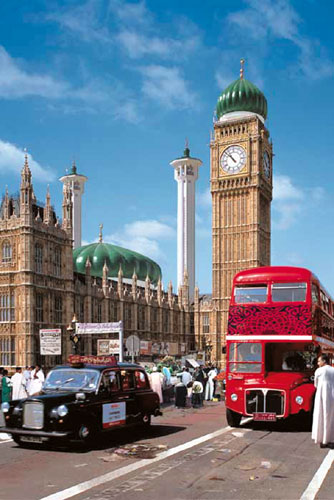
Is Islam a threat to the West? When I get the answer, I’ll report back to readers of Sandbox. In the meantime, ponder this simulation of how the Houses of Parliament could appear in future (click on image to enlarge). It’s the work of a group of provocative Russian artists. I suppose it’s one possible answer to the conference question.

Sorry, no blogging or links this week. The site will return to life sometime over the weekend, after I get back.