Commander of Arabic

Juan Cole has taken some delight in smashing pundit Jonah Goldberg, who ventured a one-paragraph criticism of Cole’s take on the Iraqi elections. Cole hammered back that Goldberg knows no Arabic, has no Iraq expertise, hasn’t lived in an Arab country, etc. The spat has been all over the weblogs. Cole draws this analogy:

If you saw an hour-long piece on al-Jazeerah about the reality of the United States, with English subtitles, and the reporter speaking on the U.S. had never been to America, had never read a book about America, did not know a word of English, and moreover said all kinds of things that were complete fantasy and altogether wrong, would that man be someone you would recommend to others as having an important opinion on the matter that millions of people should be exposed to on NPR and CNN every other day?

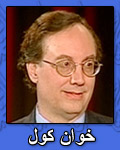
Quite right. But I see that Cole appeared the other day on Al-Jazeera to discuss the Iraqi elections with Fouad Ajami and an Iraqi opposition figure. Cole decided to speak in English, apologizing to his Arab viewers that “the subject requires precision.” So I guess they gave his remarks Arabic subtitles. Now I wouldn’t dare to speak Arabic on Al-Jazeera either, but then I don’t make the boast that Cole makes: “Unlike a lot of American specialists in the Middle East, who did one Fulbright year and now find their language is rusty, I kept up my Arabic.” His bio also claims that he “commands Arabic.” I guess his Arabic, like mine, doesn’t always obey. I’m a bit disappointed.

Cole also writes in his bio that he’s “lived in a number of places in the Muslim world for extended periods of time,” which is an enviable credential. But the Muslim world is an awfully big place, and to the best of my knowledge, Cole has never been to Iraq. (Ajami, Michael Rubin, and a host of academics have made the trek, some of them repeatedly, over the past couple of years.) So all things considered, I wonder what millions of Arabs who watch Al-Jazeera make of Cole as an expert on the reality of Iraq.

(Here’s an addendum, but only if you know Arabic. It’s a joke I heard ages ago from the late Charles Issawi, a man with an impish sense of humor. I’m sure it’s as old as the Pyramids, but here it is anyway. A Western orientalist goes to Egypt, and strikes up a conversation in Arabic with his taxi driver. The poor driver, after straining to understand his passenger, plaintively asks him how he came to know Arabic. Ana mustashriq! the orientalist answers proudly. In reply to which, the taxi driver mutters: Wa’ana mustaghrib…)

Updates: Read about how Ajami took Cole to task for not visiting Iraq here.

Another update: Cole responds to some of this. Details here.

Orientalists: there when you need them

Edward Said famously omitted any discussion of German orientalists from his book Orientalism, and he skipped the Italians too. So I rejoice whenever I see one of these remote figures resurrected, and all the more so when it’s done by Arabs, now grateful for the work of those dead white Europeans who devoted their lives to Islamic studies, and who escaped Said’s scattershot indictment.

My latest satisfaction is prompted by a ceremony held the other week at the National Library in Algiers. It celebrated the recent publication of an Arabic translation of the monumental history of Muslim-ruled Sicily written by the Sicilian orientalist Michele Amari (1806-1889). Amari, the founder of Islamic studies in Italy, spent 30 years researching and writing Sicily’s history during the island’s two-plus centuries under Muslim rule (9th-11th centuries). His Storia dei Musulmani di Sicilia was a work of the highest scholarship, but it had a political purpose too: Amari wanted to prove that Sicilians didn’t need tutoring from northern Europeans about democracy and freedom, because they had lived for over two hundred years under Islamic law. That’s right: his work was a paean to the syncretic “social democracy” of Islamic rule. That wouldn’t have fit very well under any of the chapter headings of Said’s Orientalism.

For Muslim historians, Sicily was a sideshow, and the Arabic sources are scattered. Thanks to this new Arabic translation, produced by a team of Egyptian and Italian scholars, many Arabic readers will learn for the first time of this chapter in Islamic-Christian relations. Of course, in the present climate, it may also stimulate a call by Muslim extremists for the return of Sicily to Muslim rule. Don’t say I didn’t warn you.

Leading orientalists arrived today

Today I received my subscriber’s copy of the Encyclopaedia of Islam supplement. That’s volume 12 of the project, which brings it to a conclusion after nearly fifty years. It’s completely irrational to own a hard copy of the encyclopaedia, since today you can buy a CD version or subscribe to it online. The supplement alone arrived with a bill for 634 Euros.

But I admit to being irrational when it comes to EI2. I derive expensive satisfaction from seeing those dark green volumes lined up on my shelf, each bearing this shocking confession on the title page: “Prepared by a number of leading orientalists.” As a student, I always had to seek out the encyclopaedia on the library reference shelf, and scour the nearby desks if a volume was missing, so I associate ownership of a personal set with luxury and standing. I wish I had more spare time to leaf idly through the double-columned pages, acquiring knowledge both relevant and arcane. (Would that I had an hour to read through the eleven columns in the supplement devoted to the subject of ghanam, which “designates the class of small livestock with a predominance, according to the countries, of either sheep or goats.” At a glance, it really does look fascinating.) One could browse like this endlessly.

I’m the author of exactly one entry (“Mu’tamar,” on Islamic congresses, in volume 7), so I’ve added one small brick to this monument, a contribution that’s quite likely to outlast anything on this website. Dare I say it, perhaps this confers upon me the status of a “leading orientalist.” So I will grimace, write my check, and settle down to enjoy my purchase. I presume my heirs will recoup some of the expense, and some acquisitive younger scholar will derive the same pleasure from ownership of this set as I have. About which, consult the entry dawr (a period of cyclical time, a turn), supplement, pp. 206-7.