
I made the following remarks at the unveiling of Bernard Lewis’s gravestone at Trumpeldor Cemetery in Tel Aviv on February 6.
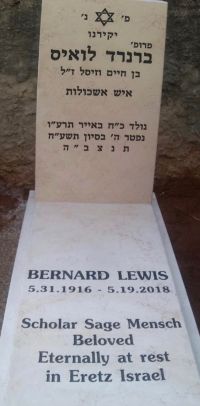 Twenty years ago, I asked Bernard Lewis if he had ever written any obituary notices about friends. He wrote to me to say that he had found all of them, and sent me copies. There were exactly three (none of which appears in his bibliography). He ended his cover letter to me with these words: “I have no other such notices in the course of production, preparation, or even contemplation, and it seems likely that my next appearance in this context will be in the heading, not the signature.”
It’s remarkable that Bernard, in the course of so long a career, produced only a few appreciations of departed colleagues. (I’ve found one more, for a total of four.) He wrote no obituaries even of his close friends, such as Paul Kraus, Shlomo Dov Goitein, “Taki” Vatikiotis and Charles Issawi, just to name a few.
Why? What was it about the genre of the memorial eulogy or obit that didn’t appeal to him? I have no answer to this question, but I have a strong suspicion that he thought that writing these things wasn’t very useful. At the end of the day, it isn’t the eulogies that determine how a scholar is regarded going forward. It’s whether future generations deem the scholar’s own work to be of lasting relevance.
And so Bernard kept to his work. Bernard’s loved ones have erected a fine stone here in his memory. But in a way, Bernard erected his own monument, in his works of scholarship. That monument is a groaning shelf of books in our libraries.
It is important here to distinguish between memory and legacy. Those of us who stand here today have our memories of Bernard, which we cherish. We share them with one another, to console ourselves, and also because by sharing these memories, we hope not to lose them to time. But I think Bernard would be the first to warn us that memory is a fickle thing. I refer you back to his wonderful short book History: Remembered, Recovered, Invented. Memory doesn’t come out well in the comparison. He would be the first to point out that when we reassemble here in ten years, we’ll remember less, and less accurately, not more, and more accurately.
Preserving memory is a lost cause. But constructing legacy isn’t. In this case, its foundation is Bernard’s work. And the people who will elaborate Bernard’s legacy going forward will be, by necessity, people who never knew him and so don’t remember him. But they will have read him, and found that Bernard’s ideas still speak to some contemporary issue, some present or future need. If Bernard Lewis remains useful to them, his legacy will live.
For that to happen, people who have never heard of Bernard will have to discover him. For those of us who teach, write, speak, or administer, our mission is to put Bernard front and center. Since May, there have been at least five gatherings devoted to him—at Tel Aviv University, The Washington Institute for Near East Policy, ASMEA (the Association for the Study of the Middle East and Africa), the American Historical Association, and Shalem College.
This is only the beginning. Much more remains to be done, if young people are to be persuaded to read Bernard. And on this score, I’m optimistic. Every other year, I teach a course on Bernard, and young students are fascinated by him. And why not? His prose style is timeless, his range covers everything, and he was involved in some exciting controversies.
The opportunities are endless. For example: it is now the 40th anniversary of the Iranian revolution this month. This is an opportunity to remind audiences of how Bernard explained the revolution, with a link to his 1985 piece “How Khomeini Made It” at the New York Review. Then there is his 2009 article in the Wall Street Journal, entitled “Israel’s Electoral System is No Good.” That piece is certainly evergreen. Let each of us who is positioned to do so mention Bernard whenever we see an opening, whether it’s in a scholarly article or a Facebook post or even a tweet. He’s always pertinent.
May Bernard’s memory be a blessing, for as long as we can still remember. But may his legacy be a guide, long after our memories of him have dimmed.
 Martin Kramer on the Middle East
You must be logged in to post a comment.