
On Thursday, Mosaic Magazine published my piece on the treatment of the Suez cover-up in the hit Netflix series The Crown. I didn’t write much about the collusion itself—the story has been told countless times—but I focused on the aftermath. Anthony Eden didn’t just lie about the collusion, he sought to destroy the evidence for it—to be precise, the Sèvres Protocol, drawn up among Britain, France, and Israel at the insistence of David Ben-Gurion. When Eden mentions its existence to the Queen (unlikely; see my piece), The Crown cuts away to the protocol being burned by an unseen hand. But Ben-Gurion had put away another copy in his vest pocket—and so put Eden there as well.
The ten-person fact team of The Crown put a lot of thought into these cutaways. Here’s another example. While Eden describes the Sèvres Protocol to the Queen, we see a clacking typewriter. For a flash of less than a second, we even see the typebars from above.
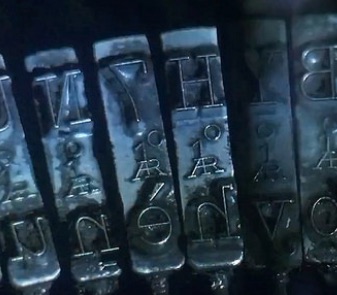 Now the Sèvres Protocol was typed in French. And if you capture this fleeting image, you’ll see that the typewriter is a French one. How so? On an English keyboard, the number 7 shares a key with the ampersand (&). On a French keyboard, the 7 shares a key with the letter e under a grave accent (è). So someone at The Crown went to the trouble of finding a French typewriter, because the Sèvres Protocol was typed in French, in France. I may be the only viewer who’s noticed this—and yet someone on the fact team of The Crown thought it was an important detail that the show absolutely had to get right.
But the remarkable thing about The Crown is that within the space of a few moments, it can be fanatically faithful to some arcane detail, and then totally disregard a much more significant one.
So, when Eden begins to admit the collusion to the Queen, there’s a cutaway to British, French, and Israeli negotiators arriving at what Eden calls “a small village on the outskirts of Paris”—that would be the suburb of Sèvres—and entering a château to conclude their secret deal. The stand-in used by the filmmakers is the imposing Waddesdon Manor in Buckinghamshire, a Disneyesque pile built by one of the Rothschilds to resemble a famed Loire château. (For the frame, see illustration, top.)
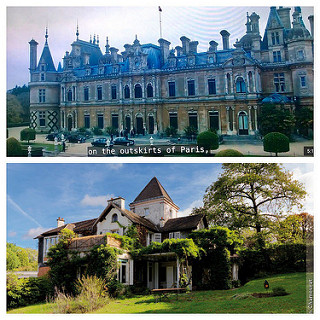 This is a disappointing choice. The French hosts convened the negotiation in a modest villa (illustration, bottom). This house had great symbolic significance. It was the family home of a young Frenchman who, in 1942, assassinated Admiral François Darlan, a Vichy collaborator second only to Pétain. The young man, Fernand Bonnier (de La Chapelle), was summarily executed. During the Nazi occupation, Resistance members used the place as a safe house. They included the French minister of defense in 1956, Maurice Bourgès-Maunoury.
Mordechai Bar-On, Israel’s note-taker at the meeting, explained that for the French negotiators, who were almost all veterans of the Resistance, the villa stood for
the resolve and courage they deemed to be their heritage. During the Suez crisis the French leaders, as well as Anthony Eden’s group, compared President Nasser of Egypt with Hitler or Mussolini. They referred often to the cowardly submission to Hitler’s demands over Czechoslovakia at Munich in 1938. The living room of the villa, where most of the meetings took place, held a prominent reminder of the need to resist arbitrary dictators who encroached on the interests of the free world: a bust on the mantelpiece of the young Bonnier de La Chapelle, flanked by two candlesticks and surrounded by flowers.
Fernand’s room in the villa was kept exactly as he left it.
The other Israeli participants, in their memoirs, could not but comment on the deep symbolism of the venue. This world-shaking secret pact was negotiated in the living room of a Resistance safe house, before a shrine to a martyr! The setting inspired righteous moral conviction. Alas, The Crown, preferring to locate the negotiation in a luxurious fantasy castle, misses that entirely.
Now at this point, I could sink into philosophical reflection. It’s impossible to reconstruct or reenact the past; it’s all an approximation. So at what level of resolution should the filmmaker attempt it? And with what degree of consistency? Is it acceptable to get the French typewriter exactly right, but get the French villa exactly wrong? Which details enhance meaning, and which only add verisimilitude? And how much distance is admissible between known fact and its representation, before history becomes “fake”?
But I won’t go there. As Robert Lacey, historical adviser to The Crown, openly admits, the show includes “outright invention—what you could call dramatic license, or as I would prefer to put it, dramatic underlining.” (Underlining!) In other words, dear viewer, The Crown shifts the burden of determining the historicity of events to you. You must rush to Google and Wikipedia if you wish not only to be entertained, but to be educated.
Some people are worried you won’t bother. Hugo Vickers, a royal historian who’s written a quick book on fact and fiction in The Crown, is one of them: “I do not approve of The Crown because it depicts real people in situations which are partly true and partly false; but unfortunately most viewers take it all as gospel truth.”
It’s hard to argue with that, but as the New York Times reviewer has written, “No one’s really watching The Crown for the stories that made it into history textbooks.” Anyway, the industry of which The Crown forms a part is flourishing and profitable, so sniffing one’s disapproval is a losing proposition. It’s probably best to see each such production as an opportunity for critics to show a wider public how history is best practiced.
I want to end this addendum by emphasizing how much my piece owes to Mordechai Bar-On, the last surviving Israeli participant of the Sèvres negotiations. As I mentioned, he took Israel’s notes at the meetings, and he has used them several times to produce detailed and knowing accounts of the proceedings. This meticulous chronicler stands head and shoulders above any other witness. He’s now 89, and while I studied everything he wrote on the subject, in English and Hebrew, I still wanted him to see the piece before publication. He did, and while I alone am responsible for it, I’m gratified that he found no fault with it.
 Have you seen (or binge-watched) the Netflix series The Crown? And wondered whether this conversation or that reenactment is “true” to the historical record? For example, did British prime minister Anthony Eden really hope to keep Queen Elizabeth II in the dark about Suez? (He almost does just that in The Crown.) And why, when he comes clean to her about the secret “collusion” with Israel and France, are we shown a lighter setting fire to a document? I tell the secret-within-the-secret, of the cover-up, and how David Ben-Gurion kept it—and used it.
 Martin Kramer on the Middle East
You must be logged in to post a comment.