Down and out at Columbia

The resignation of Minouche Shafik, president of Columbia University, is being hailed as a victory all around. Rep. Elise Stefanik (R-N.Y.), who had called for her resignation back in April, celebrated the news:

Since her catastrophic testimony at the Education and Workforce Committee hearing, Shafik’s failed presidency was untenable and it was only a matter of time before her forced resignation. After failing to protect Jewish students and negotiating with pro Hamas terrorists, this forced resignation is long overdue.

But at Columbia, the campus chapter of Students for Justice in Palestine (SJP) also celebrated:

After months of chanting ‘Minouche Shafik you can’t hide’ she finally got the memo. To be clear, any future president who does not pay heed to the Columbia student body’s overwhelming demand for divestment will end up exactly as President Shafik did.

While Stefanik and SJP play tug-of-war over Shafik’s scalp, the battle for Columbia is far from over. Once the academic year begins, Columbia could face some of the same problems it encountered last spring: encampments, building occupations, intimidation of Jewish students, faculty alienation, and campus shutdowns. The demand by faculty and student radicals for “divestment” from Israel isn’t going away, and it’s one that no Columbia administration can satisfy.

My personal view is that Shafik was probably as good as you could get at a university as corrupted as Columbia, and likely more than Columbia deserved.

What went wrong

I began sounding the alarm over Columbia many years ago. I spent a year there as a graduate student and earned a master’s degree in history in 1976. Aside from the indomitable J.C. Hurewitz, I found nothing to keep me there. So I returned to Princeton for my doctorate. I had completed my undergraduate degree there, and Princeton had just acquired Bernard Lewis.

I left Morningside Heights, but I continued to watch Columbia with an insider’s interest. After I published a critique of Middle Eastern studies in 2001, I began identifying Columbia as the epicenter of the problems plaguing the field—so much so that Columbia’s Palestinian star, Edward Said, made this complaint in 2003:

An outrageous Israeli, Martin Kramer, uses his Web site to attack everybody who says anything he doesn’t like. For example, he has described Columbia as ‘the Bir Zeit [West Bank university] on the Hudson,’ because there are two Palestinians teaching here. Two Palestinians teaching in a faculty of 8,000 people! If you have two Palestinians, it makes you a kind of terrorist hideout.

Only seven years later, Columbia inaugurated a new Center for Palestine Studies. The announcement stated that “Columbia University is currently the professional home to a unique concentration of distinguished scholars on Palestine and Palestinians.” How did Columbia go from “two Palestinians” to a “unique concentration” in just seven years?

The same way Hamas built an underground warren in Gaza: through resolve, deception, cooptation, and intimidation. No one should have been surprised when an army of pro-Palestine and even pro-Hamas students, encouraged from behind the scenes by faculty, appeared last spring. The plot against Columbia had been more than twenty years in the making.

Most of the tunneling took place during the tenure of Lee Bollinger, president from 2002 to 2023. Whenever trouble surfaced—whether it was granting tenure to unqualified extremists or hosting the antisemitic Iranian president Mahmoud Ahmadinejad on campus—Bollinger turned on the charm machine. Columbia is so much more, he reassured. This “move on, folks, nothing to see here” approach worked because donors, alumni, and students needed it to work. After all, they had shares in Columbia, Inc. That included many Jews, in all three categories.

Shafik had nothing to do with the administrative neglect that ate away at the foundations of the university. She wasn’t an alumna, and she’d never taught there. Her whole career had unfolded in Britain. When she assumed the Columbia job in June 2023, she may not have known how deep the rot went. What had started as a faculty problem had metastasized over two decades, spreading both to the student body and to the administrative bureaucracy. “Bir Zeit-on-Hudson” had gone from (my) hyperbole to reality.

Embed from Getty Images

I didn’t say so at the time, to avoid adding fuel to the wrong side, but I thought Shafik showed grit in calling in the NYPD twice: first, to clear the “Gaza Solidarity Encampment” on South Lawn, and second, to clear Hamilton Hall, which had been forcibly occupied by a mix of students and off-campus radicals. But those decisions are what ultimately doomed her presidency.

More precisely, it was the faculty who made her position untenable. They had already taken umbrage at her Congressional testimony, where she appeared vaguely amenable to disciplining faculty speech. Her decision to call in the police compounded the crisis. A no-confidence resolution passed by the Faculty of Arts and Sciences (with 65 percent in favor) declared that Shafik’s decisions “to ignore our statutes and our norms of academic freedom and shared governance, to have our students arrested, and to impose a lockdown of our campus with continuing police presence, have gravely undermined our confidence in her.”

It was just such a vote of no-confidence that drove Lawrence Summers out of the Harvard presidency in 2006. When you lose such a vote, you’re on borrowed time. Shafik prepared her departure, and announced that she would be returning to Britain to take up an economic advisory position with the Foreign Secretary. The statement by her temporary replacement, the CEO of Columbia’s medical center, made it quite clear who must be appeased henceforth: the Columbia faculty. “You are the ultimate keepers of the institution’s values and the stewards of its long and proud history.”

Upon Shafik’s resignation, Stefanik gloated: “THREE DOWN, so many to go.” The other two were the presidents of Harvard and Penn. But not every campus is the same. The pro-Israel stakeholders at Columbia have always been weak, and what Congress thinks doesn’t much matter on Morningside Heights. In my view, Shafik’s fall should actually be counted in the pro-Palestine column. If I’m right, it’s not “three down,” but “two to one.”

Does it get better?

Shafik was born in Egypt to a well-to-do family. In 1966, Nasser’s “Arab revolution” stripped her father, a chemist by training, of his expansive estate and all his property, in a wave of nationalization. The Shafiks arrived on America’s shores “with little money and a few possessions.” Minouche was four years old. “It taught me that you can go from having a lot to having nothing overnight, and you can’t get too attached to stuff because you can lose it.”

Shafik was driven from the land of her birth by an angry and aggrieved nationalism. Now, she’s been driven out of America by another variety of angry and aggrieved nationalism, this time Palestinian. She’ll always be remembered as the president who called in New York’s finest to handcuff some of Columbia’s worst. I’d be surprised if the next president is made of sterner stuff.

Embed from Getty Images

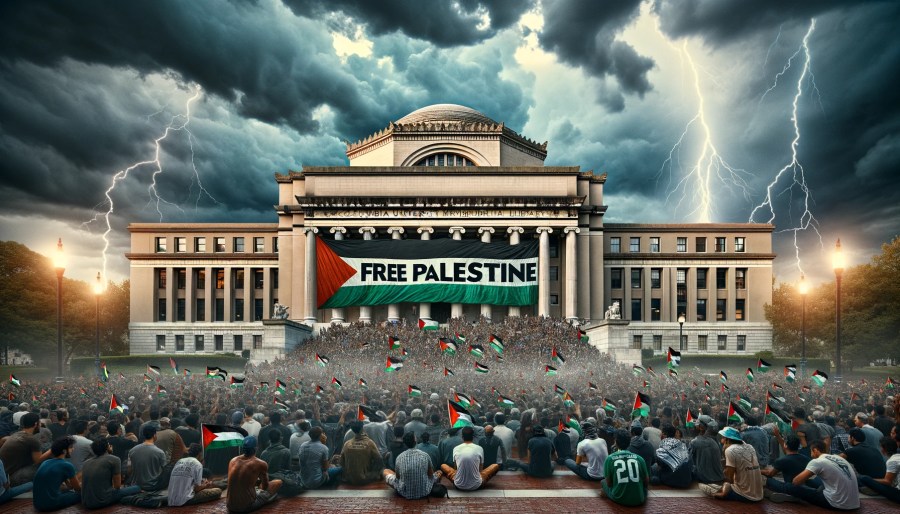
Header image created by DALL-E, OpenAI’s image generation model.

Bibi’s evolving Hamas story

Last November, I asked this question: why didn’t Benjamin Netanyahu keep his 2009 campaign promise to topple Hamas? I found at least part of the answer in his 2022 memoir, Bibi: My Story.

In that account, Netanyahu explained, first, that “the cost in blood and treasure was not worth it.” Overthrowing Hamas would involve the loss of “many hundreds [of soldiers] on the Israeli side,” burden Israel with governing Gaza “for an indefinite period,” and result in “the wholesale destruction of Gaza, with tens of thousands of civilian deaths.” Second, it wasn’t a priority. “Did I really want to tie down the IDF in Gaza for years,” he wrote, “when we had to deal with Iran and a possible Syrian front? The answer was categorically no. I had bigger fish to fry.”

In a new interview with TIME, conducted by Eric Cortellessa, Netanyahu preempts the question before it is asked. After rationalizing the Qatari funding of Gaza, he explains that before October 7, he had conducted “three full-fledged military campaigns against Hamas in which we killed thousands of terrorists, eliminated some of their top military leadership, and sought to prevent them from having the capacity to attack us.” But he adds this:

One thing we didn’t do was we didn’t come out to eradicate Hamas completely, because that would require a full-scale ground invasion for which we had no internal legitimacy or international legitimacy. Look at the problem we have with legitimacy now, after they conducted the worst terror onslaught on the Jewish people since the Holocaust…. We sort of cut the weeds, but we didn’t come in to uproot them completely until October 7th. October 7th showed that those who said that Hamas was deterred were wrong. If anything, I didn’t challenge enough the assumption that was common to all the security agencies.

The interviewer said he would “come back to that in a second,” and when he did, he formulated the question in his own pointed way: “Why didn’t you take out Hamas earlier? You could have gone all the way in 2014.” Netanyahu responded:

No I couldn’t. I don’t think there was—there wasn’t a consensus. There was, in fact, a consensus among the military that we shouldn’t do it. But more importantly, you can overrule the military, but you can’t act in a vacuum. There was no public, no domestic support for such an action. There was certainly no international support for such an action, and you need both or at least one of them in order to take such an action. I think that became evident right after the October 7th massacre.

“I decided”

These explanations differ significantly from the rationales Netanyahu provided in his memoir. There, it isn’t the public that lacks “consensus” over toppling Hamas; rather, “The public invariably expects the government to continue the battle and ‘flatten Gaza,’ believing that with enough punishment the Hamas regime would collapse.” In his memoir, Netanyahu credited himself with tempering this unrealistic expectation, which was fueld by political rivals who would “irresponsibly take contrarian positions which they know are wrong.” The final decision he claimed for himself alone: “I decided against a full-scale ground invasion.”

As for the need for “international” (largely American) legitimacy, Netanyahu made no mention of it in his memoir. While he obviously faced constraints during the eight years of Barack Obama, everything changed during his four-year partnership with Donald Trump. A centerpiece of the memoir is Netanyahu’s exploitation of Trump’s unprecedented support, from enhancing the Israeli status of Jerusalem and the Golan to rolling back the Iran nuclear deal. There is no evidence that Netanyahu prioritized Gaza.

And that brings us to the most important difference in Netanyahu’s latest apologia. It makes no mention of his earlier view of the relative threat posed by Hamas. According to Netanyahu’s own strategic priorities, a final showdown with Hamas would have been a trap: “After destroying the Hamas regime, Israel would have to govern two million Gazans for an indefinite period. I had no intention of doing that, especially since I had my gaze fixed on Iran, a much greater threat.”

Netanyahu, then, wasn’t simply aligning with the “consensus” of “security agencies” and the public when he held back on Hamas. Clearly, he calculated his priorities and took a decision that ended a policy debate. The TIME interview is disappointing for not quoting his memoir. Bibi: My Story offers the most comprehensive statement of his pre-October 7 strategy.

Another question remains unlikely to be answered: Did Hamas leaders who read the relevant passages of his memoir in 2022 conclude that Netanyahu, should he return to power, would be preoccupied elsewhere? Did they believe that as long as Netanyahu ruled, they enjoyed immunity from destruction? And did this belief embolden them to implement their plan, assuming he would stop short of toppling them? The mere possibility serves as a warning to all leaders: one should never publish one’s most closely held strategic thoughts before stepping down for good.

Bibi: My Story sold well. In November 2022, it spent three weeks on the New York Times bestseller list. It remains the most reliable starting point for understanding the events leading up to October 7.

Header image created by DALL-E, OpenAI’s image generation model.
The day the Mufti died

Fifty years ago, on July 4, 1974, Hajj Amin al-Husayni, the “Grand Mufti” of Jerusalem, passed away in Beirut, Lebanon, at the American University Hospital. At age 79, he died of natural causes. The Mufti had faded from the headlines a decade earlier. In 1961, his name had resurfaced numerous times during the Jerusalem trial of Adolf Eichmann. But a couple of years later, the Palestinian cause gained a new face in Yasser Arafat. With that, the Mufti entered his final eclipse.

When he died, the Supreme Muslim Council in Jerusalem asked the Israeli authorities for permission to bury him in the city. Israel refused the request. Any Palestinian who wanted to attend the funeral in Lebanon would be allowed to do so, but the Mufti of Jerusalem would not be buried in Jerusalem. Instead, the Mufti was laid to rest in the Palestinian “Martyrs’ Cemetery” in Beirut.

The Mufti was appointed to his position by the British in 1921. Within the British Empire, authorities preferred to work through “native” institutions, even if they had to create them on the fly. So they established a supreme council for Palestine’s Muslims and placed the Mufti at its helm. Although he lacked religious qualifications, he came from a leading family and appeared capable of striking deals.

In fact, he used his position to oppose the Jewish “National Home” policy of the Mandate. The “Arab Revolt” of 1936 finally convinced the British that he had to go, and in 1937 he fled the country.

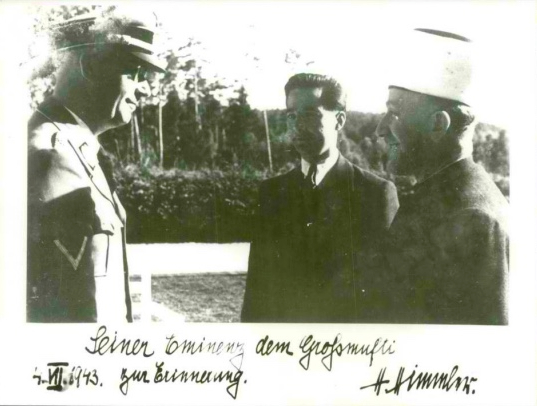
After a period in Lebanon, he ended up in Iraq, where he helped foment a coup against the pro-British regime. When British forces suppressed the coup, he fled again, making his way through Tehran and Rome to Berlin. There, the Nazi regime used him to stir up Arabs and Muslims against the Allies. He was photographed with Hitler and Himmler, recruited Muslims to fight for the Axis, and attempted to secure promises of independence for colonized Arabs and Muslims. None of his efforts met with much success. His role, if any, in the Holocaust is a contested matter. Hitler and his henchmen hardly needed any prompting to execute their genocidal plans. Clearly, though, the Mufti rooted for Jewish destruction from the fifty-yard line.

After the Nazi collapse, he fell into French hands, and spent a year in comfortable house detention near Paris. Later, he fled to Egypt and subsequently moved in and out of Syria and Lebanon. Following the Arab debacle of 1948, Egypt established an “All Palestine Government” in the refugee-choked Gaza Strip, leaving the presidency open for the Mufti. It didn’t last long. He continued to maneuver through Arab politics, but he was yesterday’s man to a new generation of Palestinians born in exile. During the Eichmann trial, the prosecution sought to implicate the Mufti as an accomplice. Yet the Mossad never came after him, and he didn’t die a martyr’s death.

Man without a country

The Mufti was a formidable politician. In 1951, a State Department-CIA profile of him opened with this evocative enumeration of his many talents, which is worth quoting at length:

King of no country, having no army, exiled, forever poised for flight from one country to another in disguise, he has survived because of his remarkable ability to play the British against the French, the French against the British, and the Americans against both; and also because he has become a symbol among the Arabs for defending them against the Zionists. His suave penchant for intrigue, his delicate manipulation of one Arab faction against another, combined with the popularity of his slogan of a united Muslim world, has made him a symbol and a force in the Middle East that is difficult to cope with and well nigh impossible to destroy. The names of Machiavelli, Richelieu, and Metternich come to mind to describe him, yet none of these apply. Alone, without a state, he plays an international game on behalf of his fellow Muslims. That they are ungrateful, unprepared, and divided by complex and innumerable schisms, does not deter him from his dream.

Profilers would later write similar things about Arafat, but the Mufti had none of Arafat’s cultivated dishevelment. He was manicured, even chic:

The Mufti is a man of striking appearance. Vigorous, erect, and proud, like a number of Palestinian Arabs he has pink-white skin and blue eyes. His hair and beard, formerly a foxy red, is now grey. He always wears an ankle length black robe and a tarbush wound with a spotless turban. Part of his charm lies in his deep Oriental courtesy; he sees a visitor not only to the door, but to the gate as well, and speeds him on his way with blessings. Another of his assets is his well-modulated voice and his cultured Arabic vocabulary. He can both preach and argue effectively, and is well versed in all the problems of Islam and Arab nationalism. His mystical devotion to his cause, which is indivisibly bound up with his personal and family aggrandizement, has been unflagging, and he has never deviated from his theme. For his numerous illiterate followers, such political consistency and simplicity has its advantages. The Mufti has always known well how to exploit Muslim hatred of ‘infidel’ rule.

So why did the Mufti fade into obscurity? (By 1951, he was on his way out.) Many mistakenly believe his collaboration with Hitler and the Nazis discredited him. It didn’t. Not only did the Arabs not care, but Western governments eyed the Mufti with self-interest. The general view in foreign ministries held that he had picked the wrong side in the war, but not more than that.

The above-quoted American report expressed this view perfectly: “While the Zionists consider him slightly worse than Mephistopheles and have used him as a symbol of Nazism, this is false. He cared nothing about Nazism and did not work well with Germans. He regarded them merely as instruments to be used for his own aims.” If so, why not open a discreet line to him and let him roam the world unimpeded?

Nakba stigma

What finally discredited the Mufti in Arab opinion, where it mattered most, was his role in the 1948 war. It was a war he wanted and believed his side would win. In late 1947, the British sent someone to see if there might be some behind-the-scenes flexibility in his stance on partition, which he had completely rejected. There wasn’t. He explained:

As regards the withdrawal of British troops from Palestine, we would not mind. We do not fear the Jews, their Stern, Irgun, Haganah. We might lose at first. We would have many losses, but in the end we must win. Remember Mussolini, who talked of 8,000,000 bayonets, who bluffed the world that he had turned the macaronis back into Romans. For 21 years he made this bluff, and what happened when his Romans were put to the test? They crumbled into nothing. So with the Zionists. They will eventually crumble into nothing, and we do not fear the result, unless of course Britain or America or some other Great Power intervenes. Even then we shall fight and the Arab world will be perpetually hostile. Nor do we want you to substitute American or United Nations troops for the British. That would be even worse. We want no foreign troops. Leave us to fight it out ourselves.

This underestimation of the Zionists proved disastrous, even more so than his overestimation of the Axis. He later wrote his memoirs, blaming “imperialist” intervention, Arab internal divisions, and world Zionist mind-control for the 1948 defeat. To no avail: his name became inseparable from the Nakba, the loss of Arab Palestine to the Jews. His reputation hit rock bottom, along with that of the other failed Arab rulers of 1948.

Upon his death in 1974, he received a grand sendoff in Beirut from the PLO, Arafat presiding. In 1970, Arafat had transferred the PLO headquarters from Jordan to Lebanon, and the funeral finalized his status as the sole leader of the Palestinian people. Four months later, Arafat addressed the world from the podium of the UN General Assembly, achieving an international legitimacy that the Mufti could never have imagined.

The PLO then dropped the Mufti from the Palestinian narrative; nothing bears his name. Even Hamas, which inherited his uncompromising rigidity and Jew-hatred, doesn’t include him in their pantheon. (Their man is Izz al-Din al-Qassam, a firebrand “martyr” killed by the British in 1935.)

If anyone still dwells on the Mufti, it’s the Israelis, including their current prime minister, who find him useful as a supposed link between the Palestinian cause and Nazism. One can understand Palestinians who push back on this; the Mufti was no Eichmann. But that doesn’t excuse Palestinian reluctance to wrestle candidly with the Mufti’s legacy. He personified the refusal to see Israel as it is and an unwillingness to imagine a compromise. Until Palestinians exorcise his ghost, it will continue to haunt them.

Highlights from the funeral of the Mufti. Yasser Arafat appears in his trademark keffiyeh.

Header image: “To His Eminence the Grand Mufti as a memento. H. Himmler. July 4, 1943.” Israel State Archives.