Assassination in Zion

It has been a century since the first nationalist murder of a Jew by a fellow Jew. On June 30, 1924, Jacob Israël de Haan left his evening synagogue prayers in Jerusalem. A man approached him and asked for the time. As De Haan reached for his pocket watch, the man shot him three times and escaped, never to be apprehended.
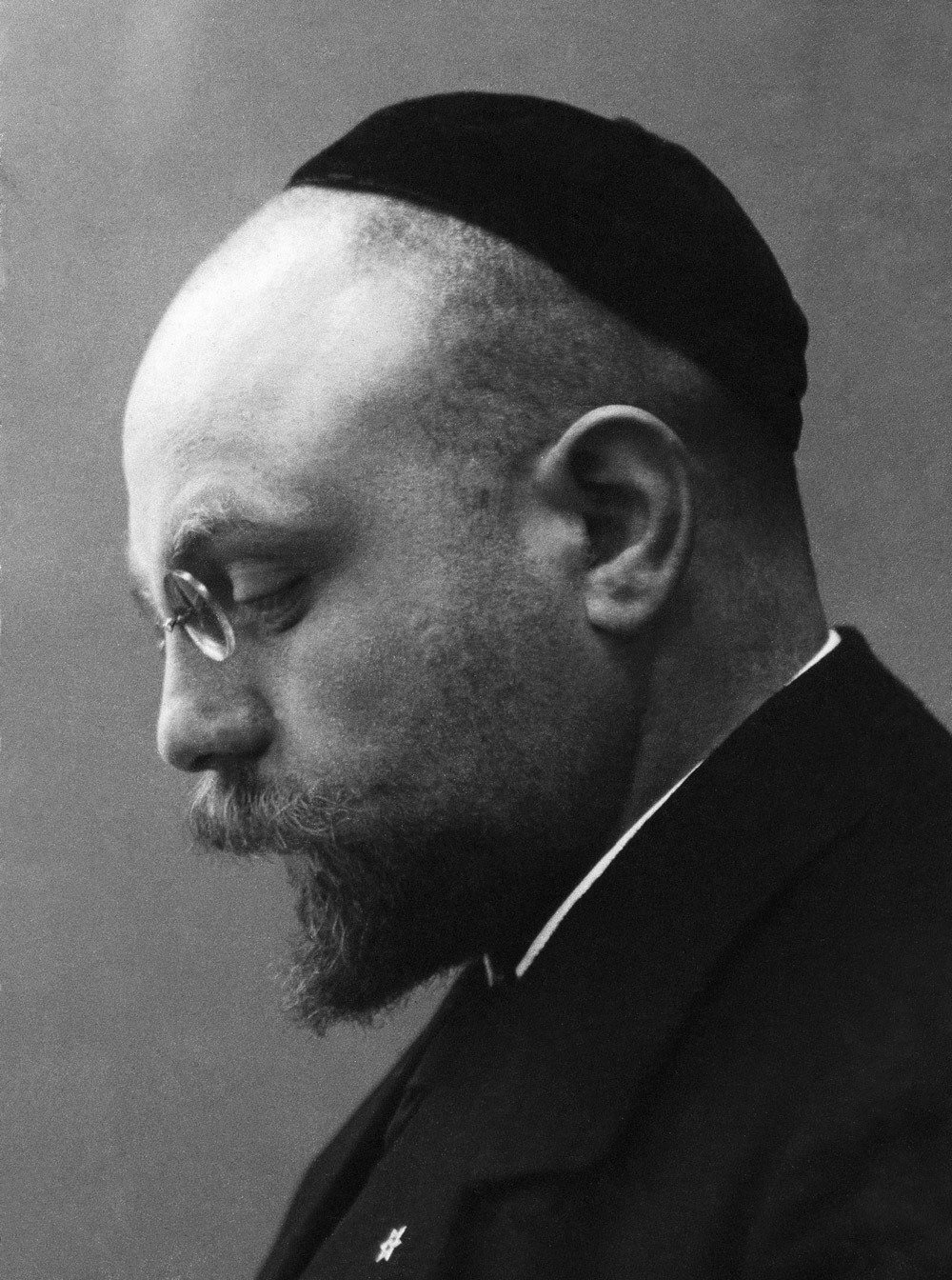
Jacob Israël de Haan.

For many years, the question “Who killed De Haan?” inspired rounds of accusations and journalistic investigations. Now, a century later, the more relevant question might be, “Who was De Haan?” Sixty years after his death, his assassin, then a Haganah operative, essentially confessed to the murder. While no new revelations about the assassination have emerged since then, fascination with De Haan’s complex personality has steadily grown.

That fascination has its own century-long history. Colonel Frederick Kisch, a decorated British-Jewish officer who chaired the Zionist Executive in Jerusalem, knew De Haan well. “I have been thinking a good deal about De Haan,” he wrote in his diary the day after the assassination.

—not about his death but about his life; really an amazing human story. Formerly regarded as one of the most brilliant poets in Holland, he spent his latter days living in dirt and squalor in a single room—little more than a cell—in an Arab courtyard at Jerusalem. He passed through an intermediate stage of intense Jewish national enthusiasm, having acclaimed the Balfour Declaration in inspiring verse, and came to Palestine as an enthusiastic Zionist. His personal ambitions, his resistance to the discipline which is indispensable in any organization, and a mania which showed itself no less in his private than in his public life, turned him against the majority of his own people. Thereafter he made of religious orthodoxy a political weapon, which he wielded relentlessly against his fellow Jews.

This “amazing human story” captivates the imagination today precisely because of the elements Kisch succinctly summarized. De Haan was an acclaimed Dutch poet and writer, a European intellectual of the first order. After arriving in Palestine in 1919, he gradually shifted from secular Zionism to ultra-religious anti-Zionism. By the “mania” of his private life, Kisch referred to De Haan’s homosexuality, evidenced in both his writings and his liaisons.

De Haan briefly taught in the British-run Government Law School, and reported on Palestine for a leading Dutch daily, filing nearly 400 feuilletons. He also served as a kind of foreign minister for the ultra-Orthodox Agudat Israel community, which opposed subordination to the Zionist institutions recognized by the British Mandate. De Haan worked diligently to dissuade British colonial officials and press barons from endorsing a Zionist monopoly on Jewish life in Palestine.

He also maintained close contact with the then-leaders of Arab nationalism: Hussein of Mecca and his sons, Abdullah and Faisal. The British governor of Jerusalem recalled how De Haan’s “gold-rimmed spectacles would peer out of a white silk kufiyya as he drove across the Jordan in full Beduin costume—now become a Nordic Arab—to visit the Amir Abdullah.” While the Zionists pressed these Arab leaders to recognize a Jewish “national home” in Palestine, De Haan told them that the Jews he represented wanted only communal autonomy in a larger Arab kingdom.

It was likely anger at De Haan’s diplomacy that precipitated his assassination. The plot against him emerged from the ranks of the Haganah, the nascent self-defense force of the socialist Yishuv. Just how high up the plot reached has been the subject of endless speculation. Did Yitzhak Ben-Zvi, later Israel’s second president, order the killing? Or perhaps David Ben-Gurion? It’s unlikely that we will ever see any new evidence to answer these questions definitively.

Retrieving De Haan

The circles that cherished the memory of De Haan were once fairly limited, primarily comprising the most anti-Zionist of the ultra-Orthodox, such as Neturei Karta, for whom De Haan was a martyr. To them, his killing proved the moral debasement of secular Zionism. As one adherent put it, “our homage is to be paid to the penitent who rose from the [Zionist] idol’s feet to spit in its face and sacrificed his life to rescue the faithful from its clutches.” These faithful would annually mark the anniversary of De Haan’s death, 29th Sivan (this year, July 5), by visiting his grave on the Mount of Olives.

Then there were gay Dutch readers who found inspiration in his homoerotic novels and poetry. A sample illuminates this body of work: “I wait for what, this evening hour— / The City stalked by sleep, / Seated by the Temple Wall: / For God or the Moroccan boy?” A line from one of his poems is etched on the Homomonument in Amsterdam.

De Haan in Arab dress.

The more recent growth of interest comes not from these circles, but from left-wing anti-Zionists, including Jews, who seek Jewish precursors for their views. For them, De Haan is the bearer of a timely political message: the path to peace lies not in continued Jewish statehood, but in the abandonment of Jewish sovereignty. A photograph of De Haan in keffiyeh and agal is sometimes deployed to pique the interest of “river-to-the-sea” critics of “settler-colonialism.”

How far this retrieval of De Haan will go seems uncertain. For one thing, his diplomacy didn’t engage Palestinian Arabs, and his dispatches sometimes disparaged their character. He instead swooned to the titled rulers of the Hashemite house, the makers of the “Arab Revolt” in their palatial desert tents across the Jordan. And much of his reportage on Jewish settlement was reasonably balanced.

For these and other reasons, De Haan hasn’t yet emerged as an inspiration for “free Palestine” activists. That would require a selective reading of his oeuvre, slanted toward the last year or so of his life. But since the great bulk of his work has never been translated into English, and there is no English-language biography, more would have to be done to make him accessible to today’s anti-Israel mainstream.

An irrational act

To mark this centenary, I’ve chosen to translate not something written by De Haan, but another text by a formidable publicist almost totally lost to memory. Moshe Beilinson was a prolific writer and journalist. This Russian-born physician and socialist relocated from Italy to Palestine in 1924. He quickly became a voice of authority in the labor movement, and played an outsized role in the Histadrut’s sick fund, which later named its flagship hospital in Petah Tikvah after him. (Beilinson Hospital is now part of the Rabin Medical Center.) If Beilinson is little remembered, it’s perhaps because he died before the birth of Israel, at the age of 47 in 1937.

The Zionist press generally responded to De Haan’s assassination much like Colonel Kisch did: “I made it clear to the police that they were not justified in taking it for granted that the crime was political, since De Haan had many private enemies.” The insinuation was that he had fallen victim to an Arab honor killing. Beilinson rightly asserted otherwise, arguing that this blatantly political murder crossed every red line. Beilinson responded to the first Zionist assassination with the first Hebrew case against it. Interestingly, he didn’t make the narrow argument that Jews must not kill Jews. Instead, he insisted that assassination itself was irresponsible, ineffective, and immoral.

It’s hard to tell how his argument was received, but it’s a fact that after De Haan’s murder, the Haganah largely forswore political assassination almost to the end of the British Mandate. This distinguished it from the rival Irgun (Etzel), which De Haan’s assassin ultimately helped to found.

Published in Kontres 9 (Tammuz 16, 5684 [July 18, 1924]): 14-15. Reprinted in Do’ar Ha-Yom, July 22, 1924.

On the Murder of De Haan

The war [of 1914-18] has taught the world to devalue human life. Political murder, which was rare and only tolerated under exceptional conditions before the war, has become commonplace, especially in the countries of Eastern and Central Europe. The use of this abhorrent method has been particularly embraced in the political struggles of those defending a crumbling world, which is somewhat understandable. But for those living under conditions of political freedom, where wars of words and writings are allowed, resorting to such means not only demonstrates a criminal attitude towards the lives of others, but also exposes their weakness and inability to fight by other means.

The murder of De Haan compels everyone in the country to rethink these questions.

De Haan’s personality is irrelevant in this context. No positive movement can derive any benefit from such a death. Even if we view De Haan’s actions as extremely harmful to the Yishuv, we must add that his personality was in no way so powerful or exceptional that his absence would change the situation today. Just as before, there will be Jewish enemies of our national interests, and it is likely that even now, as before, hidden hostility will lead them to measures which will justifiably arouse the Yishuv’s anger.

Assassinations of individuals have never and nowhere led to a change in the situation. The bullets and bombs that killed Plehve and Stolypin did not bring about the Russian Revolution, nor did the deaths of Erzberger and Rathenau ease Germany’s situation. On the contrary, if the Russian Revolution is now fading due to unnecessary destruction and if Germany still has not found peace, it is also due to political murder. That said, De Haan’s murder cannot be compared to the murder of those at the helm of governments. There, the purpose of the acts is not only to get rid of individuals but also to prepare for a revolution, which is irrelevant in this case.

This act is not only irrational but also very harmful to our cause. It gives all our enemies a perfect excuse to blame our entire movement, and rightly so. Who will demand justice and fairness when they can smear and harm us? It can be predicted that this evil act will be fully used to turn Arab and English public opinion against us, amplifying the supposed “Bolshevik danger” posed by secular Jews in the Land of Israel; and to provoke opposition to us within Jewish Orthodoxy. After all the accusations and false charges leveled at us, our enemies finally have a real fact to use against us, and they will undoubtedly seize upon it. In his life, De Haan was a highly dubious figure, and even those close to his views were not always willing to defend him. In these circles, his blood will overshadow his offenses against the Jewish people. De Haan, the criminal in his actions against his people, will be overshadowed by De Haan, the victim. His dead body can cause more harm than his actions in life.

Let our movement not be stained with the blood of the innocent or the guilty; otherwise, our movement will be in dire straits. Blood always begets blood, always seeks revenge, and once you start down this path, you never know where it will lead. Irresponsibility born of excessive emotion replaces measured and rational conflict. Political murder is always linked with provocation, betrayal, espionage, slander, and suspicion. We are strong enough to let our enemies live and to look upon them with contempt if they use illegitimate means. We are not strong enough to adopt methods of warfare that could lead to moral ruin within the movement. Our movement has a clear and definite path: it is the path of labor, and only under this sign will we prevail. This does not mean that we should not defend ourselves when attacked, but our defense of our work has no connection with killing unarmed individuals.

There is another side, a purely moral one, making it the hardest to address. We, the Hebrews, were the first to establish the commandment: “Thou shalt not kill.” We, the socialists, always and everywhere demand the abolition of the death penalty. Who has the right to violate, to transgress the most sacred commandment of Judaism and civilized humanity? Who in their mind can dive into the depths of another person’s soul—even if that person is a hundred times our opponent—and find them deserving of death? The most cruel aspect of political murder is that the accused have no chance to defend themselves, making it worse than a military trial; judgment is passed without investigation and counter-evidence. They use “objective facts,” but how often are these false, and how often do they lead to the gravest errors, even in courts of law? But let’s assume De Haan was truly guilty, that he did act from impure motives. He fought us with the power of speech and writing, and we should have fought him with the power of speech and writing, exposed his schemes, and refuted his lies—we live in a land of political freedom, and our mouths are not shut. But no one has the right to take another’s life—life that is not given by man and cannot be restored once it is taken away.

Political sense, concern for the purity of our movement, and moral feeling compel us—regardless of the victim’s personality and the motives of the perpetrator—to pass a harsh verdict on the murder of De Haan.

M. Beilinson

De Haan (right) in Jericho, 1922 or 1923, Frank Scholten Collection, Leiden University Libraries.

Israel must never stand alone

Israeli politicians often assert that Israel can and will “defend itself by itself,” a longstanding formula dating back decades. Prime Minister Benjamin Netanyahu has repeated it often. But he’s added an amplification: Israel will do so “even if we must stand alone.”

From here, from Jerusalem, on the eve of Holocaust Memorial Day, I send a message, loud and clear: ‘You will not tie our hands.’ If Israel is forced to stand alone, we will stand alone, and will continue to smite our enemies until we achieve victory. Even if we must stand alone, we will continue fighting human evil.

This is borrowed from Winston Churchill, specifically his “We Shall Fight on the Beaches” speech in the House of Commons after Dunkirk in June 1940. There he said Britain would fight “to outlive the menace of tyranny, if necessary for years, if necessary alone.”

Netanyahu isn’t the first leader to steal a phrase from the incomparable Sir Winston. But it’s a very partial crib, as Churchill said more in that speech, and it’s the forgotten part that is more relevant.

No sooner had he spoken of fighting “if necessary alone” than he began to name allies: “The British Empire and the French Republic, linked together in their cause and in their need, will defend to the death their native soil, aiding each other like good comrades to the utmost of their strength.”

And then this:

We shall never surrender, and even if, which I do not for a moment believe, this Island or a large part of it were subjugated and starving, then our Empire beyond the seas… would carry on the struggle, until, in God’s good time, the New World, with all its power and might, steps forth to the rescue and the liberation of the old.

When Churchill aimed to raise the morale and stiffen the resolve of the British people, he promised more than blood, toil, tears, and sweat. He also promised the support of allies. When he wanted to warn Hitler against an invasion, he alluded to American intervention. The speech is about the courage to fight—and the value of alliances, especially with America. America had “power and might,” and it would come to “rescue” and “liberate” Britain.

The only friend that counts

In his Holocaust Day speech, Netanyahu said: “We know we are not alone because countless decent people around the world support our just cause.” But this is anemic. Countless people, decent and otherwise, also support the Palestinian cause. And the question isn’t whether your friends can or can’t be counted; it’s whether they are strong enough to help you stand up in a crisis. As with Britain, so with Israel, that friend is the United States.

Since October 7, Israel has not stood alone for a moment. In the direct channel, there has been a U.S. airlift of thousands of tons of war materiel, the largest since 1973. Dozens of U.S. C-17s and 747 cargo planes have shuttled in and out of Israel from U.S. bases around the world: Dover in Delaware, and bases in Germany, Qatar, Spain, Italy, and Greece. More than half of the munitions in this war have come from the United States. Looking ahead, Congress has appropriated $14 billion in special military aid to Israel.

Regionally and internationally, the United States has deployed its premier naval assets to Israel’s shores and the Red Sea approaches to deter both Hezbollah and Iran. It played an indispensable role in coordinating the region-wide blunting of the Iranian barrage on Israel on April 13. Additionally, it has provided a diplomatic firewall for Israel in hostile international forums and wavering capitals.

Has there been a grinding of gears in the U.S.-Israel relationship? Obviously. But as Churchill once put it, “There is only one thing worse than fighting with allies, and that is fighting without them.”

The wrong lesson

Israelis often say that the lesson of the Second World War is that, since no one stepped up to save the Jews during the Holocaust, the Jewish state must be prepared to fight alone. This past Holocaust Day, Netanyahu quoted a Holocaust survivor who told him that “gentiles (goyim) who make promises are not to be trusted.”

These heroic survivors are right. In the terrible Holocaust, there were great leaders in the world who stood by, so the first lesson of the Holocaust is this: If we don’t protect ourselves, no one will protect us.

But Israel is more similar to the states of pre-war Europe—Czechoslovakia and Poland, Belgium and Holland, even France and Britain—than to the stateless Jews who perished. Like Israel, these states had sovereignty, armies, industrial bases, weapons factories, and even fleets. However, they lacked strong, committed allies, so Nazi Germany either overran them or, in Britain’s case, bombed them relentlessly.

Their lesson from that war wasn’t that “we will continue fighting human evil even if we must stand alone.” It was that you must never stand alone. If you want to defeat human evil, you must rely on powerful allies. The combination of smallness and isolation invites aggression; strong alliances deter it. Today, these states are all embedded in an alliance system centered around the United States.

Leave no doubt

Israelis are a proud lot, and with good reason. Israel has the size and population of New Jersey. If you dropped New Jersey on the far shores of the Eastern Mediterranean, it might struggle to survive. Americans, both Jewish and non-Jewish, are right to admire a Jewish state that has held its own and more for seventy-six years.

But it’s time for its leader to stop talking like a Holocaust survivor and act like what he is: the head of a sovereign but small state whose job is to leave Israel’s enemies in no doubt that the Jewish state will never stand alone. To even suggest that “the gentiles” might shun it is an invitation to unending assaults. Any leader who errs there should be left by the Israeli people to fight for his own political survival—alone.

Header image created by DALL-E, OpenAI’s image generation model.

Byron and Zion

April 19 marks the 200th anniversary of the death of the English Romantic poet Lord Byron, at the age of 36. Byron was an acclaimed celebrity in his day, hailed for his literary genius and scrutinized for his notorious personal life, which gave rise to endless fascination and speculation. He died of a fever in Missolonghi, Greece, where he had lent his name, person, and what remained of his fortune to the Greek struggle for independence from Ottoman rule.

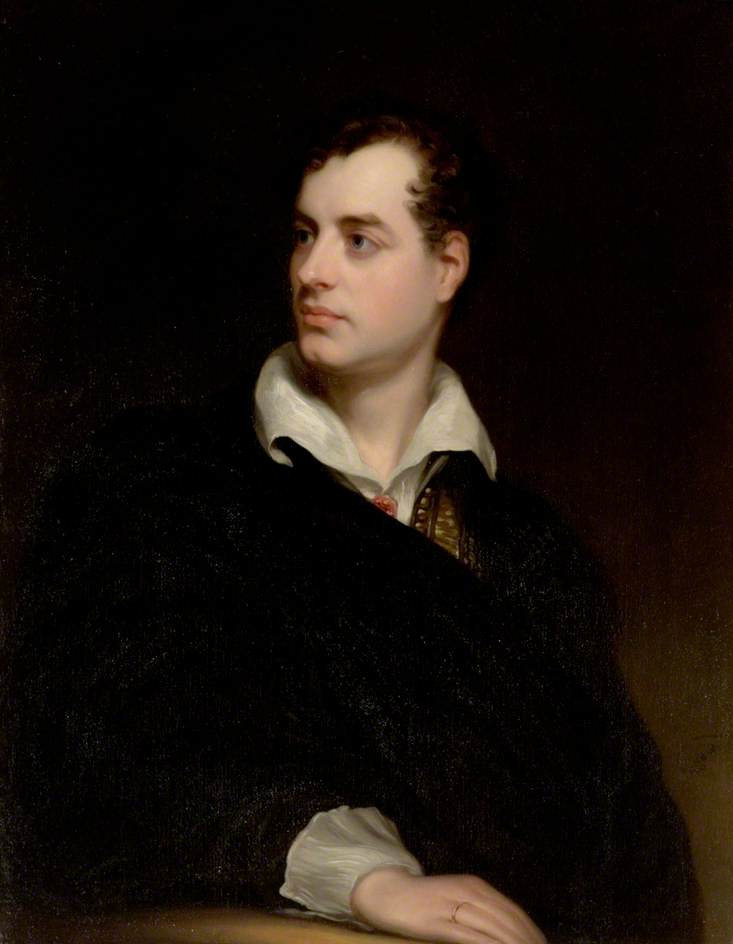
Byron by Thomas Phillips, 1813, Newstead Abbey. Wikimedia.

Byron may well be considered the secular saint of all Western enthusiasts for various foreign “liberation” struggles. He fit the description of such types offered by Tory statesman George Canning in 1821: “a steady patriot of the world alone, the friend of every country but his own.” Today, every American and European campus teems with would-be Byrons, though slogans have supplanted cantos in their repertoire.

Byron is identified above all with Greece and the philhellenes. But at various times he showed sympathy for Turks and Armenians, and seems to have been as promiscuous in his foreign attachments as he was in other aspects of his life.

He was also hugely popular with early Zionists, who imagined that had political Zionism gotten off to an earlier start, he might well have been its champion.

Zionist poetry

The most famous exponent of this view was Nahum Sokolow, a Zionist thinker and diplomat, whose overlooked contribution to securing the Balfour Declaration I’ve assessed elsewhere. In Sokolow’s two-volume History of Zionism (1919), he devotes a section to Byron within his discussion of non-Jewish supporters of Jewish national redemption. Sokolow made the case for Byron as a proto-Zionist by quoting his Hebrew Melodies, a collection published in 1815. Byron wrote these poems at the behest of the Jewish composer and musician Isaac Nathan, who wanted to set (supposedly) ancient Jewish music to contemporary verse.

“Zionist poetry owes more to Byron than to any other Gentile poet,” wrote Sokolow.

His Hebrew Melodies, which are among the most beautiful of his productions, have been translated several times into Hebrew, and there are no lines more popular and more often quoted than:

The wild dove hath her nest, the fox his cave.
Mankind their country, Israel but the grave.

which might well have been a Zionist motto….  [Byron,] who died a martyr to his zeal in the cause of the freedom of Greece, might perhaps have been equally able to sacrifice his life for the freedom of Judaea, had the deliverance of Judaea offered scope for a similar struggle in his time. As it was he expressed the Jewish tragedy, not only in its poetical but also in its political aspect.

In this “what-if,” Sokolow engaged in a bit of fanciful appropriation. There is no evidence at all that Byron saw the Jewish “tragedy” as amenable to a political solution. Yet, there is no doubt that Jews, including Zionists, saw in Hebrew Melodies a validation. The poem “Oh, Weep For Those!” lamenting that the Jews have no home, was translated dozens of times into Hebrew and Yiddish. Jewish settlers as early as the First Aliyah sang it to their own improvised tune.

Indeed, no less than Theodor Herzl may have quoted it. Herzl and the thinker and critic Max Nordau were playing the lead roles in the Second Zionist Congress in 1898, and the press organized a banquet for them. A French newspaper, according to a witness, had just published an article expressing delight at Nordau’s phenomenal memory.

Dr. Herzl, it seems, wished to showcase this, using a strategy that turned out to be both a huge surprise and the highlight of the banquet. After Dr. Nordau finished speaking, Dr. Herzl took the stage. Suddenly, he mentioned a quote from Lord Byron. Looking distressed, he glanced towards Nordau. The help arrived just when needed. Nordau recited the quote, both in the original language and translated, as though reading from an open book.

I say “may have quoted it,” because the report does not specify which poem Herzl attempted to recall or pretended to have forgotten. We shall never know, but what is telling is that, eighty years after Byron’s death, learned European Jews were still quoting him, sometimes accurately. In 1904, the Zionist leader Vladimir (Ze’ev) Jabotinsky included Byron on a list of the ten authors whose works deserved to be preserved if all other books in the world had to be destroyed. According to Jabotinsky, Byron’s influence on his own generation of Russians surpassed that of Tolstoy.

Greeks and Jews

Much of Hebrew Melodies had little to do with the Hebrews at all, so Herzl, Nordau, and Sokolow didn’t have a massive amount to memorize. Indeed, in the case of Byron, there was certainly much they would have preferred to forget. His later poem, “The Age of Bronze” (1823), contains one of the meanest tirades against the Jews in all of English letters. There Byron portrays the Jews, and particularly the Rothschilds, as allies of tyranny against freedom:

All States, all things, all Sovereigns they controul,
And waft a loan “from Indus to the Pole.”
The banker – broker – Baron – Brethren, speed
To aid these bankrupt Tyrants in their need.

The rant escalates, culminating in this:

On Shylock’s shore behold them stand afresh,
To cut from Nations’ hearts their “pound of Flesh.”
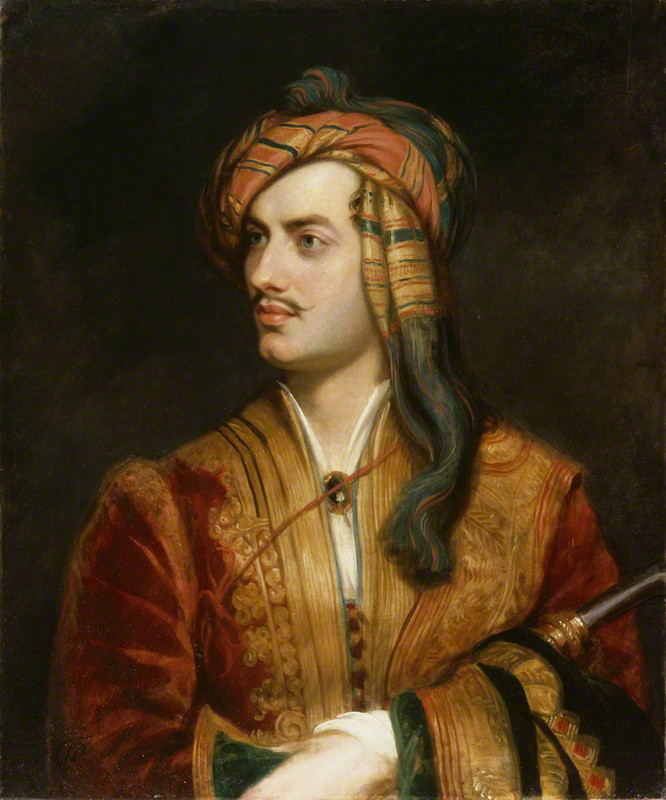
Byron in Albanian dress by Thomas Phillips, c. 1835 from 1813 original, National Portrait Gallery. Wikimedia.

At most, it could be argued that Byron might have championed Jewish freedom as ardently as he did Greek independence, based on his remark to an acquaintance: “I am nearly reconciled to St. Paul, for he says, there is no difference between the Jews and the Greeks, and I am exactly of the same opinion, for the character of both is equally vile.”

It might also be noted (parenthetically) that the cause Byron did champion—Greek independence—was hardly favorable to Jews in its earliest phase. During the struggle, Greek Christians massacred Jews along with Muslims across the Peloponnese, most notoriously in 1821 at Tripolitsa, where all 1,000 Jewish inhabitants were slaughtered. Byron was well aware of the flaws in the movement he embraced. His willingness to look past them is another distinctive characteristic of the foreign friend of foreign causes.

Of course, Zionism owed a vast debt to Romanticism, and in that respect, it hardly matters what the Romantics thought of the Jews. After all, when Herzl wrote his manifesto Der Judenstaat (The Jewish State) in Paris, he refueled each evening by attending Richard Wagner’s opera Tannhäuser. So if Herzl and his disciples took inspiration from Byron, I suppose Israel owes him something.

On this bicentenary of his passing, then, let us reflect on the words of the nineteenth-century Hebrew poet Judah Leib Gordon, who also translated Hebrew Melodies. Just as Byron

was pained by the distress of the Greeks oppressed under the Ottoman yoke and rushed to their aid, he similarly felt compassion for the plight of Joseph and supported the children of Israel with his poetic charm. Byron was the pioneer in using his verses to awaken the love for Zion and a fondness for Jerusalem among his own people and in his land, a love that remains more deeply embedded in our people than in any other nation. Therefore, it is our duty to honor the name of this poet and cherish his memory among our people.

A selection from Hebrew Melodies

Oh! Weep For Those

Oh! Weep for those that wept by Babel’s stream,
Whose shrines are desolate, whose land a dream;
Weep for the harp of Judah’s broken shell;
Mourn—where their God that dwelt the Godless dwell!

And where shall Israel lave her bleeding feet?
And when shall Zion’s songs again seem sweet?
And Judah’s melody once more rejoice
The hearts that leap’d before its heavenly voice?

Tribes of the wandering foot and weary breast,
How shall ye flee away and be at rest!
The wild-dove hath her nest, the fox his cave,
Mankind their Country—Israel but the grave!

On Jordan’s Banks

On Jordan’s banks the Arabs’ camels stray,
On Sion’s hill the False One’s votaries pray,
The Baal-adorer bows on Sinai’s steep—
Yet there—even there—Oh God! thy thunders sleep:

There—where thy finger scorch’d the tablet stone!
There—where thy Shadow to thy people shone!
Thy glory shrouded in its garb of fire:
Thyself—none living see and not expire!

Oh! in the lightning let thy glance appear!
Sweep from his shiver’d hand the oppressor’s spear:
How long by tyrants shall thy land be trod!
How long thy temple worshipless, Oh God!

The Wild Gazelle

The wild Gazelle on Judah’s hills
Exulting yet may bound,
And drink from all the living rills
That gush on holy ground;
Its airy step and glorious eye
May glance in tameless transport by:—

A step as fleet, an eye more bright,
Hath Judah witness’d there;
And o’er her scenes of lost delight
Inhabitants more fair.
The cedars wave on Lebanon,
But Judah’s statelier maids are gone!

More blest each palm that shades those plains
Than Israel’s scattered race;
For taking root it there remains
In solitary grace.
It cannot quit the place of birth,
It will not live in other earth.

But we must wander witheringly,
In other lands to die;
And where our fathers’ ashes be,
Our own may never lie:
Our temple hath not left a stone.
And Mockery sits on Salem’s throne.

On the Day of the Destruction of Jerusalem by Titus

From the last hill that looks on thy once holy dome
I beheld thee, Oh Sion! when rendered to Rome:
’Twas thy last sun went down, and the flames of thy fall
Flash’d back on the last glance I gave to thy wall.

I look’d for thy temple, I look’d for my home,
And forgot for a moment my bondage to come;
I beheld but the death-fire that fed on thy fane,
And the fast-fettered hands that made vengeance in vain.

On many an eve, the high spot whence I gazed
Had reflected the last beam of day as it blazed;
While I stood on the height, and beheld the decline
Of the rays from the mountain that shone on thy shrine.

And now on that mountain I stood on that day,
But I mark’d not the twilight beam melting away;
Oh! would that the lightning had glared in its stead,
And the thunderbolt burst on the conqueror’s head!

But the Gods of the Pagan shall never profane
The shrine where Jehovah disdain’d not to reign;
And scattered and scorn’d as thy people may be,
Our worship, oh Father! is only for thee.

The Destruction of Sennacherib

The Assyrian came down like the wolf on the fold,
And his cohorts were gleaming in purple and gold;
And the sheen of their spears was like stars on the sea,
When the blue wave rolls nightly on deep Galilee.

Like the leaves of the forest when Summer is green,
That host with their banners at sunset were seen:
Like the leaves of the forest when Autumn hath blown,
That host on the morrow lay withered and strown.

For the Angel of Death spread his wings on the blast,
And breathed in the face of the foe as he pass’d,
And the eyes of the sleepers wax’d deadly and chill,
And their hearts but once heav’d, and for ever grew still!

And there lay the steed with his nostril all wide,
But through it there roll’d not the breath of his pride:
And the foam of his gasping lay white on the turf,
And cold as the spray of the rock-beating surf.

And there lay the rider distorted and pale,
With the dew on his brow, and the rust on his mail;
And the tents were all silent, the banners alone,
The lances unlifted, the trumpets unblown.

And the widows of Ashur are loud in their wail,
And the idols are broke in the temple of Baal;
And the might of the Gentile, unsmote by the sword,
Hath melted like snow in the glance of the Lord!

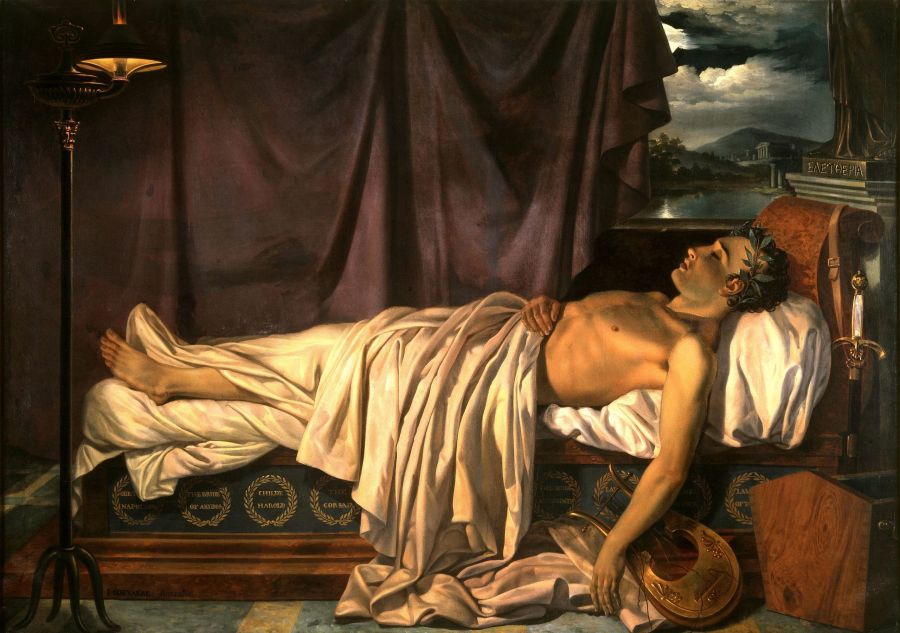
Header image: Byron on his Death-bed by Joseph Dionysius Odevaere, c. 1826, Groeninge Museum, Bruges. Wikimedia.