Civilians should be protected, unless…

In going back over earlier Hamas materials to which I’ve linked in years past, I rediscovered this August 2001 exchange between an interviewer and the late Hamas founder and leader Sheikh Ahmad Yassin (whose image is the background to this photo of present Hamas “prime minister” Ismail Haniyeh). In the interview, Yassin offered a rather unique interpretation of the Geneva Convention. It seems relevant to the present discussion about targeting and avoiding civilian casualties, and faithfully reflects the Hamas view to this day. The relevant segment:

Question: What is the consequence of the deaths of Sheikh Jamal Mansur and Sheikh Jamal Selim (the two top Hamas leaders killed in Nablus) for your organization?

Yassin: Their deaths push us towards more resistance and increase our determination. The way the two sheikhs were killed was cowardly. They were sitting in a media office, they were not in a military base or engaged in a military operation. Military people know they risk dying in battle, but civilians should be protected by the Geneva Convention.

Question: How about Israeli civilians, shouldn’t they be kept out of the conflict as well?

Yassin: The Geneva convention protects civilians in occupied territories, not civilians who are in fact occupiers.

Question: Wasn’t it cowardly to attack young people at a Tel Aviv disco (a terror attack for which Hamas has claimed responsibility)?

Yassin: They’re the ones who are criminals. They took my house and my country. The soldier who attacks us, the pilot who shells us, where do they live? All of Israel, Tel Aviv included, is occupied Palestine. So we’re not actually targeting civilians—that would go against Islam. The crime of occupation is not more legitimate in Tel Aviv [than it is in the West Bank, seized by Israel in 1967] because it is older. If Israel stole my house in Ashkelon in 1948, does it mean it’s OK to have made me homeless? Up to this day Jews are running after Nazis and suing countries although their losses happened a long time ago.

So civilians who are occupiers are not protected, and Tel Aviv is occupied Palestinian territory. Remember this the next time you hear someone say that Hamas deserves sympathy as a movement of “resistance” against “occupation.” Accurate translation: jihad to drive the Jews from “Palestine.”

By the way, in that same interview, Yassin was asked if he was afraid Israel would try to kill him. His answer: “Please, they are welcome.” A couple of years later, they took him up on that.
A plan for surrender (to Hamas)

Israeli Yossi Alpher today publishes a piece in the International Herald Tribune, under the headline “Stop Starving the Gazans.” Alpher claims that the economic sanctions imposed on Gaza after the Hamas power grab in mid-2007 (what he calls “the economic-warfare strategy”) have failed totally; indeed, they have “produced no political or strategic benefit.” “There is not a shred of evidence,” he adds, that economic punishment or incentives toward Palestinians have ever worked. The “blockade” should be abandoned unconditionally—which, by the way, is precisely the main demand of Hamas.

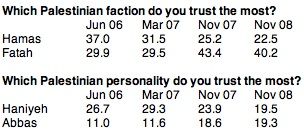
Not a shred of evidence? Here’s some evidence. Hamas sank in Palestinian public opinion in Gaza after it seized power. The most reliable Palestinian pollster got these answers from Gazans (in percentages):

So something was happening in Gaza: a steady erosion of support for Hamas and its leader, benefitting both Fatah and Abbas. What caused it? No doubt Hamas did much to offend Gazans, from its violent coup d’etat to its attempts at social Islamization. But many analysts have pointed primarily to the economic sanctions and the failure of Hamas strategy to get them lifted. “Hamas was losing popularity before this operation,” says Rashid Khalidi. “It was losing popularity because it had failed to open the crossings.” Hamas could read the trend, and it’s why it refused to renew the “lull” and renewed its rocket fire. “Hamas wanted to weaken the Israeli siege,” says Hisham Milhem, “because they have been hurt politically and economically because of the siege.”

So what would the Alpher plan of unconditionally ending the “siege” mean? Hamas would gain credit for lifting the blockade, and have something to show for the war, beyond its mere survival. The opposition to Hamas would be severely undercut, and the split between the West Bank and Gaza would be made permanent. The “peace process” industry, now gearing up again in Washington, would be reduced to the hopeless task of trying to “moderate” Hamas, probably through desultory “engagement.” While we waited for Hamas to have an epiphany, the maps of various final status options might as well be folded up and put in the archives for another twenty years. And Israel might as well fly a white flag over the crossings.

Economics will be crucial when the guns fall silent and the rockets stop falling. Here, too, Israel and the international community have to remain steadfast if they want an outcome that doesn’t just stop the violence today, but also provides hope for tomorrow. When the dust settles, the people of Gaza will be desperate for a return to some normalcy—one denied to them under the rule of jihadists who fanatically tell them they must suffer on the deluded promise that Israel will be destroyed, and that Gazans will one day “return” to repossess all that they lost 60 years ago. Normalcy can be restored only if the needs of Gazans are answered by the international community and the legitimate Palestinian Authority—without the Hamas middleman.

Hamas in Gaza was a bubble. Let’s not inflate it again.

Sanctioning ‘resistance’

Israel’s war against Hamas, now in its third week, is probably closer to its end than to its beginning. Israel has said that the “operation”—there is an official aversion to the term “war”—is close to achieving its stated goal of securing sustained quiet for the south of Israel. Quiet refers to a cessation of rocket fire, and sustainability alludes to an end to weapons smuggling into Gaza from Egypt. These are the two elements that Israel seeks in a cease-fire.

But there is also an unstated goal of the war. It is the humiliation and degradation of Hamas, to such an extent that its continued rule over Gaza will be undermined. As long as Hamas remains in power, it will continue to indoctrinate and prepare for “resistance”—its term for violent jihad-style attacks on Israel. This is the Iran-inspired alternative to acceptance of compromise with Israel, and it is the doctrine that animates Hezbollah as well. Discrediting and delegitmating “resistance” is a prime Israeli objective—one shared by the United States, and presumably by all supporters of any Israeli-Palestinian “peace process,” however configured.

There is a present danger concealed in the diplomacy toward achieving Israel’s stated goal, which could damage its unstated goal.

It is the possibility that a cease-fire might include a lifting of Israeli economic sanctions on Gaza. Israel imposed these sanctions after Hamas seized power in a violent coup in June 2007. Since that time, Israel has restricted imports via its crossings to “humanitarian” shipments of food and medicines, as well as fuel. The crossings have been closed to most commercial products and virtually all building materials.

The sanctions regime had a number of demonstrable effects. It made it impossible for Hamas to deliver on its social and welfare promises. As a result, its rule appeared much inferior to Palestinian Authority rule in the West Bank, which lately has enjoyed the economic benefits of increased cooperation with Israel. Reports from Gaza suggested a simmering discontent with isolation and economic hardship. The sanctions also had symbolic value, by branding the Hamas regime as illegitimate.

Contrary to some Palestinian claims, the “lull” agreement did not provide for a lifting of the sanctions. It eased them, but only partially, and some imports, such as much-needed construction materials, continued to be banned altogether. It was in the hope of securing a new cease-fire, ending the sanctions altogether, that Hamas refused to renew the “lull” agreement and began firing rockets in December.

The lifting of sanctions has become the principal Hamas demand in the cease-fire negotiations. If Hamas can lift the sanctions, it will claim victory. It will argue that it broke the “siege” through “resistance”—albeit at a high cost—and that it effectively wrested economic control of Gaza’s frontiers from Israel. It will also claim that the lifting of the “blockade” constitutes de facto acceptance of Hamas rule in Gaza by both Israel and the international community.

Mediators operate by finding formulae that allow each side to claim some achievement. Lifting the “blockade” could well become the concession Israel will be asked to make to Hamas, especially since Israel hasn’t defined the continuation of sanctions as one of its declared goals. The concession will be urged upon Israel as a “humanitarian” measure by much of the international community, which will point to the urgent need for reconstruction.

After the military campaign is over, Israel’s control of Gaza’s economy will be its principal lever for translating its military achievements into political gains—above all, the continued degradation of Hamas control. Gaza will be desperate for all material things. Whoever controls their distribution will effectively control many aspects of daily life in Gaza.

This is a card Israel must be careful not to trade, either for a cease-fire or for international anti-smuggling cooperation on the Egypt-Gaza border. To that end, it must act now to affirm its adhesion to the sanctions. Israel should be willing to ease sanctions only if an international consortium for reconstruction is established, which has the legitimate Palestinian Authority as its sole agent within Gaza. In any cease-fire agreement, Israel should agree to open the crossings only to emergency food and medical aid—as it has during the fighting itself.

Ultimately, Operation Cast Lead will be judged not only by whether it produces an end to rocket fire—which it will—but whether it sets the stage for a shift of power within Gaza, away from Hamas “resistance”—a deceptive misnomer for Palestinian jihadism. This long-term goal should not be sacrificed to achieve short-term objectives.

This post originally appeared in the series On Second Thought, published by the Adelson Institute for Strategic Studies, Shalem Center, Jerusalem.