Golda Meir’s filtration system

The film Golda, coinciding with the 50th anniversary of the Yom Kippur War, has sharply focused attention on how Prime Minister Golda Meir made critical decisions in the lead-up to and during the fateful days of October 1973. Here I offer some evidence and insights from the late Bernard Lewis, the most acclaimed historian of the Middle East in our time. Lewis was an astute observer who frequently traveled between Cairo and Jerusalem prior to the war. He has left us a valuable account of his experience in his memoirs.

Lewis was well-acquainted with a wide range of Israel’s leaders from his generation and those that followed. They included Abba Eban, whom he knew from an early age, as well as Moshe Dayan, Shimon Peres, Yitzhak Rabin, Ehud Barak, and Benjamin Netanyahu. However, apart from Eban, Golda Meir was the first Israeli leader he got to know well, and he approached her as a man on a mission.

“Egypt was ready for peace”

In 1969, Lewis visited Egypt to attend a conference. Gamal Abdul Nasser still held power, and Egypt struggled to rebound from its defeat in the Six-Day War two years prior. Lewis briefly met Nasser, but they did not have a conversation. Still, he recalled, “I saw a lot of people, including old friends, and I was very much struck by the change in mood. I came away with a very clear impression that Egypt was ready for peace. I was sure of it. I had no doubts whatsoever.”

Over the next two years, Lewis’s conviction deepened. He returned to Cairo in 1970 and again in 1971, after Nasser’s death. While he did not meet Nasser’s successor, Anwar Sadat, he met his advisers, and he became “convinced that a direct approach to Egypt would produce results.”

In 1971, he reiterated his view in US Senate testimony: “I am quite convinced that there is in Egypt a genuine desire for peace. I have no doubt about that at all. It was there before the death of Nasser, and it has become more open since the death of Nasser.” In fact, Sadat’s adviser, Tahseen Bashir, seems to have asked Lewis to convey to Golda that Sadat wished to negotiate an interim agreement.

But the Israelis were not interested. During one of Lewis’s visits to Israel, Golda invited him into her kitchen and offered him tea and cake. Lewis made his case for a direct approach to Egypt, but Golda summarily dismissed it. Lewis tells the story:

She didn’t believe me. She indicated that I had allowed myself to be duped by the Egyptians and that it was all nonsense. I tried the same on Moshe Dayan. I think he did believe me, but he didn’t like it. He just didn’t want to negotiate…. I also put it to Rabin. I even wrote Rabin a letter to that effect. But it fell on deaf ears; they didn’t believe me or didn’t want to believe me.

Did the Yom Kippur War occur because Golda thought Lewis had been misled? She missed many more signals in far more important channels. But Golda’s dismissal of Lewis sheds light on why those other messages got lost in transmission.

“Only what she wanted to hear”

Lewis had another encounter with Golda Meir a few years later, on the Palestinian question. In 1974, Lewis prepared a piece that eventually would be published by Commentary under the title “The Palestinians and the PLO.” Lewis began by demonstrating how the concept of a Palestinian people arose only after the First World War. “The emergence of a distinctive Palestinian entity,” he wrote, “is a product of the last decades and may be seen as the joint creation of Israel and the Arab states — the one by extruding the Arabs of Palestine, the others by refusing to accept them.”

Golda distributed Lewis’s article to the entire cabinet, and she summoned him to a meeting. According to one participant, “they spoke for hours. Her aides tried to end it, but Golda kept going, and Bernard didn’t want to be rude.” Golda latched onto Lewis’s historical point about the recent origin of Palestinian identity. In 1969, she had said that “there was no such thing as Palestinians,” perhaps her most famous (or infamous) remark. Now she believed she had found scholarly support to validate her claim.

But she completely ignored the rest of the article, where Lewis had urged Israel to “test the willingness or ability” of the PLO to negotiate a two-state solution — this, at a time when Israel regarded the PLO as a terrorist organization utterly beyond the pale. Golda simply ignored that part of Lewis’s argument.

Lewis later identified Meir’s problem. She was admirably tough, but overly rigid:

Golda was fitted with a kind of personal filtration system — she only heard what she wanted to hear. If she picked up anything in what I was saying to her that fit within her pattern of thought, she would immediately grasp and use it. Anything that didn’t fit just went straight past her.

The same might be said of the entire political and security establishment over which she presided in 1973.

The question of whether historians have valuable insights to offer policymakers is always up for debate. No historical circumstance perfectly mirrors the current moment. However, one abiding truth taught by historians is irrefutable: in human affairs, nothing remains static. Israel learned that the hard way in 1973. This 50th anniversary should remind us once more that Israel must never rest.

This is based on a lecture I delivered about Bernard Lewis and world leaders at Tel Aviv University in June. View the entire lecture at this link.

Header image: Prime Minister Golda Meir shaking hands with Chief of Staff Haim Bar Lev, standing between Supreme Court Justice Shlomo Agranat and Defense Minister Moshe Dayan, before departing for the United States at Lod Airport, September 24, 1969. Photographer: Moshe Milner, Israel Government Press Office.

Bernard Lewis and world leaders

In his memoirs, Bernard Lewis, the late, great historian of the Middle East (and my mentor), wrote this:

I had occasional encounters with the historic process through meetings which made policy. Over the years, in my innumerable visits to the Middle East I had meetings with kings, presidents, prime ministers, other high officials, as well as with ambassadors of different states. We talked of various things, and from time to time I gave my opinions—sometimes in response to a request, sometimes not.

In a new lecture (delivered at Tel Aviv University), I put flesh to the bare bones of this statement. I name some of those kings, presidents, prime ministers, and other high officials; reconstruct a few of Lewis’s interactions with them and put them in context; and, finally, ask whether they made any difference.

Some of the central players in the story: Israeli prime minister Golda Meir, American politician Henry “Scoop” Jackson, Mohammed Reza Shah of Iran, Turkish president Turgut Özal, former Jordanian crown prince Hassan, U.S. vice-president Dick Cheney and president George Bush, Libyan dictator Mu‘ammar Qadhafi, and Israeli prime minister Benjamin Netanyahu. I also treat the much-discussed matter of Lewis and the Iraq war. To watch the lecture, click here or watch below (one hour, illustrated).

As I said in the lecture, this is a work in progress. If you have any information that fills a gap in my presentation, please send it along.

Israel from 25 to 75

Israel is celebrating its 75th birthday. Many have noted the cloud over this anniversary. The Associated Press ran its story on Israel’s Independence Day under this headline: “A deeply divided Israel limps toward its 75th birthday.” The New York Times led with this headline: “Political chaos unsettles Israel as it looks to honor the fallen and its independence.” 

To put this in perspective, I’d like to recall another anniversary that I witnessed, and that took place under a cloudless sky.

Fifty years ago, in 1973, I’d been living in Israel with my parents and brothers for nearly two years. In May, Israel was set to celebrate its “silver” 25th anniversary. Israel’s self-confidence at that moment couldn’t have been higher. Its smashing victory of June 1967 was still fresh in the collective memory. Israel sat astride the Middle East like a colossus, from the Suez Canal in the south, to the outskirts of Damascus in the north. The country was booming: in every year since 1969, per capita income had grown by 20 percent. 

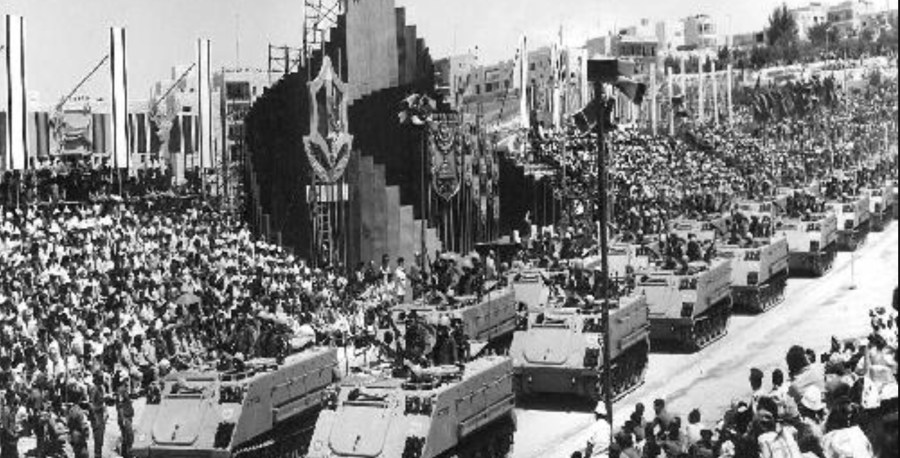
The leaders of the day, who included Prime Minister Golda Meir and Defense Minister Moshe Dayan, decided that the best way to mark Israel’s 25th anniversary would be a giant military parade in Jerusalem. 

My father, who was a resourceful man, managed to get us tickets to the main reviewing stand. So I sat with my family on that glorious day, watching the full might of Israel unfold before 300,000 spectators. 

Thousands of soldiers marched by, from every branch of the military. Tanks and armored personnel carriers rumbled before us, spewing smoke as their tracks rattled over the asphalt. (Some of those tanks were Soviet, captured in 1967 from Arab armies.) Fighter jets and attack helicopters roared overhead in perfect formation. In the main reviewing stand were not just the leaders of Israel, but the surviving founders of this tiny superpower—most notably, David Ben-Gurion, the Old Man himself, then 86. 

It’s a day I’ll never forget: a day of unsurpassed pride in the power of Israel.

Highlights of the 1973 military parade in Jerusalem.

And also, as we would learn, a day of unsurpassed hubris. No one in that crowd imagined that five months later, Israel would be plunged into a desperate struggle for survival. On the next Yom Kippur day, October 6, the armies of Egypt and Syria launched a combined surprise attack on Israel. Israel’s flexing of its muscles hadn’t deterred them at all. 

Israel survived that war, but the country was shaken to its foundations. Israelis had been arrogant in thinking themselves invincible. Their leaders had been wrong to dismiss the resolve and the capabilities of the Arabs. And Israel had paid a terrible price: almost 2,700 dead and more than 7,200 injured, thousands of them permanently incapacitated and maimed. They included many who had paraded in Jerusalem only months earlier.

The war also brought down a political elite that had run the country since independence, including both Golda Meir and Dayan. It marked the beginning of the end for the Labor Party. And there would never be a military parade on Independence Day again. 

Why do I tell this story now? Israel has the most to fear not from doubt, but from hubris. An Israel that questions itself has a better chance than an Israel that puffs with pride. An Israel that looks strong on the outside can conceal weakness within. But an Israel that fearlessly probes its weaknesses can emerge stronger. 

So I’m actually reassured by the apprehensive and pensive mood on this 75th anniversary. Israel has so much to celebrate. We owe it to our children and grandchildren to explain the inexplicable: how a tormented people rose from the slag heap of history, and rebuilt itself as an independent state and a prosperous nation, against all the odds. Along the way, it welcomed millions of refugees, defeated and made peace with enemies, and became a military and economic powerhouse. 

But Israelis must also remain vigilant. That not only means standing up to enemies, but questioning the judgment of their own elected politicians. The leaders I saw in the reviewing stand on that day in 1973 had been in power for a long time, and thought they shouldn’t be doubted. The leaders of today’s Israel have been in power a long time, and think the same. The duty of citizens doesn’t end with elections. Perpetual vigilance is crucial, because as we discovered fifty years ago, even the most seasoned statesmen and politicians can make tragic mistakes.

Happy birthday, Israel!

If you never watched it, this is a great time to view my seven-part lecture series on Israel’s Declaration of Independence, at this link.

Header image: From the 1973 parade, Central Zionist Archives, PHKH/128915.