Did you notice this sentence in a recent story about the Khalidi-Obama video controversy in the Los Angeles Times? It mentioned “[Rashid] Khalidi, a renowned scholar on the Palestinians who in the 1970s had acted as a spokesman for Yasser Arafat’s Palestine Liberation Organization.”
Wait a minute—isn’t that “spokesman” claim supposed to be dubious, false, contested? “They’ve falsely called him a spokesman for the PLO,” huffed Jake Tapper, ABC News’ Senior National Correspondent. The bloggers say so too. “Khalidi was not, as the schlock rightwing press charges, a spokesman for the Palestine Liberation Organization” (Juan Cole). “The fact that [McCain] repeats the charge that Khalidi was a spokesman for the PLO, a claim that Khalidi denies, and that there is independent reason to think is false—suggests either that he doesn’t know, or that he doesn’t care what the truth is” (Hilary Bok at Obsidian Wings). “Rashid Khalidi, by the way, is not and never was a ‘PLO spokesperson'” (Richard Silverstein). And not all the protest comes from the left. “He never was a spokesman for the PLO” (R. Bruce McColm, who was the president of the International Republican Institute when it dumped hundreds of thousands of dollars on a Khalidi-backed project in the 1990s).
So what gives at the Los Angeles Times? Simple. It was the Times, back in 1976, which first tagged Khalidi as “a PLO spokesman.” And it wasn’t just any correspondent who did it. It was Joe Alex Morris Jr., who at the time headed the newspaper’s Beirut bureau (which he had opened in 1965).
Morris was a legendary Middle East correspondent. Upon his death in Iran in 1979—he was killed while covering the Iranian revolution—the Washington Post wrote that he “was regarded by his colleagues as the dean of American correspondents in the Middle East. For more than a quarter century he chronicled them all, Arabs and Israelis, Farouk and Nasser and Saddam Hussein and the Palestinians, the shah and Khomeini, always insisting on reporting from up front.” In 1968, he won the Overseas Press Club Award for his coverage of the June 1967 war. In 1981, the Nieman Foundation posthumously conferred upon him its award for conscience and integrity in journalism. Since that time, the Foundation has sponsored an annual memorial lecture in his name, delivered at Harvard by an outstanding journalist. (Lecturers have included a who’s who of prominent Middle East correspondents: Tom Friedman, Jonathan Randal, Anthony Shadid, John Burns, George Packer…)
If Morris reported it, then the Los Angeles Times regards it as a fact. In the face of all the self-interested denials of a heated election year, it’s clearly sticking by the 32-year-old reportage of a long-dead correspondent. I find that noble, and if you admire the newspaper for holding back the video, then you should admire it for this as well. Morris was not an interested party when he identified Khalidi as “a PLO spokesman,” he was contemporary with events, and there is every reason to presume that he reported this accurately. The Los Angeles Times hasn’t allowed politically motivated howls to erode its total confidence in Morris and his professionalism.
Plaudits to the Los Angeles Times.
(Footnote: In 1978, the Beirut bureau chief of the New York Times, James M. Markham, likewise wrote that Khalidi “works for the P.L.O.” Let’s see if the New York Times stands by that highly esteemed correspondent—also long dead. For all the evidence of Khalidi’s role as spokesman, now including a 1979 radio documentary, visit my post “Khalidi of the PLO.”)
“He has family literally all over the world. I feel a kindred spirit from that.”
—Rashid Khalidi on Barack Obama
The link between Palestinian-American agitprof Rashid Khalidi and Democratic presidential candidate Barack Obama has finally been picked up by the mainstream media. It’s something they should have looked at long ago, and even now, they aren’t really digging. They’re simply reporting the demand of the McCain campaign that the Los Angeles Times release the video of Obama’s praise of Khalidi, at a farewell gathering for Khalidi in 2003. Obama and Khalidi (and their wives) became friends in the 1990s, when Obama began to teach at the University of Chicago, where Khalidi also taught. In 2003, Khalidi accepted the Edward Said Professorship of Arab Studies at Columbia; the videotaped event was his Chicago farewell party. The Los Angeles Times, which refuses to release the tape (and which endorsed Obama on October 19) reported last spring that Obama praised Khalidi’s “consistent reminders to me of my own blind spots and my own biases.” Other speakers reportedly said incendiary things against Israel. Whether or how Obama reacted, only the videotape might tell.
That Obama spoke on this important occasion suggests that his attachment to Khalidi wasn’t a superficial acquaintance. As Obama admits, the two had many “conversations” over dinner at the Khalidis’ home, and these may well have constituted Obama’s primer on the Middle East. Yet Obama has given no account of these conversations, even as he has repeatedly emphasized other ones which would seem far less significant.
For example, Obama, in an interview and in his spring AIPAC speech, recalled conversations with a Jewish-American camp counselor he encountered—when he was all of eleven years old. “During the course of this two-week camp he shared with me the idea of returning to a homeland and what that meant for people who had suffered from the Holocaust, and he talked about the idea of preserving a culture when a people had been uprooted with the view of eventually returning home. There was something so powerful and compelling for me, maybe because I was a kid who never entirely felt like he was rooted.” (In the same interview, Obama said Israel “speaks to my history of being uprooted, it speaks to the African-American story of exodus.”)
Of course, the story of someone like Khalidi could just as readily have spoken to Obama’s history of uprootedness, exodus, preserving a culture, and longing to return home. (So too would the story of the late Edward Said, who was photographed seated at a dinner with Obama in 1998, and who entitled his memoir Out of Place. Obama has never said anything about the impact, if any, of that conversation.) And indeed, it stretches credulity to believe that a two-week childhood encounter at a summer camp was more significant to Obama that his decade-long association, as a mature adult, with his senior university colleague, Khalidi.
Nor does it seem far-fetched that the sense of “kindred spirit” felt by Khalidi toward Obama was mutual. One particularly striking parallel deserves mention. Obama, it will be recalled, was born to a nominally Muslim father (a Kenyan bureaucat) and an American Christian mother, which has created some confusion as to the religious tradition in which he was raised. Khalidi’s father, a nominally Muslim Palestinian (and a bureaucrat who worked for the United Nations) married his mother, a Lebanese-American Christian, in a Unitarian Church in Brooklyn, where Khalidi would later attend Sunday school. For such people caught between traditions, Third Worldist sympathies often serve as ecumenical substitutes for religion. (Obama himself allows that as an undergraduate, “in the dorms, we discussed neocolonialism, Franz Fanon, Eurocentrism and patriarchy.” One wonders how Israel fared in those conversations.)
Were we to see the videotape, it might give us some sense of how far down the road Obama went in that direction—and not all that long ago. It would be interesting to know, for example, if there was reference to Iraq. In 2003, when Khalidi’s friends gave him his goodbye party, he was deep into propagandizing against the Iraq war. Among his arguments, he included this one:
This war will be fought because these neoconservatives desire to make the Middle East safe not for democracy, but for Israeli hegemony. They are convinced that the Middle East is irremediably hostile to both the United States and Israel; and they firmly hold the racist view that Middle Easterners understand only force. For these American Likudniks and their Israeli counterparts, sad to say, the tragedy of September 11 was a godsend: It enabled them to draft the United States to help fight Israel’s enemies.
This argument against the war was not at all unusual on the faculty of the University of Chicago at the time. Another professor of Middle East history, Fred Donner, gave it blatant expression on the pages of the Chicago Tribune, calling the Iraq war “a vision deriving from Likud-oriented members of the president’s team—particularly Richard Perle, Paul Wolfowitz and Douglas Feith.” So perhaps it is not surprising that Obama, in his October 2002 antiwar speech, declared: “What I am opposed to is the cynical attempt by Richard Perle and Paul Wolfowitz and other arm-chair, weekend warriors in this Administration to shove their own ideological agendas down our throats, irrespective of the costs in lives lost and in hardships borne.” No mention of Cheney or Rumsfeld—and no need to mention them, to a constituency that knew who was really behind the push for war, and why. (Later, the same argument would figure prominently in The Israel Lobby, co-authored by another Chicago professor, John Mearsheimer.)
Obama, when pressed during an appearance before a Jewish audience, admitted that “I do know him [Khalidi] because I taught at the University of Chicago.” This sounds wholly innocuous; I also know Khalidi because I taught at the University of Chicago—twice, in 1990 and 1991, when I had an office on the same hall. Obama continues: “And I do know him and I have had conversations.” Well, even I’ve had conversations with Khalidi. (A former Chicago graduate student who must keep meticulous records writes to me that he spotted me on December 6, 1990, at the Quad Club lunching with Khalidi.) Nor does it mean much if Khalidi introduced Obama to Edward Said; Khalidi introduced me to Edward Said in New York in November 1986.
The difference is that while I came away from these encounters convinced that Khalidi’s purported moderation was a sham, and have said so, Obama went the other direction, maintaining their friendship right up to Khalidi’s send-off from Chicago, to which he contributed an encomium. Which is why I’d really like to see that videotape. I’m just curious which of Rashid Khalidi’s virtues I somehow missed, and Barack Obama saw.
Pointer: The next public sighting of Khalidi will be at a Columbia conference entitled “Orientalism from the Standpoint of its Victims—An Edward Said Conference,” on November 7. Khalidi will deliver the opening address.
This post has several important updates. The first brings a passage from a 1978 New York Times report from Beirut, noting that Rashid Khalidi “works for the P.L.O.” The third uncovers a passage from a 1976 Los Angeles Times report, also from Beirut, describing Khalidi as “a PLO spokesman.”
The fourth update, the most compelling, unearths a 1979 radio documentary on the PLO featuring Khalidi, in which he is repeatedly identified as an official PLO spokesperson in the Palestinian news service, Wafa. The interview with him was conducted at PLO headquarters in Beirut. The documentary may be heard in its entirety. —Martin Kramer
Was Rashid Khalidi a PLO “spokesman” or director of its press agency in Beirut back in 1982? I’ll leave it to others to determine whether or not it matters (or matters enough) to the Khalidi-Obama connection. But I get riled up when people testify to Khalidi’s bona fides without doing due diligence—especially when they specifically address Jewish audiences. Example: Ron Kampeas of the Jewish Telegraphic Agency (JTA).
Kampeas makes this argument, against the claim that Khalidi was a PLO spokesman:
The problem with the “spokesman” claim is that you can actually prove it’s not true. In saner times, “prove it’s not true” would be a phrase frowned on in an innocent until proven guilty culture. Khalidi’s denial would be enough in the face of a lack of evidence as to same. Those promoting the claim cite a single 1982 article by Tom Friedman; Khalidi says Friedman got it wrong, and that the term “PLO spokesman” was used promiscuously in 1982 Beirut.
But like I said, things ain’t so sane.
So here’s the thing: What everyone acknowledges is that Khalidi was an adviser to the Palestinian delegation to the 1991 Madrid talks. That delegation—to a person—could not have had any formal affiliation with the PLO. Israel regarded the group as terrorist and its laws banned contact with its members; then-Prime Minister Yitzhak Shamir made not being affiliated with the PLO a condition of Israel’s agreement to participate. The names of the Palestinian team would have been vetted by Israeli intelligence.
This was something of a nudge and a wink, of course: Faisal Husseini, who headed the team, was in constant contact with PLO headquarters in Tunis.
Still, it should put to rest the notion that Khalidi was ever a “spokesman” for the group.
This is a tissue of errors. Khalidi was not part of the official Palestinian delegation, whose 14 members all came from the West Bank and Gaza. He belonged to a six-person advisory panel which came to Madrid precisely to serve as a conduit between the official delegation and the PLO. The Israeli government was not at all pleased with this addition, and the New York Times ran a story about it under the headline: “Israelis Deplore Advisory Panel Of Palestinians.” Khalidi is named there as one of the six.
Clyde Haberman, the Times correspondent who reported the story, said of the six: “It is this group that presumably will be calling the shots, and one way or another all its members violate Israel’s guidelines for the sort of Palestinians with whom it is prepared to negotiate. In particular, they speak openly for the P.L.O.” So, pace Kampeas, Israel did not vet and approve Khalidi—exactly the opposite was true. “We will not speak with these advisers,” announced then-Israeli prime minister Yitzhak Shamir. “Secondly, they will not be present in the room during the deliberations of the conference.” Poof! There goes Kampeas’s “proof” that the “spokesman” claim is logically false.
As for Khalidi’s denial, there are ample grounds to question it. In 2004, when he made it, Khalidi wrote that between 1976 and 1983, “I was teaching full time as an Assistant Professor in the Political Studies and Public Administration Dept. at the American University of Beirut, published two books and several articles, and also was a research fellow at the independent Institute for Palestine Studies.” Khalidi claimed he had time for little else. “I often spoke to journalists in Beirut, who usually cited me without attribution as a well-informed Palestinian source. If some misidentified me at the time, I am not aware of it.”
Now if someone misidentified me on the pages of the New York Times—Tom Friedman, no less—I’m sure I would be aware of it. So would you. Yet Khalidi did not seek a correction of Friedman’s characterization at the time, although the Times regularly issues corrections of such mistakes, and presumably would have done the same for Khalidi.
Khalidi’s self-description as being a preoccupied professor while in Beirut also contradicts a statement he made in a 2005 interview. After listing the stations in his academic career, he was asked this question: “You were also involved politically as well?” Khalidi: “Well, yes. I was deeply involved in politics in Beirut.”
It is worth explaining what it meant to be “deeply involved in politics in Beirut” during the civil war in Lebanon. It was not at all like community organizing in Chicago. The Lebanese state had ceased to function; the political actors were all armed militias, Lebanese and Palestinian. Every individual needed to be affiliated with such an organization, if not for bread then at least for protection. Khalidi was known to be affiliated with, and protected by, Arafat’s Fatah. A 1979 New York Times report (by Youssef Ibrahim) described Khalidi as “a professor of political science who is close to Al Fatah.” In Beirut, to be “close” to an organization meant you enjoyed its protection in return for loyalty and services rendered. Khalidi’s wife also worked as an English translator for the PLO’s press agency, Wafa. So savvy journalists knew that if they wanted the Fatah spin, they could get it from Khalidi.
This is also probably why Khalidi didn’t correct Tom Friedman’s “error,” although he would have known of it. Friedman, in a report filed from Beirut on the third day of the 1982 Israeli invasion, called Khalidi “a director of the Palestinian press agency, Wafa” which must have reflected his perception. It’s possible that in the PLO’s (chaotic) mobilization, Khalidi had a reason to represent himself as such, and was working alongside his wife. Or perhaps Friedman just got it wrong in the heat of battle (he had not quoted Khalidi before). In any event, Khalidi presumably didn’t ask for a correction, because the Times never ran one.
Khalidi later broke with Arafat, but like him, he remains a bundle of ambiguities and incongruities, many of them deliberately constructed. He’s much too elusive for any passing journalist to pin down. Rashid Khalidi becomes what people wish him to be. Perhaps that’s yet another way in which he and Barack Obama are kindred spirits.
First Update: Ron Kampeas has rushed to defend his indefensible thesis, insisting that because the advisory panel came to Madrid, they still must have been “vetted” by Israel and cleared of any PLO taint. In fact, the United States had invited all of them without asking Israel, as the New York Times reported. (“The Americans are playing clever games and trying to outsmart us,” complained an Israeli diplomat to the Boston Globe.) Israel objected but acquiesced. That cannot logically be read as establishing for a fact that Khalidi couldn’t have been PLO-affiliated almost a decade earlier in Beirut, which is Kampeas’s thesis.
Nor is there any reason to be certain that Tom Friedman erred in identifying Khalidi as he did—certainly not because Khalidi claimed so twenty years later. I’ve been interviewed many times by journalists, and standard operating procedure—which Kampeas no doubt follows—is to end by asking the interviewee how he or she wants to be identified. My personal inclination is to believe that Friedman is too professional not to have asked Khalidi, or to have called Khalidi “a director of the Palestinian press agency, Wafa” out of the blue. Why might Khalidi have identified himself thus? He would have had his reasons. (How Friedman described Khalidi in a review of one of Khalidi’s books years later, which Kampeas thinks proves something, seems to me entirely irrelevant.)
Finally, Kampeas argues that Khalidi couldn’t have known or done anything to correct Friedman’s “error” because Israel’s invasion of Lebanon had just begun. It’s not inconceivable (if it really was an error). But a commentator on this post brings my attention to an earlier New York Timesarticle, dated February 19, 1978 (by the late James M. Markham), which has been overlooked because Khalidi’s name appears there as Khalidy. There he is identified as “an American-educated Palestinian who teaches political science at the American University of Beirut and also works for the P.L.O.” The front-page story opened a major series on the Palestinians, and Khalidi certainly could have corrected the PLO reference, if it was an error. He didn’t.
Poor Ron—reduced to contortions to uphold the truth-telling credibility of Rashid Khalidi, of all people. He joins a long list of the credulous (including well-meaning journalists, rabbis, deans, etc.) who haven’t figured out that Khalidi says one thing here, and another thing there. For more evidence, see my exhaustive archive of Khalidiana.
Second update: Ron Kampeas, in another update (scroll down), does still more absurd acrobatics to prove that Tom Friedman had to be wrong back in 1982, or the New York Times had to have fouled up—that Khalidi couldn’t possibly have misled them. I don’t buy it at all, but Friedman and the Times can speak for themselves, and maybe they will.
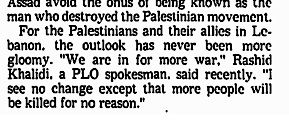
But Kampeas dismisses the 1978 Times piece (clip right above) with this:
Martin finds an earlier New York Times reference to Khalidi—as Khalidy—as “working for the PLO.” Yet this writer clearly didn’t ask Khalidi how to spell his name. (The loose rules of Arab transliteration would not apply to a New York-born U.S. citizen; Khalidi is consistent on how one spells his name.)
That’s it? Case dismissed? “This writer,” James Markham, was the Times Beirut bureau chief in 1975 and 1976, covering the civil war (for which he almost took a Pulitzer), and he covered the Israeli invasion of Lebanon in 1978 and the Iranian revolution. He was a Princeton grad and a Rhodes Scholar, and during a long career as a foreign correspondent earned a reputation as a consummate professional. (He knew his Palestinians, too, and he once responded to criticism of being too sympathetic to them in these words: ”I do not romanticize Palestinian gunmen, because I have seen too many of them. I have even had them stick guns at my head and threaten to kill me. But I have also met and talked with other Palestinians, and not all Palestinians are terrorists.”) If Kampeas is suggesting that Markham somehow made up the PLO tag for Khalidi….
Markham and Friedman mistakenly put Khalidi in the PLO? Two strikes of lightening? Come on. Khalidi has never come clean about Beirut; he’s said he was too busy to be political, and that he was “deeply involved” in politics. So the truth should be determined independently of what he claims or denies, and the evidence so far is that he was in thick with the PLO, when the organization was still neck-deep in terrorism. Markham, interestingly, identified Khalidi as an “American-educated Palestinian,” which suggests to me that Khalidi may have been hiding the fact of his U.S. citizenship as well. There is a mystery here, and one hopes that a major newspaper—perhaps the Times itself—will get to the bottom of it, now that “Khalidi” is a household word, and Barack Obama has anointed him a “respected scholar.”
Third Update: And here is the earliest and most unequivocal evidence yet. It is from an article filed by the late Joe Alex Morris Jr., Los Angeles Times Middle East correspondent based in Beirut, published in that paper on September 5, 1976, under the headline “Lebanon War Hurts Palestinian Cause.” Rashid Khalidi is identified as “a PLO spokesman.”
Fourth Update:Now comes the most decisive proof of all, thanks to a reader of this blog. It is a 48-minute radio documentary entitled “The Gun and the Olive Branch: The Palestine Liberation Organization,” produced in 1979 for Pacifica in Berkeley, California. The production is overwhelmingly sympathetic to the PLO, and it features Rashid Khalidi from Beirut. Download it here (mp3), or go here and listen to it in a media player.
Khalidi is given an affiliation by the narrator five times, as follows (with the elapsed time in parentheses):
“Rashid Khalidi, interviewed in Beirut, is an official spokesperson for the Palestinian news service Wafa” (7:34)
“PLO spokesperson Rashid Khalidi” (11:45)
“Rashid Khalidi, official spokesperson for the PLO” (21:00)
“Rashid Khalidi, interviewed at the headquarters of the PLO in Beirut” (29:57)
“Rashid Khalidi is the leading spokesperson for the PLO news agency, Wafa” (32:51)
These references to Khalidi’s role in Wafa confirm the subsequent identification of him in 1982 by Tom Friedman in the New York Times as “a director of the Palestinian press agency, Wafa” (see above). This report has been wrongly dismissed as erroneous. Not only is it now shown to be entirely accurate, but Khalidi’s role at Wafa now appears to have been sustained over some years.
In my second update, I wondered why the late James M. Markham, in his 1978 article in the New York Times, identified the New York-born Khalidi as “an American-educated Palestinian,” and I speculated that Khalidi might have concealed his American citizenship while in Beirut. The comments by the narrator of this documentary seem to suggest that he did just that, and that Khalidi may even have claimed to have been born in Palestine. At one point, we are told that a younger generation of Palestinians, born in Palestine and raised abroad, was now returning to take up arms. The narrator adds: “Rashid Khalidi, who studied for ten years in the United States, was one of those who returned” (17:38). At another point, the narrator states: “Rashid Khalidi was born in Palestine,” shortly after which Khalidi says: “My grandfather’s home in Jaffa is housing a number of families, I don’t know where they’re from, but it’s not my house anymore, it’s not my father’s house, it’s not our house any longer. So that it’s a personal thing” (38:07).
As for the content of Khalidi’s remarks, it is vintage PLO circa 1979. Particularly noteworthy is the justification of attacks on civilians as legitimate reactions to disproportionate Israeli violence (14:00). Khalidi explains PLO strategy, gives an outline of the organization’s history, claims the PLO represents all Palestinians everywhere, offers a flattering account of its structure and services, and argues for a “secular democratic state” to replace Israel, which he calls a “magnanimous” offer on the part of the PLO.
It is a stunning performance, which should be heard in its entirety. It puts to rest the debate over whether Khalidi was a PLO spokesman in Beirut. He most definitely was.
Postscript: Ron Kampeas graciously concedes: “Martin is right—the evidence of Rashid Khalidi’s PLO past is now irrefutable.”
Fifth Update: The Washington Post has published a letter by Thomas W. Lippman of the Middle East Institute. Lippman, a former diplomatic, national security, and Middle East correspondent for the Washington Post (1966-99, 2003), writes in that letter (November 1):
The Post’s defense of Rashid Khalidi [“An ‘Idiot Wind,’” editorial, Oct. 31] was generally commendable, but in fairness to Sen. John McCain, it should be noted that Mr. Khalidi was indeed “a PLO spokesman.”
In the early years of the Lebanese civil war, Mr. Khalidi was the Beirut-based spokesman for the Palestine Liberation Organization, and his office was a stop on the daily rounds of journalists covering that conflict. As we used to say in the pre-electronic newspaper business: Check the clips.
Lippman informs me that he personally went around to see Khalidi as part of his reporting duties whenever he was in Beirut.
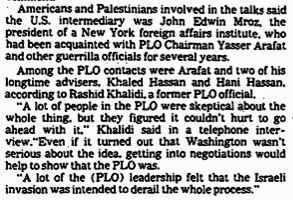
Sixth Update: A reader sends me yet another piece of contemporary evidence from the mainstream U.S. media for Rashid Khalidi’s PLO connection. This one appears in the Los Angeles Times of February 20, 1984, in an article by Doyle McManus under the headline: “Account of PLO Talks Questioned: Reagan Unaware of Such Contacts, His National Security Aide Declares.” The article discusses reports of back-channel U.S.-PLO talks. One of the named sources is Rashid Khalidi, identified simply as “a former PLO official,” who is quoted verbatim on thinking within the PLO about the talks. By this time, Khalidi would have been in the United States (he left Beirut the previous year).


 Martin Kramer on the Middle East
You must be logged in to post a comment.