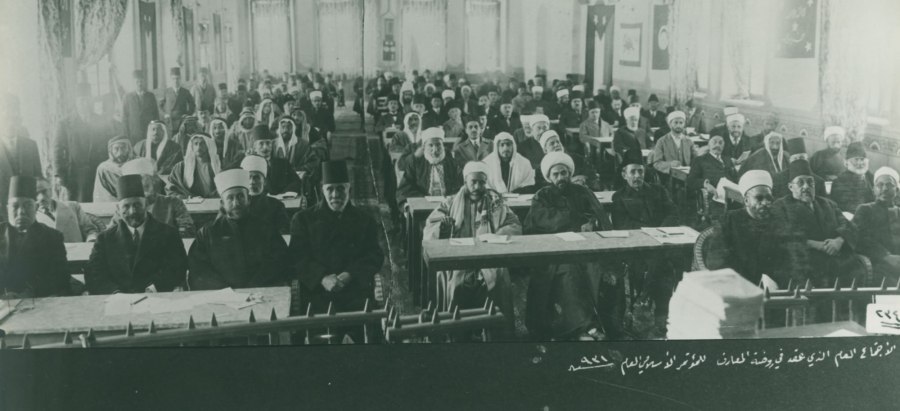
Der Islam, vol. 65, no. 1 (1988), pp. 143-45. (Translated from German. On Ende, see here.)
The publication of this book marks a major step forward in historical research on pan-Islamic movements. No one before Martin Kramer—a research fellow at the Dayan Center for Middle Eastern and African Studies at Tel Aviv University—has dared to undertake such a comprehensive, thorough investigation into the development of the congress idea in Islam. Successfully tackling this topic requires solid training as a historian, expertise in Islamic studies, fluency in multiple languages, ingenuity, and a systematic approach to gathering and analyzing the abundant but widely scattered and highly diverse material—along with tremendous diligence. Under the mentorship of Bernard Lewis, with whom he studied at Princeton, and in consultation with many other experts, Kramer has handled this task in an exemplary fashion.
Kramer concentrates his work on the political history of the congress movements, some of which were successful while others failed. By contrast, the intellectual background, or the “Islamic” content of what was debated at the congresses, plays a relatively minor role in his analysis. He introduces the reader to the key players, behind-the-scenes figures, and even peripheral participants in these congresses, devoting entire chapters to some of the most important meetings, such as the 1926 Cairo and 1931 Jerusalem congresses. In an appendix (pp. 171-94), he includes a number of statutes, programs, and other documents related to congress plans or resulting from congress deliberations.
In the opening chapters, Kramer traces in meticulous detail the emergence of the congress idea, its association (particularly concerning for the Ottomans) with the concept of an Arab caliphate, and the significant role non-Muslim figures like Wilfred Blunt, Louis Sabunji, and Malkum Khan played in these discussions. The narrative concludes with what Kramer refers to as the “Congresses of Collaboration”—pan-Islamic congresses or congress plans supported by Japan and Germany during World War II (chapter XIII). After the war, with the partition of India and Palestine and the transformation of former colonies, mandates, and protectorates into (more or less) independent nation-states, a new situation arose in the Islamic world. The congress concept persisted, but it shifted from consultations among individual Islamic representatives to efforts at the governmental level to establish a political organization for all Islamic states. While this is no longer the focus of the current book, Kramer has addressed later developments in other writings, notably in his contributions to the Middle East Contemporary Survey yearbook.
In these contributions, as in Islam Assembled, Kramer stands out as a historian with a dispassionate view of politics, combined with a keen sense of the often tragicomic aspects of political actions. He shows great interest in biographical details, and readers will encounter not only familiar figures involved in congress efforts, such as Gasprali, Rashid Rida, and Shakib Arslan (about whom many lesser-known, all-too-human details are revealed), but also notable, yet largely forgotten eccentrics, adventurers, idealists, and/or agents of colonial powers. Intrigues, rivalries, and intense conflicts, both public and behind the scenes, are frequently discussed.
The wealth of information presented here is the result of extensive, thorough reading not only of printed primary and secondary sources in Eastern languages (especially Arabic and Turkish) as well as in Western languages, but also of systematic, intensive research in private and public archives from London to Cairo and Jerusalem, from Bern to Washington. What Kramer has brought to light is remarkable. In this regard, he has set entirely new standards.
Despite the author’s attention to detail, this is also a highly readable book, stylistically brilliant in many parts. For historians of the Middle East who deal with the modern era, it should become required reading, and it is also highly recommended to scholars of Islamic studies.
Freiburg im Breisgau
Werner Ende
 Martin Kramer on the Middle East