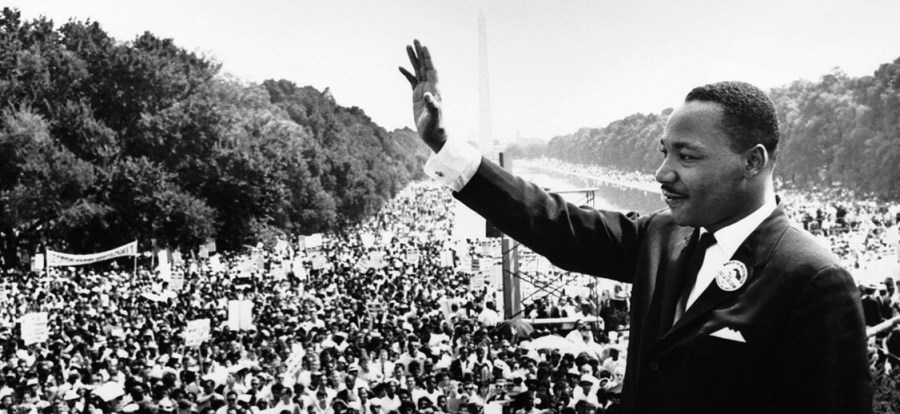
Why Martin Luther King never visited Israel

This is a perfect opportunity to remind readers that since the last Martin Luther King Day, I solved the mystery of this quote attributed to him: “When people criticize Zionists, they mean Jews. You’re talking anti-Semitism!” Some pro-Palestinian polemicists claimed he couldn’t possibly have spoken these words where he was supposed to have said them, at a dinner in Cambridge, Massachusetts, not long before he died. I succeeded in establishing a date (October 27, 1967), a street address (20 Larchwood Drive), and a time of day (early evening) for the occasion. Go here for the full story.

And while I’m at it, I’ll solve a mystery-in-the-making. In honor of the day, the Israel State Archives has published a batch of Israeli documents, from the mid-1960s, about a possible visit by King to Israel. It’s fascinating material, and I commend my friend Yaacov Lozowick, the State Archivist, for taking this initiative (and others) to bring official documents to a wider public. But this cache, as Yaacov notes, leaves a question hanging.

In a nutshell, the Israelis thought it would be a fine idea to host MLK in Israel, and the more important he grew, the more convinced they were that it was something they should make happen. King, from his side, kept on saying all the right words, but kept on not coming. Those are the facts. What do they mean? Hard to say. Read the publication and see if you find an answer.

Of course, if the answer had been there, Yaacov would have found it already. The answer lies elsewhere, and it’s perfectly clear.

First, in 1966, King did enter an agreement to lead a Holy Land pilgrimage. King’s assistant, Andrew Young, visited Israel and Jordan in late 1966 to do advance planning with Jordanian and Israeli authorities. The pilgrimage was rumored to be in the works from that time, and on May 15, 1967, King announced the plan at a news conference, reported by The New York Times the following day.

The pilgrimage would take place in November, and King insisted that it would have no political significance whatsoever. The organizers hoped to attract 5,000 participants, with the aim of generating revenue for King’s Southern Christian Leadership Council. King was slated to preach on the Mount of Olives in Jordanian East Jerusalem (November 14), and at a specially constructed amphitheater near Capernaum on the Sea of Galilee in Israel (November 16). The pilgrims would pass from Jordan to Israel through the Mandelbaum Gate in Jerusalem. King had visited the Jordanian side of Jerusalem in 1959, so he knew the situation on the ground, and thought he could strike just the right balance between Israel and Jordan. (The photo above depicts King and the Rev. Sandy Ray, pastor of a Baptist church in Brooklyn, who initiated and promoted the pilgrimage. King is pointing to the Holy Land on the map.)

The June 1967 war threw a wrench into the plan. King was now being asked his opinion of the war and Israel’s territorial gains. His position on both was complex, and perhaps I’ll go into it in a future post. But for now, let’s focus on the pilgrimage. After the war ended, Ray was still keen on going forward, and he immediately sent his own tour agent to Jerusalem to get a read on the situation. She came back enthusiastic: “I firmly believe that Dr. King’s visit will prove to be a much more historic event then we ever dreamed possible. Everyone, from the Governments down to the people on the streets were asking me about Dr. King… We desperately need a new Press Release from Dr. King reaffirming the Pilgrimage plans.”

So what happened? King got cold feet, and this isn’t a guess. We have it right from King himself, in the FBI wiretaps of one of his advisers, Stanley Levison. In a conference call of King and his advisers, on July 24, 1967, King noted that the responses to the pilgrimage promotion had been “fairly good.” (Andy Young said about 600 people had sent in deposits.) But if King went to the Middle East, “I’d run into the situation where I’m damned if I say this and I’m damned if I say that no matter what I’d say, and I’ve already faced enough criticism including pro-Arab.” He had met a Lebanese journalist who told him that the Arabs now had the impression he was pro-Israel, and that “you don’t understand our problem or something like that. And I expect I would run into a continuation of this.” King asked for advice, but set this tone:

I just think that if I go, the Arab world, and of course Africa and Asia for that matter, would interpret this as endorsing everything that Israel has done, and I do have questions of doubt.

King added that “most of it [the pilgrimage] would be Jerusalem and they [the Israelis] have annexed Jerusalem, and any way you say it they don’t plan to give it up.” After some back-and-forth among his advisers, in which it was suggested that he balance an Israel trip with a visit to King Hussein in Amman or Nasser in Cairo, King announced that “I frankly have to admit that my instincts, and when I follow my instincts so to speak I’m usually right… I just think that this would be a great mistake. I don’t think I could come out unscathed.”

King procrastinated out of deference to Ray, who had laid out money on promotion of the pilgrimage. But on September 22, 1967, he wrote the following to Mordechai Ben-Ami, the president of El Al, which was to have handled part of the flight package:

It is with the deepest regret that I cancel my proposed pilgrimage to the Holy Land for this year, but the constant turmoil in the Middle East makes it extremely difficult to conduct a religious pilgrimage free of both political over tones and the fear of danger to the participants.

Actually, I am aware that the danger is almost non-existent, but to the ordinary citizen who seldom goes abroad, the daily headlines of border clashes and propaganda statements produces a fear of danger which is insurmountable on the American scene.

He ended by promising to revisit the plan the following year.

The cancellation took place a month before King attended that dinner in Cambridge. It adds another layer of context for his balancing act on the Middle East, of which his remark about Zionists, Jews, and antisemitism was but a piece.

Update, 2016: This post has been amalgamated into a larger published article on King’s approach to the Six-Day War, here.

(Below: Cover of the promotional brochure for the 1967 pilgrimage. Thanks to Düden Yeğenoğlu, who photographed it for me in the Andrew Young Papers at the Auburn Avenue Research Library in Atlanta.)

1967 and memory

How did the outcome of 1967 change the way Arabs think about themselves and the world? It was the late Malcolm Kerr, one of America’s leading Arabists at the time, who perfectly summarized the consensus. (Kerr was a UCLA professor, later president of the American University of Beirut, who was killed there in 1984.) He put it thus, in a famous passage written only about four years after the 1967 war:

Since June, 1967 Arab politics have ceased to be fun. In the good old days most Arabs refused to take themselves very seriously, and this made it easier to take a relaxed view of the few who possessed intimations of some immortal mission. It was like watching Princeton play Columbia in football on a muddy afternoon. The June War was like a disastrous game against Notre Dame which Princeton impulsively added to its schedule, leaving several players crippled for life and the others so embittered that they took to fighting viciously among themselves instead of scrimmaging happily as before.

I leave aside the identification of the Arabs with Princeton. Kerr was a Princetonian, but so am I, and I would have preferred to identify the Arabs with Columbia, for all sorts of reasons. But it is the way Kerr contrasts pre-1967 with post-1967 Arab politics that is striking—and misleading. Even in 1967, Arab politics hadn’t been “fun” in a very long time: as early as the 1940s, they had become a serious and deadly game of costly wars and bloody coups. True, Kerr was writing in the aftermath of Black September in Jordan, a time when Arab politics seemed to have come completely unhinged. But the idea that 1967 put an end to the “good old days” of Arabs “scrimmaging happily” was a pure piece of nostalgic romance in the grand Arabist tradition.

Unfortunately, such nostalgia is seductive. For years, it has been at the root of a notion that persists even today: if we could somehow undo the 1967 war—if we could undo the injury inflicted in those six days—we could put the Middle East back to where it was in the “good old days.” In this view, the Arabs and the world could have “fun” again if only we could erase the Arab memory of that war—by erasing its every consequence.

But the “good old days” analysis is entirely false, and not only in its distortion of Arab politics prior to 1967. It is false because it overlooks how the 1967 trauma trimmed the ideological excess of the pre-war period, and opened the way to pragmatic Arab acceptance of Israel.

That ideological excess, known as pan-Arabism or Nasserism, rested upon a prior sense of injury, in which 1948 played the major part. In that earlier war, Israel succeeded in defeating or holding off an array of Arab armies, and three quarters of a million Palestinian Arab refugees ended up in camps. The injury of 1948 was so deep that, over the following twenty years—Kerr’s “good old days”—there was no peace process. The Arabs nursed their wounds and dreamed only of another round.

1948 also had a profoundly destabilizing effect on Arab politics. Three coups took place in Syria in 1949, and often thereafter; Jordan’s King Abdullah was assassinated (by Palestinians) in 1951; Free Officers toppled the monarchy in Egypt in 1952. Everywhere, the 1948 regimes were faulted for their failure to strangle Israel at birth. Military strongmen seized power in the name of revolution, and promised to do better in the next round. Those “good old days” were in fact very bad days, during which Arab politics became militarized in the certainty and even desirability of another war with Israel.

In 1967, the other war came, and these regimes suffered a far more devastating defeat, delivered in a mere six days. Unlike 1948, when they had lost much of Palestine, in 1967 they lost their own sovereign territory. The shock wave, it is generally assumed, was even greater.

Yet what is telling is that the regimes didn’t fall. Nasser offered his resignation, but the crowds filled the streets and demanded that he stay on—and he did. The defense minister and air force commander of Syria, Hafez Asad, held on and ousted his rival two years later, establishing himself as sole ruler. King Hussein of Jordan, who had lost half his kingdom, also survived, as did the Jordanian monarchy. The only regime that failed to withstand the shock waves of 1967 was Lebanon’s, and Lebanon hadn’t even joined the war. Kerr wrote that 1967 had left the Arab players “crippled for life.” In the three Arab states that lost the war, the regimes survived, the leaders ruled for life, and they are now being succeeded by their sons.

What explains the fact that 1967 didn’t destabilize the Arab system as 1948 did? It is true that even before 1967, these regimes had started to harden themselves. The evolution of the Arab state as a “republic of fear” dates from the decade before 1967, and this probably helped regimes weather the storm. Unlike in 1948, there weren’t many refugees either—the Arab states lost territory, but the war was quick, and most of the inhabitants of the lost territory stayed in their homes.

But I believe the reason 1967 didn’t destabilize the Arab order is this: Arab regimes and peoples drew together in the fear that Israel could repeat 1967 if it had to, and that it might show up one day on the outskirts of Cairo or Damascus (as it threatened to do in 1973), or come right into an Arab capital (as it did in Beirut in 1982).

The memory of 1967 thus became the basis of an implicit understanding between the regimes and the peoples: the regimes will avert war, and in return the people will stay loyal, even docile. The regimes have upheld their end, by gradually coming to terms with Israel, and by leaving the Palestinians to fight their own fight. Pan-Arabism—which largely meant sacrificing for the Palestinians—faded away because no Arabs were prepared to risk losing a war for them. The skill of rulers in averting war has helped to secure and entrench them.

I call this understanding implicit—it doesn’t have an ideological underpinning. Pragmatism rarely does. But the evidence for it is that no Arab state has entered or stumbled into war with Israel in over thirty years. The memory of the 1967 trauma has been translated into a deep-seated aversion to war, which underpins such peace and stability as the region has enjoyed. 1967 thus marks the beginning of the end of the Arab-Israeli conflict—the conflict between Israel and Arabs states, which had produced a major war every decade. 1973 marks the end of the end, in which two Arab states stole back some honor and territory, precisely so they could lean back and leave Israelis and Palestinians to thrash out their own differences. This narrower Israeli-Palestinian conflict has been a sore, but its costs have been limited compared to a state-to-state war.

It is important to note that pan-Arabism did survive elsewhere in the Arab world, where its illusions continued to exact a very high cost. I refer to Baathist Iraq, which wasn’t defeated in 1967, and where pan-Arabism continued to constitute one of the ideological pillars of the regime, vis-à-vis Iran and the West. There it also led to miscalculation, war, and defeat, on a truly massive scale. The Iraq wars—there have been three in the last three decades—provide a striking contrast to the relative stability in Israel’s corner of the Middle East—a stability which rests, I suggest, on the Arab memory of 1967, which restructured Arab thinking in the states surrounding Israel, away from eager anticipation of war, and toward anxiously averting it.

So in regard to Arab politics, I have offered a possible revision of the usual view of 1967: perhaps its memory, far from making the Arabs angry and volatile, underpins the stability of the Arab order and regional peace. If so, then perhaps we should recall it as a year of net benefit all around—as compared, say, to 1979, the year of Iran’s revolution, or 2003, the year of the U.S. invasion of Iraq. The impact of 1967 was to create a new balance, and push ideology to the margins of politics. The impact of 1979 and 2003 has been to unbalance the region and strengthen radical ideologies. 1967 ultimately produced a process that led to the finalizing of borders between states. The combined impact of 1979 and 2003 threatens to erase borders from the map.

The risk today, over forty years later, is not that the consequences of 1967 are still with us. It is that memory of 1967 is starting to fade, and its legacy is being eroded. I am struck by the subtitles of the two leading books on 1967. Michael Oren’s is June 1967 and the Making of the Modern Middle East. Tom Segev’s goes even further: Israel, the War, and the Year that Transformed the Middle East. If only it were so. The problem is that the Middle East continues to be remade and transformed by subsequent events, whose legacy is much more damaging than the legacy of 1967.

What then happens when the Arab world is dominated by generations that no longer remember 1967 or, more importantly, no longer think Israel capable of reenacting it? What memories are replacing the memory of 1967? The 2006 summer war in Lebanon? (To rework Kerr’s analogy, that was like Columbia playing Notre Dame to a draw.) Without the memory of that defeat of forty years ago, the ranks of the Islamists could swell with people who imagine victory. Without the fear of war, peoples could turn away from those rulers who have made peace—away from the implicit understanding that underpins order. Will it be possible to build stability and peace on other memories, or other promises?

This post originally appeared at Middle East Strategy at Harvard (MESH) on November 13, 2008. Earlier versions were delivered at two conferences in Jerusalem last year, marking the 40th anniversary of the war.