Down and out at Columbia

The resignation of Minouche Shafik, president of Columbia University, is being hailed as a victory all around. Rep. Elise Stefanik (R-N.Y.), who had called for her resignation back in April, celebrated the news:

Since her catastrophic testimony at the Education and Workforce Committee hearing, Shafik’s failed presidency was untenable and it was only a matter of time before her forced resignation. After failing to protect Jewish students and negotiating with pro Hamas terrorists, this forced resignation is long overdue.

But at Columbia, the campus chapter of Students for Justice in Palestine (SJP) also celebrated:

After months of chanting ‘Minouche Shafik you can’t hide’ she finally got the memo. To be clear, any future president who does not pay heed to the Columbia student body’s overwhelming demand for divestment will end up exactly as President Shafik did.

While Stefanik and SJP play tug-of-war over Shafik’s scalp, the battle for Columbia is far from over. Once the academic year begins, Columbia could face some of the same problems it encountered last spring: encampments, building occupations, intimidation of Jewish students, faculty alienation, and campus shutdowns. The demand by faculty and student radicals for “divestment” from Israel isn’t going away, and it’s one that no Columbia administration can satisfy.

My personal view is that Shafik was probably as good as you could get at a university as corrupted as Columbia, and likely more than Columbia deserved.

What went wrong

I began sounding the alarm over Columbia many years ago. I spent a year there as a graduate student and earned a master’s degree in history in 1976. Aside from the indomitable J.C. Hurewitz, I found nothing to keep me there. So I returned to Princeton for my doctorate. I had completed my undergraduate degree there, and Princeton had just acquired Bernard Lewis.

I left Morningside Heights, but I continued to watch Columbia with an insider’s interest. After I published a critique of Middle Eastern studies in 2001, I began identifying Columbia as the epicenter of the problems plaguing the field—so much so that Columbia’s Palestinian star, Edward Said, made this complaint in 2003:

An outrageous Israeli, Martin Kramer, uses his Web site to attack everybody who says anything he doesn’t like. For example, he has described Columbia as ‘the Bir Zeit [West Bank university] on the Hudson,’ because there are two Palestinians teaching here. Two Palestinians teaching in a faculty of 8,000 people! If you have two Palestinians, it makes you a kind of terrorist hideout.

Only seven years later, Columbia inaugurated a new Center for Palestine Studies. The announcement stated that “Columbia University is currently the professional home to a unique concentration of distinguished scholars on Palestine and Palestinians.” How did Columbia go from “two Palestinians” to a “unique concentration” in just seven years?

The same way Hamas built an underground warren in Gaza: through resolve, deception, cooptation, and intimidation. No one should have been surprised when an army of pro-Palestine and even pro-Hamas students, encouraged from behind the scenes by faculty, appeared last spring. The plot against Columbia had been more than twenty years in the making.

Most of the tunneling took place during the tenure of Lee Bollinger, president from 2002 to 2023. Whenever trouble surfaced—whether it was granting tenure to unqualified extremists or hosting the antisemitic Iranian president Mahmoud Ahmadinejad on campus—Bollinger turned on the charm machine. Columbia is so much more, he reassured. This “move on, folks, nothing to see here” approach worked because donors, alumni, and students needed it to work. After all, they had shares in Columbia, Inc. That included many Jews, in all three categories.

Shafik had nothing to do with the administrative neglect that ate away at the foundations of the university. She wasn’t an alumna, and she’d never taught there. Her whole career had unfolded in Britain. When she assumed the Columbia job in June 2023, she may not have known how deep the rot went. What had started as a faculty problem had metastasized over two decades, spreading both to the student body and to the administrative bureaucracy. “Bir Zeit-on-Hudson” had gone from (my) hyperbole to reality.

Embed from Getty Images

I didn’t say so at the time, to avoid adding fuel to the wrong side, but I thought Shafik showed grit in calling in the NYPD twice: first, to clear the “Gaza Solidarity Encampment” on South Lawn, and second, to clear Hamilton Hall, which had been forcibly occupied by a mix of students and off-campus radicals. But those decisions are what ultimately doomed her presidency.

More precisely, it was the faculty who made her position untenable. They had already taken umbrage at her Congressional testimony, where she appeared vaguely amenable to disciplining faculty speech. Her decision to call in the police compounded the crisis. A no-confidence resolution passed by the Faculty of Arts and Sciences (with 65 percent in favor) declared that Shafik’s decisions “to ignore our statutes and our norms of academic freedom and shared governance, to have our students arrested, and to impose a lockdown of our campus with continuing police presence, have gravely undermined our confidence in her.”

It was just such a vote of no-confidence that drove Lawrence Summers out of the Harvard presidency in 2006. When you lose such a vote, you’re on borrowed time. Shafik prepared her departure, and announced that she would be returning to Britain to take up an economic advisory position with the Foreign Secretary. The statement by her temporary replacement, the CEO of Columbia’s medical center, made it quite clear who must be appeased henceforth: the Columbia faculty. “You are the ultimate keepers of the institution’s values and the stewards of its long and proud history.”

Upon Shafik’s resignation, Stefanik gloated: “THREE DOWN, so many to go.” The other two were the presidents of Harvard and Penn. But not every campus is the same. The pro-Israel stakeholders at Columbia have always been weak, and what Congress thinks doesn’t much matter on Morningside Heights. In my view, Shafik’s fall should actually be counted in the pro-Palestine column. If I’m right, it’s not “three down,” but “two to one.”

Does it get better?

Shafik was born in Egypt to a well-to-do family. In 1966, Nasser’s “Arab revolution” stripped her father, a chemist by training, of his expansive estate and all his property, in a wave of nationalization. The Shafiks arrived on America’s shores “with little money and a few possessions.” Minouche was four years old. “It taught me that you can go from having a lot to having nothing overnight, and you can’t get too attached to stuff because you can lose it.”

Shafik was driven from the land of her birth by an angry and aggrieved nationalism. Now, she’s been driven out of America by another variety of angry and aggrieved nationalism, this time Palestinian. She’ll always be remembered as the president who called in New York’s finest to handcuff some of Columbia’s worst. I’d be surprised if the next president is made of sterner stuff.

Embed from Getty Images

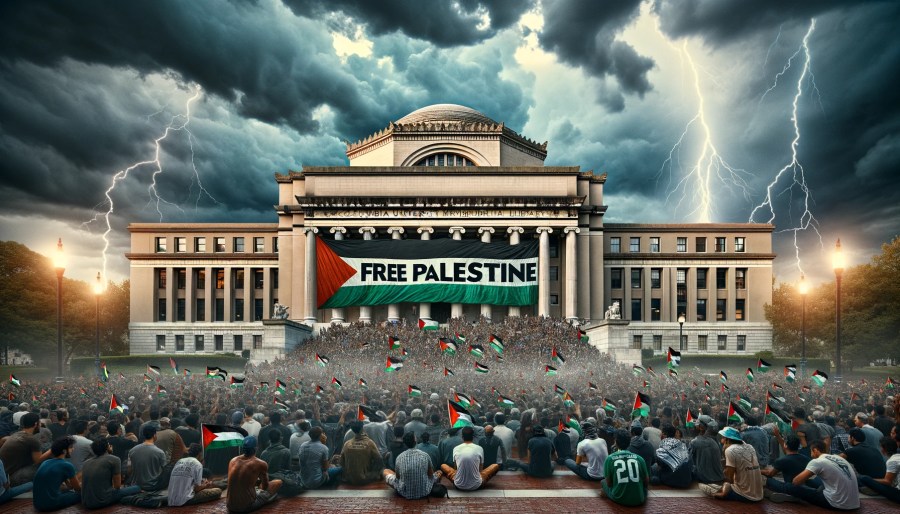
Header image created by DALL-E, OpenAI’s image generation model.

To boycott or not to boycott?

In the fall, I delivered the keynote address at the annual conference of the Association for the Study of the Middle East and Africa (ASMEA). The topic: “The State of Middle Eastern Studies, Revisited.” In that address, I assessed the state of Middle Eastern studies according to three parameters first defined by ASMEA co-founder Bernard Lewis: standards, politicization, and funding. In all three areas, the field remains plagued by endemic problems. 

A video became available almost immediately; the address has now been published in ASMEA’s journal. It’s open access, so you can read and share it by going to this link

I can now add a footnote. In my address, I criticized (or more precisely, ridiculed) the academic boycott resolution adopted by the Middle East Studies Association (MESA) last spring. (March 22 will be the first anniversary of that resolution.) I mentioned that one of MESA’s past presidents, the University of Chicago historian Fred Donner, had consistently argued against such a resolution. Donner called it “short-sighted in the extreme” and “utterly irresponsible.” But in the end, I said, “serious scholars like Donner were shunted aside” by the “determined militants [who had] infiltrated MESA’s ranks.”

What made Donner’s stand all the more interesting is that he himself did sign a boycott letter back in 2014. There the signatories pledged “not to collaborate on projects and events involving Israeli academic institutions, not to teach at or to attend conferences and other events at such institutions, and not to publish in academic journals based in Israel.” The letter argued that Israeli academic institutions were “complicit in the occupation and oppression of Palestinians.” So Donner supported the boycott as an individual, although he thought that MESA, as an academic association, should have nothing to do with it.

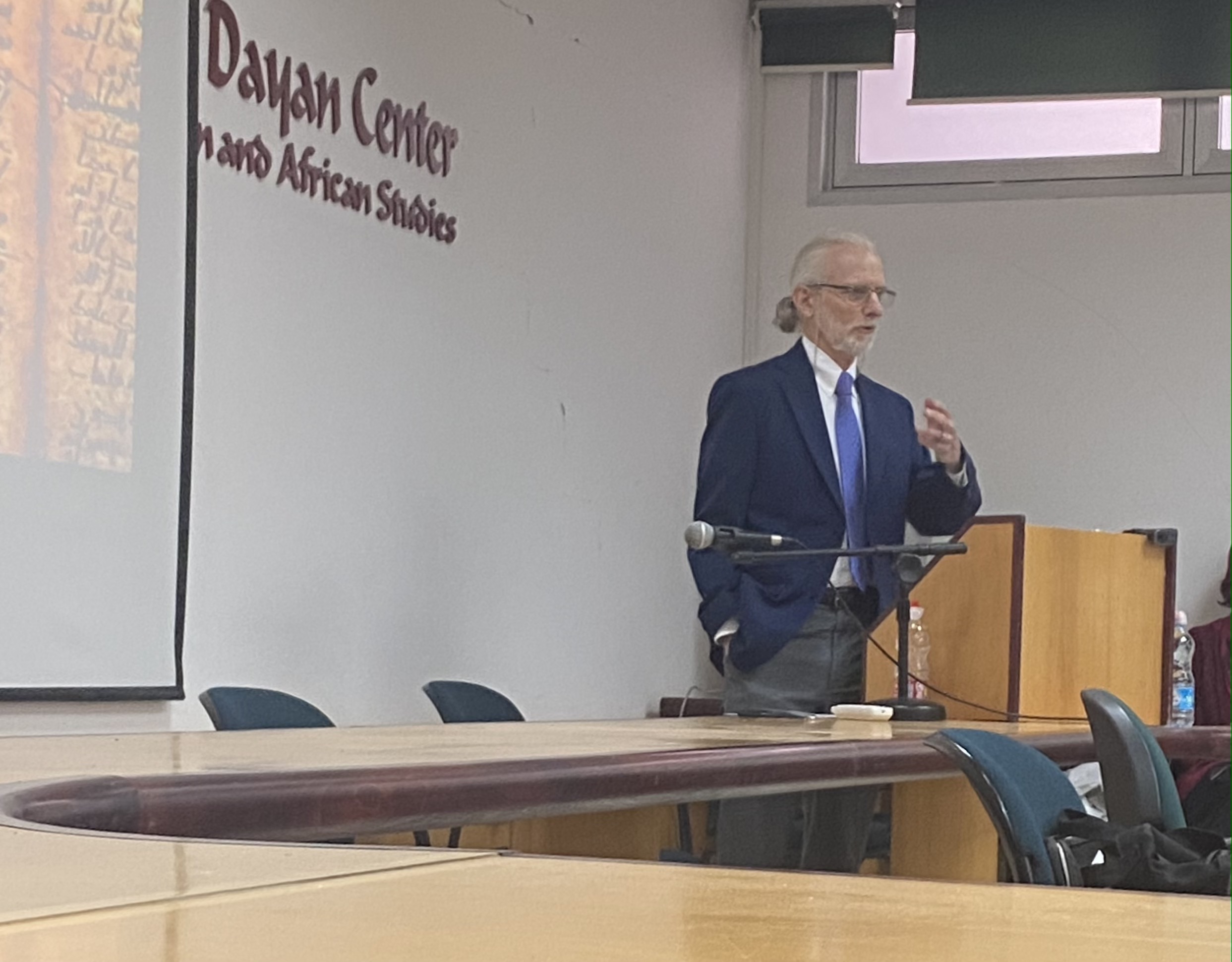
Imagine my surprise when I read that Donner would be speaking today in person at Tel Aviv University, my university. His topic: “Further Reflections on Islam’s Origins.” I attended the lecture, delivered in a packed seminar room to about fifty faculty and students, Jews and Muslims. Donner made an elegant presentation, and while his core thesis is controversial, he showed the requisite humility of a historian handicapped by a paucity of reliable sources.

In my ASMEA address, I said this:

I imagine there are hundreds of people in MESA… who recoil at this sort of politicization [BDS], and think it is a travesty. But I only imagine it because they haven’t spoken up. Where are the scholars with the courage of their convictions? The majority of MESA’s members didn’t cast a vote in the BDS referendum. Do they believe that such self-imposed silence is a counterweight to the BDS vote?

I didn’t take into account the possibility that MESA members could counter the boycott resolution simply by participating in the intellectual life of Israel’s universities. Actions sometimes do speak louder than words.

Below: Fred Donner delivers his lecture (my photograph). The sponsoring host was the Zvi Yavetz School of Historical Studies, Professor Miri Shefer-Mossensohn in the chair; the venue, the seminar room of the Moshe Dayan Center for Middle Eastern and African Studies.

Israel boycotters convene in Denver

As you read this, the Middle East Studies Association (MESA) is meeting in its annual conference, the first since its membership passed a resolution calling for the academic boycott of Israeli universities. These universities, so the resolution claims, are “imbricated” by “their provision of direct assistance to the Israeli military and intelligence establishments.” The vote was 768 to 167, a lopsided count reminiscent of referenda held in parts of the Middle East.

MESA, in its conference, will deliberate on what the boycott means in practice. One can find a preview in a 2014 boycott letter signed by “Middle East studies scholars and librarians.” The signers pledged “not to collaborate on projects and events involving Israeli academic institutions, not to teach at or to attend conferences and other events at such institutions, and not to publish in academic journals based in Israel.” 

This will now become the policy of MESA, and while MESA’s leaders will disavow any intention to enforce it, the resolution will have a chilling effect. The sanctions are most threatening not to Israel’s high-powered and innovative universities, but to vulnerable American scholars and students (many of them Jewish) who would like to join conferences and programs in Israel, but fear being stigmatized.

It is ironic that an association for the study of the Middle East should boycott the freest universities in the Middle East. According to the Academic Freedom Index, 2022, Israel is the only country in the Middle East to earn “A” status for academic freedom.

For comparison, Tunisia earns a “B,” Iraq, Kuwait, and Lebanon receive a “C,” while Jordan, Libya, and Sudan earn a “D.” Most of the other countries in the Middle East get an “E,” including Bahrain, Egypt, Iran, Qatar, Saudi Arabia, Syria, Turkey, the United Arab Emirates, and Yemen. (The Palestinian Authority, operating under the “yoke” of Israel, scores a “B.” Israel must not be all that effective in suppressing academic freedom there.) In fact, Israel’s score is higher than those of the United States, the United Kingdom, France, and Australia.

If MESA really cared about academic freedom in the Middle East, it would hold up Israeli universities as models to the region. Instead, these are the only universities MESA thinks deserve to be boycotted. I see that later this month, Noam Chomsky will be participating (via Zoom) in a course at Tel Aviv University. Even he isn’t as extreme as the boycotters who now rule the roost at MESA.

I imagine there are hundreds of people in MESA who recoil at this sort of politicization, and think it is a travesty. But I only imagine it, because they haven’t spoken up. Where are the scholars with the courage of their convictions? The majority of MESA’s members didn’t cast a vote in the boycott referendum. Do they think that is sufficient? Do they believe that such self-imposed silence is a counter-weight to the boycott vote? 

If so, they delude themselves. In the words of Yeats, “The best lack all conviction, while the worst are full of passionate intensity.” That’s why the center of Middle Eastern studies hasn’t held, and I fault not the militants, but those others who failed to stand their ground. They allowed an association founded with high scholarly purpose, built with sweat over decades, to be hijacked by rabid Israel-haters who have shackled it to their agenda. MESA is meeting in Denver. Perhaps next year it should meet in Damascus, out in Syria. MESA has become a place not where the Middle East is studied, but where the worst of it is replicated.

This is also the moment to question those American universities that are complicit in this ban on the freest universities in the Middle East. There are still Middle East centers, some subsidized by taxpayers, that are institutional members of MESA. A few even sponsor panels and throw parties at the annual conference. They should rethink, not because there will be consequences, but because it’s morally obtuse. 

These days, MESA is headquartered at George Washington University, to which MESA migrated after its boycott politics got it thrown off another campus. It’s a blemish on the name of the university, not just because MESA managed to infiltrate the campus, but because GWU’s administration knows that MESA is toxic, yet hasn’t acted. (In contrast, praise is due to the Association for Israel Studies, which terminated its affiliation with MESA, and the Crown Center at Brandeis University, which dropped its institutional membership. A few other centers have let their memberships lapse, without making a fuss about it.)

Last month, I participated in the fifteenth annual conference of ASMEA, the Association for the Study of the Middle East and Africa, co-founded by two departed giants, Bernard Lewis and Fouad Ajami. In Lewis’s memoirs, he wrote that the purpose of ASMEA was “to counter the straitjackets of MESA,” and “to provide a platform and a medium for ideas and opinions that deviate from currently enforced orthodoxy.” 

At ASMEA’s inaugural conference in 2008, scholars presented nineteen papers. In the 2022 conference, they presented more than 130. ASMEA doesn’t yet match MESA for size, but MESA has been around since 1966. More to the point, ASMEA’s membership is growing, while MESA’s membership, both institutional and individual, is in decline.

ASMEA is the true heir to the liberal, open-minded mission for Middle Eastern studies first defined by the founders of MESA—a mission cast overboard by their radicalized successors. This leaves ASMEA the only scholarly association for the study of the Middle East in America. What’s called MESA has become a political advocacy group. 

This may seem to you a brash assertion. I believe it will come to be acknowledged as fact in the fullness of time. 

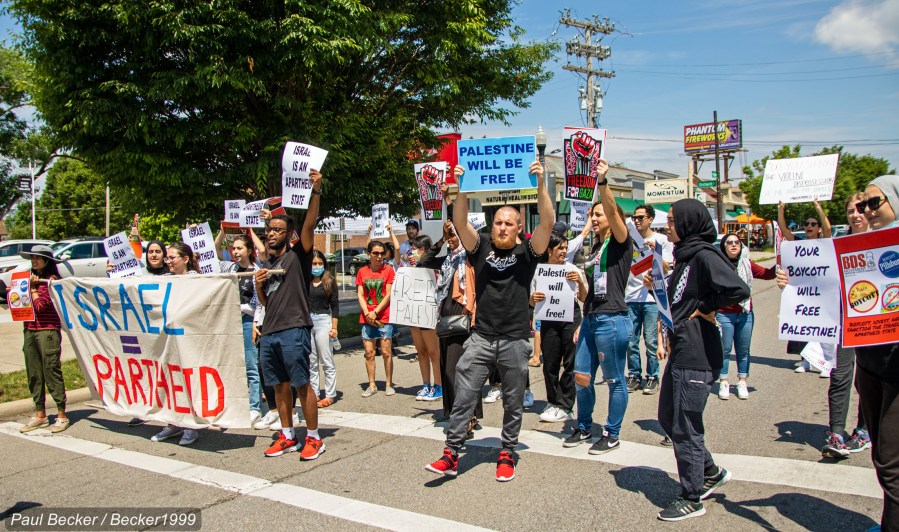
Photo credit: Rally to boycott Israel, Columbus, Ohio, summer 2021, photo by Paul Becker/Becker1999, Wikimedia Commons, licensed under CC BY-ND 2.0