Syria in the Fertile Crescent


In 2015, I gave a lecture on the deeper historical background to the civil war in Syria, and I published it in my 2016 book The War on Error. Under present circumstances, it seems as relevant as ever, and I wouldn’t change a word. 

When the revolution (or uprising, or insurgency) started in Syria in 2011, many people saw it as the obvious continuation of the so-called Arab Spring. There had been revolutions in Tunisia, then Egypt and Libya—countries with Mediterranean shorelines. When conflict broke out in Syria, analysts initially read it as an extension of the same process.

In retrospect, it was not. The countries of North Africa are fairly homogeneous and overwhelmingly Sunni Muslim. There are regional and tribal differences in Libya, and Egypt has an important Coptic Christian minority. But revolutions in these countries did not involve the transfer of power from one religious or sectarian or ethnic group to another.

In Syria, political transformation threatened to do precisely that. And so what evolved in Syria wasn’t an extension of the “Arab Spring,” but a continuation of another series of conflicts, far more devastating in their effects. Going back from the present moment, chronologically, its predecessors included the post-2003 Iraqi civil war, the Kurdish insurgency in Turkey, the Lebanese civil war from 1975 through 1989, and, still more remotely, the Armenian genocide of 1915. These might conveniently be called the wars of the Fertile Crescent.

What is the Fertile Crescent?

What the Arabs somewhat laboriously call “Iraq and Sham” or “Iraq and the Levant” (from which derive ISIS and ISIL) has a perfectly serviceable English name. It was invented by James Henry Breasted, an American Egyptologist at the University of Chicago, and popularized in his 1916 book Ancient Times. Breasted defined the Fertile Crescent as the expanse of territory set between the desert to the south and the mountains to the north—a place constantly under pressure from invaders, precisely because it is sustaining of life (Breasted called it “the cultivable fringe of the desert”). He marked it as a zone of “age-long struggle … which is still going on.”1

“Fertile Crescent” gained popularity in the West because it seemed fertile in another way, as the site of the earliest biblical narratives and the birthplace of monotheism. It was the presumed locale of the Garden of Eden, which generations of early cartographers sought to place on a map.2 It was the site of the Tower of Babel, which purported to explain the emergence and diffusion of different languages. It was the stage for the wanderings of the patriarch Abraham, who crossed it from east to west—a migration in the course of which he came into communion with the one God. The Bible, before it linked the Holy Land to Egypt, linked it to Mesopotamia. And while the peoples of the Fertile Crescent may have been many, and of many languages, they were the first to imagine God as one.

The Fertile Crescent thus came to signify diversity amidst unity: a multitude of peoples believing in the existence of one God. This was in contrast to Greece and Egypt, which were cases of single peoples of one ethnic origin and language believing in many gods. It was in the Fertile Crescent that Islam would be tested as a unifying force for diverse populations. Only after passing that test did it expand across the globe. The Fertile Crescent itself then would be folded into the great Islamic empires. In the last of them, the Ottoman, it sometimes flourished and more often languished as a single, borderless expanse.

Sykes-Picot

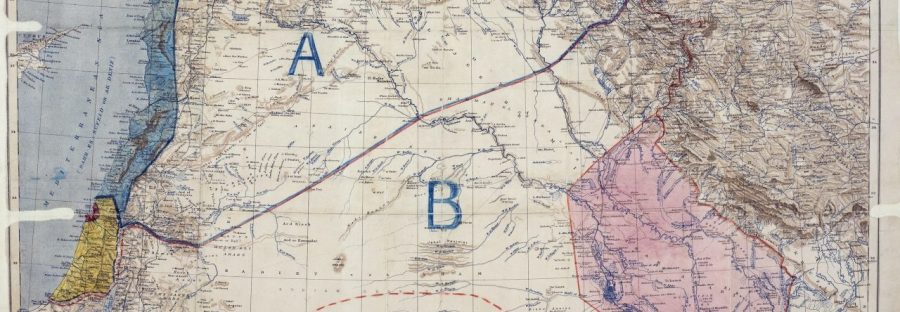
But in 1916, the same year that Breasted popularized the phrase Fertile Crescent, Britain and France concluded the Sykes-Picot agreement for the partition of the Ottoman Empire, dividing this zone into states and drawing straight borders through the desert. Within those borders, Britain and France imposed one faction over all others in political orders that depended to some degree or another on coercion. Power in Iraq and Syria coalesced around minorities. In Iraq, a Sunni minority was imposed over a Shi‘ite majority; in Syria, a Shi‘ite-like minority, the Alawis, over a Sunni majority. (The Kurds, minorities in both countries, were at the bottom of the heap.)

In Mesopotamia, Britain imported a Sunni monarchy from Arabia and bound it to the indigenous Sunnis of Baghdad and its surroundings, giving them dominion over a vast territory unified under the name of Iraq. The French initially tried a very different approach in Syria. Whereas the British sought to unify, the French originally intended to divide: for a period in the 1920s and 1930s, what would become Syria was in fact divided into an Alawite state, a Druze state, the states of Aleppo and Damascus, and Lebanon. In 1937, the French acceded to the demands of Syrian nationalists, and also unified Syria (excluding Lebanon). But at the same time, the French worked to empower minorities, above all the Alawis, by recruiting them into the military, in order to keep Arab nationalism in check. After independence, the Alawis parlayed that advantage into their own dominion.

While the rulers of Syria and Iraq stood, from a sectarian point of view, on opposite ends of the spectrum, they were both cases of post-colonial minority-domination in states engineered from the outside. Still, there was a difference. Syria’s ruling minority was much more of a minority. The Alawis in Syria are probably no more than twelve percent of the population whereas the Sunnis in Iraq are probably about twice that percentage. And while the ruling Sunni minority in Iraq had an integral connection with the wider Sunni majority in the region, the ruling Alawis in Syria had no such backstop, and ended up relying on distant Iran.

Perhaps Breasted would have warned us that this order couldn’t last. That it lasted as long as it did was the result of ruling minorities modernizing their repressive machinery in ways the ancients could never have imagined. But this machinery was discredited and dismantled by the United States in Iraq, and it has broken down from within in Syria. Power is now shifting from one religious or sectarian group to one which happens to be larger or more powerful or more connected to sources of outside support. Or it is fragmenting altogether.

From Strength to Weakness

There is much irony in the contraction of Iraq and Syria. Both states, at their twentieth-century high watermarks, were strong enough to project their power beyond their borders, and they even tried to redraw them. Iraqi nationalists believed that Iraq should have been awarded still wider borders, especially along the Persian Gulf littoral. Syrian nationalists likewise claimed that “greater” Syria should have been incorporated within Syria’s borders. The 1919 General Syrian Congress passed this resolution: “We ask that there should be no separation of the southern part of Syria, known as Palestine, nor of the littoral Western zone, which includes Lebanon, from the Syrian country. We desire that the unity of the country should be guaranteed against partition under whatever circumstances.”3

But it wasn’t to be. A separate Lebanon and Palestine came into existence. For this reason, Syria refused to reconcile itself to its own borders. Indeed, for three years, from 1958 to 1961, Syrians readily agreed to dismantle their own independent state, and incorporate Syria into a union with Egypt called the United Arab Republic.

Iraqi president Saddam Hussein, when he thought he had the opportunity, attempted to redraw Iraq’s borders by force, through his invasion of Iran and his occupation and annexation of Kuwait. Syrian president Hafez Assad likewise occupied Lebanon and gave safe haven to the Kurdish PKK, which was headquartered in Damascus. Iraq and Syria seemed to have become powers in their own right. In the case of Syria, in particular, American secretaries of state and even presidents came to Damascus as supplicants, hoping to win its ruler over to their geopolitical concepts of regional order.

Now all that has been reversed. Not only is Syria no longer capable of projecting its power beyond its borders; others are meddling inside Syria, to advance their own agendas, in alliance with the various domestic factions, while Syrian refugees flee the country in the millions. Syria’s elites once regarded the state’s external borders as inadequate to Syria’s great historical role, but Syria is now incapable of preserving unity even in its “truncated” borders. Syrians were educated to believe that the state of Syria was the nucleus of a greater Syria, itself the nucleus of a greater Arab unity. But in practice, Syria itself could not resist imploding into a de facto partition, driven by deep internal divisions.

Now it is not Syria’s power, but Syria’s weakness, that threatens the region. Albert Hourani, the historian of the Middle East, once wrote this: “Even were there no Syrian people, a Syrian problem would still exist.”4 That is exactly where the Middle East is now stuck. There is no Syrian people, but there is still a Syrian problem, and it will continue to dominate the region and worry the world, perhaps for years to come.

Since this disorder has no name—certainly none as succinct as “Sykes-Picot”—I propose to call it, for now, the Breasted Fertile Crescent. This would be a Fertile Crescent made up of shifting principalities, subject to occasional intervention by surrounding powers, characterized by variety and diversity, essentially without fixed borders—a place where Shi‘ites struggle against Sunnis, Arabs against Kurds, the desert against the sown. The Breasted (dis)order will persist, until some great outside power or group of regional powers proves willing to expend the energy needed to restructure the Fertile Crescent in accord with their interests—something the Ottomans did for four hundred years, Europe did for fifty years, and America has not yet attempted at all.

Notes

  1. James Henry Breasted, Ancient Times: A History of the Early World (Boston, MA: Ginn, 1916), 100–1.
  2. See Alessandro Scafi, Mapping Paradise: A History of Heaven on Earth (Chicago, IL: University of Chicago Press, 2006).
  3. J. C. Hurewitz, The Middle East and North Africa in World Politics: A Documentary Record, vol. 2: British-French Supremacy, 1914–1945 (New Haven, CT: Yale University Press, 1979), 181.
  4. A.H. Hourani, Syria and Lebanon: A Political Essay (London: Oxford University Press, 1946), 6.

The Arab crisis

In October, I made a short presentation to an American-Israeli conclave in Washington. This is the major part of it.

This is an extraordinary time in the Middle East, but just what we have witnessed has eluded consensus. That is reflected in the terminology. Some called it the “Arab Spring,” by analogy to the democratic transformations in Europe. When it became clear that the path wasn’t going to be as smooth as in Europe, others backtracked and called it the “Arab Awakening,” which sounds like a longer-term proposition. Still others, who saw Islamists initially triumph in elections, took to calling it the “Islamist Winter.” The terminological confusion is a reflection of analytical disagreement.

Another source of confusion has been the widespread resort to historical analogies. When it didn’t look like the transition would be that smooth, or might even be aborted, commentary began to appear comparing the events to Europe in 1848. When optimists wanted to make the point that sometimes successful revolutions take a long time, they pointed to the American revolution of 1776. When pessimists wanted to emphasize that revolutions conceived in idealism could go astray, they pointed to the Russian Revolution of 1917. Finally, some circled back to 1989, but this time not with an emphasis on the “Spring” analogy to Poland, but on the “Balkan Ghosts” analogy to Bosnia. Analogies are a crutch, to which we return when our analysis is thin.

As a historian by training, I have no difficulty predicting that the debate over terminology and the application of analogies will go on for many years to come. If historians still debate the causes of the French Revolution, there is no reason to think the events of the past couple of years won’t be debated far into the future. That’s how we historians make our living.

But you don’t make your living that way. You do analysis of the moment, and you have to make a judgment call based on what evidence there is now, in order to predict the future trajectory on which to base policy and strategy. So while it would suit me just fine to say that it’s too early to tell, let me go out on a limb and make some generalizations.

Let us agree that what we are witnessing is a very profound crisis. Regimes have fallen, tens of thousands have died, millions are refugees. There is even a nominal price tag. The banking giant HSBC has just released a report estimating that this crisis will have cost Middle Eastern countries $800 billion in lost output by the end of next year. It also estimates that the combined GDP of the seven most-impacted countries—Egypt, Tunisia, Libya, Syria, Jordan, Lebanon and Bahrain—will be 35% lower by the end of 2014 than it would have been if the 2011 uprisings hadn’t happened.

This is wealth destruction on a massive scale. And it is not as if these economies had a big buffer to absorb this hit: the already-poor have become desperately poor. As against these mounting costs, the gains have been debatable. Has there been progress toward good governance and the rule of law? Or descent into rule by militias and pervasive insecurity? The situation differs from country to country, but overall, it is hard to be optimistic about any of the impacted countries, which are mired in various degrees of turmoil.

But before we can say what sort of crisis this is, let’s say what sort of crisis it isn’t. It isn’t just a repudiation of authoritarian rule. It is true that the kind of rule based on personality cult and pervasive fear has lost its grip. The United States contributed to that by removing Saddam Hussein from power in 2003. Saddam was the avatar for a certain kind of regime, and his fall exposed others who ruled in the same way. His removal dissipated the aura of fear that surrounded such regimes, because the praetorian guards entrusted with their defense could be put to flight. The enablers of these regimes were prepared to torture to defend them. What they weren’t prepared to do was to fight and die. That proved to be the case from Tunisia to Egypt to Libya.

But if it was a revulsion against authoritarian rule, and a yearning for the dignity conferred by democracy, how does one explain the support of Egyptians for a Muslim Brotherhood regime which was itself authoritarian? Or the counter-revolution in Egypt, which returned a military junta to power by coup? Perhaps this isn’t a political crisis of authoritarianism versus democracy, between bad (authoritarian) guys and good (democratic) guys. In the case of Egypt, there isn’t even an agreement over who the bad guys and good guys are. And there isn’t a consensus over Syria either, where only a handful of the players are committed to democracy in a form we would recognize.

If it wasn’t about freedom and democracy, was it a “return to Islam”? It briefly did look just like that. For a moment, it seemed like another analogy, Iran 1979, might be apt. Certainly the status quo has been eroded by the spread of an Islamist social movement among the masses. But Islamists didn’t lead the uprisings, and they haven’t been able to consolidate their early victories in elections and secure positions of dominance. Islamists have struggled without success to translate their social base into coherent and effective politics. Perhaps this is because people aren’t persuaded they have the answer to the crisis, or even understand it.

Was it an economic crisis? Many of you are no doubt familiar with what I might call, for lack of a better term, deep explanations for the revolutions. One of them, backed up by many statistics, is the demographic youth bulge which has surged through the Arab world. This part of the world is in a transition to lower rates of fertility, but it is now paying the price of extraordinarily high fertility rates registered twenty to thirty years ago. Millions of young people have flooded the labor markets, and no economy in the world could keep up. The turmoil is sometimes interpreted as the outburst of frustrated young men venting their rage at their own indolence and impotence.

But if this were primarily an economic crisis, why did it erupt at a time of economic expansion and growth? And why wasn’t it anticipated that the resulting instability would actually worsen the economic plight of these countries?

Having now exhausted various explanations, and found them wanting, I proceed to my sweeping generalization. This is a crisis of culture. That is to say, it is more than a political or social or economic crisis. Of course it has elements of all of these things, but at its most fundamental, it is a crisis of culture—to be precise, the implosion of the hybrid civilization that dominated the twentieth century in the Arab world.

That hybrid was the defensive, selective adaptation of Islamic traditions to the ways of the West. The idea was that the tradition could be preserved, that its essence could be defended, while making adjustments to modernity as needed. The timeless character of the political, religious, and social traditions of the region could be upheld, even as upgrades were made to accommodate modernity. In Turkey, Atatürk’s cultural revolution had thrown all of tradition overboard and embraced the ways of Europe without reservation. The Arabs resisted the notion, and their leaders promised them a different path, a hybrid of the Arab-Islamic tradition with Western-style modernity.

This hybrid civilization pretended to be revolutionary, but it permitted the survival of those pre-modern traditions that block progress, from authoritarianism and patriarchy to sectarianism and tribalism. This hybrid civilization has now failed, and what we have seen is a collapse, not of a political system, but of a moral universe left behind by time.

That failure was long concealed by a mixture of regime maneuvering and the prop of oil. It has been cushioned in those places in the Arab Gulf where rulers have given up on the better part of Arab-Islamic civilization, inviting the Louvre and the Guggenheim and American universities to build branches, and allowing expatriates to outnumber the Arabs. These are the places that have become refuges from chaos elsewhere, and that have even profited from it. But in the great centers of Arab-Islamic civilization, from Cairo to Damascus to Baghdad, the crisis of the political order is primarily a symptom of the collapse of their own hybrid of tradition and modernity.

The failure of the hybrid is most dramatically evidenced by the rise of sectarianism. The Sunni-Shiite divide has lots of layers, including a disparity of power, often the legacy of colonialism. But the mindset of sectarianism is thoroughly pre-modern. Modern nationalism was devised at least in part to blunt sectarianism among Muslims.

But because the tradition had to be respected, the hybrid civilization of the region tolerated the exclusion of Jews and the marginalization of Christians. It was only one step from there to the defamation by Shiite of Sunni, by Sunni of Alawi, and on and on. The jihad of Muslim against Muslim, whether waged by Lebanon’s Hezbollah in Syria, or by extreme Islamists in parts of Iraq and northern Syria, is a huge reversal. It is like a page taken straight out of eighth- or ninth-century Islamic history. Here we are in a Middle East where the major divide isn’t over the form of government, or the nature of the economic system, or the extent of individual liberty. It is over a dispute dating from the seventh century of Islam—the sort of thing Europe left behind when it secularized during the Enlightenment.

There are some who would actually reify this by inscribing it on the map. There is a certain line of reasoning, that what the Middle East really needs is a new map, drawn along sectarian lines. This is how the argument goes: The 1916 Sykes-Picot map is worn out, it is coming apart at the seams. The lines on the political map are losing their meaning, the lines that aren’t yet on the map are becoming realities. An alternative map is needed, and most of the alternatives have a standard feature: divvying up the Fertile Crescent along sectarian and ethnic lines.

There is no doubt that the present crisis is weakening some states, and that they are losing their ability to project central power up to their borders. Sectarian and ethnic separatism does have purchase. But even if new lines could be drawn, how would this solve the crisis? How would it make the region better suited to embrace modernity? The fact is that sectarian statelets, predicated on pre-modern identities, could well go the other way. Think about the Sunni Islamist quasi-states centered around Raqqa in northern Syria and Gaza on the Mediterranean. These aren’t going to become the next Dubai or Qatar, and not just because they don’t have oil. If the map does come undone, and new statelets or quasi-states or mini-states are born, that is just as likely to bring about more sectarian and ethnic conflict than ease it.

In summation, there are millions of people who now must reconfigure the way they see themselves and the world, not just through a political revolution, but through a cultural one. There is no way any outside power can deliberately accelerate or channel this transformation. And since we are much closer to the beginning of that process than the end, the region will remain a cauldron for years if not decades to come.

 I also commend this 10-point scorecard by BBC correspondent Kevin Connolly. Just one irony: the winners of the “Arab Spring” haven’t been Arabs, but Iran and the Kurds.

Worst-case scenario in Egypt

A Muslim Brother, Muhammad Morsi, has entered Egypt’s presidential palace and taken his seat in the chair once occupied by Nasser, Sadat, and Mubarak. This is a stunning development—a slow-motion Islamic revolution that few envisioned back in January 2011, when the crowds filled Tahrir Square.

The experts systematically underestimated the Muslim Brotherhood for a simple reason: they saw the revolution as they wanted it to be, not as it was. The distorted optic of the Tahrir stage seduced and misled them. But it was even more than that: the Muslim Brotherhood itself conducted a campaign of deliberate deception. They claimed they wouldn’t try to dominate the parliament, that they wouldn’t run candidates for every seat—and then they did. They said they wouldn’t run a presidential candidate of their own—and then they did. The credulous believed these reassurances—they seemed so rational and pragmatic. Marc Lynch, an estimable expert on these matters, actually chided the Brotherhood when it defied his analysis of its best interests and nominated a presidential candidate. It was, in his words, a “strategic blunder.”

In fact, it was a strategic master-stroke. From the beginning of the revolution, the Muslim Brotherhood has understood that the fluid situation created by the fall of Mubarak won’t last forever, and that now is the time to seize every possible position they can, before alternatives take form. They want power, they crave power, and they won’t let it slip through their fingers by sitting out even a single contest. At the end of the day, all of the arguments for holding back have fallen by the wayside. They’re going for broke.

And have no doubt about the Muslim Brotherhood. The Brotherhood seeks to restore Egypt to the glory it once knew, by implementing Islamic social and legal norms. The translation of Islamic ideology into practice is the point of holding political power. The Brotherhood might not be able to effect an exact translation—that would be difficult—but a translation of ideology into practice it will be. This worries secular Egyptians, the international community, and Israel. At this early stage, many will say that such worries are overblown, that the Brotherhood will adapt and compromise. To consolidate power, it might. But at a later stage, many may regret having been so nonchalant.

No one can stop Brotherhood. You say: what about the military chiefs? The military, at times, has appeared to be winning. The revolution got rid of Gamal Mubarak, Husni Mubarak’s son and presumed successor, and that suited the military fine. The parliamentary elections, won by Islamists, demolished the liberals by revealing their weakness. That suited the military fine.

This left standing the Muslim Brotherhood and the Salafis. Everyone assumed that they wouldn’t dare put forth a candidate for the presidency. The new president was to have been a consensus personality above party politics—an ElBaradei or Amr Musa. It was the Brotherhood’s decision to run a presidential candidate that threw the military off-balance, and they have been scrambling ever since. The first Brotherhood candidate, the formidable deputy-guide Khayrat ash-Shater, was disqualified—he would have won a sweeping victory. His replacement, Muhammad Morsi, basically a stand-in, had less appeal, and against him, the unlikely Ahmad Shafik stood a chance. But it gradually became evident that even the stand-in might defeat Shafik, hence the drastic measures by the military chiefs, stripping the presidency of most of its powers even before the first ballot was counted.

The military’s efforts to contain the Muslim Brotherhood, at this late date, can only buy limited time. The parliament has been dissolved, but it will have to be reconstituted, and then what? The rewriting of the constitution can be delayed, but the constitution will have to be written and approved by the legislature, and then what? And if the president isn’t to be the supreme commander of the Egyptian armed forces, then who will be? The simple truth is that Egypt isn’t going to revert to military rule—it’s too late, the polls show that a vast majority of Egyptians want a transition to civilian, constitutional rule. For the military, the question is, what are the terms of this transition? What will guarantee their economic enterprises? What will assure them that they won’t be prosecuted and purged? This is now the core of Egyptian domestic politics: the terms on which the military will exit. And with each passing day, the hand of the Muslim Brotherhood is strengthened in this negotiation, because it grows more legitimate and the generals grow less legitimate. There are those who think that the Muslim Brotherhood can still be outmaneuvered by gerrymandering the system. In the long term, it can’t. Egypt is headed toward populist Islamist rule, and it is just a matter of time before the Brotherhood checkmates its opponents.

So how will the Muslim Brotherhood rule? It is the misfortune of the Muslim Brotherhood that, having waited more than 80 years for power, they have come to it at perhaps the lowest point in the modern history of Egypt. The country teeters on the edge of bankruptcy, the result of decades of bad decisions, corruption, and the absence of the rule of law. The Muslim Brotherhood is in a bind, because it has to deliver. For the masses of people who voted for the Muslim Brotherhood, the revolution wasn’t about democracy and freedom. It was about bread and social justice.

The Brotherhood has a so-called “Renaissance” plan for the overhaul of the Egyptian economy. I won’t pretend to judge its feasibility. Could modernization of tax collection double or triple tax revenues? Can Egypt double the number of arriving tourists, even while contemplating limits on alcohol and bikinis? Can a renovation of the Suez Canal raise transit revenues from $6 billion a year to $100 billion? Can Egypt’s economy surpass the economies of Turkey and Malaysia within seven years? These are all claims made at various times by the economic thinkers of the Muslim Brotherhood, who trumpet Egypt’s supposed potential for self-sufficiency.

If you think this is pie in the sky, then it isn’t difficult to imagine the “Plan B” of the Muslim Brotherhood. It is to find ways to raise the rent Egypt collects from the West and rich Arabs for its geopolitical position. Call it a shakedown, call it a bailout, it doesn’t matter. The message Egypt is sending is that it’s too big to fail, and that the world, and especially the United States, owes it. The deputy guide, Khayrat ash-Shater, put it directly: “We strongly advise the Americans and the Europeans to support Egypt during this critical period as compensation for the many years they supported a brutal dictatorship.” Egypt, which is one of the largest recipients of U.S. foreign aid, is thus owed compensation.

A key part of this narrative is that Mubarak sold peace with Israel on the cheap. In Egypt it is believed that the $1.3 billion that Egypt receives a year in military aid, and hundreds of millions more in economic aid, are just a portion of what Egypt’s adherence to peace is worth. To get more, the plan of the Muslim Brotherhood is to persuade Washington that it can’t take Egypt for granted. The strategy will be to stimulate crises that will be amenable to resolution by the transfer of resources. No one can predict what those crises will look like. It’s hard to imagine that some of them won’t involve Israel.

So the question the United States faces will be this: is Egypt indeed too big to fail? Is the United States now not only going to talk the Muslim Brotherhood—which it is already doing—but actively work to help it succeed? The question comes at a time when the United States has become frugal. And there is no superpower rivalry that Egypt can exploit. When John Foster Dulles informed Nasser in 1956 that the United States wouldn’t finance his great dam at Aswan, Nasser went to Moscow. Today there aren’t any alternatives to the United States.

That being the case, the only way for Egypt to get the attention of Washington is to threaten to spin out of American orbit and into the opposing sphere of radical Islam. At no point will it be indisputable that the United States has “lost Egypt.” But at every point, Egypt’s loss will seem imminent. In that respect, the Muslim Brotherhood has already made its mark on history: from this day forward, Egypt can’t ever be taken for granted again.

For future reference, Marc Lynch stands by his analysis: