Scenes from the massacres

Exactly 200 years ago, a disturbing painting debuted in Paris, depicting a massacre in a distant corner of the Mediterranean. No other work in the artistic canon speaks more to the events of October 7 than this one.

The painting Scenes from the Massacres of Chios by the French artist Eugène Delacroix was first unveiled at the Salon, the exhibition that defined artistic taste in 19th-century Paris, on August 25, 1824. For the past 150 years, it has belonged to the Louvre Museum in Paris. Millions have seen it over two centuries, and critics, art historians, and Delacroix biographers have analyzed it from every possible angle.

Scenes from the Massacres at Chios, Eugène Delacroix, 1824. Oil on canvas, 419 cm × 354 cm. Musée du Louvre, Paris.

My purpose is more personal than theirs. For myself—and, I imagine, for many of my fellow Israelis, Jewish co-religionists, and friends of both—this painting cannot but evoke the primal brutality of October 7. I’ve attended a few exhibitions in Israel that attempt to capture October 7 in art. Contemporary sensibilities, along with the Israeli modernist tradition in art, permit this only at a high level of abstraction. By contrast, Delacroix’s painting is visceral. Indeed, it’s reminiscent of the horrific videos of slaughter, abduction, and abuse recorded by the body cams of Hamas terrorists.

Death or slavery

The young Delacroix—only 26 when he finished the painting—was inspired by the Greek War of Independence from Ottoman rule, which began in March 1821. “I am thinking of doing a painting for the next Salon on the subject of the recent wars between the Turks and the Greeks,” he wrote to a friend in the fall of 1821. “I think that under the circumstances, this would be a way of distinguishing myself.”

He didn’t complete the painting until the 1824 Salon. Fresh events gave him the impetus. In 1822, the prosperous Ottoman-ruled island of Chios, in the Aegean Sea, was seized by Greek insurgents. The Ottomans recaptured the Greek-populated island with a ferocity that shocked Europe. Estimates vary, but the Ottomans massacred, enslaved, and starved as many as 100,000 Greek Christians, leaving the island depopulated. Graphic accounts of savage torture spread across the continent, fueling the philhellene movement with rage and resolve. In composing his painting, Delacroix relied on such reports, as well as conversations with a French eyewitness.

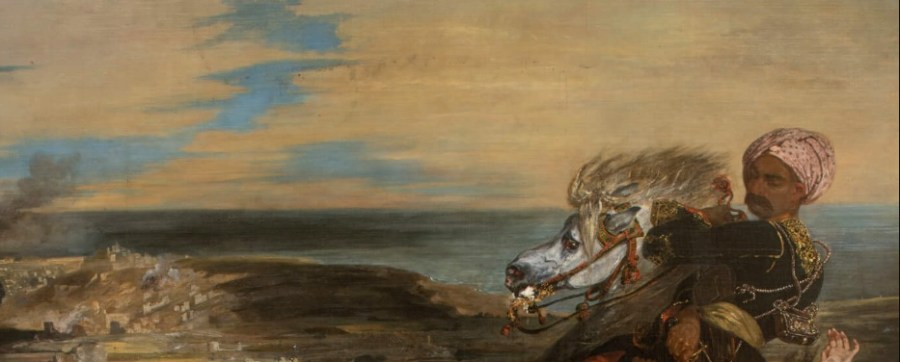
The subtitle of the work as submitted was “Greek families await death or slavery, etc.,” with the “etc.” serving as a discreet allusion to rape. The painting is centered on a cluster of despairing men, women, and children. Defeat, degradation, and resignation are etched on their faces. The most poignant tableau rises on the right side of the painting: a naked, bound woman is being dragged away by an indifferent Turkish horseman, destined for rape and slavery. Beneath lies the corpse of a dead mother, while her living infant instinctively searches for her bare breast. The bodies of Greek wounded and dead are strewn across a scorched and devastated landscape, where a battle still rages. The impact of the work is magnified by its overwhelming size: the painting is nearly fourteen feet high (over four meters) and almost twelve feet wide (over three meters). It hangs today in the gallery reserved for the largest masterpieces.

It was an unconventional work. The painting referenced contemporary events, not classical history. Delacroix did not portray his Greeks as ennobled, but as ordinary people. Moreover, the work had no redeeming hero. One contemporary critic found it more evocative of a plague scene than a massacre. Art historians have also offered their interpretations. Is the painting a subversive critique of the French regime’s neutrality regarding Greek independence? Is it Islamophobic, positing Islamic barbarity against Christian civilization? Or is the depiction of the Turkish horseman, indistinguishable from a Greek, a deliberate challenge to prejudice?

In an art history seminar, these questions all have their place. But this is a painting that has always stirred emotions and invites analogies. Many could be drawn; the intervening 200 years provide plenty.

Historical continuities

The foremost French specialist on Islam and politics, Gilles Kepel, in his new book Holocaustes: Israël, Gaza et la guerre contre l’Occident, has presented October 7 through the lens of its perpetrators, as a ghazwa (razzia in European parlance): a raid deliberately intended to subjugate and dehumanize a non-Muslim adversary. The Prophet Muhammad conducted such a raid against the Jewish tribes of the Khaybar oasis in Arabia in the year 628, establishing the ghazwa as a model of warfare that would be replicated throughout history. At Khaybar, writes Kepel,

cruelty was explicitly embraced as an exemplary punishment of God’s enemies. Men were tortured and put to the sword, women were captured and distributed among the victors’ harems, and children were enslaved, all to the cries of ‘O Victorious One, bring death, bring death!’ (Ya mansûr! Amit, amit!). On October 7, there was an attempt to emulate this feat from sacred history with the ruthless massacre of Jews, the abduction of women and children from border kibbutzim and the attack on ‘the tribe of Nova.’ Videos circulating online showed prisoners being assaulted, paraded as trophies in jeeps, unfortunate women stripped naked on pickup trucks and perched on motorcycles to be transported to Gaza’s tunnels—just as the captives of Khaybar were once carried off on camels.

The line that connects the years 628 and 2023 (with 1824 along the way) is one of traditionally Muslim and now Islamist supremacism. It not only promises victory but seeks to inscribe it upon the bodies of the vanquished.

We cannot bear to see or hear this, which is why the most graphic images and testimonies from October 7 are still withheld. Delacroix, for all the emotion and outrage he wished to stir, likewise did not depict the full extent of the brutality on Chios. But Scenes from the Massacres of Chios came as close as Western art dares. That this canvas from another era still speaks to our moment is a reminder of continuities we would rather forget.
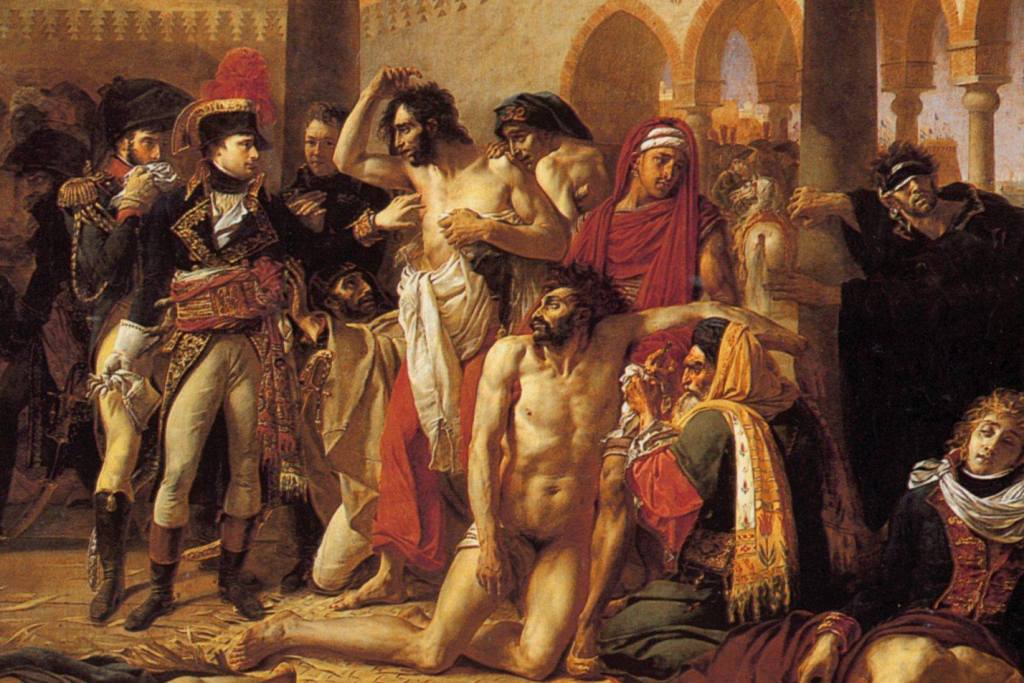
Plague and politics, then and now

Antoine-Jean Gros, Bonaparte Visiting the Plague-Stricken in Jaffa

“The appearance of Bonaparte in Palestine was only like the passing of a terrible meteor, which, after causing much devastation, again disappears.”

This was the verdict of the great Jewish historian Heinrich Graetz in volume 11 of his monumental Geschichte der Juden (History of the Jews, 1870). He was referring to Napoleon Bonaparte’s short-lived invasion of Palestine in 1799.

Borrowing Graetz’s metaphor, the Zionist leader Nahum Sokolow (in his History of Zionism, 1919) thought it a pity that the meteor should have disappeared so quickly. Had Napoleon actually managed to establish an eastern empire including Palestine, wrote Sokolow,

perhaps he would have assigned a share in his government to members of the Jewish nation upon whom the French could rely . . . as having indisputable historical claims on the Holy Land and Jerusalem.

In this scenario of Sokolow’s, Zionism might have had a century’s head start. But, as he himself wryly concludes, “no Jew seriously believed in the success of Bonaparte’s ambitious designs or in the possibility of his victory.”

One possible reason for Napoleon’s failure was the plague. On Passover, Jews mark the exodus of the chosen people, launched at last on their journey toward the Land of Israel, from an Egypt that had been visited by ten plagues. Napoleon was a chosen person who proceeded from Egypt to invade the Land of Israel, only to be thwarted there by a plague. It’s a reminder—as if we needed one at this moment—that politics and plagues are inseparable.

The ancient story, the one about the Jews, is preserved in sacred texts; the modern one, about Napoleon, is preserved in an immortal painting. Prominently displayed in the Louvre in Paris, it depicts an event that took place in Jaffa, now a part of Tel Aviv. Bonaparte Visiting the Plague-Stricken in Jaffa was painted by Antoine-Jean Gros in 1804. At the time, it was a sensation; today it remains the subject of enduring fascination.

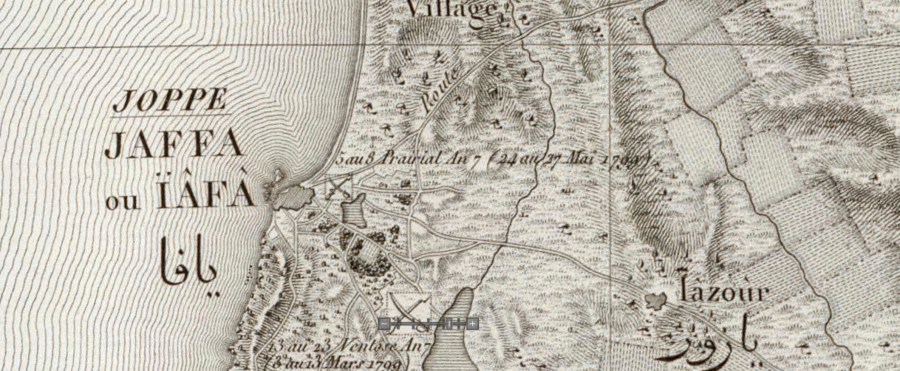
The date is March 11, 1799, in the midst of the French invasion of Ottoman Palestine. At the center of the painting is the twenty-nine-year-old Napoleon (then still known modestly as General Bonaparte), who the previous year had seized Egypt as part of a plan to checkmate Great Britain, then at war with France and soon to be allied with Ottoman Turkey. A British fleet had cut off Napoleon’s force; to escape the closing noose, he marched across the Sinai and invaded Palestine.

Reaching Jaffa, the French army overcame resistance by the local Ottoman garrison and conquered the town by storm, pillaging left and right and, on Napoleon’s order, massacring several thousand Muslim war prisoners. (This butchery inspired a 1934 play, Bonaparte in Jaffa, by the German-Jewish novelist and playwright Arnold Zweig.) In the aftermath of the mayhem, many dozens of French troops fell ill with the bubonic plague, which had been endemic in their ranks even in Egypt.

This is the point at which the painting, a huge neoclassical masterpiece, comes in. Napoleon, in uniform and accompanied by his aides, is visiting a makeshift ward of desperately ill French soldiers. It is a scene of abject misery and physical suffering. A shaft of light illuminates the general as he fearlessly extends his bare hand to touch a bubo (an inflamed lymph node) of an infected soldier. Behind him, an officer holds a handkerchief to his nose, to block the stench or to protect against contagion. But Napoleon himself is undeterred.

The scene is loosely based on a real event reported by the French army’s chief medical officer:

The general visited the hospital and its annex, spoke to almost all of the soldiers who were conscious enough to hear him, and, for one hour and a half, with the greatest calm, busied himself with the details of administration. While in a very small and crowded ward, he helped to lift, or rather to carry, the hideous corpse of a soldier whose tattered uniform was soiled by the spontaneous bursting of an enormous abscessed bubo.

The effect of the painting, to anyone who’s viewed it in the Louvre, is searing. Not only is the image of Napoleon himself unforgettable, but the rest of the canvas, which measures roughly 23 x 17 feet, painstakingly depicts each horrifying stage of the plague’s afflictions while also offering an ethnographic rendition of the “Orientals” on the scene.

Still, as unforgettable as is the artistic achievement, it’s been a long time since the event depicted by it has spoken to contemporary concerns. Perhaps now, however, it does. In what follows, I’ll restrict myself to five aspects that may have escaped notice in the past but that resonate in this COVID-19 moment. I’ll then conclude with a rumination on a question never asked before: by some twist of historical logic, could the event captured by Gros have been good for the Jews?

Read the rest here:

From Bonaparte to Bush

Over the last few weeks, the French press has been full of reviews of the Louvre’s retrospective of the French neoclassical painter Anne-Louis Girodet (1767-1824), in the Hall Napoléon. Over the next year, the exhibition will travel (under the title Girodet: Romantic Rebel) to the Art Institute in Chicago, the Met in New York, and the Museum of Fine Arts in Montreal. Try to see it, because it includes a flamboyant work that speaks to historians of the Middle East, and that has a contemporary resonance for the United States as it faces insurgency in Iraq.

In the summer of 1798, a French expeditionary force under Bonaparte occupied Egypt, destroying the Mamluk regime at the Battle of the Pyramids. The French cast themselves as liberators, but they eventually incurred the wrath of the ulema of al-Azhar, who tapped a wellspring of popular resentment. On October 21, 1798, the ulema put themselves at the head of a revolt, preaching to the faithful that “jihad is incumbent upon you.” The French resolutely put down the uprising in 36 hours, at a cost of a couple of hundred French lives, and a couple of thousand Egyptian ones. The Egyptian chronicler Jabarti described the French thrust in these words:

The French entered the city like a torrent rushing through the alleys and streets without anything to stop them, like demons of the Devil’s army… And the French trod in the Mosque of al-Azhar with their shoes… They treated the books and Qur’anic volumes as trash, throwing them on the ground, stamping on them with their feet and shoes. Furthermore they soiled the mosque, blowing their spit in it, pissing, and defecating in it… They are enemies of the Religion, the malicious victors who gloat in the misfortune of the vanquished, rabid hyenas, mongrels obdurate in their nature.

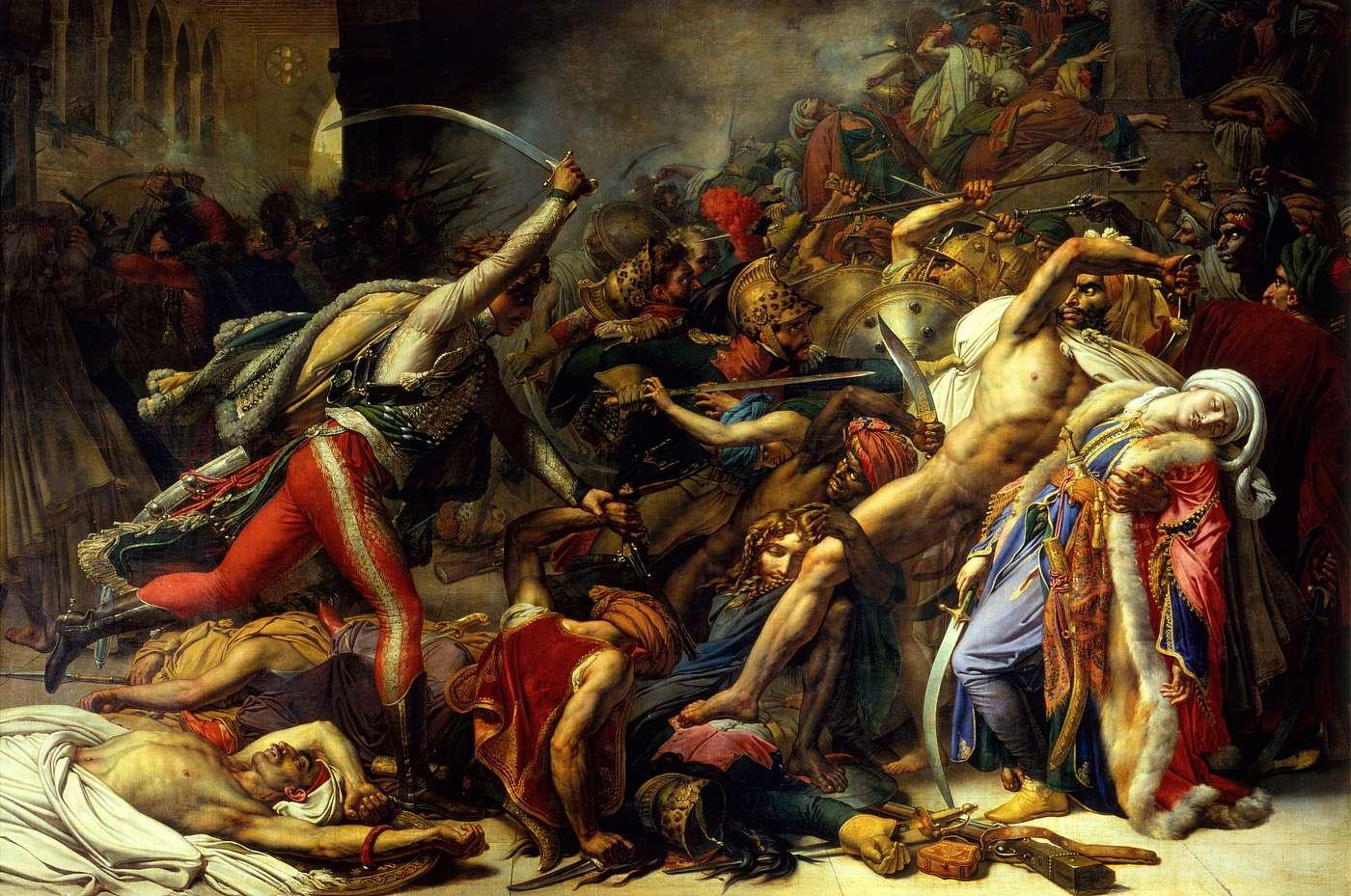
The French, of course, saw it differently. And while Bonaparte’s Egyptian venture ultimately ended in retreat, the First Empire later commissioned a slew of paintings to celebrate it. Girodet, a disciple of David, received the commission to portray the Cairo uprising on an epic scale. His Revolt of Cairo was first displayed at the 1810 Salon, the competitive exhibition of French academic painting. Today it resides in the museum at Versailles.

Take a close look at the painting. (You may also click here for a larger, detailed view.) It depicts a moment of the battle when French troops had stormed the inner sanctum of the Azhar mosque. To the left is a French hussar, sword raised above his head, bearing down on the insurgents with a steely resolve. To the right are the insurgents, centered on the naked figure (identified by contemporary viewers as an “Arab”) whose sword is raised in defense. In his left arm, he grasps a wounded Mamluk in lavish garb; at his feet is a black man, with a short bloodied sword in one hand, and the pale severed head of a French hussar in the other. It’s a tumultuous work. As one art historian has written, “To be fully appreciated the Revolt must make you smile. Death and decapitation cannot override (or suppress) the picture’s sheer glee. The painting is absurd, and also inflated, bombastic, extreme. In the Revolt of Cairo, the logic of the world we live in is fantastically suspended.” (And Girodet, for all his care in detailing clothes and arms, played loose with the identity of the insurgents: the revolt was led by ulema, not Mamluk holdovers, and no Arab bedouin joined it.)

I’ve just quoted art historian Darcy Grimaldo Grigsby of Berkeley, and to fully appreciate Girodet’s work, consult her book Extremities: Painting Empire in Post-Revolutionary France, where she devotes sixty riveting pages to the Revolt of Cairo. Sure, there’s the customary dwelling on the homoeroticism of the painting–it can’t be missed, and Girodet reportedly had liaisons with Mamluks who found their way to Paris and who posed for him.

But there’s more. Girodet, Grisgsby argues, subverted the very political purpose he was commissioned to serve:

Girodet prominently displays the ‘orientals’ and eclipses the French hussar’s face by a cast shadow. The painter thus deprives his primary French protagonist not only of highest rank–there is no general here–but also of individual celebrity. He is neither Murat nor Bonaparte but an anonymous French soldier and the picture refuses to grant him the stature of portraiture. He remains, moreover, despite his tightly fitting clothing, a flattened pattern of rotating limbs…. Boots, pants, jacket, cape, we dress him like a paper doll… In the Revolt of Cairo, the naked warrior, unlike the spinning hussar, is irresistably charismatic…. In Girodet’s painting of colonial warfare, it is the insurgents not the French colonizers who are aligned with the classical narratives of passion, loyalty, and courage so revered within the French tradition.

So much for Edward Said. Even this officially-commissioned work, to commemorate a (short-lived) French victory, has the power to subvert. But to appreciate that, you need a sense of irony.

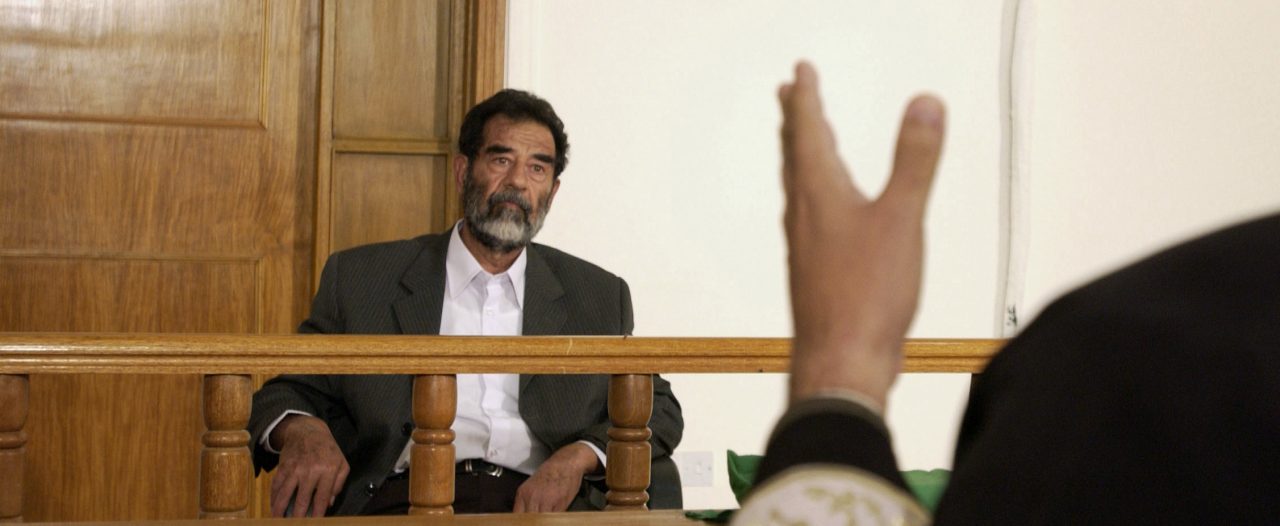
The American reception of Girodet’s painting is bound to be colored by America’s experience in Iraq. Conquest, insurgency, decapitation–there’s too much here not to evoke Iraq. Personally, I find that analogies between Iraq and Vietnam or World War Two don’t speak to me, and when I need an analogy as a crutch, I go back to the history of the Middle East itself. The French occupation of Egypt seems to me especially relevant. That brief intervention ended in military failure, but as the Syrian Sadek al-Azm has written, it “made a clean sweep of all that had become irrelevant on our side of the Mediterranean–the traditional Mamluk and Ottoman conduct of warfare, the supporting production systems, local knowledges, and forms of economic, social, legal, and political organization.” The French left in defeat, but their ideas became thoroughly embedded in the minds of those who resisted them.

Will the U.S. “moment” in the Middle East produce a similar transformation? In a paradoxical way, this doesn’t depend upon success in stabilizing Iraq, which may prove to be a mission impossible, just as holding Egypt was beyond the capabilities of Bonaparte. In the longer term, the more lasting impact may result not from anything the United States succeeds in building, but from the combined destruction of Saddam’s regime and the constant reiteration of the democracy message. Egyptian dissident Saad Eddin Ibrahim has put it this way:

It was a jolt of the French Expedition back in 1798 that was the beginning of the Liberal Age, the Arab awakening after not decades, but centuries, of stagnation…. Egyptians resisted the French Expedition and finally got it out; Napoleon was expelled out of Egypt in less than three years, like you–probably Americans would be expelled out of Iraq–but the three years of the French Expedition were really the beginning of the so-called New Arab Renaissance.

“I don’t mean to compare Bush to Napoleon,” Ibrahim has said, but “over the past 200 years, it seems that it is usually such external jolts that enable the seeds of change to materialize, for the pregnant to give birth.” We can’t know how the Iraq intervention will appear two centuries hence (and it probably won’t leave behind anything quite like Girodet’s Revolt of Cairo). But let’s not presume to know how history will judge it.

Girodet: Romantic Rebel: Art Institute, details here; Met, here; Montreal, here.