When the history of Israel’s policy toward Hamas is investigated, one question will loom large: why did Israel allow Hamas, an implacable enemy, to grow alongside its jugular?
This development occurred almost entirely during Benjamin Netanyahu’s tenure. Hamas rose to power in Gaza in June 2007, and Netanyahu emerged as prime minister from elections in February 2009, a position he has occupied for thirteen of the last fourteen years.
The promise
During the 2009 election, Netanyahu criticized Tzipi Livni, the leader of the rival Kadima party then in power, for failing to bring down Hamas. On February 3, he visited the southern city of Ashkelon following a rocket attack from Gaza. Israel had concluded Operation Cast Lead against Hamas a few weeks earlier, and the Knesset elections were just a week away. Netanyahu recorded the following video message:
We’re here at the entrance to Ashkelon. This morning a Grad rocket landed here. That says it all. By chance, by a stroke of luck, there was a miracle, and the children who showed me the shrapnel weren’t harmed.
But we can’t rely on miracles. We need action to eliminate the threat. Only one action will do this, and that’s to topple the Hamas regime in Gaza.
I’ve sounded the alarm regarding Hamas for several years now, cautioning that rockets would be fired from Gaza towards Ashkelon. Tzipi Livni and Kadima scoffed at the idea. They downplayed these warnings, accused us of being alarmists and of instilling fear in the populace. It turns out that we foresaw what they, in their short-sightedness, could not.
And not only did they not see the danger. When it became evident, they showed weakness. They practiced restraint, they agreed to a truce, they allowed Hamas to arm itself with more and more rockets. Ultimately, when they finally took action (and the IDF did an outstanding job), Tzipi Livni and the Kadima government halted the IDF before it could finish the mission.
So I want to say here and now, we won’t stop the IDF, we’ll complete the task. We’ll topple the regime of Hamas terror, we’ll restore security to the residents of Ashkelon, Ashdod, Sderot, Be’er Sheva, and Yavne. We’ll restore security to all the inhabitants of Israel.
Neutralizing Hamas didn’t seem like a difficult proposition in 2009. The group had very limited capabilities at the time, and its performance against Israeli forces during Operation Cast Lead proved to be lackluster. “They are villagers with guns,” said an Israeli soldier to a reporter. “We kept saying Hamas was a strong terror organization, but it was more easy than we thought it would be.”
Netanyahu won the election and became the prime minister, yet he made no attempt to topple Hamas once in office. This stance can be partially understood by reconstructing some of Netanyahu’s rationales, as evidenced in his widely available memoirs, Bibi: My Story, published in 2022. These memoirs reveal that Hamas effectively deterred Netanyahu from carrying out his promise, even as he declared that he had deterred Hamas.
“Bigger fish to fry”
Netanyahu first faced an expectation to keep his promise of bringing down Hamas in November 2012, during Operation Pillar of Defense, an air offensive against Hamas and Palestinian Islamic Jihad. Early on, Israel killed Ahmad Jabri, a leading commander in Hamas. Hamas launched barrages of rockets on Israel, leading to an exchange that culminated in a ceasefire. Netanyahu’s thinking during this crisis is revealed in his memoirs::
Since we had achieved our major objective, knocking out the top Hamas commander Jabri right at the start of the campaign, there was no point in continuing. But ending these kinds of operations is much harder than starting them. The public invariably expects the government to continue the battle and “flatten Gaza,” believing that with enough punishment the Hamas regime would collapse.
Yet that would only happen if we sent in the army. The casualties would mount: many hundreds on the Israeli side and many thousands on the Palestinian side. Did I really want to tie down the IDF in Gaza for years when we had to deal with Iran and a possible Syrian front? The answer was categorically no. I had bigger fish to fry.
“You’re the political echelon, I’m not”
The operation bought time, but by 2014 the situation in the south had deteriorated. In a security cabinet meeting on January 19, Netanyahu authorized a “strategic discussion devoted to the possibilities of toppling Hamas in Gaza.” However, when the cabinet reconvened on February 16, he shifted the focus to operational matters, excluding strategy. This met with resistance from both the chief of staff and the national security adviser, who argued that operations were inherently linked to the overarching strategy. Acknowledging this, Netanyahu committed to addressing strategic goals in a future meeting.
In the cabinet meeting of March 13, several cabinet members complained to Netanyahu that they still hadn’t discussed a long-term strategy. Gilad Erdan, home front minister, complained that “over the year that I’ve been a member of this cabinet, I haven’t gained even a shred of information that would enable me to make decisions about long-term policy.” Netanyahu promised that a discussion of strategy toward Gaza would take place at the next meeting.
In the discussion held on March 23, three options were considered: gradual escalation, a large-scale but limited military operation, and toppling Hamas. Reflecting on this a year later, Yair Lapid, then the finance minister, stated that the purpose of the discussion was “to show why it wasn’t worth it to conquer Gaza.” The head of the IDF’s operations directorate commented on the session: “It wasn’t really a strategy discussion, because it set no strategic objectives.”
The conflict with Hamas continued to escalate, culminating in July in Operation Protective Edge, a fifty-day clash between Israel and Hamas. Israel entered the battle without a long-term strategy. This frustration became immediately apparent in the security cabinet on July 8, the first day of the operation. The following quotes from the protocol, as detailed in the State Comptroller’s report on decision-making during the operation, illustrate the cabinet’s frustration:
Yair Lapid (finance minister): “We never even held a discussion on whether we want the Hamas regime in Gaza to continue.”
Yuval Steinitz (minister of strategic affairs and intelligence): “We focus on tactics and run away, time after time, year after year—it’s already nine years that we’re running—from the strategic reality that’s forming right before our eyes.”
Yossi Cohen (national security adviser): “I define the problem for you, you should define the goal. You’re the political echelon, I’m not. It’s your job to define the goal.”
“Not worth it”
This time the open calls for toppling Hamas came from coalition partners, especially cabinet ministers Naftali Bennett and Avigdor Lieberman. In his memoirs, Netanyahu recalled that Bennett in particular,
advocated a full-scale ground invasion to “conquer Gaza.” That could only be done with the wholesale destruction of Gaza, with tens of thousands of civilian deaths. After destroying the Hamas regime, Israel would have to govern two million Gazans for an indefinite period. I had no intention of doing that, especially since I had my gaze fixed on Iran, a much greater threat.
Netanyahu needed back-up against such formidable political rivals, so he called in the troops:
Midway into the conflict, I convened the cabinet and asked the chief of staff to lay out the invasion plans and assess the toll in lives. Then I asked the Defense Ministry to assess the resources needed for the postwar administration of Gaza.
The briefing, which was leaked within a week, portrayed toppling Hamas as the worst possible option. It predicted the deaths of hundreds of soldiers and thousands of Palestinian civilians, and the abduction of other soldiers. Peace treaties with Egypt and Jordan might be jeopardized. The occupation of Gaza would cost Israel tens of billions of shekels annually, and eliminating 20,000 Hamas fighters and their arsenal would likely take no less than five years. (Whether the prime minister’s office influenced the content of this briefing warrants further investigation.)
Some cabinet ministers reportedly found the briefing unduly “pessimistic,” but Netanyahu made the call:
I believed the cost in blood and treasure was not worth it. My clear impression was that all the cabinet ministers agreed with my assessment, though they were reluctant to say so publicly.
He then gave himself points for standing up to “hypocrisy”:
In war, people expect their leaders to make the right decisions. Yet some allow themselves to irresponsibly take contrarian positions which they know are wrong. I decided against a full-scale ground invasion.
Who deterred whom?
Although an investigation might turn up more evidence, it doesn’t seem that toppling Hamas ever returned to the agenda after Operation Protective Edge. Occasional flare-ups ended in standoffs, Israel claiming each time that it had restored deterrence.
On December 12, 2019, a radio journalist asked Netanyahu whether refraining from toppling Hamas was a mistake. “We are preparing,” he said. “When you are a commander, you have to decide how to conduct the war. I won’t begin it one minute, even one second, before conditions are optimal.” He didn’t explain what constituted “optimal” conditions, which apparently never materialized over fourteen years.
It is important to note the motive that Netanyahu did not offer. He did not provide the grander strategic rationale of building up Hamas as a counterweight to the Palestinian Authority (PA). Over the years, some of his supporters and critics have claimed that leaving Hamas in place constituted an ingenious or diabolic strategy to avoid negotiations with the PA. But Netanyahu himself never said so.
In his memoirs, he speaks instead about Israeli casualties (“many hundreds on the Israeli side,” “the cost in blood,” “the toll in lives”), the burden of occupation (“tie down the IDF in Gaza for years ,” “govern two million Gazans for an indefinite period”), and the cost in Palestinian lives and property (“many thousands on the Palestinian side,” “the wholesale destruction of Gaza, with tens of thousands of civilian deaths”), for which Israel would be condemned.
In short, to judge from his memoirs, Netanyahu only strategized over Iran (the “bigger fish”). Hamas was a distracting sideshow; toppling it wasn’t part of the grand Iran strategy, and “not worth” the cost “in blood and treasure.” This is classic deterrence, and Hamas achieved it, even as Netanyahu boasted that he’d deterred Hamas.
Courage vs. caution
David Ben-Gurion will always be synonymous with May 14, 1948, the day he declared Israel’s independence. On that Friday, he displayed extraordinary political courage. Ben-Gurion was determined to overturn the status quo and create a state. Despite warnings against declaring independence from the United States and his generals’ assessments that the chances of victory were only fifty-fifty against Arab armies, Ben-Gurion took that chance. He forged ahead regardless of the cost. Israel’s very existence today is a testament to his unwavering resolve, demonstrated under circumstances far from “optimal.”
Benjamin Netanyahu will always be synonymous with October 7, 2023. His approach was one of political caution, aiming to maintain power and the status quo with minimal cost. He promised to topple Hamas when it appeared electorally advantageous, but abandoned this pledge when it seemed politically risky. When his generals painted a pessimistic picture, he readily embraced it. His associates may even have leaked it, to justify his restraint. Netanyahu’s belief that leaders should wait for “optimal” conditions before taking decisive action effectively became an excuse for inaction.
Now he has been forced to wage a war he did everything to avoid, following the worst catastrophe in the annals of modern Israel. “This is our second War of Independence,” Netanyahu has declared. He has secured his place in history by undoing a small part of the first one.
Election banner, 2006: “Strong Against Hamas: Only the Likud [and] Netanyahu.”
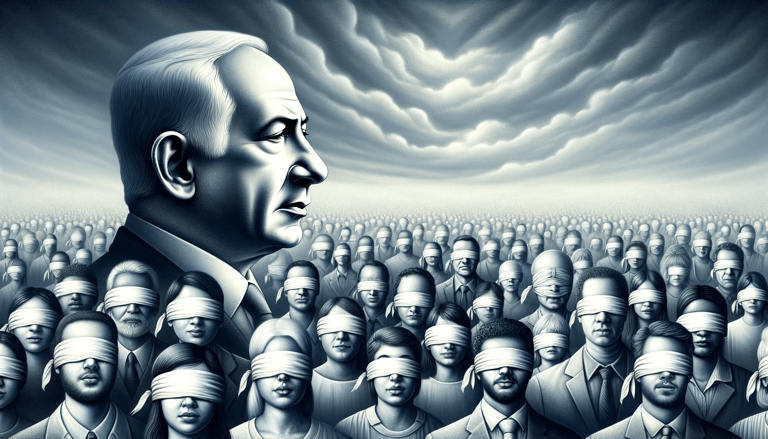
Header image created by DALL-E, OpenAI’s image generation model.
Left to right: Peel plan 1937, UN plan 1947, Trump plan 2020
It’s officially called the “Vision for Peace, Prosperity, and a Brighter Future.” But the scheme devised by Jared Kushner for his father-in-law President Donald Trump is basically a partition plan, replete with a map.
The President seems to think that his plan is unprecedented in its detail:
In the past, even the most well-intentioned plans were light on factual details and heavy on conceptual frameworks. By contrast, our plan is 80 pages and is the most detailed proposal ever put forward by far.
But past partition plans also were heavy on details and accompanying maps. The British partition plan of 1937, produced by a “royal commission” and popularly named after its otherwise-forgotten chairman, one Lord Peel, ran to 231 pages. Its follow up, the Palestine Partition Commission Report, had 310 pages and thirteen maps. The 1947 partition plan written by the United Nations Special Committee on Palestine had 83 pages (including “annexes, appendix and maps”). The two follow-ups of the Ad Hoc Committee for Palestine, with additional details, added more than a hundred pages.
That’s a long time ago, and one might be forgiven for categorizing Trump’s initiative among the more recent and conceptual “peace plans.” But it’s really the successor to the two preceding partition plans, both in its level of detail and, especially, in its maps.
The most striking consistency in these three partition plans is that the Zionist or Israeli side helped to fashion them so as to say “yes,” while the Palestinian Arabs refused to help prepare them, and so ended up saying “no.” Each rejected plan has been followed eventually by another, which has offered the Palestinians still less.
Comparing the 2020 map to 1947, and the 1947 map to 1937, makes that graphically clear. The Palestinians have appealed every verdict of history, and have lost every time. Odds are that this pattern will be repeated yet again, because the Palestinians remain too weak and divided, or resentful and myth-infected, to say “yes.”
Gradations of legitimacy
But while there’s consistency in the way these plans have been received, there are major differences in their authority. The most legitimate partition plan was that of 1947, because it was put together by an international commission, and it enjoyed the overt support of the two superpowers, the United States and the Soviet Union. On that basis, it garnered two-thirds support in the UN General Assembly, and became enshrined as Resolution 181.
While the resolution wasn’t more than a recommendation, it was strong enough to figure in Israel’s declaration of statehood. “By virtue of our natural and historic right,” the declaration reads, “and on the strength of the resolution of the United Nations General Assembly, [we] hereby proclaim the establishment of a Jewish state in Eretz-Israel, to be known as the State of Israel.”
The earlier 1937 partition plan didn’t get nearly as far. The royal commission’s report was no more than a recommendation to the British government, which then convened another commission, which then declared partition impractical. The League of Nations, in whose name Britain ruled Palestine, never weighed in. For all the heft of the Peel plan, few remember it, although it was the first to establish partition as a possible solution.
At this moment, the Trump partition plan is closer to 1937 than 1947. True, it’s officially and overtly promoted by the president of the world’s leading power, which works in its favor. But it’s the brainchild of a handful of Americans, and it has no wider buy-in, except by Israel. A partition plan, to make history, doesn’t need Palestinian backing, as 1947 showed. But it can’t go very far if it doesn’t have what the 1947 plan had: some degree of international endorsement.
Russia, Europe, the Arab states — all of them could advance or retard the plan. Wooing them is especially important for Israel, since it seeks “recognition” for what it’s possessed for half a century. Borders gain legitimacy by mutual agreement (Israel’s borders with Egypt and Jordan) or international certification (its border with Lebanon). It isn’t enough for Trump to wave a scepter, or Israeli prime minister Benjamin Netanyahu to evoke the Bible, however potent both instruments may be. The United States and Israel will have to canvas the world for support, just as they did in 1947.
Dancing in the streets?
Another difference is the degree of urgency: past plans emerged from crisis situations. In 1937, Palestine was in the midst of an Arab rebellion and violent turmoil. Jews fleeing Nazi persecution sought a refuge. In 1947, surviving Jewish refugees in Europe cried out for entry to Palestine. Partition was conceived as a kind of emergency surgery.
In 2020, in contrast, Israelis and Palestinians are living through the calmest decade-plus in their modern history. They have hammered out a status quo that’s far from perfect, but that still functions. The Trump partition plan emerges, instead, from the urgent political needs of Trump and Netanyahu. Since no one else is desperately awaiting such a plan, few will be keen to make sacrifices for its success.
That may be why the Trump plan is such a conservative one, grounded in realities as they are. Remember that the 1937 plan, forged in a different moral climate, proposed the involuntary “transfer” of more than 200,000 Palestinian Arabs out of the Jewish state. The 1947 plan left more than a third of the country’s Arabs within a Jewish state they opposed. (Most ended up fleeing it.) 1937 and 1947 gave rise to huge debates and fed deep passions all around.
Trump’s partition, by contrast, doesn’t imagine anyone moving, or (with few exceptions) living under a new kind of rule. That’s why its map is also so convoluted, compared to its predecessors. All partition maps have had strange anomalies, with awkward corridors and crossing points. The Trump map is full of enclaves, bypasses, and even a tunnel, precisely so that no one need relocate or submit to alien rule.
Because the plan so closely hews to the status quo, it won’t spark much jubilation among Israelis or much violence among Palestinians. But perhaps that’s its best hope. On the ground, there already exists a kind of two-state reality. Israel is a very strong polity, the Palestinian Authority a very weak one. But both have presidents, cabinets, security forces, anthems, and control of territory. Trump’s plan is focused on drawing final borders and building Palestinian state capacity. It may be a fool’s errand, but it’s not as radical as its predecessors.
History books or recycle bin?
So is it “historic,” a word regularly abused by politicians? Netanyahu: “I believe that down the decades — and perhaps down the centuries — we will remember January 28, 2020.” He even bordered on blasphemy when he compared the occasion to May 14, 1948, arguably the most significant date in Jewish history in the last two millennia.
At this point, it’s not even clear we’ll remember January 28 six months from now. A plan on paper doesn’t make history, even if it’s called “The Vision” and gets launched to strains of “Hail to the Chief.” The Trump partition plan isn’t “dead on arrival.” But for an American plan to stand even a chance of survival, the president must put his and America’s full weight behind it for years to come, perhaps even “down the decades.”
Does Trump’s America, does anyone’s America, have the attention span, grit, and finesse to see the “deal of the century” through? That’s the question of the century.
Was the feud between U.S. President Barack Obama and Israeli Prime Minister Benjamin Netanyahu, first over settlements and then over Iran, a watershed? Netanyahu, it is claimed, turned U.S. support of Israel into a partisan issue. Liberals, including many American Jews, are said to be fed up with Israel’s “occupation,” which will mark its 50th anniversary next year. The weakening of Israel’s democratic ethos is supposedly undercutting the “shared values” argument for the relationship. Some say Israel’s dogged adherence to an “unsustainable” status quo in the West Bank has made it a liability in a region in the throes of change. Israel, it is claimed, is slipping into pariah status, imposed by the global movement for Boycott, Divestment, and Sanctions (BDS).
Biblical-style lamentations over Israel’s final corruption have been a staple of the state’s critics and die-hard anti-Zionists for 70 years. Never have they been so detached from reality. Of course, Israel has changed—decidedly for the better….



 Martin Kramer on the Middle East
You must be logged in to post a comment.