
It is hard to tell whether the Iran war is a masterstroke, a misadventure, or something in between. “The owl of Minerva spreads its wings only with the falling of the dusk.” When we do know, it will only be after the fact, so scoring the war now is premature. My own sense, based on no special intelligence, is that if the war were a boxing match, the referee would have stopped it by now.
My thoughts instead turn to my mentors, and the question of what they’d think if they were still among us. One comes especially to mind.
Bernard Lewis (1916-2018) is best known as a historian of the Arab lands, the Ottoman Empire, and Turkey. But from the very outset, he had a particular interest in Shi‘ite Islam and Islamic Iran. He first visited Iran in 1950. “I traveled extensively around the country for a few weeks and found it a fascinating and hospitable place. The people were most tolerant of my fragmentary Persian.” He made several subsequent visits and attended the 1971 Persepolis celebrations as an official guest. He had a few audiences with the Shah, one in the year or so before the revolution.
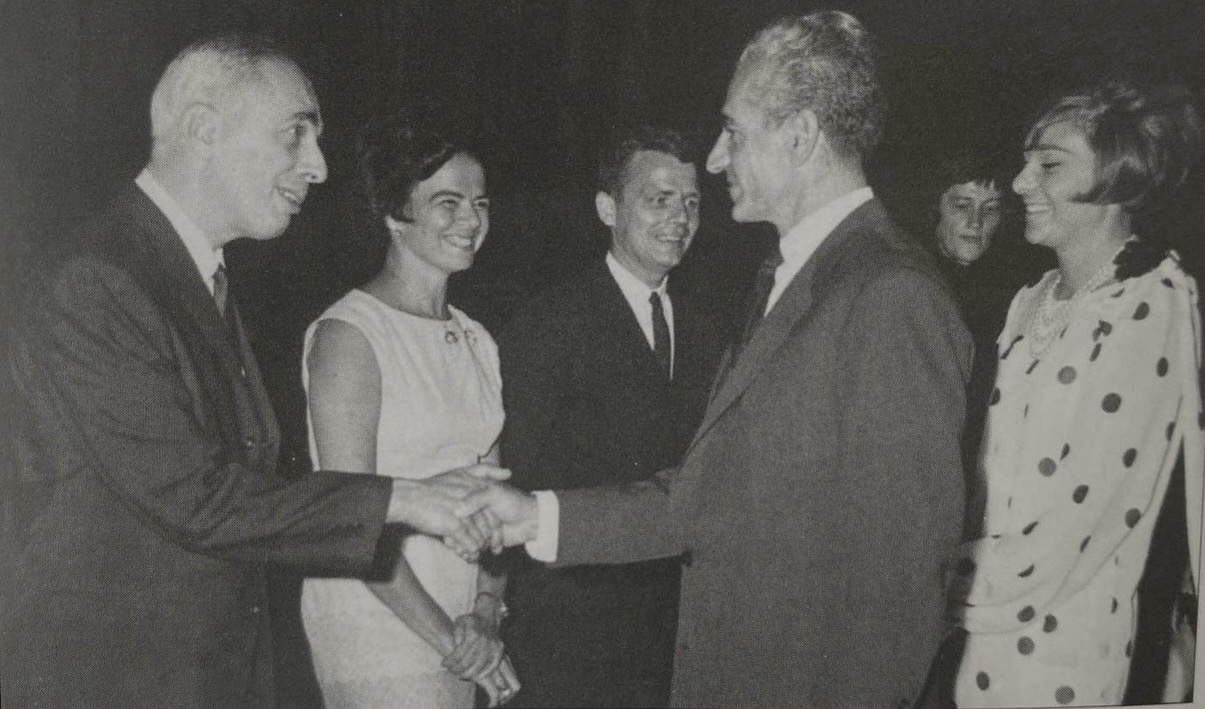
Lewis meets Mohammad Reza Shah, early 1970s.
Later, he wrote much-discussed articles on the Iranian revolution, particularly for the New York Review of Books in the 1980s and 1990s. (These can be found in his two collections, Islam and History and From Babel to Dragomans.) He never visited the Islamic Republic, despite receiving an invitation to participate in a conference on religious dialogue. “The subject is a very interesting and important one, but I did not feel inclined to discuss it under the auspices of the current regime.”
I was his student at Princeton during the Iranian revolution, and Lewis shares a revealing story about that time, which I remember well. Few in the West knew much about Ayatollah Khomeini, and neither did Lewis, so he went to the university library to see if Khomeini had written anything. There, he found the Arabic and Persian texts of Khomeini’s lectures in exile, now known in English as Islamic Government. This would later be called Khomeini’s Mein Kampf, a fitting comparison according to Lewis.
It was a work of unrelenting extremism, promising a harsh and purifying Islamic regime. Lewis struggled to get Washington and the New York Times to take it seriously: many wanted to believe that Khomeini would fade away if the monarchy fell. You can see a youngish Lewis on TV here, eloquently warning of what would happen if Khomeini gained power. He was right, and Iran ended up with a clerical dictatorship. The Iranian revolution brought Lewis into the American spotlight for the first time, although it was 9/11 that later catapulted him into the stratosphere.
If Lewis were here, I think the media would ask him the now-ubiquitous question: Is regime change possible, and will foreign military action accelerate it? From time to time, the media did ask him that question, so we have his past answers spanning twenty years.
Lewis repeatedly insisted that the regime couldn’t last. In 1993, he told Le Monde:
The regime is firmly in place, but sooner or later it risks being replaced by a new Reza Khan. Regional centers that have become stronger could emerge, and Tehran’s power could be diminished. Some general might come with his army into the capital to restore the unity of the nation. This may be how the Islamic Revolution in Iran will end; it could happen tomorrow or in fifty years.
This speculation relied on Iran’s own history for a precedent. Reza Khan was the generalissimo who seized power and made himself shah in 1925. But in 1997, Lewis offered a different analogy, from Europe’s repertoire. The “aging and tiring” regime
faces mounting discontent among ever larger sections of the population at home. The Iranian revolutionaries are in many ways following the path of their French and Russian predecessors—the struggle of radicals and pragmatists, the terror, the Thermidorian reaction. It is not impossible that the Iranian Revolution, too, may culminate in a Napoleon or a Stalin. They would be wise to remember that Napoleon’s career ended at Waterloo and St. Helena and that Stalin’s legacy to the Soviet Union was disintegration and chaos.
Yet, while these analogies from the 1990s differed, Lewis anticipated a strongman would rise, centralize power, and break the fever of the revolution.
After 9/11, Lewis began to speak of a different engine of regime change: not a man on horseback but the Iranian people. In 2001, he was asked if any country in the region was moving toward democracy. He gave a surprising answer:
I would say Iran is moving in that direction. They do have elections of a sort, it’s true, under a whole series of constraints. Nevertheless, it has been possible in Iran for the electorate, the people in general, to express an opinion. It’s indirect, it’s ineffectual, but it’s not unimportant because of that. And what you have, in effect, now in Iran is two governments: an elected government, which has no power, and a ruling government which was never elected and is not answerable. And that sets up tensions, which may well lead to the development of more democratic institutions.
Not only were Iranians moving toward democracy. They were moving toward America. In 2002, he noted that “after the events of Sept. 11, great numbers of people came out into the streets in Iranian cities, where, in defiance of the authorities, they lit candles and held vigils in sympathy and solidarity with the victims in New York and Washington. This contrasted markedly with the scenes of rejoicing elsewhere.”
From this, he developed a thesis he repeated again and again: “While the citizens of supposedly ‘friendly’ Arab nations sometimes harbor deep anti-American resentment, the populations living under fiercely anti-American dictatorships—most notably Iran and Iraq—often hold strongly pro-American sentiments.” Indeed, they saw the United States as potential liberators. “You remember the scenes of rejoicing in Afghanistan,” he told an interviewer in 2002, after the United States brought down the Taliban regime. “I’ve been told by Iranian friends that that would look like a funeral compared with the rejoicing in Iran, if America would step in and help them get rid of their government.”
At about the same time, Lewis participated in an independent study group convened at the Pentagon’s behest. Its report, “Delta of Terrorism,” co-signed by Lewis and twelve other people, is remembered for advocating regime change in Iraq. But it also included a section on Iran. Not surprisingly, the Iran discussion followed lines of argument Lewis made elsewhere: Lewis was the senior figure in the group with knowledge of the Middle East, and the other two were his self-described disciples.
Iran was presented there as “the most populous, developed, sophisticated society in the Muslim Middle East,” and “the region’s universal joint.” Its people were “increasingly pro-American, seeing the United States as the counterforce to a tired and calcified regime.” Thought of “any deals or accommodations” with the regime should be banished; the American goal should be “to undermine and eventually replace” it.
But this would happen from within. The United States “should begin contingency planning now for a U.S. response to a spontaneous popular revolution in Iran,” encouraged by “a Reagan-style information campaign of the kind we waged successfully in Poland and Serbia. Iran constitutes the new Eastern Europe for us. A liberated Iran—like a liberated Eastern Europe—transforms the regional power equation. ”
Indeed, so powerful were the internal forces for change that they required only encouragement. “I realize I am sticking my neck out,” Lewis said in 2003, “but I would say that the prospects of a reasonably easy transition to democracy are better in Iran than in Iraq, because the regime in Iran, with all its faults, was not as destructive as that of Saddam Hussein.” Easy? In 2007, he discerned “a level of discontent at home, which could be exploited. I do not think it would be too difficult to bring it to the point when the regime could be overthrown.”
In 2011, he added another element: fracturing within the regime. He told the Wall Street Journal:
There is strong opposition to the regime—two oppositions—the opposition within the regime and the opposition against the regime. And I think that sooner or later the regime in Iran will be overthrown and something more open, more democratic, will emerge. Most Iranian patriots are against the regime. They feel it is defaming and dishonoring their country. And they’re right of course.
Lewis didn’t specify a timeline for this process, but he still framed it as an internal one.
Alas, the nuclear program made waiting problematic. Lewis had a strong view on Iran’s program. “There is a radical difference between the Islamic Republic of Iran and other governments with nuclear weapons,” he wrote. “This difference is expressed in what can only be described as the apocalyptic worldview of Iran’s present rulers.” Famously, he said that for Iran’s regime (under Ahmedinejad in particular), Mutually Assured Destruction (MAD) was “not a constraint; it is an inducement.” (In 2012, Israeli Prime Minister Netanyahu quoted Lewis before the UN, adding this flourish: “Iran’s apocalyptic leaders believe that a medieval holy man will reappear in the wake of a devastating Holy War, thereby ensuring that their brand of radical Islam will rule the earth.”)
Even so, Lewis repeatedly ruled out a military “invasion” to change the regime. He said this in 2006:
I don’t think it’s a good idea to launch an armed invasion. There is a great deal one can do short of that to indicate displeasure, to make things difficult and to encourage resistance among the subjects of the Iranian government. And there is ample evidence of widespread unhappiness and discontent among the people of Iran. I think we could do more to encourage and help them in a number of ways.
In 2007, he reiterated his objection. What Iranians wanted was “not a military invasion. My Iranian friends and various groups are unanimous on that point. They feel a military invasion would be counterproductive.”
He also hesitated about military action short of invasion. In a lecture given sometime between 2009 and 2011, he insisted that other options hadn’t been exhausted.
What are the possibilities in dealing with this threat from Iran? I think one can divide them into two: one is the obvious military one. It may reach a point when there is no other; I do not personally believe that we have reached that point yet, and I believe that, even in talking about it, it is very important not to give the regime a free gift of something that they do not at present enjoy, that is, the support of Iranian patriotism…. I think one has to handle this very carefully and before deciding that the military option is the only one that remains. There are possibilities internally within Iran, opportunities which I think have been underused or totally neglected.… It seems to me that, for the moment, one should aim at disruption rather than a military action.
He immediately followed this with a caveat: “I must, in concluding, admit the possibility that one may, at some time, reach a situation when there is no other option available.” But for the rest of his life—he died in 2018 just shy of age 102—he never publicly stated that such a “point” or “situation” had been reached. In 2012, when asked whether he supported military action against Iran, Lewis said: “I don’t think it’s the right answer…. We should do what we can to help the Iranian opposition. We could do a lot to help them and we’re not doing a damn thing, as far as I know.” “It may come to [military action],” he added, but it hadn’t yet.
So Lewis didn’t completely rule out using force, but he viewed it as a last resort that, if mishandled, could spark a patriotic outpouring and turn into a “free gift” to the regime.
Would he have made the same argument today? It’s a question that cannot be answered, as events since his death would have shaped his perspective. The most significant of these are progress in Iran’s nuclear program, which was less advanced in the 2010s, and the regime’s growing ruthlessness. Lewis lived a very long life and saw historic shifts in power. He stayed relevant for so long because he understood and explained change. So we don’t know how he would have responded to changing conditions in Iran, and we can only regret that no one of his caliber has replaced him.
Still, revisiting Lewis helps us frame the questions that will occupy us moving forward. Is there a foundation for democracy beneath the battered shell of the Islamic Republic? If so, can foreign military and clandestine actions help expand it? If there are two oppositions, inside and outside the regime, could they unite? Or will the war only strengthen the regime? It’s probably fair to say that the threat posed by Iran’s regime has been diminished. The key question now is, will the promise of Iran’s people also be fulfilled?
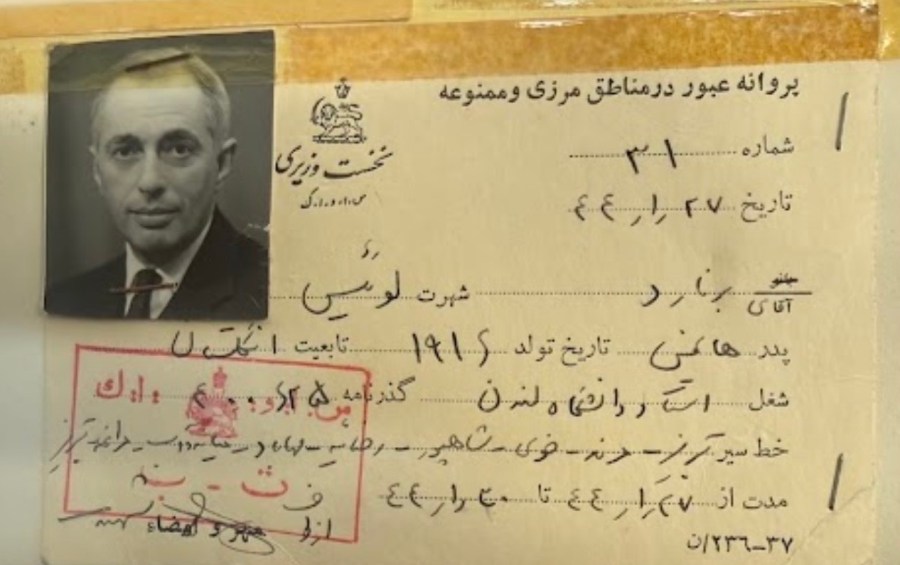
Header image: An official travel permit issued to Lewis in April 1965 for a trip across Iranian Azerbaijan starting in Tabriz. This followed a lecture series delivered by Lewis in Tehran, organized by the British Council.
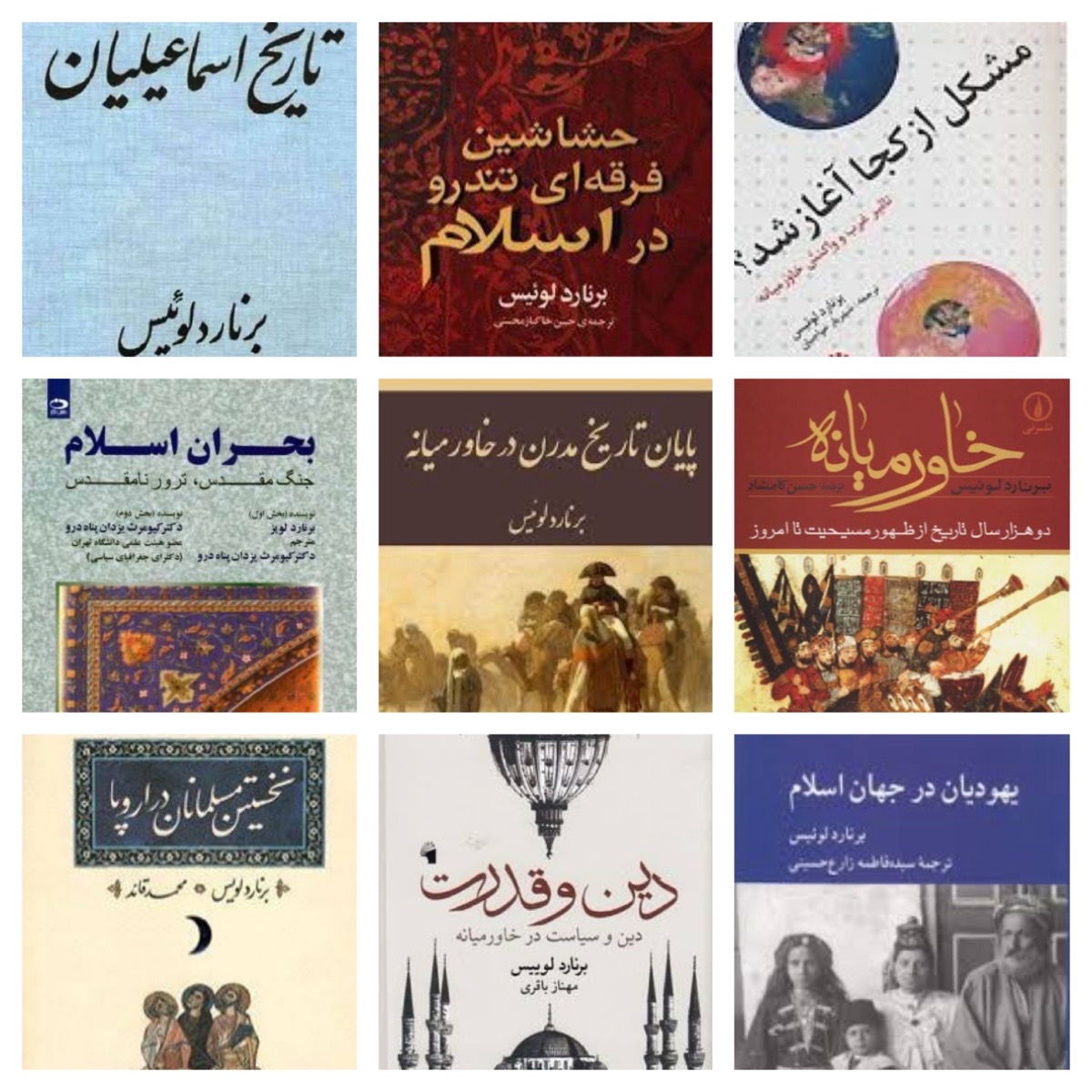
Below: covers of Lewis’s books in Persian translation. Left to right, top row: The Origins of Isma‘ilism; The Assassins: A Radical Sect in Islam; What Went Wrong?: Western Impact and Middle Eastern Response. Middle row: The Crisis of Islam: Holy War and Unholy Terror; The End of Modern History in the Middle East; The Middle East: A Brief History of the Last 2,000 Years. Bottom row: The Muslim Discovery of Europe; Faith and Power: Religion and Politics in the Middle East; The Jews of Islam.



 Martin Kramer on the Middle East
You must be logged in to post a comment.