
On Facebook, I ran a series listing the most influential modern books on the Middle East (in the English language). I selected each not on the basis of quality, but my rough assessment of a book’s impact on readers and politics, short-term and long. It’s rather rare for a book on the Middle East to have much of an influence in America and Britain; at most times, it’s a marginal region. But events have propelled a few books into the limelight, and these six, for better or worse, had an impact, influenced perceptions, and may have changed history.
Arabia of Lawrence
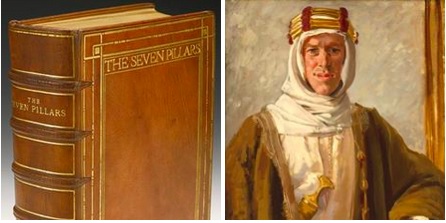
Seven Pillars of Wisdom by T. E. Lawrence (1926). I rather like Charles Hill’s depiction of Lawrence as someone “who wrote himself into history as a fictional character leading Arab tribes in revolt against the Ottoman Turks.” (Hill calls the book “a novel traveling under the cover of autobiography.”) But the book lives, and is even said to have inspired U.S. counter-insurgency theorists in Iraq.
Arise, ye Arabs!

The Arab Awakening by George Antonius (1938). This purported exposé of British double-dealing provided all the pretext that Britain needed to retreat from its support for the Jewish National Home in Palestine, culminating in the 1939 White Paper. The British commander of forces in Palestine in 1946 said he kept the book “on my bedside table.” It also became the bible of American sympathizers of Arab nationalism. “We had our revered texts,” wrote the American Arabist Malcolm Kerr, “such as The Arab Awakening.” It has been refuted on many grounds, but while its influence doesn’t endure, it lingers.
God Gave This Land…
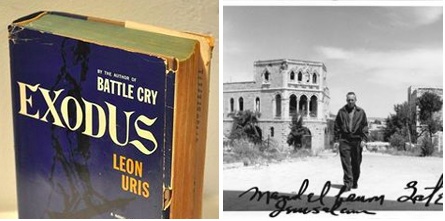
Exodus by Leon Uris (1958). Recently I asked a class of grad students in Mideast studies whether they’d heard of it, and I didn’t get a single nod. But this fictionalized account of Israel’s founding was said to have been the biggest seller since Gone with the Wind, propelled by a blockbuster motion picture starring Paul Newman. The novel, confessed journalist Jeffrey Goldberg, “set me, and many others, on a course for aliyah, and it made American Jews proud of Israel’s achievements. On the other hand, it created the impression that all Arabs are savages.” Arabs have been searching for their equivalent of Exodus ever since.
Snake Charmer

Orientalism by Edward Said (1978). Sigh… I suppose “baneful” is the best adjective. No book has done more to obscure the Middle East, and impart a sense of guilt to anyone who has had the audacity to represent it. The French scholar Jacques Berque (praised by Said) put it succinctly: Said had done “a disservice to his countrymen in allowing them to believe in a Western intelligence coalition against them.” But the book gave rise to a cottage industry in Western academe, and helped tilt the scales in academic appointments. Its influence may be waning, but it’s still on syllabi everywhere.
Fit to Print and Reprint

From Beirut to Jerusalem by Thomas Friedman (1989). It spent nearly twelve months on the New York Times bestseller list and won the 1989 National Book Award for nonfiction. Coming in the wake of the 1982 Lebanon war and the 1987 intifada, it captured the “falling-out-of-love-with-Israel” mood, although it cut no slack for the Arabs either. Friedman has said he keeps threatening to bring out a new edition with this one-line introduction: “Nothing has changed.”
How the East Was Lost

What Went Wrong? by Bernard Lewis (2002). The book appeared in the aftermath of 9/11, and it rocketed to the New York Times bestseller list, where it spent 18 weeks. Lewis used his broad historical repertoire to explain “why they hate us.” (In a word: resentment, at failed modernization and an absence of freedom.) Lewis later summarized his view thus: “Either we bring them freedom, or they destroy us.” Some in Washington took him literally.
Nakba Validation

At a reader’s suggestion, I’m adding a seventh book to my list. It’s The Birth of the Palestinian Refugee Problem, 1947-49 (1988) by Benny Morris. Drawing on Israeli archives, Morris did what no Palestinian Arab historian had managed to do: (partially) validate the Nakba narrative. The book confirmed Israel’s “original sin” in the eyes of the Israeli left, and persuaded Palestinians (wrongly) that Israel might compromise on the “right of return.” Neither the criticism by Efraim Karsh, nor the political swerves of Morris himself, could mitigate the book’s political impact.
This doesn’t exhaust the list of books about the Middle East that made the New York Times bestseller list or won the admiration of scholars. That bibliography would be much longer (and some years ago, I myself put together a different list, of choice scholarly works). But for sheer influence in the longer term, I don’t see another book that deserves inclusion in this club. If you have other ideas, share them at this link on Facebook.
 Back in the fall, Garth Hall, a grad student and research assistant at the American University in Cairo, sent an email to 202 professors of Middle Eastern studies. Hall asked them to “jot down what you think are the ten most interesting, informative, and readable nonfiction books in the last century of Middle East studies… And if you could, please write one sentence on why you chose the book you did for your first choice.” (Details
  Martin Kramer on the Middle East
You must be logged in to post a comment.