Down and out at Columbia

The resignation of Minouche Shafik, president of Columbia University, is being hailed as a victory all around. Rep. Elise Stefanik (R-N.Y.), who had called for her resignation back in April, celebrated the news:

Since her catastrophic testimony at the Education and Workforce Committee hearing, Shafik’s failed presidency was untenable and it was only a matter of time before her forced resignation. After failing to protect Jewish students and negotiating with pro Hamas terrorists, this forced resignation is long overdue.

But at Columbia, the campus chapter of Students for Justice in Palestine (SJP) also celebrated:

After months of chanting ‘Minouche Shafik you can’t hide’ she finally got the memo. To be clear, any future president who does not pay heed to the Columbia student body’s overwhelming demand for divestment will end up exactly as President Shafik did.

While Stefanik and SJP play tug-of-war over Shafik’s scalp, the battle for Columbia is far from over. Once the academic year begins, Columbia could face some of the same problems it encountered last spring: encampments, building occupations, intimidation of Jewish students, faculty alienation, and campus shutdowns. The demand by faculty and student radicals for “divestment” from Israel isn’t going away, and it’s one that no Columbia administration can satisfy.

My personal view is that Shafik was probably as good as you could get at a university as corrupted as Columbia, and likely more than Columbia deserved.

What went wrong

I began sounding the alarm over Columbia many years ago. I spent a year there as a graduate student and earned a master’s degree in history in 1976. Aside from the indomitable J.C. Hurewitz, I found nothing to keep me there. So I returned to Princeton for my doctorate. I had completed my undergraduate degree there, and Princeton had just acquired Bernard Lewis.

I left Morningside Heights, but I continued to watch Columbia with an insider’s interest. After I published a critique of Middle Eastern studies in 2001, I began identifying Columbia as the epicenter of the problems plaguing the field—so much so that Columbia’s Palestinian star, Edward Said, made this complaint in 2003:

An outrageous Israeli, Martin Kramer, uses his Web site to attack everybody who says anything he doesn’t like. For example, he has described Columbia as ‘the Bir Zeit [West Bank university] on the Hudson,’ because there are two Palestinians teaching here. Two Palestinians teaching in a faculty of 8,000 people! If you have two Palestinians, it makes you a kind of terrorist hideout.

Only seven years later, Columbia inaugurated a new Center for Palestine Studies. The announcement stated that “Columbia University is currently the professional home to a unique concentration of distinguished scholars on Palestine and Palestinians.” How did Columbia go from “two Palestinians” to a “unique concentration” in just seven years?

The same way Hamas built an underground warren in Gaza: through resolve, deception, cooptation, and intimidation. No one should have been surprised when an army of pro-Palestine and even pro-Hamas students, encouraged from behind the scenes by faculty, appeared last spring. The plot against Columbia had been more than twenty years in the making.

Most of the tunneling took place during the tenure of Lee Bollinger, president from 2002 to 2023. Whenever trouble surfaced—whether it was granting tenure to unqualified extremists or hosting the antisemitic Iranian president Mahmoud Ahmadinejad on campus—Bollinger turned on the charm machine. Columbia is so much more, he reassured. This “move on, folks, nothing to see here” approach worked because donors, alumni, and students needed it to work. After all, they had shares in Columbia, Inc. That included many Jews, in all three categories.

Shafik had nothing to do with the administrative neglect that ate away at the foundations of the university. She wasn’t an alumna, and she’d never taught there. Her whole career had unfolded in Britain. When she assumed the Columbia job in June 2023, she may not have known how deep the rot went. What had started as a faculty problem had metastasized over two decades, spreading both to the student body and to the administrative bureaucracy. “Bir Zeit-on-Hudson” had gone from (my) hyperbole to reality.

Embed from Getty Images

I didn’t say so at the time, to avoid adding fuel to the wrong side, but I thought Shafik showed grit in calling in the NYPD twice: first, to clear the “Gaza Solidarity Encampment” on South Lawn, and second, to clear Hamilton Hall, which had been forcibly occupied by a mix of students and off-campus radicals. But those decisions are what ultimately doomed her presidency.

More precisely, it was the faculty who made her position untenable. They had already taken umbrage at her Congressional testimony, where she appeared vaguely amenable to disciplining faculty speech. Her decision to call in the police compounded the crisis. A no-confidence resolution passed by the Faculty of Arts and Sciences (with 65 percent in favor) declared that Shafik’s decisions “to ignore our statutes and our norms of academic freedom and shared governance, to have our students arrested, and to impose a lockdown of our campus with continuing police presence, have gravely undermined our confidence in her.”

It was just such a vote of no-confidence that drove Lawrence Summers out of the Harvard presidency in 2006. When you lose such a vote, you’re on borrowed time. Shafik prepared her departure, and announced that she would be returning to Britain to take up an economic advisory position with the Foreign Secretary. The statement by her temporary replacement, the CEO of Columbia’s medical center, made it quite clear who must be appeased henceforth: the Columbia faculty. “You are the ultimate keepers of the institution’s values and the stewards of its long and proud history.”

Upon Shafik’s resignation, Stefanik gloated: “THREE DOWN, so many to go.” The other two were the presidents of Harvard and Penn. But not every campus is the same. The pro-Israel stakeholders at Columbia have always been weak, and what Congress thinks doesn’t much matter on Morningside Heights. In my view, Shafik’s fall should actually be counted in the pro-Palestine column. If I’m right, it’s not “three down,” but “two to one.”

Does it get better?

Shafik was born in Egypt to a well-to-do family. In 1966, Nasser’s “Arab revolution” stripped her father, a chemist by training, of his expansive estate and all his property, in a wave of nationalization. The Shafiks arrived on America’s shores “with little money and a few possessions.” Minouche was four years old. “It taught me that you can go from having a lot to having nothing overnight, and you can’t get too attached to stuff because you can lose it.”

Shafik was driven from the land of her birth by an angry and aggrieved nationalism. Now, she’s been driven out of America by another variety of angry and aggrieved nationalism, this time Palestinian. She’ll always be remembered as the president who called in New York’s finest to handcuff some of Columbia’s worst. I’d be surprised if the next president is made of sterner stuff.

Embed from Getty Images

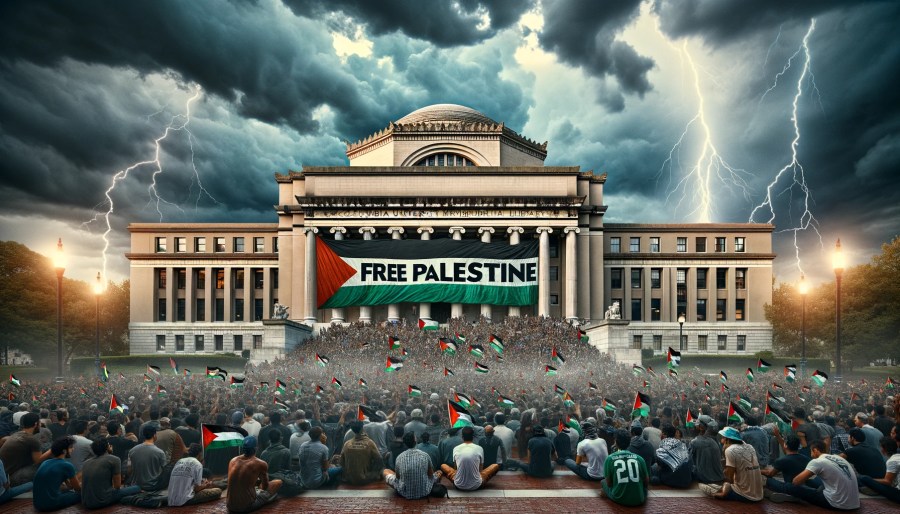
Header image created by DALL-E, OpenAI’s image generation model.
Columbia’s slippery boycotters

This post first appeared on the Commentary blog on October 2.

In a post in late August, I asked whether Columbia University’s federally-funded Middle East Institute was boycotting Israeli institutions of higher education. Why? Its director, anthropologist Lila Abu-Lughod, has signed a pledge by some Middle East studies academics “not to collaborate on projects and events involving Israeli academic institutions.” Did that personal pledge extend to the Middle East Institute, a Title VI National Research Center under her direction?

I posed the question to David Stone, executive vice-president for communications at Columbia, and received this reply from him:

If an individual faculty member chooses not to participate in events involving Israel, that is a personal choice that has no effect on the programs of the Middle East Institute or the rest of the University. The Institute itself is home to a broad range of teaching and research including a number of fellowships and grants that support faculty and student research and study in Israel; and its faculty members are engaged in a variety of projects with Israeli scholars.

Alan Luxenberg, president of the Foreign Policy Research Institute, posed the same question directly to Abu-Lughod, and received this reply:

My decision does not affect the Middle East Institute where we welcome distinguished scholars and students from all over the world, fund language training for students in all Middle Eastern languages, support study abroad in all the region’s universities, and support, modestly, summer research for students in all the countries of the region, including Israel.

The Middle East Institute serves the Columbia community. It does not have any institutional partnerships with other universities, whether in the US or abroad.

I’m not surprised (or persuaded) by these answers. I think it’s telling that Abu-Lughod has not issued a public statement of her position, which might be deemed an unacceptable compromise by the BDS (boycott, divestment, and sanctions) cult. After all, if you really believe that Israel is South Africa (or worse), why not demonstrably abjure any administrative role in academe that compels you to treat it equally? What’s the worth of a boycott if it doesn’t mean sacrificing your access to something to advance a cause—whether it’s a home soda maker or the coveted directorship of a Middle East center?

But that’s neither here nor there. The taxpaying public has the right to expect that every signatory of the boycott pledge who runs a Title VI National Research Center issue an assurance that the boycott doesn’t apply during working hours. And the public has the right to expect an equal assurance from a university’s higher administration. Anything less than that should be automatically suspect, because it’s the bare minimum, and because it’s obvious that even these assurances don’t mean that there isn’t a stealth boycott underway.

A Title VI federally-funded National Research Center is committed by law to making sure that its programming will reflect “diverse perspectives and a wide range of views and generate debate on world regions.” Unfortunately, the U.S. Department of Education, which administers the program, has failed even to define what this means. Consider this test case. On September 19, Columbia’s Middle East Institute co-sponsored (with the university’s Center for Palestine Studies) a panel entitled “The War on Gaza: Military Strategy and Historical Horizons.” (Notice the title, as though there wasn’t a war on Israel too.) It included three Palestinian-American boycotters: Columbia professor Rashid Khalidi, Barnard professor Nadia Abu El-Haj, and legal activist Noura Erakat. And that’s it. Read the live tweets from the session, and judge the tenor of the proceedings yourself. Did this event offer “diverse perspectives and a wide range of views,” and was it structured to “generate debate”? No. So just what must the Middle East Institute do now to assure that it meets its obligation?

My own view is that there’s nothing that a bureaucrat in Washington can do to assure that it does. No Department of Education official is going to detect a stealth boycott or do any serious follow-up on whether taxpayer dollars are going to political activists in academic guise. That means that the reform of Title VI, a creaking holdover from the Cold War, is impossible. If you think that Title VI, on balance, does more good than harm, you’re just going to have to accept that some of your tax dollars will go to agitprop for Hamas. If you think that’s totally unacceptable, you should favor the total elimination of Title VI from the Higher Education Act, now up for reauthorization. There is no middle ground.

Columbia boycotts Israel?

Several hundred Middle East scholars have put out a letter pledging to boycott Israeli institutions of higher education. The organized association of Middle Eastern studies has rejected boycotts in the past, and is likely to do so again if the issue even gets tabled at the next convention. So the boycott of Israel in Middle Eastern studies is being organized along the lines of a personal pledge by individual scholars.

Israeli institutions of higher education (including, presumably, the one over which I preside, Shalem College in Jerusalem), are deemed by these scholars to be “complicit in violating Palestinian rights.” The signatories thus pledge “not to collaborate on projects and events involving Israeli academic institutions, not to teach at or to attend conferences at such institutions, and not to publish in academic journals based in Israel.” The pledge will remain in effect until these institutions call on Israel to end the Gaza “siege,” evacuate all territory “occupied” in 1967, and “promote the right of Palestinian refugees to return to their homes.” In other words, it’s a boycott until Israel dies.

I looked down the list of signatories, and mostly saw the usual suspects. Columbia, of course, is heavily represented. The boycotters include such tenured Columbia radicals as Rashid Khalidi, Nadia Abu El-Haj, Hamid Dabashi, Gil Anidjar, Mahmood Mamdani, George Saliba, Brinkley Messick, Timothy Mitchell, and Wael Hallaq. In fact, no university has more senior faculty boycotters signed on this letter than Columbia.

But one name in particular caught my eye: Lila Abu-Lughod, professor of anthropology. I remembered that she had become director of Columbia’s Middle East Institute a few years back. Why is that significant? The Institute she directs is a Title VI U.S. Department of Education-supported National Resource Center (NRC) for the Middle East. An NRC is supposed to “maintain linkages with overseas institutions of higher education and other organizations that may contribute to the teaching and research of the Center.”

The question I now have is whether this (taxpayer-subsidized) academic unit of Columbia is boycotting Israeli academe? Or are we to believe that Professor Abu-Lughod is only boycotting Israeli institutions personally, but is prepared to cooperate with them officially? Columbia should issue a clarification, and give a public account of the overseas institutional linkages the Institute does have, so that we can see whether a de facto boycott of Israel is in place at Columbia. You can even pose the question yourself, to Columbia’s Office of Communications and Public Affairs, right here.