Columbia’s Troubles Bubble Up Through the Bubbly

Last night, Columbia College (the university’s undergraduate college) threw its big bash of the year: a black-tie gala at the Plaza Hotel, held in honor of five alumni recipients of the John Jay Award for professional achievement. One of them, the renowned classical composer John Corigliano, added what a report this morning calls a “moment of drama,” when he “briefly silenced the crowd with his muted but nonetheless unexpected criticism of Columbia’s Middle Eastern Studies program.” Corigliano reflected on his own undergraduate days:

I didn’t know it at the time, but I felt encouraged to go on and be a composer because I wasn’t discouraged by the kind of fundamentalist “there is only one way” kind of composing. I say this because throughout this country there has been an enormous, enormous amount of publicity about the various departments of Middle Eastern Studies, and about the fact that the anti-Israeli policy in these [departments] is enormous. And one can say that of the department of Middle Eastern languages and cultures at Columbia, that that’s true here.

According to the report, “Corigliano’s comments drew raised eyebrows but also sustained applause.” Bravo, maestro.

When this sort of complaint crops up in a midtown dinner (which, by the way, raised $700,000 for scholarships), you know that Bir Zeit-on-Hudson has a real problem. I predict it will get worse before it gets better. According to another press report, the Department of Middle Eastern and Asian Languages and Cultures (MEALAC), the heart of darkness and home to such extremist luminaries as Hamid Dabashi and Joseph Massad, is already in the midst of a dramatic expansion. And the History Department, where Rashid Khalidi is about to become the Edward Said Professor, is also seeking to add an assistant professor. In the self-referential friend-brings-a-friend world of Middle Eastern studies at Columbia, it is Khalidi who will have the biggest say in that hire. In fact, the push for the junior slot was put off until Khalidi signed on. “If we were going to have a distinguished senior professor of modern Middle Eastern history, then [Khalidi] should play a central role in choosing who the junior person is in the field,” announced one member of the department. Does that sound like a formula for producing intellectual diversity, or like a mechanism for guaranteeing intellectual conformity?

Middle Eastern studies at Columbia, across all the departments, have functioned like a private club for more than a decade. Until the administration breaks it up, nothing will change. In the meantime, let’s acknowledge John Corigliano. The man who composed the Oscar-winning score for The Red Violin and the Pulitzer-winning Symphony No. 2 has done his alma mater a big favor. He said out loud what untold numbers of friends of the university are saying in private. This time the criticism was in a minor key. The next time, the university may not be so lucky.

UPDATE: Hamid Dabashi, the chair of MEALAC, has written an intemperate letter to the Columbia Daily Spectator, firing in all directions. Criticism of his department is denounced as “fabricated lies,” “pernicious lies,” “malicious misrepresentations,” “misguided accusations,” “insults to the dignity of my colleagues,” etcetera. It’s delightful to see this militant squirm under the heat of the spotlight.

“I find it particularly distasteful,” storms Dabashi, “that as we are honoring our alumni they can muster such rude audacity to discredit the very institution that is honoring them.” Really. The John Jay Award has two roles. In some cases, its purpose is to honor donors and friends. In others—like Corigliano’s—it is to allow the College to bask in the fame of a highly accomplished alumnus. Corigliano was perfectly within his rights to exclude a rogue department from his endorsement of today’s Columbia.

Dabashi—get this—also says he has written an “official letter” to the dean of the College, demanding an answer to this question: “Did he or anyone else from Columbia College publicly defend the good name and the dignity of my colleagues who have served generations of Columbia students honorably with the fruits of their teaching and scholarship?” That would have given the evening a splendid touch. It’s not enough that Columbia is pumping up MEALAC with new slots and resources. Dabashi expects deans to jump up in their tuxedos to defend MEALAC’s blatant excesses, against perfectly legitimate criticism.

Three times in his letter, Dabashi writes that the episode was an affront to the “dignity” of the department. “Dignity” isn’t an intrinsic characteristic of a university department: it has to be earned, and it can be lost. MEALAC’s “good name” is in serious question, and if its members want it back, they can take a first step: dump Dabashi.
Bir Zeit-on-Hudson

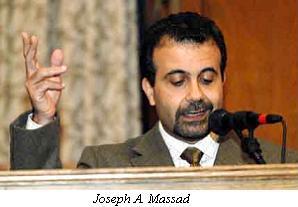
Two weekends ago, Columbia University hosted a Palestinian film festival. I have nothing against such festivals, which have been held over the past year in Seattle and Chicago. Some of the films are worthy examples of the art. But of course, Columbia’s faculty can be counted upon to give a legitimate exercise the flavor of a hate-fest. This time, it was the turn of Joseph Massad, an assistant professor in the department that sponsored the festival. According to the Columbia Daily Spectator, Massad, speaking on a festival panel, praised the films as “weapons” and “likened Israeli Prime Minister Ariel Sharon’s cultural views to those of Nazi Minister of Propaganda Joseph Goebbels.”

All this is standard procedure for Massad, who throws out Nazi analogies with reckless abandon. (When the Campus Watch website named him, presumably for doing just that sort of thing, he called it “a Gestapo file.”) This week, Massad has cropped up on the pages of Al-Ahram Weekly, and he has outdone himself. The article is a rant against the anti-Israel left in Europe (e.g., Derrida, Bourdieu), for not being anti-Israel enough. Alas, too many of the left’s culture heroes only demand an end to Israeli occupation. They fail to see that Israel itself, in any borders, is a racist entity. The Jews, not being a nation by (Massad’s) definition, cannot have nationalism. They have only racism, implemented through colonialism. In this one op-ed, Massad manages to repeat the words “racist” and “racism” twenty-two times. Talk about Goebbels.

So here are the highlights. Israel is “a racist Jewish state,” the “offspring” of “the foundational racism of Zionism.” The “European Jew is a colonizer who has used racist colonial violence for the last century against the Palestinian people.” Israel was founded “by armed colonial settlers.” “Zionist Jewish colonialism” was a “commitment to European white supremacy in Jewish guise.” “Jewish colonists were part of the British colonial death squads that murdered Palestinian revolutionaries between 1936 and 1939.” There has been an “ideological and practical collusion between Zionism and anti-Semitism since the inception of the movement.” Zionism “has always been predicated on anti-Semitism and on an alliance between Zionists and anti-Semitic imperialists.” Zionism itself had an “anti-Semitic project of destroying Jewish cultures and languages in the diaspora.”

Heard enough? Too bad. “Israeli colonialism and racism operate with the same force, albeit with different means, inside the Jewish state as they do in the territories Israel occupies.” Israel’s racism manifests itself in “the racist curricula of Israeli Jewish schools, the racist Israeli Jewish media representations of Palestinians, the racist declarations of Israeli Jewish leaders on the right and on the left, and the Jewish supremacist rights and privileges guiding Zionism and Israeli state laws and policies.” “The ultimate achievement of Israel,” concludes Massad, is “the transformation of the Jew into the anti-Semite, and the Palestinian into the Jew.”

On any blind reading, you would discount these as the blurtings of a rabid fanatic, obviously consumed by a hatred of Israel and its people so venomous and manic that it has destroyed any capacity for sober historical judgment. You would be right.

Yet Massad, in the dens he inhabits, is not considered a fanatic at all. Quite the contrary: he is the flower of Columbia University and American Middle Eastern studies. He completed his doctorate at Columbia; Columbia University Press published it; and Columbia University now employs him (to teach, inter alia, Israeli politics and society). The Middle East Studies Association (MESA) awarded him its prize for outstanding dissertation, and the resulting book has been reviewed favorably by MESA’s current president-elect. Massad also recently passed his three-year review at Columbia, and is now on leave writing what I have heard described as his “tenure book,” the opus he hopes will make Columbia his oyster. It’s entitled The Persistence of the Palestinian Question, and its core argument is—you guessed it—Israel is a racist state.

It will be fascinating to see how Rashid Khalidi, the new Edward Said Professor of Middle Eastern Studies at Columbia, and designated head of its Middle East Institute, deals with the Massad phenomenon. (Khalidi earlier endorsed Massad’s first book as “one of the best of the new crop.”) And I eagerly look forward to Massad’s “tenure book”—or, to borrow from his own stock of analogies, his Mein Kampf.

POSTSCRIPT: I noticed that Khalidi’s endorsement of Massad’s only book describes it as “well-written.” So here’s a sample, from chapter one:

Whereas the genetic moment of every national interpellation secures the subsequent claims made by popular nationalism anchoring the political and popular concept of the nation, every retelling of the story of the nation becomes in fact a moment of sublation (incorporation and transcendence), wherein the newly constituted Jordanian identity sublates its predecessor in an interminable process, and whereby the new Jordanian identity is reinscribed as the one that had always already existed as it does today.

Also don’t miss Massad’s recent exchange with Israeli “new historian” Benny Morris, in which Morris turns the tables and shows “surprise” at Massad’s racism. “I resent your accusation of racism,” Massad huffed—and immediately retaliated by calling Morris a “racist Orientalist.” Is there a pattern here?

UPDATE: One of the things I did learn from Orientalism was that the most effective way to damn someone is to quote him. Said, in his walk through the valley of orientalist texts, left no quote unturned. I recently deployed this technique in dealing with Columbia’s Joseph Massad, who wrote an anti-Israel article in the Ahram Weekly full of self-incriminating hyperbole. All I had to do was quote him.

Now Massad has replied, also in the Ahram Weekly, in an article loaded with sweeping assertions. According to Massad, I am “keen to defend Israel’s prerogative to kill and bomb anyone who stands in its way.” I seek to “extend Israeli violence to the U.S. academic arena.” I have “not yet eliminated anyone physically,” but I and my “young dupes” have the “express aim of imploding freedom.” I am guilty of “virulent anti-Arab racism.” And so on.

What disappoints me about this rambling text of 2,300 words is that Massad does not quote me even once. Of course, nowhere have I written that Israel has the “prerogative to kill and bomb anyone,” but surely I must have written something worth quoting, even out of context, which would damn me. Massad, alas, has failed to master the ingenious technique of Orientalism, despite reading and rereading it. (He’s also failed to learn from Said that you lie low until you have tenure, but that’s another matter.)

It’s just another reminder that the unique and irreplacable Edward Said will have no successors. The Beirut Daily Star once likened one of Said’s Beirut lectures to “an American rock concert for the learned and the not-so.” An apt comparison—and when Said is gone, we’ll be left with the Edward impersonators.

The Columbia Club of Middle Eastern Studies

Things go from bad to worse at Columbia University, the Bir Zeit of American academe. Articles in yesterday’s Chicago Sun-Times and in today’s New York Sun report that Professor Rashid Khalidi of the University of Chicago is weighing an offer to join Columbia University, as the Edward Said Professor (of God-only-knows—there are no precise details). The donor is reported to be anonymous; an endowed chair at Columbia runs between $3 and $4 million. All this has been rumored for some time, but now that it’s in the newspapers, it’s fair game for comment.

Let me begin with the anonymity of the donor. In Middle Eastern studies, concealment of the identity of donors has become a major contributing factor to the field’s deepening corruption. Twenty years ago, the Middle East Studies Association (MESA) passed a resolution calling “on institutions in Middle East Studies to make regular disclosure of the sources of funding for their programs.” It’s a dead letter. For example, a few years back, Harvard University established a program for contemporary Arab studies, “initiated by generous new funding not previously available to the university.” To my knowledge, that’s the most the program has ever said about its funding.

Now Columbia University wishes to establish a chair with an anonymous donor, for a person (and in the name of a person) known for Palestinian activism no less than for scholarship. Excuse me, but Columbia must make known the identity of the donor. Otherwise, kind reader, assume the worst: Palestine’s cause has its share of unsavory advocates, and when they don’t come forward, there is usually a good reason. In a couple of weeks, MESA meets in Washington. It should reiterate its resolution of 1982, especially as MESA’s incoming president, Lisa Anderson, is a dean at Columbia. Hopefully, she’ll get the message.

The other issue of overriding concern here is the apparent absence of any effort by the Columbia administration to promote diversity. Here I don’t mean the false diversity of academic mafias. They think it’s crucial to assemble people of different ethnic, national, religious, racial, gender, and disciplinary backgrounds—provided they say the same thing. I’m talking about intellectual diversity, which used to be a value at Columbia. The only historian of the modern Middle East at Columbia is another Palestinian, Joseph Massad, who is a militant follower of Edward Said. (He’s now up for tenure.) Imagine that Khalidi were added, and Massad were tenured, both to teach history. They work in the same area, and their politics, while not identical, are very similar. The whole thing begins to look like a cozy club of like-minded pals, who peer at the Middle East through exactly the same telescope, from exactly the same vantage point.

I leave aside Khalidi’s scholarship. It is sturdy, nationalist historiography—no stunning breakthroughs or departures, just the usual stuff, done with rather more polish and style. Others can (and will) pick through Khalidi’s political writings for nuggets. I’ve been rather more taken by how little he understands the Middle East generally, and by the sheer density of his ideological filters. (See my Ivory Towers on Sand, pp. 65-66, for the litany of Khalidi predictions about the Middle East that never panned out.) Of course, there’s no substantive penalty for being wrong about anything in Middle Eastern studies—as long as your politics are just right. Here, of course, Khalidi’s credentials are impeccable. I can’t imagine anyone more suited to a chair named in honor of someone who replaced scholarship with politics.

On top of that, Columbia now has a divestment petition, on which its Middle East faculty have an overwhelming presence. (I list them below). On the counter-petition which has many more signatories, there is almost no presence.

Self-referential groupthink is clearly running rampant at Columbia, now reinforced by hidden money, and the administration seems unwilling or impotent to stop it. So the time has come for alumni and supporters of Columbia to weigh in against the cozy conformism on Morningside Heights. The faculty will bleat “academic freedom,” but at Columbia it’s been reduced to their freedom to provide plum chairs for allies and chums. It’s a privilege they’ve so abused that it’s time for the administration to repossess it. I speak as an alumnus. I’m appalled. And I’m not alone.

_____________

The following are signatories of the Columbia divestment petition whose major field is the Middle East, or who hold appointments in the Department of Middle Eastern and Asian Languages and Cultures (MEALAC).

Nadia Abu El-Haj, Anthropology, Barnard
Lila Abu-Lughod, Anthropology & Women’s Studies, Columbia
Samir Awad, MEALAC, Columbia
Gil Anidjar, MEALAC, Columbia
Janaki Bakhle, MEALAC, Columbia
Zainab Bahrani, Art History & Archaeology, Columbia
Elliot Colla, MEALAC, Columbia
Elaine Combs-Schilling, Anthropology, Columbia
Hamid Dabashi, MEALAC, Columbia
Joseph Massad, MEALAC, Columbia
Brinkley Messick, Anthropology, Columbia
Marc Nichanian, MEALAC, Columbia
Frances Pritchett, MEALAC, Columbia
George Saliba, MEALAC, Columbia
Nader Sohrabi, MEALAC, Columbia
Marc van de Mieroop, MEALAC, Columbia

UPDATE: Columbia University’s president, Lee Bollinger, has rejected the divestment petition (as has Barnard president Judith Shapiro). That’s a good beginning. Now it’s time for the administration to ask whether there is enough intellectual diversity on the hallways where the petition found near-unanimous support.

UPDATE+: The Columbia Spectator reports that there are thirty donors, and that some of the names might be released. And Hamid Dabashi, chair of MEALAC, tells the Chronicle of Higher Education that the “notion of ideological conformity here is entirely obscene.” (I guess he hasn’t seen the list above.)

CORRECTION: Joseph Massad is not up for tenure. He just passed his third-year review, and will come up for tenure in four years. If Khalidi joins Columbia next year, students interested in subjects like Israel, Palestine, and the modern Arab world, will get a wide choice: Massad or Khalidi, for the next three years.