The film Golda, coinciding with the 50th anniversary of the Yom Kippur War, has sharply focused attention on how Prime Minister Golda Meir made critical decisions in the lead-up to and during the fateful days of October 1973. Here I offer some evidence and insights from the late Bernard Lewis, the most acclaimed historian of the Middle East in our time. Lewis was an astute observer who frequently traveled between Cairo and Jerusalem prior to the war. He has left us a valuable account of his experience in his memoirs.
Lewis was well-acquainted with a wide range of Israel’s leaders from his generation and those that followed. They included Abba Eban, whom he knew from an early age, as well as Moshe Dayan, Shimon Peres, Yitzhak Rabin, Ehud Barak, and Benjamin Netanyahu. However, apart from Eban, Golda Meir was the first Israeli leader he got to know well, and he approached her as a man on a mission.
“Egypt was ready for peace”
In 1969, Lewis visited Egypt to attend a conference. Gamal Abdul Nasser still held power, and Egypt struggled to rebound from its defeat in the Six-Day War two years prior. Lewis briefly met Nasser, but they did not have a conversation. Still, he recalled, “I saw a lot of people, including old friends, and I was very much struck by the change in mood. I came away with a very clear impression that Egypt was ready for peace. I was sure of it. I had no doubts whatsoever.”
Over the next two years, Lewis’s conviction deepened. He returned to Cairo in 1970 and again in 1971, after Nasser’s death. While he did not meet Nasser’s successor, Anwar Sadat, he met his advisers, and he became “convinced that a direct approach to Egypt would produce results.”
In 1971, he reiterated his view in US Senate testimony: “I am quite convinced that there is in Egypt a genuine desire for peace. I have no doubt about that at all. It was there before the death of Nasser, and it has become more open since the death of Nasser.” In fact, Sadat’s adviser, Tahseen Bashir, seems to have asked Lewis to convey to Golda that Sadat wished to negotiate an interim agreement.
But the Israelis were not interested. During one of Lewis’s visits to Israel, Golda invited him into her kitchen and offered him tea and cake. Lewis made his case for a direct approach to Egypt, but Golda summarily dismissed it. Lewis tells the story:
She didn’t believe me. She indicated that I had allowed myself to be duped by the Egyptians and that it was all nonsense. I tried the same on Moshe Dayan. I think he did believe me, but he didn’t like it. He just didn’t want to negotiate…. I also put it to Rabin. I even wrote Rabin a letter to that effect. But it fell on deaf ears; they didn’t believe me or didn’t want to believe me.
Did the Yom Kippur War occur because Golda thought Lewis had been misled? She missed many more signals in far more important channels. But Golda’s dismissal of Lewis sheds light on why those other messages got lost in transmission.
“Only what she wanted to hear”
Lewis had another encounter with Golda Meir a few years later, on the Palestinian question. In 1974, Lewis prepared a piece that eventually would be published by Commentary under the title “The Palestinians and the PLO.” Lewis began by demonstrating how the concept of a Palestinian people arose only after the First World War. “The emergence of a distinctive Palestinian entity,” he wrote, “is a product of the last decades and may be seen as the joint creation of Israel and the Arab states — the one by extruding the Arabs of Palestine, the others by refusing to accept them.”
Golda distributed Lewis’s article to the entire cabinet, and she summoned him to a meeting. According to one participant, “they spoke for hours. Her aides tried to end it, but Golda kept going, and Bernard didn’t want to be rude.” Golda latched onto Lewis’s historical point about the recent origin of Palestinian identity. In 1969, she had said that “there was no such thing as Palestinians,” perhaps her most famous (or infamous) remark. Now she believed she had found scholarly support to validate her claim.
But she completely ignored the rest of the article, where Lewis had urged Israel to “test the willingness or ability” of the PLO to negotiate a two-state solution — this, at a time when Israel regarded the PLO as a terrorist organization utterly beyond the pale. Golda simply ignored that part of Lewis’s argument.
Lewis later identified Meir’s problem. She was admirably tough, but overly rigid:
Golda was fitted with a kind of personal filtration system — she only heard what she wanted to hear. If she picked up anything in what I was saying to her that fit within her pattern of thought, she would immediately grasp and use it. Anything that didn’t fit just went straight past her.
The same might be said of the entire political and security establishment over which she presided in 1973.
The question of whether historians have valuable insights to offer policymakers is always up for debate. No historical circumstance perfectly mirrors the current moment. However, one abiding truth taught by historians is irrefutable: in human affairs, nothing remains static. Israel learned that the hard way in 1973. This 50th anniversary should remind us once more that Israel must never rest.
This is based on a lecture I delivered about Bernard Lewis and world leaders at Tel Aviv University in June. View the entire lecture at this link.
Header image: Prime Minister Golda Meir shaking hands with Chief of Staff Haim Bar Lev, standing between Supreme Court Justice Shlomo Agranat and Defense Minister Moshe Dayan, before departing for the United States at Lod Airport, September 24, 1969. Photographer: Moshe Milner, Israel Government Press Office.
CELEBRITY journalist Barbara Walters, who died last Friday at the age of 93, owed much of her fame to her interviews with Middle Eastern leaders. These included the Shah of Iran, Saddam Hussein, Mu‘ammar Qaddhafi, King Hussein of Jordan, King Abdullah of Saudi Arabia, King Abdullah II of Jordan, Moshe Dayan, Golda Meir, and Yasir Arafat.
But none of these interviews made a splash like the one she conducted on November 20, 1977, in a room at the Israeli Knesset in Jerusalem. The interviewees: Israeli prime minister Menachem Begin and Egyptian president Anwar Sadat.
She interviewed them together, in the tumult of Sadat’s surprise visit to Jerusalem and just after they delivered their addresses to the Knesset. The joint interview was a breakthrough, and Walters later gave a riveting account of how it came about. (Begin told her he had asked Sadat to do it “for the sake of our good friend Barbara,” and Sadat agreed.)
Walters had scored a scoop. In her memoirs, she called this “the most important interview of my career.” But the answers she got didn’t advance Israel and Egypt toward an agreement by one iota. Walters tried her best, probing for possible concessions from both leaders. “You are always like this, Barbara,” Sadat gently chided her. “Politics cannot be conducted like this.” Her reply: “I have to keep trying.”
The bonhomie in the room failed to conceal the deep differences between Begin and Sadat, in those earliest days of a negotiation that would last years. Journalism isn’t diplomacy: divergent interests can’t be reconciled by media celebrities operating in the glare of lights. Sadat used Walters, and before her Walter Cronkite (who’d spliced together interviews with Sadat and Begin) to push a distracted Carter administration into action. Once U.S. diplomacy kicked in, the news blackout went up, and even Walters found herself prowling the perimeter of Camp David.
Fraternize? Already?
A footnote to the Knesset interview has been forgotten, but deserves a retelling. The tireless Walters was already on the hunt for her next scoop, and she opened the interview with a series of questions meant to set it up. The exchange went like this:
Walters: After tomorrow, your ambassadors, for example, your two ambassadors in Washington can meet and talk?
Sadat: Why not?
Walters: Well, because they never have before.
Sadat: It has never happened, yes. But, as I said today, we are ready.
Begin: There shall always be a beginning and I can only express my deep satisfaction at the words uttered by the president. I do hope that, starting from tomorrow, the ambassadors of Egypt and Israel all over the world will give common interviews with journalists and express their opinions and that will apply also to the United Nations.
This back-and-forth confused Egyptian ambassadors all over the world. Sadat’s visit had already plunged Egypt’s foreign ministry into turmoil: the foreign minister, Ismail Fahmy, had resigned two days before the trip. Sadat’s remarks in Jerusalem now deepened the uncertainty, complicated by his answer to another question posed by Walters: “Do you still consider that you are in a state of war?” Sadat: “Unfortunately, yes.”
A “diplomatic source” tried to clarify the situation for the New York Times:
Mr. Sadat’s televised sessions in Jerusalem left Egyptian ambassadors abroad unsure whether they, too, should begin fraternizing with Israeli counterparts. The instructions now emanating from Cairo are that the President’s trip was an exceptional diplomatic maneuver and should not be construed as a signal for warmer contacts.
This did not take into account the dogged determination of Barbara Walters.
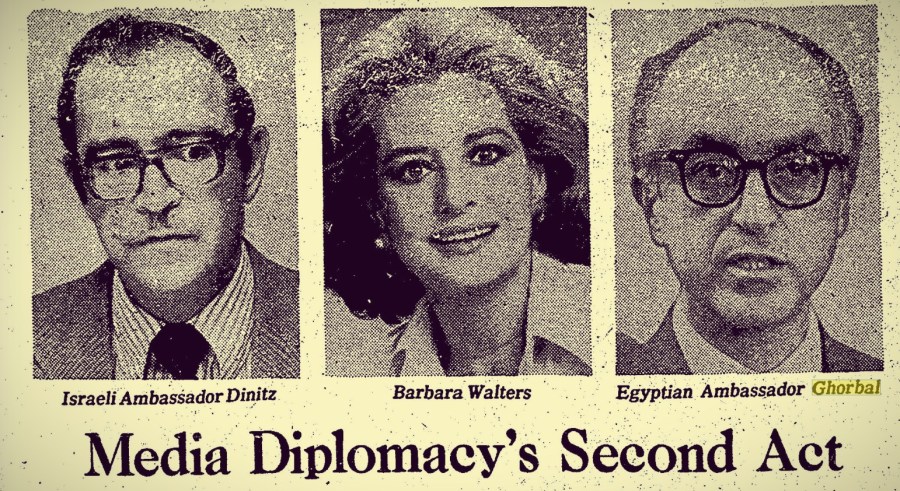
Walters counted among her Washington friends the suave Ashraf Ghorbal, Egyptian ambassador and an old pro. A Harvard PhD, he had been in the Egyptian diplomatic service for almost thirty years. He ran the Egyptian interests section in Washington after 1967, did a stint as a security adviser and press spokesperson for Sadat, and returned to Washington as ambassador upon the resumption of U.S.-Egyptian relations in 1974. Ghorbal knew how to roll with the punches. Unlike Fahmy, with whom he had a sharp rivalry, he would stick with Sadat. (Rumors even labelled him a candidate for foreign minister.) But how far would he go? This is what Barbara Walters set out to test.
Who’s coming to dinner?
As soon as Sadat left Jerusalem, she went straight to Ghorbal and to Israel’s ambassador to Washington, Simcha Dinitz, another career pro. Would they agree to be interviewed together on ABC News’s Sunday afternoon weekly, Issues and Answers? A foreign ambassador couldn’t dream of more media exposure than that.
Dinitz agreed, but Ghorbal demurred. He was prepared to meet Dinitz, but not on television. Fine; would Ghorbal meet Dinitz before an audience? Ghorbal agreed, provided the meeting was off the record.
How could Walters leverage an off-the-record meeting into the talk of the town? Her solution: invite an A-list of officials and media celebrities to dinner. ABC, Walters’ network, booked a banquet room at the Madison Hotel, and she invited fifty people to dinner in honor of the two ambassadors. Yes, it would be off the record, but word would reach all the right people. Perhaps that would set the stage for another scoop. After all, the Israeli-Egyptian show had only just begun.
The list of RSVPs glittered. From the Carter administration: Zbigniew Brzezinski (National Security Advisor), Hamilton Jordan (President Carter’s chief political advisor), and Robert Strauss (U.S. Trade Representative). From the media: Roone Arledge (president of ABC News, and co-host of the dinner), Ben Bradlee (Washington Post editor), Art Buchwald (Washington Post columnist), Sam Donaldson (ABC White House correspondent), Katherine Graham (Washington Post owner), Peter Jennings (ABC chief foreign correspondent), Sally Quinn (Washington Post style reporter), and William Safire (New York Times columnist). From the Hill: Tip O’Neill (House Speaker), Jim Wright (House Majority Leader), and Abe Ribicoff (an influential Jewish senator). From the diplomatic corps: Ardeshir Zahedi (Iran’s flamboyant ambassador).
And the guest of guests: Henry Kissinger, who as secretary of state in the previous Nixon administration negotiated not one but two military disengagement agreements between Israel and Egypt, in 1974 and 1975.
Dinner was served on the evening of December 4. When Kissinger’s turn came to speak, he quipped: “I have not addressed such a distinguished audience since dining alone in the Hall of Mirrors” at Versailles. But the significance of the evening didn’t arise from the toast offered by Kissinger, or the compliments exchanged by Ghorbal and Dinitz (for which there is no record). Rather, it brought some of the Jerusalem pageant to Washington, and made Washington stand up. People Magazine called the dinner “a political and conversational watershed.” William Safire described the atmosphere for readers of the New York Times: “There, in that room, at that moment, not even the most cynical media satrap present could help but be touched by the drama of the beginning of communication between two strong spokesmen of nations that have spent a generation at war.”
Strictly speaking, it wasn’t a “get” for Walters. (That’s the term for landing a big interview.) It was much more of a “give.” The day of the event, the Washington Evening Star ran a gossip piece, describing the planned dinner as a sequel to the carnival of “media diplomacy” that had unfolded in Cairo and Jerusalem. Walters pushed back: there had been no press release, there would be no broadcast, no ABC cameras, and no diplomacy. “If the dinner could have been held in New York,” she insisted, “I would have had it in my home.” Did the dinner add to her luster? Of course. Did it do anything for her Nielsen ratings? Not a bit.
More than a meal
The dinner had two probable effects. First, it may have helped galvanize the Carter administration into action.
Sadat’s move caught Carter’s people flat-footed. “There’s a general confusion in the Middle East about specifically what we should do next,” Carter wrote in his diary the week after Sadat’s visit to Jerusalem. “The same confusion exists in the White House.” The confusion showed at the Madison Hotel fête. Brzezinski, Carter’s national security advisor, lasted through the drinks but left before the dinner. That raised some eyebrows: why didn’t he stay to propose a toast? Jordan, Carter’s political advisor, was reported to have behaved boorishly: he had one too many, and, staring at Mrs. Ghorbal’s bodice, declared: “I always wanted to see the Pyramids.” True or not, the episode sparked a gossip piece in every newspaper and a full-column news story in the New York Times.
The dinner came as one more reminder to the Carter administration that it had to start looking proficient and proactive, and do it fast. The CIA had just produced a profile of Sadat, saying he had a “Barbara Walters syndrome,” meaning a sense of self-importance inflated by the media. But who could blame him? She took him seriously; Carter’s people didn’t. The administration needed to get the peace process into its pipeline (and out of Kissinger’s shadow). The dinner probably accelerated that.
Second, it launched a different kind of show, starring Ashraf Ghorbal and a succession of Israeli ambassadors. Off-the-record went out the window: Sadat wanted to persuade American Jews to back Israeli concessions, and Begin wanted fast normalization. How to do both? Get the affable Ghorbal in front of American Jewish audiences, in an all-smiles show of camaraderie with Israel’s ambassador.
So the Ghorbal-and-Dinitz show went on the road, to synagogues and banquet halls. The biggest encore took place a year after the Walters dinner, at an Anti-Defamation League (ADL) luncheon for 250 guests in the ballroom of the Plaza Hotel in Manhattan. Kissinger delivered his one-liners, Ghorbal and Dinitz talked peace, and Barbara Walters (along with news anchors Walter Cronkite and John Chancellor) received ADL awards for giving “enormous impetus and thrust to the peace process between Israel and Egypt.” The applause must have been thunderous.
In March 1980, the show finally reached America’s big top. Carter had earned the right to play host, having personally hammered out the peace treaty between Egypt and Israel the previous year. To mark the first anniversary of his triumph, he summoned Ghorbal and Ephraim Evron (who’d replaced Dinitz on the Israeli side) to a celebratory reception held in the Grand Entrance Hall of the White House. Carter gave the keynote, and the two ambassadors spoke their well-rehearsed parts.
Diplomacy and spectacle
“We’ve been like Siamese twins,” Evron said of his many appearances with Ghorbal. “The public was intrigued by it.” Keeping the public intrigued was part of the process. Most of this fell on Ghorbal: by the time he finished in Washington, Dinitz and Evron had been followed by two more Israeli ambassadors. Ghorbal finally retired in 1984. The Washington Post remarked that “the joint appearances of Ghorbal and a succession of Israeli diplomats serving here during the past six years have been one of Washington’s enduring spectacles.” It endured because it was in the Egyptian interest. Ghorbal, like Sadat, understood that if you wanted to get something from Israel, complaining to the White House and the State Department would only take you so far. You had to charm American Jews, an art that Ghorbal perfected.
What he really thought of it all is hard to say. In his Arabic memoirs, written twenty years into his retirement, he didn’t mention any of it. By then, most of his Egyptian readers probably would have viewed all this elbow-rubbing and glad-handing with Israelis and Jews as bordering on the treasonous. But he did his professional duty, and he did it well.
Barbara Walters went beyond hers. Books on the secret diplomacy behind the Egyptian-Israeli peace deal fill shelves. It’s hard to find even one serious article on the marketing of that peace. When that story finally gets written, Walters should get her own chapter. Naturally, pride of place will go to the famous dual interview in Jerusalem. But perhaps the dinner in Washington left the more lasting legacy. “This was, believe me, a major event,” Walters wrote in her memoirs. “Even today the Egyptian and Israeli ambassadors are rarely at the same dinner.” Indeed, and at this distance in time, it’s all the more extraordinary.
Martin Kramer is the Walter P. Stern fellow at The Washington Institute for Near East Policy. He is writing a book on influential ambassadors from the Middle East.
Fifty years ago last night, on September 28, 1970, at 6:15 pm Cairo time, Egyptian president Gamal Abdul Nasser died. Cause: heart attack. A minute before midnight, Egyptian vice-president Anwar Sadat announced the death to the nation. “Abdul Nasser is more than words,” he said. “He is more immortal than all words.” The funeral took place on October 1. Millions of grieving Egyptians surged around the cortege. A government minister later announced that at least 46 persons died in the crush, and 80 were severely injured.
A scene from Nasser’s funeral. Bibliotheca Alexandrina and the Gamal Abdel Nasser Foundation.
Abdul Nasser may have been “more than words,” but that didn’t stop them from flowing, also in the millions. Even some of the contemporary Western commentary lamented his death.
His departure, wrote the New York Times the next day, “leaves a void that can only add to the chaos already threatening to overwhelm the Middle East.” The Washington Post practically mourned him, praising his “wisdom and underlying political strength,” because he’d recently seemed amenable to American mediation with Israel. Even the Jerusalem Post regretted his demise: “Despite his enmity, Abdul Nasser offered a hope, however slight, which was afforded by no other Arab leader—that of a man strong enough to lead the Arab world to peace.”
True or not? Last year, I published an essay on when and how the unexpected deaths of leaders matter. (Publisher: The Washington Institute for Near East Policy.) Below, I excerpt what I wrote about Nasser.
• •
The crucial question is this: If a leader were to disappear, where would he be in the arc of his life, his career, his vocation? If he is a leader, presumably he has a record of achievement. Is he in the middle of his life’s work, still attending to it? Is he bringing it to a conclusion? Or is it behind him? (This doesn’t directly correlate with age. Sometimes leaders launch early; others do so late.)
Let me now give an example of an unexpected death that came too late to have a huge effect. Gamal Abdul Nasser and his Free Officers overthrew the Egyptian monarchy in 1952. He soon emerged as the first among equals, then as the unquestioned ruler of Egypt. His biography became identical to Egypt’s history: the Soviet alliance, the Suez war, the Nasserist wave of 1958, the makeup and breakup of union with Syria, the stumble of the Yemen war, and the disaster of the 1967 war with Israel.
Nasser became diabetic, according to his wife, in 1958. He smoked a hundred cigarettes each eighteen-hour workday, had arteriosclerosis, and suffered acute pain in his legs, so that he relied heavily on painkillers. In 1969, he had a heart attack and spent six weeks in bed. According to his Egyptian physician, this destroyed 40 percent of his cardiac function. A few months later, Nasser appointed Anwar Sadat as vice president. In the summer of 1970, Nasser went on a three-week visit for treatment in Moscow.
All the while, the Egyptian public was kept completely in the dark; they were told he had influenza. His Soviet doctors urged him to avoid stress, but he ignored them. In 1970, at the close of an Arab summit in Cairo, in the midst of the Black September crisis in Jordan, he suffered another heart attack and died. Sadat later related that he and Nasser had joked about the “poor fellow” who would succeed the president. “It certainly never crossed our minds,” Sadat wrote, “that Nasser would die in the very same month.”
Because of the illusion of immortality Nasser created, his followers, like the journalist Mohamed Heikal, could claim that he was about to write another great chapter when his life was cut short. And because of that, many old Nasserists believed Nasser couldn’t possibly have died of natural causes. Heikal would later go on to insinuate that Sadat poisoned him.
But did Nasser’s death, at age 52, really change the course of events? It is interesting to read a Central Intelligence Agency analysis of this, written early in 1971, a few months after Nasser died. It reviewed all the history-making events of Nasser’s tenure, at home and in the region. Then it added this:
On the face of it, the demise of so powerful and charismatic a leader would appear to mean widespread and fundamental change in the Arab world. And the months since Nasser’s death have indeed seen changes in inter-Arab relations. But these differences have been subtle…This is so because Nasser’s ability to influence events in the Arab world had declined substantially in recent years as a result of the humiliating Egyptian defeat at the hands of Israel in 1967. The other Arab leaders… all felt free to refuse to follow Nasser’s policy direction. In a sense, then, the biggest “post-Nasser” changes had taken place prior to his death.
In other words, he was finished before he was dead; he was already at the end of his arc.
The late Middle East scholar Fouad Ajami once speculated on what would have happened if Nasser had lived some more years. Just as Sadat did, Nasser probably would have gone to war with Israel to break the post-1967 deadlock. It is an argument Sadat himself made in 1974, when he announced that “if Nasser had lived to this day he would be doing what I am doing.” But Ajami went on to add that had Nasser lived, “his charisma would have continued to fade and weaken, and his supporters would have grown increasingly lukewarm and indifferent to him. His premature and sudden death at 52 probably preserved his legacy and added to its potency.”
Now, there is a debate over the extent of continuity and change between Nasser and Sadat. But we can agree that Nasser’s death in 1970 was less consequential than, say, his death would have been in 1954. This date has not been selected at random. In October 1954, Nasser gave a speech in the central square of Alexandria. In the middle of the speech, a would-be assassin, a member of the Muslim Brotherhood, fired eight shots at Nasser. All of them missed, Nasser didn’t flinch, and then he began to roll up the Muslim Brotherhood.
Leaving aside the conspiracy theories (most notably, that Nasser himself engineered the whole thing), the point is this: had Nasser been killed in 1954—before Suez, before the United Arab Republic, before 1967—the effect on Egypt and the region would have been far more profound than the effect of his actual death in 1970.
Again, in making assessments, one has to ask where the leader stands in the arc of his life. In the middle, toward the end, or is all behind him? In 1954, Nasser was positioned somewhere in the middle—after the revolution, full of ambition, but with little to show for it yet. His death by bullet would have had incalculable effects. By 1970, his great achievements and errors were already in the past, his death by heart attack had fewer effects, and these were moderated by his chosen successor.
It isn’t that such departures have no consequences. Specialists can always compose a long list of them. But the list shrinks when a leader is simply putting touches on his largely completed project. Of course, it can always be argued that a departed leader had one more move to make, one more trick up his sleeve. But no one has unlimited moves or tricks, the possibilities recede over time, and leaders late in life are sometimes averse to bold initiatives, especially if they have moved to planning for succession.
• •
End of excerpt. Agree or disagree? Food for thought on this fiftieth anniversary. (For my full assessment of untimely deaths, read my whole essay here. There is an Arabic version right here.)



 Martin Kramer on the Middle East
You must be logged in to post a comment.