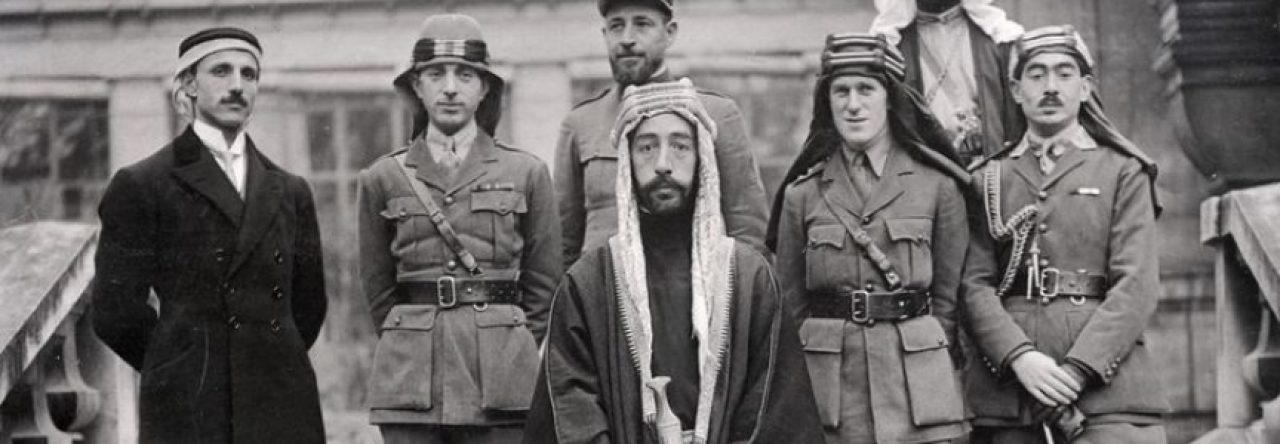
Those boring Arabs

Every so often, I take one of the works of the late Elie Kedourie off the shelf to refresh myself, and I never fail to find some pertinent passage that speaks directly to the present. Today I came across this one, a few lines of which I vaguely remembered, and which I hope to remember better in future by posting it here. It’s vintage Kedourie, on the West’s invention of the Arabs:

Chanceries, academics and newspapers are alike preoccupied with Arab grievances, demands and aspirations. From small beginnings thirty or forty years ago, the Arab question has become an industry similar to that of electronics or space technology. But the Arabs have also become a bore. Fifty or a hundred years ago an author who felt drawn to Middle Eastern subjects had a tremendous variety from which to choose: Barbary corsairs, belly dancers, fanatical Mussulmans, sultans, pashas, moors, muezzins, harems. Now, in a decidedly poor exchange, it has to be the Arabs.

By Arabs of course we do not mean the lively and interesting denizens of Cairo, Beirut, Damascus or Baghdad. We mean rather the collective entity which writers of books manufacture and in which they manage to smother the charm and variety of this ancient and sophisticated society. This collective entity is a category of European romantic historiography, and judged by its results, it is not a felicitous invention; for as they are described by their inventors the Arabs are a decidedly pitiable and unattractive lot; they erupt from the Arabian desert; they topple two empires, while making grandiloquent speeches in their rich and sonorous language; but all too soon the rot sets in, materialism and greed erode their spirit, and their caliphs change from lean puritans into fat voluptuaries. After that, it is all up with them: they are engulfed and enslaved by the Turks, hoodwinked by the British, colonized by the French, humiliated by the Jews, until at last they rise up again to struggle valiantly against Imperialism and Zionism under the banner of Nationalism and Socialism.

The ultimate insult is that the victims of this European travesty have accepted this caricature as a true picture of themselves, and as nature is said to imitate art have, in the process, come in fact to behave like it.

This passage is taken from an essay Kedourie published in the New York Review of Books back in November 1967. Since then, the idea that “the Arabs” are the heroes of the drama has retreated quite a bit, at least in the Middle East, but it still lingers in intellectual and academic circles. There has been no remission in the West’s drive to reinvent the peoples of the Middle East to suit its ever-changing moods. I wonder what Kedourie would make of their being cast in the new role of eager seekers of democracy. “The Middle Easterner is very far from thinking that he has a right to have a say in politics,” Kedourie opined in his last interview in 1992. “All he wants is to be left alone and not to be oppressed.” Kedourie was no neo-con. But by his own logic, might nature imitate art again? Well, we’ll know soon enough.

Saddam in Court: Who’s on Trial?

With Saddam in U.S. hands, thoughts turn to his future trial. Various pundits have claimed that it won’t be enough to examine Saddam’s crimes. It will also be necessary to probe U.S. and Western support for his regime, during the decade of the Iran-Iraq war and the lead-up to Iraq’s 1990 invasion of Kuwait.

The late Elie Kedourie, historian and political theorist at the London School of Economics, put the issue in just the right perspective, in an interview granted in June 1992. (This was less than three weeks before his untimely passing.) Kedourie, it will be recalled, was a native of Baghdad, and an acute observer of Iraq’s troubled history. The interviewer told him that a Paris-based scholar had declared Saddam to be a “creature of the West.” Kedourie’s reply:

I do not understand what he means by that. If he means that it was Western governments that put him in power, then that is not true. If he means that from 1980 to 1990 the American and French governments and German firms did their best to help him, this is perfectly true. But you have to look at what their intentions were….The Americans believed, mistakenly I think, that if they did not do something in order to stop Khomeini, he would sweep over the whole of the Middle East. I think there was little prospect of that, but that is what they believed and therefore they chose to support Saddam. Again, within its own terms it was a rational if mistaken calculation. It was a terrible mistake, which lay at the back of the invasion of Kuwait and the war that followed, which I consider an unnecessary war. It was the result of policies that the Americans had followed vis-à-vis Saddam for ten years and that made him think that he could invade Kuwait with impunity.

A calculation went wrong. But I do not think that there was anything else there. Saddam is not a creature of the West. He is not a creature of anybody.

There are two crucial points here. First, Kedourie knew far too much about Iraq to regard Saddam as the West’s creation. He understood precisely which tectonic forces, by their immense internal pressures, had combined to produce him.

Second, Kedourie did not rail against the United States for its best-guess policies of the 1980s. He regarded the U.S. decision to back Saddam against Iran as a mistake and a miscalculation. But as a thinking historian, who never stopped reading in diplomatic archives, Kedourie thought it perfectly legitimate for states to calculate and act on self-interest. (This was always preferable to action the name of ideology. Ideological states, Kedourie believed, were intrinsically dangerous to their peoples and their neighbors.) Kedourie also knew and expected that states, working in a fog of partial knowledge, were bound to make mistakes in pursuing their interests. He never set himself up in Olympian judgment of policymakers for these sorts of errors.

But while he could understand errors of calculation, he could not pardon failures of will. For Kedourie, support for Saddam before 1990 was an error, but the decision not to remove him in 1991 was a failure. U.S. leaders lacked the will to act in pursuit of the U.S. national interest, and so fell down on their sworn duty. In a May 1991 lecture, Kedourie said this:

The American campaign stopped in its tracks by order of the president. Given this aggression by Iraq, and given that Iraq had to be stopped, one would have thought that it would be quite meaningless simply to liberate Kuwait and leave untouched the structures of the Baathist regime which had organized and committed the aggression. Iraq is a very populous and a rich country. If the regime remains in place, there is no way it can be prevented from reestablishing itself and acquiring new supplies of weapons of all kinds….It may not be possible next time around to organize an expedition of half a million troops and an armada in order to deal with this recurrent situation. So as things look to me now, the aftermath of the Gulf war seems a tremendous failure for the U.S.

As usual, Kedourie shows us the way. Saddam was no one’s creature. It would be an affront to justice to diminish Saddam’s criminal culpability by invoking U.S. policy mistakes, however egregious. Mistakes are not crimes.

The decision that left Saddam in power in 1991 was a monumental failure, and one that history has already judged severely. But at least credit those who did organize an expedition and an armada in 2003, and who did their duty despite the criticism of feckless “allies” and the absence of “international legitimacy.” Some of those who launched this expedition were party to the previous mistake and the earlier failure. By their actions this year, they have balanced the books—and then some.

On Entering Basra and Baghdad, Avoid This Mistake

As war against Saddam looms, military planners should read a very pertinent article by the late Elie Kedourie. Its title: “The Sack of Basra and the Baghdad Farhud.” It’s the story of how not to occupy Iraq’s two principal cities.

In 1941, the British sent forces into Iraq to remove a pro-Axis military junta from power. Now it’s called “regime change,” and more than one journalist and strategist has remarked on the parallels between 1941 and today. But they omit the mistakes made by the British commander, General (later Field Marshal) Sir Archibald Wavell, in securing Basra and Baghdad.

The British didn’t want to use troops to provide administration in the two cities, preferring that it be done by Iraqi authorities, while they bore down on strategic objectives such as the besieged RAF station at Habbaniya. Wavell’s instructions: “As long as Iraqi administration meets our military requirements it is not, repeat not, to be interfered with or superseded because it is inefficient in other directions.” And Wavell again: “Every encouragement is to be given to local Iraq administration to function so far as is consistent with safety of our forces. Political officers are to be regarded as liaison officers between Iraq administration and British forces and not as administrators except where Iraq administration is inoperative.”

British forces thus left key areas of both cities to the mercies of a defeated regime. In Basra, the abdication resulted in the sack of the bazaar by rioters and looters. In Baghdad, it was far worse. Wavell instructed that his forces “should not get involved in street fighting in disadvantageous conditions.” So while the British forces camped west of the Tigris, looting on the east bank by the bedouin and the remnants of the army and police turned into a full-scale pogrom. (Jews used the term farhud, a murderous riot.)

About 180 Jews (and some Muslims) were slaughtered. A British officer later wrote of hearing “the growing crescendo of rifle and machine-gun fire. Baghdad was given up to the looters. All who cared to defend their own belongings were killed, while eight miles to the west waited the eager British force which could have prevented all this.” Iraq’s ancient Jewish community never fully recovered from the blow, and its younger members began to plan emigration. (The pogrom also left a mark on young Elie Kedourie, who lived through it.)

The British could get away with cutting corners in 1941. They were immersed in a world war on multiple fronts, their forces were stretched thin, and the world wasn’t watching. In 2003, the world’s sole superpower is bearing down exclusively on Iraq, under blazing media spotlights. If the 1941 handling of Basra and Baghdad were repeated under these circumstances, the stain would be indelible. Preventing it means exercising complete control in urban areas. Delay could produce a bloodbath surpassing any “collateral damage” in cost and effect.

Battle plans come down to priorities, and in Iraq there are a lot of them: oil fields, the Western desert, possible WMD sites, Tikrit, and more. But the lesson of Baghdad 1941 (the Jewish quarter)—like that of Damascus 1918 (the Turkish hospital) and Beirut 1982 (Sabra and Shatila)—is the importance of immediately deploying forces to police an Arab city upon its conquest. In the absence of such policing, or upon its delegation to others, the likelihood of massacre rises sharply. That lesson is liable to be forgotten in all the optimistic chatter about how ready Iraqis are for democracy. Before that, Iraqis must be kept from settling scores. The road to hell—or a Belgian indictment—is paved with good intentions.

You’ll find Kedourie’s article in his collected volume, Arabic Political Memoirs and Other Studies, 1974.

ADDENDUM: Things were done differently before CNN and the Hague tribunal. Sir Alec Kirkbride, who entered Damascus in 1918 on the defeat of the Turks, explained how he put down looting, rioting, and the butchering of Turkish stragglers by vengeful Damascenes: he made “free use” of his large service revolver. “Occasionally, someone turned nasty and I shot them at once before the trouble could spread.” Right out of his memoirs, A Crackle of Thorns, 1956.