Last November, I asked this question: why didn’t Benjamin Netanyahu keep his 2009 campaign promise to topple Hamas? I found at least part of the answer in his 2022 memoir, Bibi: My Story.
In that account, Netanyahu explained, first, that “the cost in blood and treasure was not worth it.” Overthrowing Hamas would involve the loss of “many hundreds [of soldiers] on the Israeli side,” burden Israel with governing Gaza “for an indefinite period,” and result in “the wholesale destruction of Gaza, with tens of thousands of civilian deaths.” Second, it wasn’t a priority. “Did I really want to tie down the IDF in Gaza for years,” he wrote, “when we had to deal with Iran and a possible Syrian front? The answer was categorically no. I had bigger fish to fry.”
In a new interview with TIME, conducted by Eric Cortellessa, Netanyahu preempts the question before it is asked. After rationalizing the Qatari funding of Gaza, he explains that before October 7, he had conducted “three full-fledged military campaigns against Hamas in which we killed thousands of terrorists, eliminated some of their top military leadership, and sought to prevent them from having the capacity to attack us.” But he adds this:
One thing we didn’t do was we didn’t come out to eradicate Hamas completely, because that would require a full-scale ground invasion for which we had no internal legitimacy or international legitimacy. Look at the problem we have with legitimacy now, after they conducted the worst terror onslaught on the Jewish people since the Holocaust…. We sort of cut the weeds, but we didn’t come in to uproot them completely until October 7th. October 7th showed that those who said that Hamas was deterred were wrong. If anything, I didn’t challenge enough the assumption that was common to all the security agencies.
The interviewer said he would “come back to that in a second,” and when he did, he formulated the question in his own pointed way: “Why didn’t you take out Hamas earlier? You could have gone all the way in 2014.” Netanyahu responded:
No I couldn’t. I don’t think there was—there wasn’t a consensus. There was, in fact, a consensus among the military that we shouldn’t do it. But more importantly, you can overrule the military, but you can’t act in a vacuum. There was no public, no domestic support for such an action. There was certainly no international support for such an action, and you need both or at least one of them in order to take such an action. I think that became evident right after the October 7th massacre.
“I decided”
These explanations differ significantly from the rationales Netanyahu provided in his memoir. There, it isn’t the public that lacks “consensus” over toppling Hamas; rather, “The public invariably expects the government to continue the battle and ‘flatten Gaza,’ believing that with enough punishment the Hamas regime would collapse.” In his memoir, Netanyahu credited himself with tempering this unrealistic expectation, which was fueld by political rivals who would “irresponsibly take contrarian positions which they know are wrong.” The final decision he claimed for himself alone: “I decided against a full-scale ground invasion.”
As for the need for “international” (largely American) legitimacy, Netanyahu made no mention of it in his memoir. While he obviously faced constraints during the eight years of Barack Obama, everything changed during his four-year partnership with Donald Trump. A centerpiece of the memoir is Netanyahu’s exploitation of Trump’s unprecedented support, from enhancing the Israeli status of Jerusalem and the Golan to rolling back the Iran nuclear deal. There is no evidence that Netanyahu prioritized Gaza.
And that brings us to the most important difference in Netanyahu’s latest apologia. It makes no mention of his earlier view of the relative threat posed by Hamas. According to Netanyahu’s own strategic priorities, a final showdown with Hamas would have been a trap: “After destroying the Hamas regime, Israel would have to govern two million Gazans for an indefinite period. I had no intention of doing that, especially since I had my gaze fixed on Iran, a much greater threat.”
Netanyahu, then, wasn’t simply aligning with the “consensus” of “security agencies” and the public when he held back on Hamas. Clearly, he calculated his priorities and took a decision that ended a policy debate. The TIME interview is disappointing for not quoting his memoir. Bibi: My Story offers the most comprehensive statement of his pre-October 7 strategy.
Another question remains unlikely to be answered: Did Hamas leaders who read the relevant passages of his memoir in 2022 conclude that Netanyahu, should he return to power, would be preoccupied elsewhere? Did they believe that as long as Netanyahu ruled, they enjoyed immunity from destruction? And did this belief embolden them to implement their plan, assuming he would stop short of toppling them? The mere possibility serves as a warning to all leaders: one should never publish one’s most closely held strategic thoughts before stepping down for good.
Bibi: My Story sold well. In November 2022, it spent three weeks on the New York Times bestseller list. It remains the most reliable starting point for understanding the events leading up to October 7.
Header image created by DALL-E, OpenAI’s image generation model.
When the history of Israel’s policy toward Hamas is investigated, one question will loom large: why did Israel allow Hamas, an implacable enemy, to grow alongside its jugular?
This development occurred almost entirely during Benjamin Netanyahu’s tenure. Hamas rose to power in Gaza in June 2007, and Netanyahu emerged as prime minister from elections in February 2009, a position he has occupied for thirteen of the last fourteen years.
The promise
During the 2009 election, Netanyahu criticized Tzipi Livni, the leader of the rival Kadima party then in power, for failing to bring down Hamas. On February 3, he visited the southern city of Ashkelon following a rocket attack from Gaza. Israel had concluded Operation Cast Lead against Hamas a few weeks earlier, and the Knesset elections were just a week away. Netanyahu recorded the following video message:
We’re here at the entrance to Ashkelon. This morning a Grad rocket landed here. That says it all. By chance, by a stroke of luck, there was a miracle, and the children who showed me the shrapnel weren’t harmed.
But we can’t rely on miracles. We need action to eliminate the threat. Only one action will do this, and that’s to topple the Hamas regime in Gaza.
I’ve sounded the alarm regarding Hamas for several years now, cautioning that rockets would be fired from Gaza towards Ashkelon. Tzipi Livni and Kadima scoffed at the idea. They downplayed these warnings, accused us of being alarmists and of instilling fear in the populace. It turns out that we foresaw what they, in their short-sightedness, could not.
And not only did they not see the danger. When it became evident, they showed weakness. They practiced restraint, they agreed to a truce, they allowed Hamas to arm itself with more and more rockets. Ultimately, when they finally took action (and the IDF did an outstanding job), Tzipi Livni and the Kadima government halted the IDF before it could finish the mission.
So I want to say here and now, we won’t stop the IDF, we’ll complete the task. We’ll topple the regime of Hamas terror, we’ll restore security to the residents of Ashkelon, Ashdod, Sderot, Be’er Sheva, and Yavne. We’ll restore security to all the inhabitants of Israel.
Neutralizing Hamas didn’t seem like a difficult proposition in 2009. The group had very limited capabilities at the time, and its performance against Israeli forces during Operation Cast Lead proved to be lackluster. “They are villagers with guns,” said an Israeli soldier to a reporter. “We kept saying Hamas was a strong terror organization, but it was more easy than we thought it would be.”
Netanyahu won the election and became the prime minister, yet he made no attempt to topple Hamas once in office. This stance can be partially understood by reconstructing some of Netanyahu’s rationales, as evidenced in his widely available memoirs, Bibi: My Story, published in 2022. These memoirs reveal that Hamas effectively deterred Netanyahu from carrying out his promise, even as he declared that he had deterred Hamas.
“Bigger fish to fry”
Netanyahu first faced an expectation to keep his promise of bringing down Hamas in November 2012, during Operation Pillar of Defense, an air offensive against Hamas and Palestinian Islamic Jihad. Early on, Israel killed Ahmad Jabri, a leading commander in Hamas. Hamas launched barrages of rockets on Israel, leading to an exchange that culminated in a ceasefire. Netanyahu’s thinking during this crisis is revealed in his memoirs::
Since we had achieved our major objective, knocking out the top Hamas commander Jabri right at the start of the campaign, there was no point in continuing. But ending these kinds of operations is much harder than starting them. The public invariably expects the government to continue the battle and “flatten Gaza,” believing that with enough punishment the Hamas regime would collapse.
Yet that would only happen if we sent in the army. The casualties would mount: many hundreds on the Israeli side and many thousands on the Palestinian side. Did I really want to tie down the IDF in Gaza for years when we had to deal with Iran and a possible Syrian front? The answer was categorically no. I had bigger fish to fry.
“You’re the political echelon, I’m not”
The operation bought time, but by 2014 the situation in the south had deteriorated. In a security cabinet meeting on January 19, Netanyahu authorized a “strategic discussion devoted to the possibilities of toppling Hamas in Gaza.” However, when the cabinet reconvened on February 16, he shifted the focus to operational matters, excluding strategy. This met with resistance from both the chief of staff and the national security adviser, who argued that operations were inherently linked to the overarching strategy. Acknowledging this, Netanyahu committed to addressing strategic goals in a future meeting.
In the cabinet meeting of March 13, several cabinet members complained to Netanyahu that they still hadn’t discussed a long-term strategy. Gilad Erdan, home front minister, complained that “over the year that I’ve been a member of this cabinet, I haven’t gained even a shred of information that would enable me to make decisions about long-term policy.” Netanyahu promised that a discussion of strategy toward Gaza would take place at the next meeting.
In the discussion held on March 23, three options were considered: gradual escalation, a large-scale but limited military operation, and toppling Hamas. Reflecting on this a year later, Yair Lapid, then the finance minister, stated that the purpose of the discussion was “to show why it wasn’t worth it to conquer Gaza.” The head of the IDF’s operations directorate commented on the session: “It wasn’t really a strategy discussion, because it set no strategic objectives.”
The conflict with Hamas continued to escalate, culminating in July in Operation Protective Edge, a fifty-day clash between Israel and Hamas. Israel entered the battle without a long-term strategy. This frustration became immediately apparent in the security cabinet on July 8, the first day of the operation. The following quotes from the protocol, as detailed in the State Comptroller’s report on decision-making during the operation, illustrate the cabinet’s frustration:
Yair Lapid (finance minister): “We never even held a discussion on whether we want the Hamas regime in Gaza to continue.”
Yuval Steinitz (minister of strategic affairs and intelligence): “We focus on tactics and run away, time after time, year after year—it’s already nine years that we’re running—from the strategic reality that’s forming right before our eyes.”
Yossi Cohen (national security adviser): “I define the problem for you, you should define the goal. You’re the political echelon, I’m not. It’s your job to define the goal.”
“Not worth it”
This time the open calls for toppling Hamas came from coalition partners, especially cabinet ministers Naftali Bennett and Avigdor Lieberman. In his memoirs, Netanyahu recalled that Bennett in particular,
advocated a full-scale ground invasion to “conquer Gaza.” That could only be done with the wholesale destruction of Gaza, with tens of thousands of civilian deaths. After destroying the Hamas regime, Israel would have to govern two million Gazans for an indefinite period. I had no intention of doing that, especially since I had my gaze fixed on Iran, a much greater threat.
Netanyahu needed back-up against such formidable political rivals, so he called in the troops:
Midway into the conflict, I convened the cabinet and asked the chief of staff to lay out the invasion plans and assess the toll in lives. Then I asked the Defense Ministry to assess the resources needed for the postwar administration of Gaza.
The briefing, which was leaked within a week, portrayed toppling Hamas as the worst possible option. It predicted the deaths of hundreds of soldiers and thousands of Palestinian civilians, and the abduction of other soldiers. Peace treaties with Egypt and Jordan might be jeopardized. The occupation of Gaza would cost Israel tens of billions of shekels annually, and eliminating 20,000 Hamas fighters and their arsenal would likely take no less than five years. (Whether the prime minister’s office influenced the content of this briefing warrants further investigation.)
Some cabinet ministers reportedly found the briefing unduly “pessimistic,” but Netanyahu made the call:
I believed the cost in blood and treasure was not worth it. My clear impression was that all the cabinet ministers agreed with my assessment, though they were reluctant to say so publicly.
He then gave himself points for standing up to “hypocrisy”:
In war, people expect their leaders to make the right decisions. Yet some allow themselves to irresponsibly take contrarian positions which they know are wrong. I decided against a full-scale ground invasion.
Who deterred whom?
Although an investigation might turn up more evidence, it doesn’t seem that toppling Hamas ever returned to the agenda after Operation Protective Edge. Occasional flare-ups ended in standoffs, Israel claiming each time that it had restored deterrence.
On December 12, 2019, a radio journalist asked Netanyahu whether refraining from toppling Hamas was a mistake. “We are preparing,” he said. “When you are a commander, you have to decide how to conduct the war. I won’t begin it one minute, even one second, before conditions are optimal.” He didn’t explain what constituted “optimal” conditions, which apparently never materialized over fourteen years.
It is important to note the motive that Netanyahu did not offer. He did not provide the grander strategic rationale of building up Hamas as a counterweight to the Palestinian Authority (PA). Over the years, some of his supporters and critics have claimed that leaving Hamas in place constituted an ingenious or diabolic strategy to avoid negotiations with the PA. But Netanyahu himself never said so.
In his memoirs, he speaks instead about Israeli casualties (“many hundreds on the Israeli side,” “the cost in blood,” “the toll in lives”), the burden of occupation (“tie down the IDF in Gaza for years ,” “govern two million Gazans for an indefinite period”), and the cost in Palestinian lives and property (“many thousands on the Palestinian side,” “the wholesale destruction of Gaza, with tens of thousands of civilian deaths”), for which Israel would be condemned.
In short, to judge from his memoirs, Netanyahu only strategized over Iran (the “bigger fish”). Hamas was a distracting sideshow; toppling it wasn’t part of the grand Iran strategy, and “not worth” the cost “in blood and treasure.” This is classic deterrence, and Hamas achieved it, even as Netanyahu boasted that he’d deterred Hamas.
Courage vs. caution
David Ben-Gurion will always be synonymous with May 14, 1948, the day he declared Israel’s independence. On that Friday, he displayed extraordinary political courage. Ben-Gurion was determined to overturn the status quo and create a state. Despite warnings against declaring independence from the United States and his generals’ assessments that the chances of victory were only fifty-fifty against Arab armies, Ben-Gurion took that chance. He forged ahead regardless of the cost. Israel’s very existence today is a testament to his unwavering resolve, demonstrated under circumstances far from “optimal.”
Benjamin Netanyahu will always be synonymous with October 7, 2023. His approach was one of political caution, aiming to maintain power and the status quo with minimal cost. He promised to topple Hamas when it appeared electorally advantageous, but abandoned this pledge when it seemed politically risky. When his generals painted a pessimistic picture, he readily embraced it. His associates may even have leaked it, to justify his restraint. Netanyahu’s belief that leaders should wait for “optimal” conditions before taking decisive action effectively became an excuse for inaction.
Now he has been forced to wage a war he did everything to avoid, following the worst catastrophe in the annals of modern Israel. “This is our second War of Independence,” Netanyahu has declared. He has secured his place in history by undoing a small part of the first one.
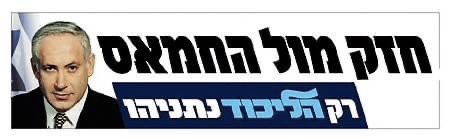
Election banner, 2006: “Strong Against Hamas: Only the Likud [and] Netanyahu.”
Header image created by DALL-E, OpenAI’s image generation model.
Rashid Khalidi, the Edward Said Professor at Columbia University, is no fool. He started out as a spokesperson for the PLO in Beirut in the 1970s, and he’s been at it ever since. A New Yorker by birth, he knows something about perceptions of the conflict in America. And he knows that terrorism has set back the Palestinian cause time and again. That’s why he’s spent much of his career trying to anesthetize America to terrorism, divert attention from it, or minimize it.
The horrific massacre of Israeli men, women, and children committed by Hamas on October 7 has made his mission much harder. “The current sentiment,” he told an Arab interviewer (in Arabic),
politically, popularly, and in the media, is overwhelmingly negative. This contrasts sharply with the past decade, which saw growing support for Palestinian political rights and strong opposition to Israeli policies…. They’re capitalizing on the deaths of Israeli civilians during the Al-Aqsa Storm operation…. Having lived in the U.S., particularly New York, for over half my life, I’ve never seen such an onslaught of lies and crude propaganda that are actually making an impact.
Khalidi recommends a number of talking points to his followers. He’s dropped some in reaction to new and awful evidence, but one remains constant. Here is how Khalidi has made it, on two separate occasions:
There are ways of making war, which advanced technological societies employ, which involve the killing of huge numbers of civilians, who are never somehow counted in the calculus. Oh, that’s collateral damage. Oh, we didn’t mean to do it. If a pilot does it from 1,000 feet, and kills fifty people, or some somebody with a gun comes in and murders fifty people, there is a difference, obviously, but in the last analysis, if this is a violation of the rules of war on the one hand, it’s a violation of the rules of war on the other hand… One kind of killing of civilians—only that kind—is called terrorism and another kind of systematic killing of civilians, with much higher death counts, is simply ignored.
Israeli lives should be considered civilian lives, should be considered important, obviously. Any civilian death should be mourned. But all people are supposedly equal…. The 900 or 1,000 Israeli civilians who died starting on the seventh of October, are now matched by a mountain of two or three times—it will soon be four times—as many Palestinians, again, like the Israelis, innocent civilians…. The rest of the world… do[es] not see the difference between Hamas or other militants coming out of Gaza killing civilians, and Israeli pilots, or Israeli gunners, or Israeli gunboats killing civilians. Killing civilians is killing civilians, especially in these numbers…. The world sees that, even as the American and European… media, which seem to move in lockstep with their governments, may distort this.
This talking point has become standard in many attempts to “contextualize” October 7. Queen Rania of Jordan made it in abbreviated form in a television interview seen by millions: “Are we being told that it is wrong to kill a family, an entire family at gunpoint but it’s OK to shell them to death? I mean, there is a glaring double standard here. And it is just shocking to the Arab world.”
Embed from Getty Images
The ‘Dresden defense’
I am a historian (like Khalidi), interested in the origins of ideas and arguments. It turns out that Khalidi’s premier talking point has a very specific genesis.
It figured in the case for the defense in the Einsatzgruppen Trial, conducted by the Nuremberg Military Tribunal from late 1947 to the spring of 1948. The Einsatzgruppen were the paramilitary death squads of Nazi Germany, which carried out mass murder by shooting in Nazi-occupied Europe. They destroyed well over a million Jews, and two million people all told. After the war, their surviving senior commanders were put on trial at Nuremberg, charged with crimes against humanity and war crimes.
The chief defendant, SS-Gruppenführer Otto Ohlendorf, had been commander of Einsatzgruppe D, which carried out mass murders in Moldova, southern Ukraine, and the Caucasus. An economist and father of five, he had supervised the killing of 90,000 Jews. Ohlendorf imagined that he had a moral conscience. The killers under his command, he told a U.S. Army prosecutor, were prohibited from using infants for target practice, or smashing their heads against trees.
Embed from Getty Images
During trial testimony, the prosecutor pressed Ohlendorf: “You were going out to shoot down defenseless people. Now, didn’t the question of the morality of that enter your mind?” Ohlendorf referred to the Allied bombings of Germany as a context:
I am not in a position to isolate this occurrence from the occurrences of 1943, 1944, and 1945 where with my own hands I took children and women out of the burning asphalt myself, and with my own hands I took big blocks of stone from the stomachs of pregnant women; and with my own eyes I saw 60,000 people die within 24 hours.
A judge immediately pointed out that his own killing spree preceded those bombings. But this would become known as the “Dresden defense,” to which Ohlendorf resorted still another time, in this exchange:
Ohlendorf: I have seen very many children killed in this war through air attacks, for the security of other nations, and orders were carried out to bomb, no matter whether many children were killed or not.
Q: Now, I think we are getting somewhere, Mr. Ohlendorf. You saw German children killed by Allied bombers and that is what you are referring to?
Ohlendorf: Yes, I have seen it.
Q: Do you attempt to draw a moral comparison between the bomber who drops bombs hoping that it will not kill children and yourself who shot children deliberately? Is that a fair moral comparison ?
Ohlendorf: I cannot imagine that those planes which systematically covered a city that was a fortified city, square meter for square meter, with incendiaries and explosive bombs and again with phosphorus bombs, and this done from block to block, and then as I have seen it in Dresden likewise the squares where the civilian population had fled to—that these men could possibly hope not to kill any civilian population, and no children.
Ohlendorf thought this defense so powerful that he invoked it yet another time:
The fact that individual men killed civilians face to face is looked upon as terrible and is pictured as specially gruesome because the order was clearly given to kill these people; but I cannot morally evaluate a deed any better, a deed which makes it possible, by pushing a button, to kill a much larger number of civilians, men, women, and children.
(The chief prosecutor, an American, called this particular iteration “exactly what a fanatical pseudo-intellectual SS-man might well believe.”)
At Nuremberg, this sort of tu quoque defense (“I shouldn’t be punished because they did it too”) wasn’t admissible. Still, in the verdict of the Einsatzgruppen Trial, the judges chose to refute it. “It was submitted,” the judges wrote, “that the defendants must be exonerated from the charge of killing civilian populations since every Allied nation brought about the death of noncombatants through the instrumentality of bombing.” The judges would have none of it:
A city is bombed for tactical purposes… it inevitably happens that nonmilitary persons are killed. This is an incident, a grave incident to be sure, but an unavoidable corollary of battle action. The civilians are not individualized. The bomb falls, it is aimed at the railroad yards, houses along the tracks are hit and many of their occupants killed. But that is entirely different, both in fact and in law, from an armed force marching up to these same railroad tracks, entering those houses abutting thereon, dragging out the men, women and children and shooting them.
The tribunal sentenced Ohlendorf to death. He was hanged in June 1951.
“In the last analysis”
Nuremberg enforced a fundamental distinction. All civilian lives are equal, but not so all ways of taking them. The deliberate and purposeful killing of civilians is a crime; not so the taking of civilian lives that is undesired, unintended, but unavoidable. The errors made by a bomber squadron cannot be deducted from the murders committed by a death squad. It’s a difference compounded many times over when those civilian men, women, and children are subjected to torture, rape, and mutilation before their murder. To borrow Khalidi’s phrase, “in the last analysis,” this distinction is what separates modern civilization from its predecessors.
More disturbing is the thought that it separates the contemporary West from its peers. Otto Ohlendorf and the regime he served did all they could to conceal their deeds from Western eyes. Nazi Germany still operated in a West founded on Enlightenment values. So massive a violation of a shared patrimony needed to be hidden from view.
In contrast, Hamas initially sought to publicize its deeds, assuming they would win applause, admiration, or at least tacit acceptance in the Arab and Muslim worlds. Here they succeeded beyond their expectations. The many millions who don’t share the West’s patrimony, and who know next to nothing about the Holocaust or Nuremberg, do see things as Khalidi says they see them. (So, too, does a sliver of alienated opinion in the West, where such views are cultivated and celebrated.)
Finally, and still more disturbing, is the fact that Ohlendorf’s defense has been revived to frame the massacre of Jews. Let’s be clear: this isn’t a world war. October 7 isn’t the Holocaust continued: in three months of 1942 alone, on average, the Nazis killed more than ten times the amount of Jews killed on October 7, every single day (Operation Reinhard). And Gaza is not Dresden, Hamburg, Pforzheim, Kassel, or any of the other German cities bombed so intensively that they literally burst into flames. The Israel-Hamas war is a skirmish by comparison.
But the Ohlendorf and Hamas defenses are the same, and so is the identity of their victims. That’s why it’s important that Israel take some of the Hamas masterminds alive, and place them on trial, Nuremberg-style. Israel owes it to the dead and wounded, their families, all Israelis, and all Jews. But it’s the Arabs and Muslims who most need to see the evidence, hear the testimonies, and weigh the arguments. No part of the world is further from drawing the line drawn at Nuremberg. October 7 is the place to start.


 Martin Kramer on the Middle East
You must be logged in to post a comment.