This post first appeared on the Commentary blog on December 2.
Last week, John Kerry appeared with British foreign secretary William Hague in London, and they congratulated one another on concluding their nuclear deal with Iran. Kerry expressed American gratitude for Britain’s support. “We are determined to press forward,” he said, “and give further life to this very special relationship and to our common objectives.”
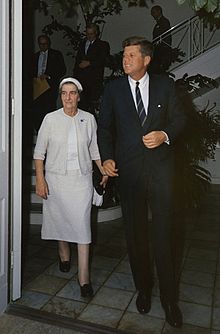
It was President John F. Kennedy who first extended the concept of a “special relationship” beyond Britain to include Israel. In December 1962, Kennedy met with Israel’s then-foreign minister, Golda Meir, in Palm Beach, Florida, and the American memorandum of conversation reported his assurance in these words: “The United States, the President said, has a special relationship with Israel in the Middle East really comparable only to that which it has with Britain over a wide range of world affairs.”
The State Department disliked this. A few months earlier, the Near East and South Asia Bureau had put together a memo on U.S.-Israel relations. “Israel’s proposals for a special relationship with the U.S. would be self-defeating if executed,” it argued. “We consider it important not to give in to Israeli and domestic pressures for a special relationship in national security matters.” But Kennedy spoke the words, and even if their definition remained foggy, they provided some reassurance to Israel every time an American president or secretary of state uttered them.
Which is why it’s worth noting that John Kerry doesn’t utter them. To the best I can determine, in his present job, he hasn’t ever described the U.S.-Israel relationship as “special.” Susan Rice, while at the UN, did so on several occasions, and Senator Kerry did it when he ran for president back in 2004 and again to AIPAC in 2009. But as best as I can tell (and I would welcome contrary evidence), he hasn’t done it as secretary of state, and that stands in striking contrast to his repeated invocation of the “special relationship” with Britain.
For example, last February he visited London and said this (Hague beaming at his side):
When you think of everything that binds the United States and Great Britain—our common values, our long shared history, our ties of family, in my case, personal and friendship—there is a reason why we call this a special relationship, or as President Obama and Prime Minister Cameron wrote, really, a partnership of the heart. It is that.
In June, Kerry (again with Hague at his side) stressed the “special relationship,” which he declared to be “grounded in so much—our history, our values, our traditions. It is, without question, an essential, if not the essential relationship.”
And in September, when Britain’s parliament voted down a motion to join the U.S. in the use of force in Syria, Kerry rushed to declare the “special relationship” intact:
The relationship between the United States and the United Kingdom has often been described as special, essential. And it has been described thusly, quite simply, because it is. It was before a vote the other day in parliament, and it will be for long afterwards after that vote. Our bond, as William [Hague] has just said, is bigger than one vote; it’s bigger than one moment in history. It’s about values. It’s about rules of the road, rules by which human beings try to organize their societies and offer people maximum freedom and opportunity, respecting rights, and finding a balance in a very complicated world. And we have no better partner in that effort than Great Britain, and we are grateful for that.
Quite early, the Obama administration earned a reputation in British public opinion for showing insufficient respect for the “special relationship,” and Kerry may see his mission as repairing that impression. But then the Obama administration stands no higher in Israeli public opinion, and Kerry sees no need to do any work of repair (and a few things he has said have heaped insult on injury).
President Obama does refer to the “special relationship” with Israel, but coming from him, the phrase means a bit less than it once did. That’s because he’s upgraded Britain to something even higher. On the eve of Obama’s visit to Britain in May 2011, he and British prime minister David Cameron published a joint op-ed in the London Times that included this sentence: “Ours is not just a special relationship, it is an essential relationship—for us and for the world.” (The headline: “Not Just Special, But An Essential Relationship.”) Suddenly, the word “essential” started cropping up in references to the relationship with Britain (see also two of the Kerry quotes above). “Essential” is now the new platinum card in relations with the United States, and Britain alone holds one. (That’s why having Britain on board the Iran deal was so important to the Obama administration, and it’s why Hague was assigned the role of setting Israel straight: “We would discourage anybody in the world, including Israel, from taking any steps that would undermine this agreement and we will make that very clear to all concerned.” How pleased he must have been to categorize Israel among the world’s “anybodies.”)
Still, while Obama may have promoted Britain, he didn’t demote Israel. And as John Kennedy made clear more than fifty years ago, the two belong in a league of their own. Just what makes a “special relationship”? It’s more than democracy—the world is full of democracies. It’s not “shared values,” since American values are widely shared around the world. What compels the United States openly to acknowledge two “special relationships” is that two foreign states embody old cultures to which the American public feels profoundly and uniquely indebted.
Given that debt, the U.S. government assumes the obligation to show a bit of respect and work a little harder to make its case, when its biggest-knows-best policies impinge on the interests of those two states. When they dissent, as Britain did over Syria and Israel now does over Iran, it’s their privilege to do so and still win American praise as “special” friends who are entitled to speak their minds freely. For an example of how it’s done, see the Kerry quote above, following the British balk on Syria. So far, there’s no equivalent for Israel over Iran.
The U.S. government’s recognition of a “special relationship” doesn’t create a fact, it acknowledges a debt felt deeply by the American people. John Kerry apparently doesn’t fully grasp that reality in regard to Israel. But then, little in his Mideast diplomacy suggests that reality constrains him anyway.

 Ann (Nancy) K.S. Lambton, the distinguished British historian of medieval and modern Iran, died on July 19 at the age of 96. Her obituaries tell some of her remarkable story as a pioneering scholar and a formidable personality. They are also interesting for what they omit, regarding her role in the idea of removing Mohammad Mossadegh from power in Iran.
 Martin Kramer on the Middle East
You must be logged in to post a comment.