Exactly 200 years ago, a disturbing painting debuted in Paris, depicting a massacre in a distant corner of the Mediterranean. No other work in the artistic canon speaks more to the events of October 7 than this one.
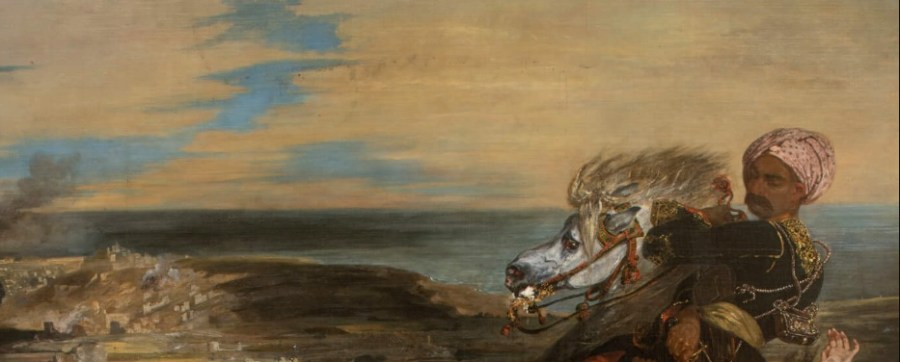
The painting Scenes from the Massacres of Chios by the French artist Eugène Delacroix was first unveiled at the Salon, the exhibition that defined artistic taste in 19th-century Paris, on August 25, 1824. For the past 150 years, it has belonged to the Louvre Museum in Paris. Millions have seen it over two centuries, and critics, art historians, and Delacroix biographers have analyzed it from every possible angle.
Scenes from the Massacres at Chios, Eugène Delacroix, 1824. Oil on canvas, 419 cm × 354 cm. Musée du Louvre, Paris.
My purpose is more personal than theirs. For myself—and, I imagine, for many of my fellow Israelis, Jewish co-religionists, and friends of both—this painting cannot but evoke the primal brutality of October 7. I’ve attended a few exhibitions in Israel that attempt to capture October 7 in art. Contemporary sensibilities, along with the Israeli modernist tradition in art, permit this only at a high level of abstraction. By contrast, Delacroix’s painting is visceral. Indeed, it’s reminiscent of the horrific videos of slaughter, abduction, and abuse recorded by the body cams of Hamas terrorists.
Death or slavery
The young Delacroix—only 26 when he finished the painting—was inspired by the Greek War of Independence from Ottoman rule, which began in March 1821. “I am thinking of doing a painting for the next Salon on the subject of the recent wars between the Turks and the Greeks,” he wrote to a friend in the fall of 1821. “I think that under the circumstances, this would be a way of distinguishing myself.”
He didn’t complete the painting until the 1824 Salon. Fresh events gave him the impetus. In 1822, the prosperous Ottoman-ruled island of Chios, in the Aegean Sea, was seized by Greek insurgents. The Ottomans recaptured the Greek-populated island with a ferocity that shocked Europe. Estimates vary, but the Ottomans massacred, enslaved, and starved as many as 100,000 Greek Christians, leaving the island depopulated. Graphic accounts of savage torture spread across the continent, fueling the philhellene movement with rage and resolve. In composing his painting, Delacroix relied on such reports, as well as conversations with a French eyewitness.
The subtitle of the work as submitted was “Greek families await death or slavery, etc.,” with the “etc.” serving as a discreet allusion to rape. The painting is centered on a cluster of despairing men, women, and children. Defeat, degradation, and resignation are etched on their faces. The most poignant tableau rises on the right side of the painting: a naked, bound woman is being dragged away by an indifferent Turkish horseman, destined for rape and slavery. Beneath lies the corpse of a dead mother, while her living infant instinctively searches for her bare breast. The bodies of Greek wounded and dead are strewn across a scorched and devastated landscape, where a battle still rages. The impact of the work is magnified by its overwhelming size: the painting is nearly fourteen feet high (over four meters) and almost twelve feet wide (over three meters). It hangs today in the gallery reserved for the largest masterpieces.
It was an unconventional work. The painting referenced contemporary events, not classical history. Delacroix did not portray his Greeks as ennobled, but as ordinary people. Moreover, the work had no redeeming hero. One contemporary critic found it more evocative of a plague scene than a massacre. Art historians have also offered their interpretations. Is the painting a subversive critique of the French regime’s neutrality regarding Greek independence? Is it Islamophobic, positing Islamic barbarity against Christian civilization? Or is the depiction of the Turkish horseman, indistinguishable from a Greek, a deliberate challenge to prejudice?
In an art history seminar, these questions all have their place. But this is a painting that has always stirred emotions and invites analogies. Many could be drawn; the intervening 200 years provide plenty.
Historical continuities
The foremost French specialist on Islam and politics, Gilles Kepel, in his new bookHolocaustes: Israël, Gaza et la guerre contre l’Occident, has presented October 7 through the lens of its perpetrators, as a ghazwa (razzia in European parlance): a raid deliberately intended to subjugate and dehumanize a non-Muslim adversary. The Prophet Muhammad conducted such a raid against the Jewish tribes of the Khaybar oasis in Arabia in the year 628, establishing the ghazwa as a model of warfare that would be replicated throughout history. At Khaybar, writes Kepel,
cruelty was explicitly embraced as an exemplary punishment of God’s enemies. Men were tortured and put to the sword, women were captured and distributed among the victors’ harems, and children were enslaved, all to the cries of ‘O Victorious One, bring death, bring death!’ (Ya mansûr! Amit, amit!). On October 7, there was an attempt to emulate this feat from sacred history with the ruthless massacre of Jews, the abduction of women and children from border kibbutzim and the attack on ‘the tribe of Nova.’ Videos circulating online showed prisoners being assaulted, paraded as trophies in jeeps, unfortunate women stripped naked on pickup trucks and perched on motorcycles to be transported to Gaza’s tunnels—just as the captives of Khaybar were once carried off on camels.
The line that connects the years 628 and 2023 (with 1824 along the way) is one of traditionally Muslim and now Islamist supremacism. It not only promises victory but seeks to inscribe it upon the bodies of the vanquished.
We cannot bear to see or hear this, which is why the most graphic images and testimonies from October 7 are still withheld. Delacroix, for all the emotion and outrage he wished to stir, likewise did not depict the full extent of the brutality on Chios. But Scenes from the Massacres of Chios came as close as Western art dares. That this canvas from another era still speaks to our moment is a reminder of continuities we would rather forget.
Last November, I asked this question: why didn’t Benjamin Netanyahu keep his 2009 campaign promise to topple Hamas? I found at least part of the answer in his 2022 memoir, Bibi: My Story.
In that account, Netanyahu explained, first, that “the cost in blood and treasure was not worth it.” Overthrowing Hamas would involve the loss of “many hundreds [of soldiers] on the Israeli side,” burden Israel with governing Gaza “for an indefinite period,” and result in “the wholesale destruction of Gaza, with tens of thousands of civilian deaths.” Second, it wasn’t a priority. “Did I really want to tie down the IDF in Gaza for years,” he wrote, “when we had to deal with Iran and a possible Syrian front? The answer was categorically no. I had bigger fish to fry.”
In a new interview with TIME, conducted by Eric Cortellessa, Netanyahu preempts the question before it is asked. After rationalizing the Qatari funding of Gaza, he explains that before October 7, he had conducted “three full-fledged military campaigns against Hamas in which we killed thousands of terrorists, eliminated some of their top military leadership, and sought to prevent them from having the capacity to attack us.” But he adds this:
One thing we didn’t do was we didn’t come out to eradicate Hamas completely, because that would require a full-scale ground invasion for which we had no internal legitimacy or international legitimacy. Look at the problem we have with legitimacy now, after they conducted the worst terror onslaught on the Jewish people since the Holocaust…. We sort of cut the weeds, but we didn’t come in to uproot them completely until October 7th. October 7th showed that those who said that Hamas was deterred were wrong. If anything, I didn’t challenge enough the assumption that was common to all the security agencies.
The interviewer said he would “come back to that in a second,” and when he did, he formulated the question in his own pointed way: “Why didn’t you take out Hamas earlier? You could have gone all the way in 2014.” Netanyahu responded:
No I couldn’t. I don’t think there was—there wasn’t a consensus. There was, in fact, a consensus among the military that we shouldn’t do it. But more importantly, you can overrule the military, but you can’t act in a vacuum. There was no public, no domestic support for such an action. There was certainly no international support for such an action, and you need both or at least one of them in order to take such an action. I think that became evident right after the October 7th massacre.
“I decided”
These explanations differ significantly from the rationales Netanyahu provided in his memoir. There, it isn’t the public that lacks “consensus” over toppling Hamas; rather, “The public invariably expects the government to continue the battle and ‘flatten Gaza,’ believing that with enough punishment the Hamas regime would collapse.” In his memoir, Netanyahu credited himself with tempering this unrealistic expectation, which was fueld by political rivals who would “irresponsibly take contrarian positions which they know are wrong.” The final decision he claimed for himself alone: “I decided against a full-scale ground invasion.”
As for the need for “international” (largely American) legitimacy, Netanyahu made no mention of it in his memoir. While he obviously faced constraints during the eight years of Barack Obama, everything changed during his four-year partnership with Donald Trump. A centerpiece of the memoir is Netanyahu’s exploitation of Trump’s unprecedented support, from enhancing the Israeli status of Jerusalem and the Golan to rolling back the Iran nuclear deal. There is no evidence that Netanyahu prioritized Gaza.
And that brings us to the most important difference in Netanyahu’s latest apologia. It makes no mention of his earlier view of the relative threat posed by Hamas. According to Netanyahu’s own strategic priorities, a final showdown with Hamas would have been a trap: “After destroying the Hamas regime, Israel would have to govern two million Gazans for an indefinite period. I had no intention of doing that, especially since I had my gaze fixed on Iran, a much greater threat.”
Netanyahu, then, wasn’t simply aligning with the “consensus” of “security agencies” and the public when he held back on Hamas. Clearly, he calculated his priorities and took a decision that ended a policy debate. The TIME interview is disappointing for not quoting his memoir. Bibi: My Story offers the most comprehensive statement of his pre-October 7 strategy.
Another question remains unlikely to be answered: Did Hamas leaders who read the relevant passages of his memoir in 2022 conclude that Netanyahu, should he return to power, would be preoccupied elsewhere? Did they believe that as long as Netanyahu ruled, they enjoyed immunity from destruction? And did this belief embolden them to implement their plan, assuming he would stop short of toppling them? The mere possibility serves as a warning to all leaders: one should never publish one’s most closely held strategic thoughts before stepping down for good.
Bibi: My Story sold well. In November 2022, it spent three weeks on the New York Times bestseller list. It remains the most reliable starting point for understanding the events leading up to October 7.
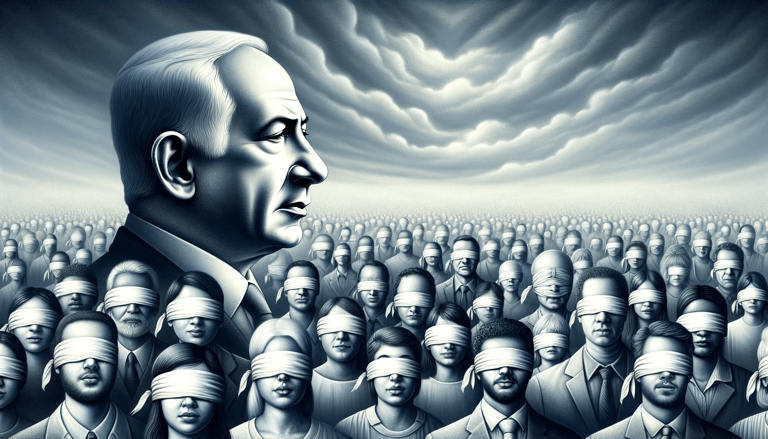
Header image created by DALL-E, OpenAI’s image generation model.
When the history of Israel’s policy toward Hamas is investigated, one question will loom large: why did Israel allow Hamas, an implacable enemy, to grow alongside its jugular?
This development occurred almost entirely during Benjamin Netanyahu’s tenure. Hamas rose to power in Gaza in June 2007, and Netanyahu emerged as prime minister from elections in February 2009, a position he has occupied for thirteen of the last fourteen years.
The promise
During the 2009 election, Netanyahu criticized Tzipi Livni, the leader of the rival Kadima party then in power, for failing to bring down Hamas. On February 3, he visited the southern city of Ashkelon following a rocket attack from Gaza. Israel had concluded Operation Cast Lead against Hamas a few weeks earlier, and the Knesset elections were just a week away. Netanyahu recorded the following video message:
We’re here at the entrance to Ashkelon. This morning a Grad rocket landed here. That says it all. By chance, by a stroke of luck, there was a miracle, and the children who showed me the shrapnel weren’t harmed.
But we can’t rely on miracles. We need action to eliminate the threat. Only one action will do this, and that’s to topple the Hamas regime in Gaza.
I’ve sounded the alarm regarding Hamas for several years now, cautioning that rockets would be fired from Gaza towards Ashkelon. Tzipi Livni and Kadima scoffed at the idea. They downplayed these warnings, accused us of being alarmists and of instilling fear in the populace. It turns out that we foresaw what they, in their short-sightedness, could not.
And not only did they not see the danger. When it became evident, they showed weakness. They practiced restraint, they agreed to a truce, they allowed Hamas to arm itself with more and more rockets. Ultimately, when they finally took action (and the IDF did an outstanding job), Tzipi Livni and the Kadima government halted the IDF before it could finish the mission.
So I want to say here and now, we won’t stop the IDF, we’ll complete the task. We’ll topple the regime of Hamas terror, we’ll restore security to the residents of Ashkelon, Ashdod, Sderot, Be’er Sheva, and Yavne. We’ll restore security to all the inhabitants of Israel.
Neutralizing Hamas didn’t seem like a difficult proposition in 2009. The group had very limited capabilities at the time, and its performance against Israeli forces during Operation Cast Lead proved to be lackluster. “They are villagers with guns,” said an Israeli soldier to a reporter. “We kept saying Hamas was a strong terror organization, but it was more easy than we thought it would be.”
Netanyahu won the election and became the prime minister, yet he made no attempt to topple Hamas once in office. This stance can be partially understood by reconstructing some of Netanyahu’s rationales, as evidenced in his widely available memoirs, Bibi: My Story, published in 2022. These memoirs reveal that Hamas effectively deterred Netanyahu from carrying out his promise, even as he declared that he had deterred Hamas.
“Bigger fish to fry”
Netanyahu first faced an expectation to keep his promise of bringing down Hamas in November 2012, during Operation Pillar of Defense, an air offensive against Hamas and Palestinian Islamic Jihad. Early on, Israel killed Ahmad Jabri, a leading commander in Hamas. Hamas launched barrages of rockets on Israel, leading to an exchange that culminated in a ceasefire. Netanyahu’s thinking during this crisis is revealed in his memoirs::
Since we had achieved our major objective, knocking out the top Hamas commander Jabri right at the start of the campaign, there was no point in continuing. But ending these kinds of operations is much harder than starting them. The public invariably expects the government to continue the battle and “flatten Gaza,” believing that with enough punishment the Hamas regime would collapse.
Yet that would only happen if we sent in the army. The casualties would mount: many hundreds on the Israeli side and many thousands on the Palestinian side. Did I really want to tie down the IDF in Gaza for years when we had to deal with Iran and a possible Syrian front? The answer was categorically no. I had bigger fish to fry.
“You’re the political echelon, I’m not”
The operation bought time, but by 2014 the situation in the south had deteriorated. In a security cabinet meeting on January 19, Netanyahu authorized a “strategic discussion devoted to the possibilities of toppling Hamas in Gaza.” However, when the cabinet reconvened on February 16, he shifted the focus to operational matters, excluding strategy. This met with resistance from both the chief of staff and the national security adviser, who argued that operations were inherently linked to the overarching strategy. Acknowledging this, Netanyahu committed to addressing strategic goals in a future meeting.
In the cabinet meeting of March 13, several cabinet members complained to Netanyahu that they still hadn’t discussed a long-term strategy. Gilad Erdan, home front minister, complained that “over the year that I’ve been a member of this cabinet, I haven’t gained even a shred of information that would enable me to make decisions about long-term policy.” Netanyahu promised that a discussion of strategy toward Gaza would take place at the next meeting.
In the discussion held on March 23, three options were considered: gradual escalation, a large-scale but limited military operation, and toppling Hamas. Reflecting on this a year later, Yair Lapid, then the finance minister, stated that the purpose of the discussion was “to show why it wasn’t worth it to conquer Gaza.” The head of the IDF’s operations directorate commented on the session: “It wasn’t really a strategy discussion, because it set no strategic objectives.”
The conflict with Hamas continued to escalate, culminating in July in Operation Protective Edge, a fifty-day clash between Israel and Hamas. Israel entered the battle without a long-term strategy. This frustration became immediately apparent in the security cabinet on July 8, the first day of the operation. The following quotes from the protocol, as detailed in the State Comptroller’s report on decision-making during the operation, illustrate the cabinet’s frustration:
Yair Lapid (finance minister): “We never even held a discussion on whether we want the Hamas regime in Gaza to continue.”
Yuval Steinitz (minister of strategic affairs and intelligence): “We focus on tactics and run away, time after time, year after year—it’s already nine years that we’re running—from the strategic reality that’s forming right before our eyes.”
Yossi Cohen (national security adviser): “I define the problem for you, you should define the goal. You’re the political echelon, I’m not. It’s your job to define the goal.”
“Not worth it”
This time the open calls for toppling Hamas came from coalition partners, especially cabinet ministers Naftali Bennett and Avigdor Lieberman. In his memoirs, Netanyahu recalled that Bennett in particular,
advocated a full-scale ground invasion to “conquer Gaza.” That could only be done with the wholesale destruction of Gaza, with tens of thousands of civilian deaths. After destroying the Hamas regime, Israel would have to govern two million Gazans for an indefinite period. I had no intention of doing that, especially since I had my gaze fixed on Iran, a much greater threat.
Netanyahu needed back-up against such formidable political rivals, so he called in the troops:
Midway into the conflict, I convened the cabinet and asked the chief of staff to lay out the invasion plans and assess the toll in lives. Then I asked the Defense Ministry to assess the resources needed for the postwar administration of Gaza.
The briefing, which was leaked within a week, portrayed toppling Hamas as the worst possible option. It predicted the deaths of hundreds of soldiers and thousands of Palestinian civilians, and the abduction of other soldiers. Peace treaties with Egypt and Jordan might be jeopardized. The occupation of Gaza would cost Israel tens of billions of shekels annually, and eliminating 20,000 Hamas fighters and their arsenal would likely take no less than five years. (Whether the prime minister’s office influenced the content of this briefing warrants further investigation.)
Some cabinet ministers reportedly found the briefing unduly “pessimistic,” but Netanyahu made the call:
I believed the cost in blood and treasure was not worth it. My clear impression was that all the cabinet ministers agreed with my assessment, though they were reluctant to say so publicly.
He then gave himself points for standing up to “hypocrisy”:
In war, people expect their leaders to make the right decisions. Yet some allow themselves to irresponsibly take contrarian positions which they know are wrong. I decided against a full-scale ground invasion.
Who deterred whom?
Although an investigation might turn up more evidence, it doesn’t seem that toppling Hamas ever returned to the agenda after Operation Protective Edge. Occasional flare-ups ended in standoffs, Israel claiming each time that it had restored deterrence.
On December 12, 2019, a radio journalist asked Netanyahu whether refraining from toppling Hamas was a mistake. “We are preparing,” he said. “When you are a commander, you have to decide how to conduct the war. I won’t begin it one minute, even one second, before conditions are optimal.” He didn’t explain what constituted “optimal” conditions, which apparently never materialized over fourteen years.
It is important to note the motive that Netanyahu did not offer. He did not provide the grander strategic rationale of building up Hamas as a counterweight to the Palestinian Authority (PA). Over the years, some of his supporters and critics have claimed that leaving Hamas in place constituted an ingenious or diabolic strategy to avoid negotiations with the PA. But Netanyahu himself never said so.
In his memoirs, he speaks instead about Israeli casualties (“many hundreds on the Israeli side,” “the cost in blood,” “the toll in lives”), the burden of occupation (“tie down the IDF in Gaza for years ,” “govern two million Gazans for an indefinite period”), and the cost in Palestinian lives and property (“many thousands on the Palestinian side,” “the wholesale destruction of Gaza, with tens of thousands of civilian deaths”), for which Israel would be condemned.
In short, to judge from his memoirs, Netanyahu only strategized over Iran (the “bigger fish”). Hamas was a distracting sideshow; toppling it wasn’t part of the grand Iran strategy, and “not worth” the cost “in blood and treasure.” This is classic deterrence, and Hamas achieved it, even as Netanyahu boasted that he’d deterred Hamas.
Courage vs. caution
David Ben-Gurion will always be synonymous with May 14, 1948, the day he declared Israel’s independence. On that Friday, he displayed extraordinary political courage. Ben-Gurion was determined to overturn the status quo and create a state. Despite warnings against declaring independence from the United States and his generals’ assessments that the chances of victory were only fifty-fifty against Arab armies, Ben-Gurion took that chance. He forged ahead regardless of the cost. Israel’s very existence today is a testament to his unwavering resolve, demonstrated under circumstances far from “optimal.”
Benjamin Netanyahu will always be synonymous with October 7, 2023. His approach was one of political caution, aiming to maintain power and the status quo with minimal cost. He promised to topple Hamas when it appeared electorally advantageous, but abandoned this pledge when it seemed politically risky. When his generals painted a pessimistic picture, he readily embraced it. His associates may even have leaked it, to justify his restraint. Netanyahu’s belief that leaders should wait for “optimal” conditions before taking decisive action effectively became an excuse for inaction.
Now he has been forced to wage a war he did everything to avoid, following the worst catastrophe in the annals of modern Israel. “This is our second War of Independence,” Netanyahu has declared. He has secured his place in history by undoing a small part of the first one.
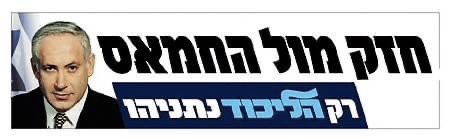
Election banner, 2006: “Strong Against Hamas: Only the Likud [and] Netanyahu.”
Header image created by DALL-E, OpenAI’s image generation model.



 Martin Kramer on the Middle East
You must be logged in to post a comment.