
On February 27, 1991, President George H.W. Bush addressed the American people, announcing the end of offensive military operations against Saddam Hussein’s forces. Iraqi troops had been completely expelled from Kuwait, which they had invaded the previous summer. During six weeks of bombing and a 100-hour ground campaign called “Desert Storm,” the U.S. and coalition allies destroyed about two dozen Iraqi divisions, hundreds of Iraqi aircraft, thousands of tanks, and Iraq’s weapons industry. A retreating Iraqi column was utterly destroyed during its escape from Kuwait. Gruesome images from that “highway of death” vividly showed the scale of Iraq’s defeat.
The following day, February 28, Bush made this entry in his diary:
It’s now early Thursday morning on the 28th. Still no feeling of euphoria. I think I know why it is. After my speech last night, Baghdad radio started broadcasting that we’ve been forced to capitulate. I see on the television that public opinion in Jordan and in the streets of Baghdad is that they have won. It is such a canard, so little, but it’s what concerns me. It hasn’t been a clean end—there is no battleship Missouri surrender. This is what’s missing to make this akin to WWII, to separate Kuwait from Korea and Vietnam.… The headlines are great. “We Win.” The television accurately reflects the humiliation of Saddam Hussein and it drives the point home to the American people. But internationally, it’s not there yet, at least in the Arab world that has been lined up with Saddam.
The fact that the enemy refused to acknowledge defeat troubled Bush. “Obviously,” he comforted himself, “when the [Iraqi] troops straggle home with no armor, beaten up, 50,000 … and maybe more dead, the people of Iraq will know.” But if they knew, Saddam regime’s made sure they never showed it. In 2003, Saddam shared his perspective with American television journalist Dan Rather:
In 1991 Iraq was not defeated. In fact, our army withdrew from Kuwait according to a decision taken by us. Yes, it withdrew, but when we were back within our boundaries, the boundaries of Iraq, the Iraqi army was not defeated. Nor was the people of Iraq…. It was [Bush’s] decision to…. stop the fighting. And, consequently, Iraq was not defeated.
No one knows how the current Iran war will end, but two things seem certain. The Supreme Leader will not send his representative to sign an unconditional surrender on the deck of the aircraft carrier Abraham Lincoln. And whoever leads the regime will declare victory for Iran, regardless of how much damage the U.S. and Israel inflict. In that respect, the Islamic Republic is no different from Saddam’s Iraq.
Iran has not experienced a military victory against a foreign enemy since the 18th century. As a result, its leaders are skilled at presenting defeats as draws, and draws (like the Iran-Iraq war in the 1980s) as victories. This is a coping strategy that allows Iran to preserve some dignity as the inheritor of past empires, which once thrived on legendary military triumphs and territorial conquests. A self-soothing narrative hides from Iranians the simple truth that Iran isn’t a global power. It’s not even the leading power in the Middle East. It’s too poor, corrupt, mismanaged, and divided to enjoy such a high status, no matter how much the regime tries to rally Iran’s people into sacrifices.
It’s now being said that if the regime remains in power, it’s somehow a triumph. “To survive would count as victory for Iran’s regime,” announces the Economist. But that’s Saddam-think. Survival isn’t victory unless it’s accompanied by a strategic gain that outweighs military losses. Since 1978, the Islamic Republic has aimed for Iran’s dominance of the Persian Gulf and the broader Middle East through ambitious weapons programs and support for proxies across the region. Survival is a poor substitute for losing all that, and most of it is already gone.
In 1991, George H.W. Bush had people around him who reassured him that it didn’t matter what people in the streets of Amman or Baghdad thought. What mattered was the objective achievement of defined war aims. They understood then, and we know in retrospect, that the war finished off Iraq as a pretender to regional power. Mission accomplished.
Thirty-five years later, Operation Desert Storm is remembered as the last decisive victory the United States won in a regional war—even though, at the time, America’s president thought it wasn’t a “clean end.” If that war didn’t end cleanly, the Iran war won’t either. The question is whether those who launched this war have the wisdom to realize it.
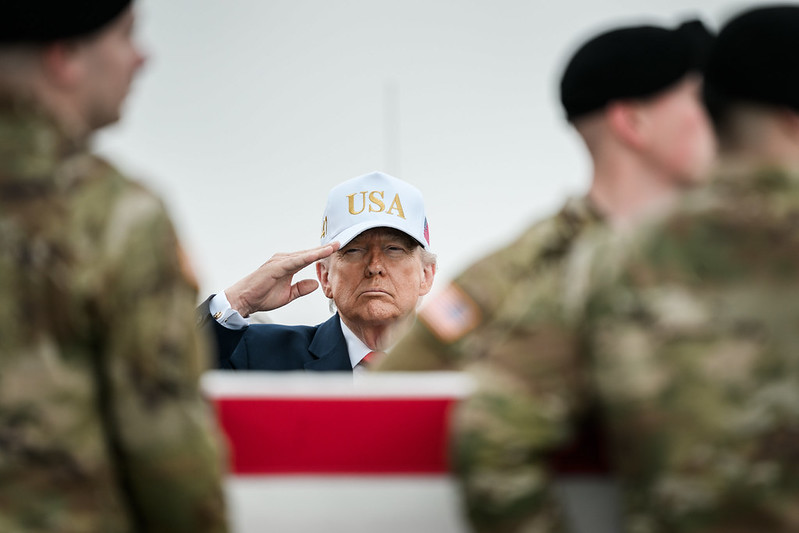
Header image: President Donald J. Trump attends transfer of remains of six US soldiers killed in an Iranian drone strike in Kuwait, March 7, 2026, at Dover Air Force Base, Delaware. Official White House photo by Daniel Torok, public domain.
 Martin Kramer on the Middle East