Yom Kippur to Iraq: Wars in Years Ending in ’3

This year, 2023, marks two significant anniversaries: the twentieth anniversary of the 2003 Iraq War and the fiftieth anniversary of the 1973 Yom Kippur War. The commemorations of these two anniversaries unfolded on two parallel tracks, which never intersected.

The reason for this divergence is not hard to understand. What common ground could they possibly share? The 1973 war began with a surprise attack by two Arab states against Israel, aiming for limited political objectives. In contrast, the Iraq War was a well-telegraphed American offensive against Iraq, undertaken with the ambitious goal of regime change.

If we draw parallels between Israel and the U.S., then Israel found itself caught in an unwanted war, while the U.S. actively initiated a war it desired. When comparing Egypt and Syria with Iraq, the former launched the offensive, whereas Iraq played a strictly defensive role. The 1973 war involved local Middle Eastern states in conflict, whereas the Iraq War saw the world’s sole superpower confronting an Arab state.

At first glance, drawing comparisons between the wars of 1973 and 2003 might appear unlikely to yield any meaningful insights. However, I wish to attempt the comparison anyway, as there are some underlying similarities that may be relevant to a broader spectrum of conflicts. These parallels could offer lessons for the future, although it’s well-known that deriving practical lessons from history is a perilous proposition.

Past as precedent

The first similarity is that both wars were influenced by earlier conflicts in which Israel and the United States emerged victorious. Israel’s Six-Day War in 1967 resulted in a swift and decisive victory, bringing large Arab territories under its control. Similarly, the United States’ Gulf War in 1991 was a clear win, with the U.S.-led coalition easily liberating Kuwait from Iraqi occupation.

These swift and relatively easy victories bred a sense of exaggerated self-confidence, bordering on hubris, among the victors. In Israel’s case, this led to the belief that no sane Arab state would dare attack it after the humiliating and comprehensive defeat they suffered in 1967. For the U.S., the ease of victory in 1991 fostered the expectation that Iraqis wouldn’t fight back against occupation. These assumptions set up Israel for the shock of the combined Egyptian-Syrian attack and the U.S. for the unanticipated Iraqi insurgency.

Intel and bias

A second similarity involves intelligence failures, rooted in a reluctance to acknowledge information that contradicted the prevailing narratives about the enemy. In Israel’s case, signs of Egyptian and Syrian war preparations were interpreted away as the intelligence assessments ascended the chain of command. Only at the last minute did incontrovertible evidence reach the decision-makers, but by then it was already too late.

In the Iraq case, a similar selective perception led to the exaggeration of unreliable reports about Iraq’s possession of weapons of mass destruction. It was only after the U.S. invasion that the reality became apparent: Iraq did not possess such weapons. In both instances, Israel and the U.S. were misled by deception campaigns: Egypt and Syria fooled Israel into believing their war preparations were just exercises, while Saddam Hussein misled the West into thinking he possessed WMD. (He was under the mistaken belief that such weapons would deter an attack against Iraq.)

Both intelligence failures underwent scrutiny in post-war analyses, which arrived at similar conclusions: preconceived biases had distorted the analysis of the collected information. As a result, Israelis overlooked actual threats, while Americans perceived threats that were non-existent.

Tainted victory

A third similarity is the perception of failure despite achieving military victory. Israel arguably secured its greatest military triumph in the 1973 war: it swiftly repelled and encircled the enemy on both fronts, ending the conflict with more territory than at its outset. Yet, the 1973 war is remembered as a low point in Israeli history, its successes overshadowed by the initial surprise attack and the high number of Israeli casualties.

Similarly, the Iraq War is perceived by many in America as a strategic failure. Despite the U.S.’s rapid overthrow of Saddam Hussein’s regime and the subsequent “surge” that curbed the insurgency, the conflict led to a prolonged and costly occupation, inadvertently strengthened Iran’s position in the region, and contributed to the emergence of ISIS.

The political price

This leads to the fourth similarity: both wars had profound consequences for the politics of Israel and the U.S. In Israel, the 1973 war eroded public confidence in the Labor party, ending its quarter-century of dominance. In the U.S., the Iraq War and its aftermath deeply polarized public opinion, undermining the Republican establishment along with its neoconservative wing, and spurred a reevaluation of America’s role in the world.

The effects in both cases were not immediate. Despite the public disaffection over the 1973 war, the Labor party under Golda Meir won the parliamentary election two months later, with the government lasting until 1976. (Meir herself resigned from the prime ministership in 1974, succeeded by Yitzhak Rabin.) Similarly, George W. Bush was reelected in 2004, continuing his presidency for another four years.

However, in the longer term, the wars significantly undermined the standing of both Meir and Bush. When historians and experts are surveyed, these leaders frequently rank in the bottom third among prime ministers and presidents, respectively. Moreover, the wars set the stage for the ascendancy of outsiders (and outliers) from the opposition: Menachem Begin in 1977 and Barack Obama in 2008.

Painful reassessments

The fifth similarity lies in how Israel and the United States reassessed their approaches to the Arab world following each war, albeit in opposite directions. Prior to the war, Israel had favored maintaining the status quo, valuing the certainty of territorial control over the uncertainties of peace. The war, however, convinced Israel that peace, even if it required territorial concessions, could bolster its security.

Conversely, the United States had been inclined to break the status quo in pursuit of a “freedom agenda” and the promotion of democracy. The Iraq War and its aftermath led America to conclude that the risks of this approach far outweighed its potential benefits. The 1973 war diminished Israel’s pessimism about peace, while the Iraq War dampened American optimism about promoting democracy. Both events became significant conceptual watersheds.

What’s to be learned?

The lessons drawn from these similarities might seem obvious. Indeed, wars often stem from hubris, particularly the belief that past military successes can be easily replicated. Intelligence failures frequently serve as a prelude or even a necessary condition for war. It’s possible to achieve a military victory yet still feel as though the war was lost. Wars can significantly reshuffle domestic politics, especially when the costs are perceived as excessively high. And certainly, wars prompt the overhaul of previous strategies, necessitating reassessments. These truths apply not only to the wars of 1973 and 2003 but also to many other conflicts that did not share an anniversary this year.

But are these lessons ever truly learned? We find ourselves in the midst of another war in the Middle East, between Israel and Hamas. Already, the initial similarities are evident: Israel lowered its guard, basing its confidence on previous rounds with Hamas which supposedly left Hamas deterred; meanwhile, intelligence, filtered through biases, rendered Israel blind.

And it’s likely that we’ll soon witness the rest unfold. Israel will prevail militarily, but its people already perceive the Hamas war as a new low point. The nation’s political and military leaders likely will pay a steep price for perceived failures. And there will probably be a reassessment of the strategy that aims to bypass the Palestinians entirely in the pursuit of regional peace.

These similarities have yet to fully materialize. Perhaps I’ll revisit them in 2033, when we will be marking not just two, but three war anniversaries.

From a roundtable discussion marking the Iraq War anniversary, annual conference of the Association for the Study of the Middle East and Africa (ASMEA).

Header image created by DALL-E, OpenAI’s image generation model.
Chronologically-challenged Professor Walt

In the past, I’ve demolished Stephen Walt and John Mearsheimer’s claim that Israel and its friends drove the United States to war with Iraq. I did it when they published their article, and did it again when they published their book, The Israel Lobby. It’s a conspiracy theory, pure and simple. And because Walt is a conspiracy theorist, he does what they all do: he rips evidence out of context. Here’s his latest grasp at a straw: his claim that Tony Blair has “revealed” that “Israel officials were involved in those discussions” on Iraq held between Blair and George Bush in Crawford, Texas in April 2002. Walt brings as evidence this quote from Blair’s testimony to the U.K. (Chilcot) inquiry investigating the Iraq war:

As I recall that discussion, it was less to do with specifics about what we were going to do on Iraq or, indeed, the Middle East, because the Israel issue was a big, big issue at the time. I think, in fact, I remember, actually, there may have been conversations that we had even with Israelis, the two of us, whilst we were there. So that was a major part of all this.

Walt’s conclusion: “Blair is acknowledging that concerns about Israel were part of the equation, and that the Israeli government was being actively consulted in the planning for the war.” Walt goes on to declare that “more evidence of their influence [of Israel and the Israel lobby] on the decision for war will leak out,” and that “Blair’s testimony is evidence of that process at work.”

When people who don’t know much about the Middle East, like Stephen Walt, pose as experts, they make basic mistakes of chronology. So let me remind him of exactly what coincided with the Crawford meeting of April 6-7, 2002.

Israel launched Operation Defensive Shield in the West Bank on March 29. Israeli prime minister Ariel Sharon ordered the operation in response to a wave of Palestinian suicide bombings. Its objective was the reoccupation of West Bank cities, dismantling the infrastructure of terror, and laying siege to Yasser Arafat in his Ramallah HQ. On April 2, Israeli forces battled their way into Bethlehem and secured Jenin city, and on April 3, they began to clear out the Jenin refugee camp. When Bush and Blair sat down in Crawford, Israel was laying siege to terrorists holed up in the Church of the Nativity, and the Battle of Jenin was in full swing. The Arab propaganda mills exploited the fog of war to make the operation seem like Sabra and Shatila redux, replete with massacres and mass graves. Arab leaders bombarded Bush and Blair with demands for action to stop Israel.

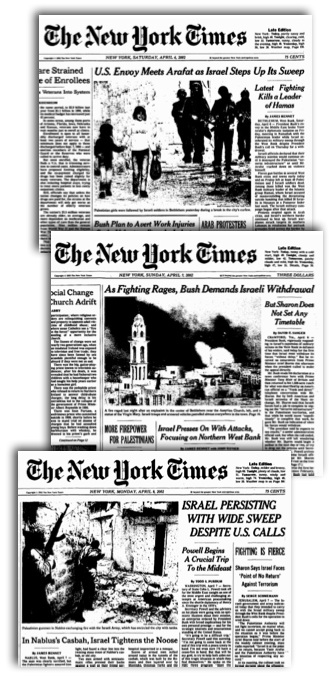
Bush succumbed to the mounting pressure, and on April 4 told Sharon to pull Israeli forces out of West Bank cities. On April 6, the first day of the Crawford meeting, Bush sharpened that message in a press conference with Blair, calling on Israel to withdraw “without delay.” He said the same in a 20-minute phone call to Sharon that very day. It was the lowest point in Israeli-American relations during the Bush years, and a crisis of massive proportions. Here is the chronology.

So Blair was right to recall that at Crawford, “the Israel issue was a big, big issue,” and that there were conversations with the Israelis. But these weren’t “active consulting” over plans for the Iraq war (and nothing in Blair’s testimony suggests they were). They were urgent negotiations about an ongoing war in the West Bank, and consisted of full-court pressure on Israel to end it. That Walt doesn’t say so—that “April 2002” doesn’t immediately trigger a mention of the historical context—is evidence either of ignorance or deception. Take your pick. (Illustration: New York Times front pages from April 6-8, 2002, the Crawford weekend.)

And while we’re on straws, Walt grasped at another one which left me smiling. Walt:

Consider that former President Bill Clinton told an audience at an Aspen Institute meeting in 2006 that “every Israeli politician I knew” (and he knows a lot of them) believed that Saddam Hussein was so great a threat that he should be removed even if he did not have WMD.

I never trust Walt to represent a source accurately (see past example), so I checked it. The quote was reported by James Bennet, who puts it in context:

[Clinton] segued into a discussion of Democratic Senator Joe Lieberman’s position in favor of going to war, noting how it squared with the view of Dick Cheney, Donald Rumsfeld and others that Saddam Hussein was such a menace he should be removed regardless of whether he had WMD. Then, out of the blue, came this: “That was also the position of every Israeli politician I knew, by the way.”

So Clinton attributed the idea that Saddam should be removed regardless of WMD to Cheney, Rumsfeld, Lieberman, and “others”—all of the usual suspects—and only then to Israeli leaders, “by the way.” As far as Walt’s thesis, this proves… well, what does it prove, Professor Walt? The amusing sequel comes when Bennet notes that even “I knew some Israeli politicians with doubts about the war,” and then relays this explanation:

One longtime and acute observer of Clinton, whom I won’t name here, suggested to me that, as is his tendency, Clinton was looking to please people he spotted in the crowd before him—in this case, seated in the front rows, several representatives of Arab nations, including Queen Noor of Jordan.

So Clinton wasn’t just speaking to “an audience” in Aspen. He had Queen Noor in the front row! Could Bill Clinton have been pandering? Naw, couldn’t be.

Mearsheimer, Walt, and “cold feet”

John Mearsheimer and Stephen Walt appear at Princeton University tonight, to promote their book The Israel Lobby. I’ve held back while other critics have had their say, and many of them have done a splendid job. But I don’t think anyone has understood the neat sleight of hand the authors performed in moving from article to book. The innovation in The Israel Lobby is their “cold feet” thesis about the Israeli genesis of the Iraq war.

But first, remember why pinning the Iraq war on the “Israel lobby” is so important to Mearsheimer and Walt. Their main argument isn’t that the Palestinians are paying a terrible price for that support. In most quarters, that draws a simple shrug. Instead, the duo claim that Americans are paying the price for U.S. support for Israel. They paid it on 9/11, and they’re paying it now in Iraq. The killers of 9/11 set out on their mission because of their rage against unconditional U.S. backing for Israel; and the pro-Israel lobby got America into the Iraq war because it served Israel’s interests, not America’s. America is bleeding so that Israel can avoid doing what it should have done years ago: give the Palestinians their state. And it’s because Americans are dying that Israel shouldn’t be indulged anymore.

Of the two arguments made by Walt and Mearsheimer, the 9/11 argument is the less effective. That’s because very early on, Americans decided that Osama bin Laden, a Saudi, and the 15 of the 19 hijackers who were Saudis, weren’t out to kill Americans over Israeli settlements on the West Bank. Al-Qaeda hates us for everything we do and represent they’re 200-proof hatred of America. Americans understood that instinctively, and it was confirmed by the 9/11 Commission Report. The report’s narrative showed how the 9/11 plot developed precisely during the years when Bill Clinton fussed over Yasser Arafat. The report became a bestseller, and its impact has been profound.

So the Iraq argument is far more crucial to the Mearsheimer-Walt thesis, and it’s also dearer to them. It’s generally believed that their anger over the Iraq war drove them to write the book in the first place. They both opposed the war before it started, and they signed a prominent letter against it. Much to their chagrin, no one took much notice of their ironclad, realist arguments against going into Iraq. To the two professors, the United States had become an anomaly, a place where the national interest (as they saw it) wasn’t driving foreign policy. They explained that anomaly by the distorting influence of the “powerful Israel lobby.”

In their original article, Walt and Mearsheimer had a straightforward chain of causation for the Iraq war: Israel pushed the “Israel Lobby” (with a capital L), which pushed the neocons, which pushed the Bush administration into war. I immediately came back with a large body of evidence, proving that Israel wasn’t much worried about Saddam, and instead wanted the United States to take care of Iran. Israeli cabinet ministers and officials went to Washington to stress Iran over Iraq, and these efforts even surfaced in prominent stories in the Washington Post and the Los Angeles Times articles that Mearsheimer and Walt had missed entirely.

In the book, Mearsheimer and Walt admit that Israel was pushing for Iran over Iraq. And yes, they say, Israel only joined the Iraq bandwagon when the Bush administration seemed set on Iraq. But they haven’t dismantled their thesis—far from it. Instead they’ve come up with the new and improved Mearsheimer-Walt thesis, and it goes like this: the Iraq war must still be blamed on Israel, because in the lead-up to the war, Israel and its lobby worked overtime to ensure that Bush didn’t get “cold feet.”

Believe it or not, this is the new Mearsheimer-Walt twist: the “cold feet” thesis of Israel’s responsibility for the Iraq war. For example, page 234: “Israeli leaders worried constantly in the months before the war that President Bush might decide not to go to war after all, and they did what they could to ensure Bush did not get cold feet.” And this, page 261: “Top Israeli officials were doing everything in their power to make sure that the United States went after Saddam and did not get cold feet at the last moment.”

Mearsheimer and Walt bring not a single footnote, in their copiously footnoted book, to substantiate this new and bizarre claim. You have to be pretty credulous to imagine that Bush, Cheney, and Rumsfeld would waver “at the last moment” when they had Saddam squarely in their sights. You can read Bob Woodward forward and backward and find no evidence of wobble. Nor is there any evidence of Israeli worries that the Bush administration would waver on Iraq. Mearsheimer and Walt just made it up.

In doing so, they miss (or conceal) the real story. Israel did worry in the lead-up to the war—not about “cold feet,” but about the “long pause.” A year before the Iraq war, Natan Sharansky, then an Israeli cabinet minister, went on the record with this quote (missed by Mearsheimer and Walt): “We and the Americans have different priorities. For us, Iran comes first and then Iraq. The Americans see Iraq, then a long pause, and only then Iran.” It never occurred to Israelis that Bush would get “cold feet” on Iraq, but they fretted endlessly over just how long the “long pause” would last, and they had good reason.

For example, four months before the war, Ariel Sharon told the London Times (November 5, 2002) that Iran should be put under pressure “the day after” action against Iraq. Mearsheimer and Walt bring the quote. But they incredibly omit what followed on the very same day: British Foreign Secretary Jack Straw shot back at Sharon on the BBC. “I profoundly disagree with him,” Straw said, “and I think it would be the gravest possible error to think in that way.” The London Times reported the spat the next day (“Straw and Sharon ‘Deeply Disagree'”), adding that both British and U.S. senior diplomats were “dismissive of Sharon’s call.” The paper went on to quote “a senior American” who spoke these words: “The President understands the nuances. You can’t paint Iran as totally black in the same way as you do Iraq.… I would have a hard time buying the idea that after victory in Iraq, the U.S. is going to turn its sights on Iran.”

So the Israelis had good cause to worry. Walt and Mearsheimer write (p. 261) that the Israelis “were convinced that Bush would deal with Iran after he finished with Iraq.” No they weren’t, because they knew Britain would oppose it, along with plenty of “senior Americans.” Precisely because they weren’t convinced, they kept coming back to it. And they were right to worry, because in the end, the United States accommodated the Brits. There would be no Iran follow-up. Why? Because Tony Blair did Bush an immense favor in Europe, and the British sent thousands of troops to Iraq. Bush’s feet were snug and warm—nailing Saddam had 80 percent public support in America—but Blair felt the chill at home. To keep him on board, Bush gave him to understand that there wouldn’t be an Iran sequel, at least not on Blair’s watch.

Not only wasn’t the Iraq war Israel’s first choice; the war’s aftermath was a defeat for Israel’s own openly declared priorities. Israel is now living with the consequences of that defeat. Here we are in the last days of 2007, and the United States is still in the midst of the “long pause.” Maybe it should be renamed: the latest U.S. National Intelligence Estimate on Iran has put a lame-duck administration into menopause. So much for the manipulative power of the “Israel lobby.” The Iraq war and its aftermath prove exactly the opposite of what Mearsheimer and Walt claim they prove. They’re evidence not of Israel’s influence, but of the limits of Israel’s leverage when it comes up against other major U.S. interests and alliances.

In sum, the Iraq war thesis of Mearsheimer and Walt is make-believe, and it doesn’t get better from the article to the book—in fact, it’s worse. Almost every reviewer has questioned it on some grounds, although not one has identified the “cold feet” thesis. But that’s what I propose to call it, and it deserves to be known for what it is: a conspiracy theory, pure and simple.

Frankly I’m astonished when even skeptical reviewers of the book preface their criticisms by saying that the authors have done us some sort of service by opening the discussion. Can you imagine them saying the same thing about a book on intelligent design? That the details are preposterous, but the basic proposition deserves to be discussed seriously by serious people? Yet here we have a thesis, insisting that U.S. foreign policy is run by Zionist intelligent design, and Mearsheimer and Walt have made it a perfectly legitimate subject for academic discussion and tony dinner party conversation. If you say otherwise, you’re accused of “stifling debate.”

In the real world, Mearsheimer and Walt, far from being stifled, have become media staples, and tonight they’ll have yet another podium, at Princeton. The respondent will be Princeton professor Robert O. Keohane, another much-ballyhooed theory-maker who’s already hailed the bravery of the duo. “It is bad for political science if some important forces and pressures are systematically concealed,” he’s said. I think it’s a lot worse for political science if some big-name theorists systematically ignore evidence and make it up. If I were a Princeton student thinking of entering a field led by this crowd, it might give me… well, cold feet.

Update, December 12: The Daily Princetonian gives an account of the evening’s proceedings. Robert Keohane, counted among the allies of Mearsheimer and Walt by the Chronicle of Higher Education, turned out to be something less than that. He called The Israel Lobby “a flawed work of political science,” marred by numerous “inconsistencies with realities,” and he particularly went after the book’s claims about the Iraq war. The Daily Prince:

A major point of contention during the discussion was the role of neoconservative policymakers in the Bush administration and their links with pro-Israel lobbyists. Mearsheimer and Walt said that neocons played a significant role in the decision to invade Iraq in 2003, a move the two argued was also seen at the time as being in Israel’s best interest.

“There’s no question that the neoconservatives were the main driving forces behind the war, supported by key organizations in the lobby like AIPAC,” Mearsheimer said.

Keohane disputed the link between AIPAC and the decision to go to war in Iraq. He cited nine other reasons for the invasion, including concerns over weapons of mass destruction and a desire to promote democracy.

The mention of AIPAC’s role in the lead up to the Iraq war set off a spirited exchange.

“It’s hard to find other organizations or institutions that were pushing the war,” Mearsheimer said. “If it wasn’t the neoconservatives, and it wasn’t the leaders of the lobby, and it wasn’t Israel, then who was it?”

“Two people: One is the president, and the other is the vice president,” Keohane said to applause.

Walt jumped in. “The problem,” he said, “is that neither the president nor the vice president was pushing for the war in the first eight months of the term.” More people applauded.

Keohane added that Sept. 11, 2001, changed the situation amid supportive shouts from the audience.

Mearsheimer responded that “Iraq had nothing to do with 9/11.”