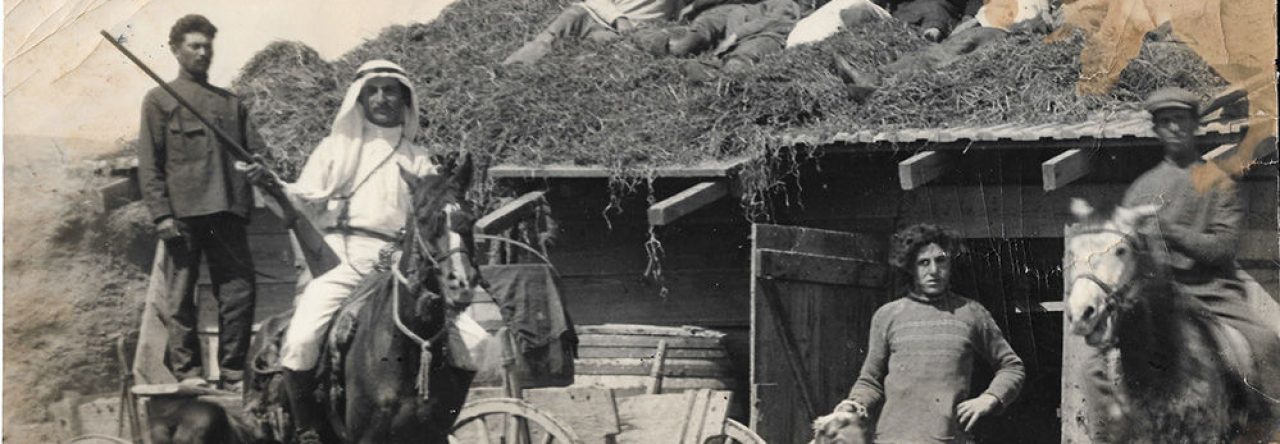
“The Iraqi People”

Read these words, written by an esteemed Iraq expert:

There are present in Iraq civilian forces possessed of brains, literacy and organizing experience, and reflecting a meaningful diversity of interest and opinions. However, the men at the head of these forces have not yet developed the ability to coexist, to play the game by recognized rules, to compound their differences for the sake of an agreed higher denominator. In addition, it is doubtful whether a sufficiently large part of the population can be interested in orderly and sustained political activity—distinct from the appeal of rabblerousing catchwords. Lastly, and most important, the civilian forces lack the prestige and forcefulness to induce the army to accept the role of a non-political guardian of public order, in times of disturbance as well as in normal circumstances.

That assessment could have been written this morning. In fact, it was written by the late historian (and my colleague) Uriel Dann 35 years ago, in the conclusion to his book Iraq under Qassem. Note that Dann located the core of the problem in the weakness of Iraq’s “civilian forces,” not in oppression by its military ones. Dann did not believe that the Iraqi people could be led; they could only be incited or intimidated, a combination that later worked perfectly for Saddam. I don’t think Dann would have suffered fools babbling in his presence about Iraqi “civil society.”

That same assessment is implicit in this crucial passage from his book:

A climate of violence is part of the political scene in Iraq…It is an undercurrent which pervades the vast substrata of the people outside the sphere of power politics. Hundreds of thousands of souls can easily be mobilized on the flimsiest pretext. They constitute a permanently restive element, ready to break into riots which more than once in recent years have resulted in mass butchery. This climate of violence…has been the cause of more political and judicial assassinations than have taken place in any other Arab country in a comparable state of social advancement.

Notice that Dann did not locate the problem only in Iraq’s military (he called it a “caste,” easily distinguished by its various uniforms). He thought that violence was endemic to Iraqi society, and perhaps inherent in the very nature of the polity. “There is no ‘Iraqi nation’,” he announced at the very outset of his massive tome—and the rest of the book proved it.

Dann’s skepticism about Iraq’s political culture led him to this conclusion: “The army leadership alone can ensure for Iraq a modicum of stability and ordered progress.” That was true, for some years, under the Baath. But Saddam brought out the army’s fatal flaw: its weakness for “Arab” adventures, such as the invasions of Iran and Kuwait. Iraq’s sole national institution showed itself to be defective at its core, and when it acquired some technology, it became an engine for the export of Iraq’s violent malaise to places abroad.

Yes, only the army leadership can ensure a modicum of stability and ordered progress. The difference between Dann’s perspective in 1968, and ours today, is that we know it will have to be the United States army. Dann would have welcomed the removal of Saddam: after Saddam was spared in 1991, Dann grimly predicted that “the day will come when he will hit, we do not know with what weapons….And when he does…the innocent will pay by the millions.” But once Saddam is gone, it will fall to America to make Iraq a nation. What would Uriel Dann have thought of that?
Chicago Prof Joins Conspiracy-of-the-Month Club

Leave it to a professor of Middle Eastern studies to infiltrate the crudest interpretation of American motive into Chicago’s leading daily. Fred Donner is a professor of early Islamic history at the University of Chicago. Last week, the Chicago Tribune ran a piece by Donner, where he called the idea of removing Saddam a “Likudniks’ scheme.”

Why? It is “a vision deriving from Likud-oriented members of the president’s team—particularly Richard Perle, Paul Wolfowitz and Douglas Feith.” (Perle is explicitly denounced as a dual loyalist: “Why is he serving in a high position in an American administration?” asks Donner.) A war against Saddam would be “mainly in the Likud’s interest rather than our own.” And poor President Bush, according to Donner, is not even aware that a war would open a “Pandora’s box,” because he now sees the Middle East through the “Likud’s rose-colored glasses.”

True, this theory has surfaced in the mainstream media, but not in such a crude form. Naturally, Jewish organizations have written letters in response. The chair of Chicago’s Jewish Community Relations Council noted that Donner, “applying thinly-veiled code words, essentially argues that America’s Iraq policy was designed and is being driven by disloyal Jews.” An officer of the Anti-Defamation League, in a published letter to the Trib, wrote that Donner had provided “fodder for conspiracy theorists and anti-Semites,” and served “to propagate centuries-old anti-Semitic canards of Jewish control.” I’d have to agree.

I’m acquainted with Professor Donner (we overlapped at Princeton for a couple of years), but I don’t purport to know him. I do know that he’s no authority on Washington’s workings or the contemporary Middle East. And I strongly suspect that he simply parrots whatever conspiracy theory is fashionable on his campus or in the media at any moment.

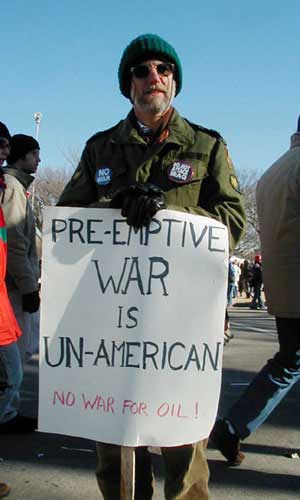
Here, for example, is a photograph of Professor Donner at the January 18 anti-war rally in Washington. Read his sign. Beneath the words, “Pre-emptive war is un-American” (a questionable assumption), it says: “NO WAR FOR OIL!” Now am I missing something? This is a completely different conspiracy theory from the one Donner has put forth in the Trib, where oil doesn’t even appear. So what is it, Fred? Greedy oil companies or devious American Likudniks? Or maybe you haven’t got a clue?

I respect Donner as a historian of early Islam. Unfortunately, he and his colleagues seem to think that modern American politics operate like the early Islamic caliphate (albeit with less moral authority). Add the Donner affair to the bill of indictment.

On Entering Basra and Baghdad, Avoid This Mistake

As war against Saddam looms, military planners should read a very pertinent article by the late Elie Kedourie. Its title: “The Sack of Basra and the Baghdad Farhud.” It’s the story of how not to occupy Iraq’s two principal cities.

In 1941, the British sent forces into Iraq to remove a pro-Axis military junta from power. Now it’s called “regime change,” and more than one journalist and strategist has remarked on the parallels between 1941 and today. But they omit the mistakes made by the British commander, General (later Field Marshal) Sir Archibald Wavell, in securing Basra and Baghdad.

The British didn’t want to use troops to provide administration in the two cities, preferring that it be done by Iraqi authorities, while they bore down on strategic objectives such as the besieged RAF station at Habbaniya. Wavell’s instructions: “As long as Iraqi administration meets our military requirements it is not, repeat not, to be interfered with or superseded because it is inefficient in other directions.” And Wavell again: “Every encouragement is to be given to local Iraq administration to function so far as is consistent with safety of our forces. Political officers are to be regarded as liaison officers between Iraq administration and British forces and not as administrators except where Iraq administration is inoperative.”

British forces thus left key areas of both cities to the mercies of a defeated regime. In Basra, the abdication resulted in the sack of the bazaar by rioters and looters. In Baghdad, it was far worse. Wavell instructed that his forces “should not get involved in street fighting in disadvantageous conditions.” So while the British forces camped west of the Tigris, looting on the east bank by the bedouin and the remnants of the army and police turned into a full-scale pogrom. (Jews used the term farhud, a murderous riot.)

About 180 Jews (and some Muslims) were slaughtered. A British officer later wrote of hearing “the growing crescendo of rifle and machine-gun fire. Baghdad was given up to the looters. All who cared to defend their own belongings were killed, while eight miles to the west waited the eager British force which could have prevented all this.” Iraq’s ancient Jewish community never fully recovered from the blow, and its younger members began to plan emigration. (The pogrom also left a mark on young Elie Kedourie, who lived through it.)

The British could get away with cutting corners in 1941. They were immersed in a world war on multiple fronts, their forces were stretched thin, and the world wasn’t watching. In 2003, the world’s sole superpower is bearing down exclusively on Iraq, under blazing media spotlights. If the 1941 handling of Basra and Baghdad were repeated under these circumstances, the stain would be indelible. Preventing it means exercising complete control in urban areas. Delay could produce a bloodbath surpassing any “collateral damage” in cost and effect.

Battle plans come down to priorities, and in Iraq there are a lot of them: oil fields, the Western desert, possible WMD sites, Tikrit, and more. But the lesson of Baghdad 1941 (the Jewish quarter)—like that of Damascus 1918 (the Turkish hospital) and Beirut 1982 (Sabra and Shatila)—is the importance of immediately deploying forces to police an Arab city upon its conquest. In the absence of such policing, or upon its delegation to others, the likelihood of massacre rises sharply. That lesson is liable to be forgotten in all the optimistic chatter about how ready Iraqis are for democracy. Before that, Iraqis must be kept from settling scores. The road to hell—or a Belgian indictment—is paved with good intentions.

You’ll find Kedourie’s article in his collected volume, Arabic Political Memoirs and Other Studies, 1974.

ADDENDUM: Things were done differently before CNN and the Hague tribunal. Sir Alec Kirkbride, who entered Damascus in 1918 on the defeat of the Turks, explained how he put down looting, rioting, and the butchering of Turkish stragglers by vengeful Damascenes: he made “free use” of his large service revolver. “Occasionally, someone turned nasty and I shot them at once before the trouble could spread.” Right out of his memoirs, A Crackle of Thorns, 1956.