The bindings of Isaac: Goldziher’s library in Jerusalem

This past Sukkot holiday marked an important anniversary for the National Library of Israel and the study of Islam in Israel. A century ago, the Hebrew University opened a prized acquisition to the Jerusalem public: the 6,000-volume private library of Ignaz (Isaac Jehuda) Goldziher, the Jewish-Hungarian scholar of Islam. The books had been transported from Budapest, after lengthy negotiations and at some cost. Chaim Weizmann welcomed their arrival, addressing an enthusiastic crowd of Jews, Christians, and Muslims outside the library. Jerusalem’s British governor and Arab mayor also attended.

The accession of Goldziher’s library marked a triumph for the Hebrew University. Several generations of students and scholars would rely on the collection to maintain their competitiveness with the highest research standards. This centennial offers an opportunity to remember Goldziher and reflect on the journey and impact of his books.

Making of a master

“The Great Goldziher,” as admirers called him even during his lifetime, laid many of the modern foundations for scholarly Islamic studies. Born in the Hungarian town of Székesfehérvár to the son of a leather merchant, he received rigorous schooling in the Hebrew Bible and Talmud from an early age. He completed his philological studies in Leipzig in 1870, and then traveled further through Europe and the East. He even studied at Cairo’s famed Islamic university, Al-Azhar.
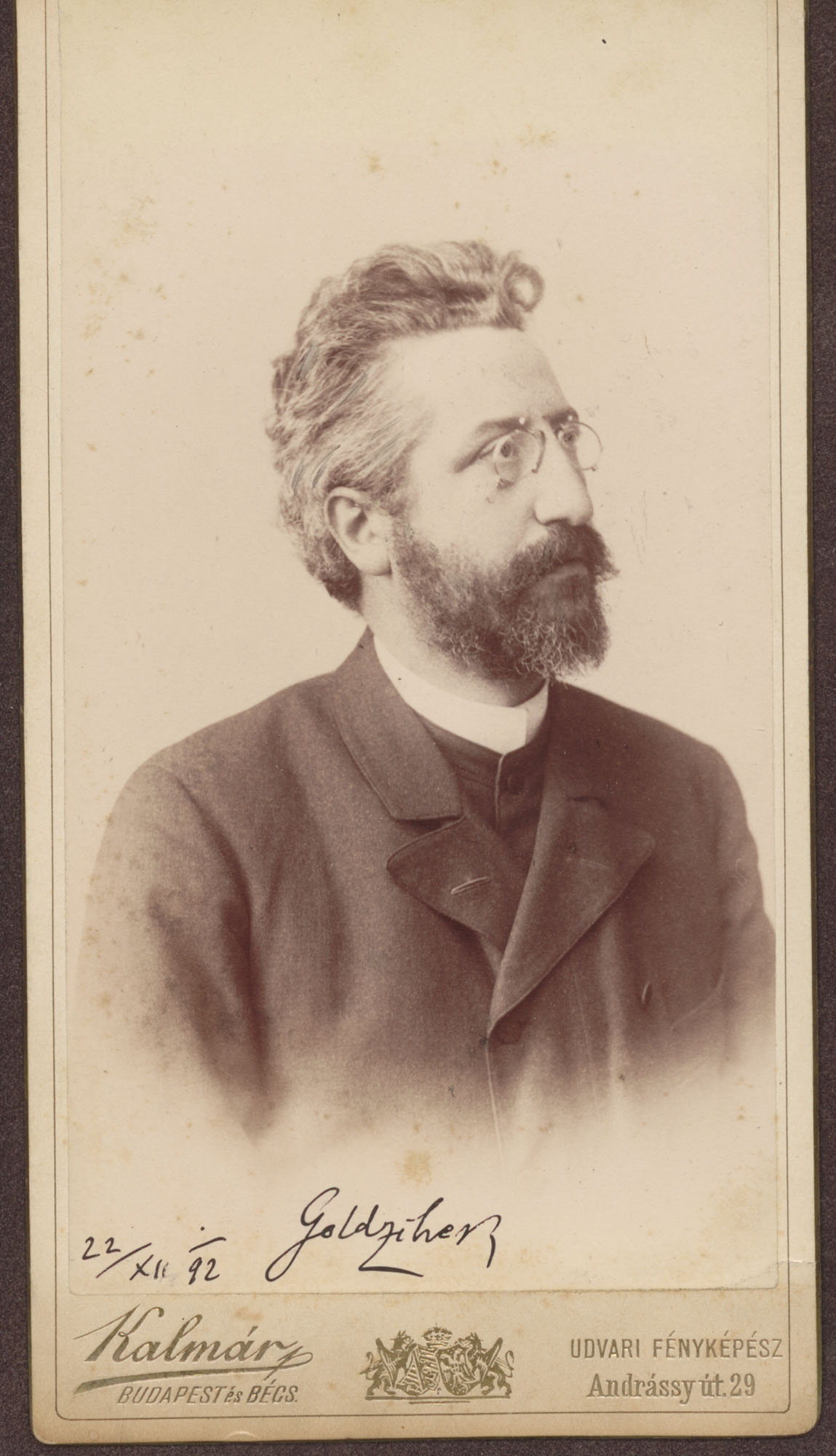
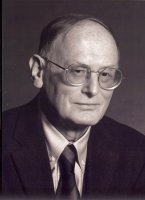
Ignaz Goldziher in 1892. Wikimedia Commons.

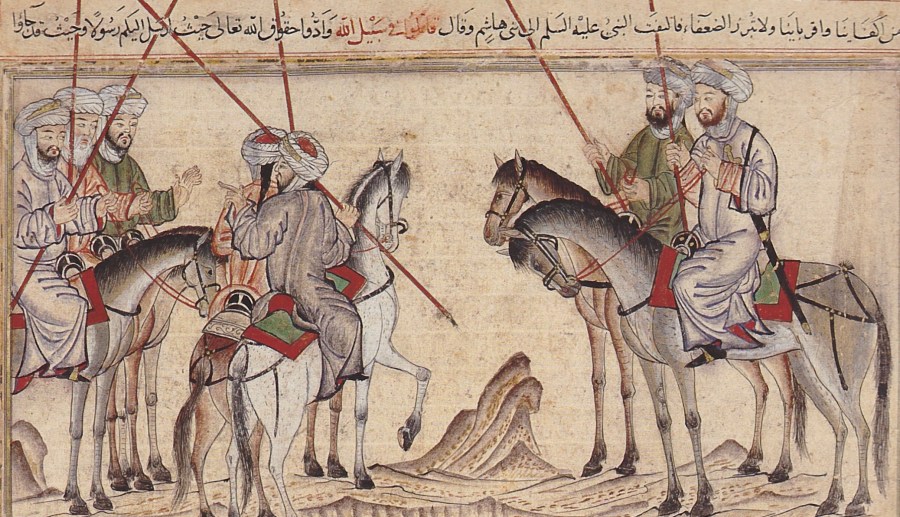
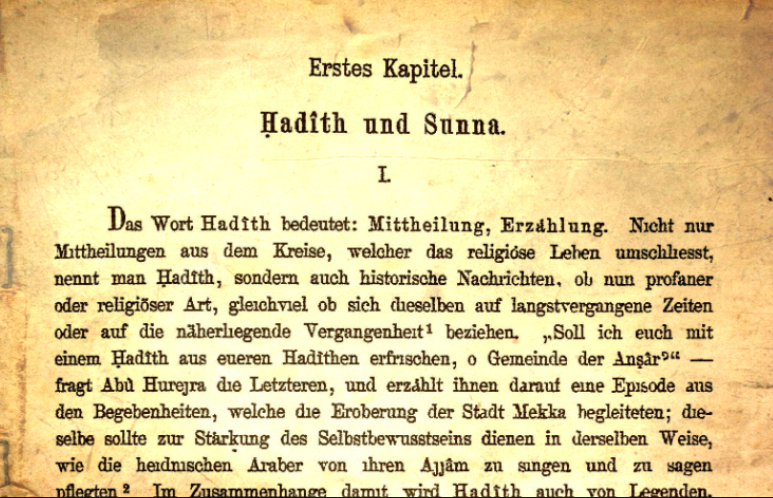
Goldziher’s Jewish faith precluded a professorship at the University of Budapest, and from 1876 he earned a living as secretary to one of the Jewish communities in the city. Only in 1905, at the age of 55, was he finally appointed to a salaried chair at the university. This meant that Goldziher had to pursue his studies on Islam after hours, following long days spent on menial tasks that he detested. His interests ranged widely, from the development of Muslim sects to Arabic poetry. But his most renowned contribution was his study of Islam’s oral tradition, the hadith, which he viewed not as a record of the Prophet Muhammad’s deeds and sayings, but as a window into the first centuries of Islam.

In the 1890s, as Goldziher’s reputation grew, foreign universities such as Heidelberg and Cambridge attempted to recruit him. But he refused to leave Hungary for personal and patriotic reasons. Nor did he consider relocating to Palestine. Goldziher, while an observant Jew, was not a Zionist. In 1920, his old schoolmate, the Zionist leader Max Nordau, encouraged him to join the planned university in Jerusalem—the future Hebrew University. Hungary had just fallen under the rule of Admiral Horthy, whose regime enacted sweeping antisemitic policies, including strict quotas on Jews in higher education. Goldziher declined Nordau’s proposal: “Parting with the [Hungarian] fatherland, especially at this time, would demand a heavy sacrifice from a patriotic point of view. This is also why I resisted moving to German or English universities in my younger years.”

Alongside his research and writing, Goldziher assembled an astonishing private library. Budapest lacked great collections of books and manuscripts from the Muslim East, so Goldziher had to acquire them himself. Foreign visitors to his home were awestruck by the scope of his collection. A young Hungarian rabbinical student, Leopold Grünwald (Greenwald), recalled visiting Goldziher’s home in 1910 and the emotional effect of seeing his library.

The room was his study, a large room filled with several thousand books and hundreds of manuscripts that did not appear to be arranged in any systematic way. Some forty books, for example, large and small, rested on a stool. It was as though a whirlwind had transported me to a Jewish ghetto of several hundred years ago, where the Jew was isolated from the entire world and enjoyed no pleasures except for the four ells of halakhah. Only among his books was he at ease; there alone he found peace. Even the air there was clear of physical desires and pleasures. All was spiritual. I thought to myself, would that I could remain in this ethereal state for as long as I live! Would that I could reject all the vain pleasures and find joy and comfort among books alone!
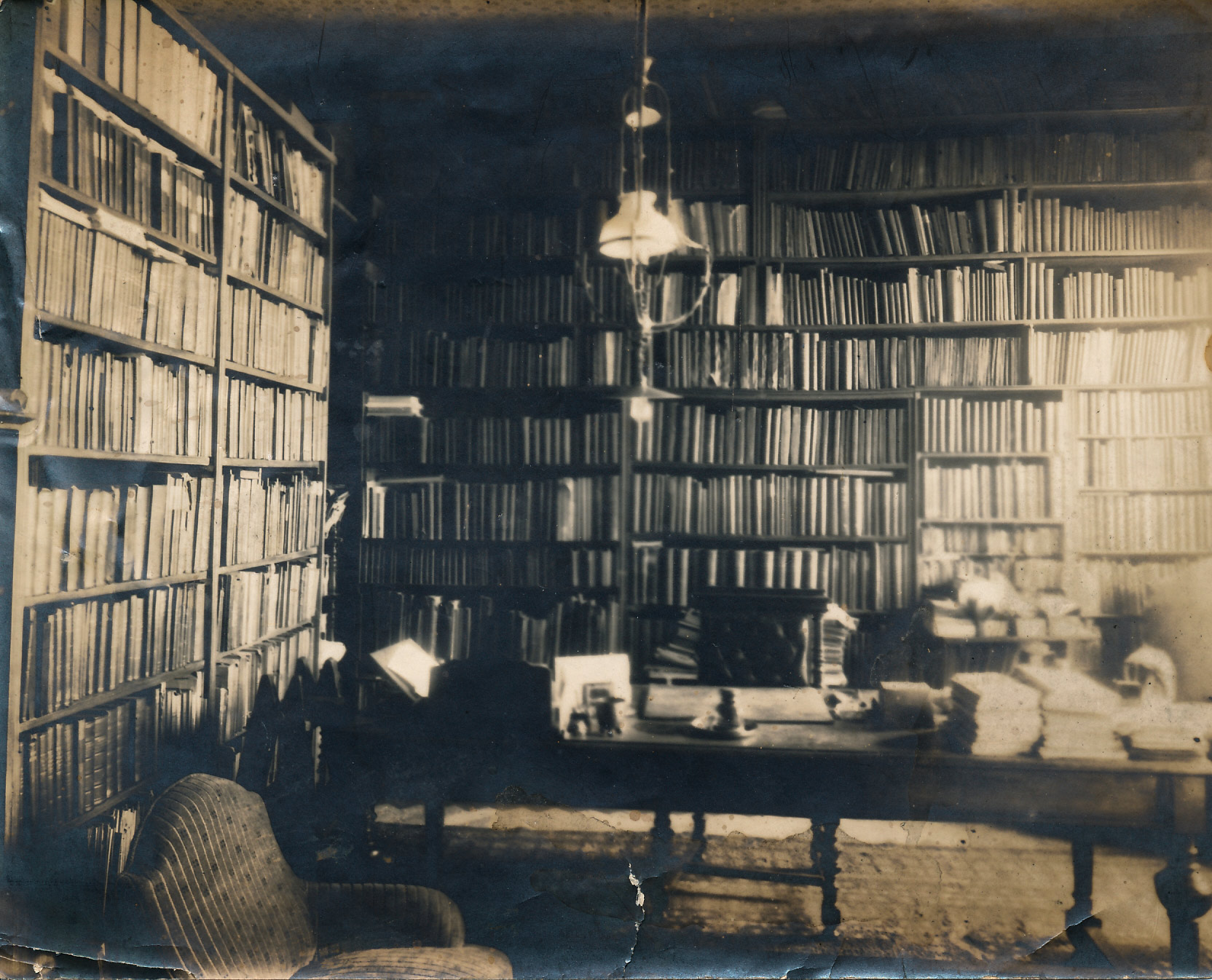
Ignaz Goldziher’s Budapest study, Goldziher family photo album, F72.94, Hungarian Jewish Museum and Archives.

Floor to ceiling

Goldziher died in November 1921. Lore has it that he wished for his library to go to the Hungarian Academy of Sciences, but there is no record that he made any specific provisions for it. His widow and son, pressed for cash, sought buyers, with serious offers coming from as far away as Japan.

However, the most persistent offers came from Jerusalem, where the newly established Hebrew University was eager to expand its library collections to an international standard. The detailed history of the Zionist Executive’s acquisition of Goldziher’s library has been expertly recounted by Samuel Thrope, curator of the Islam and Middle East Collection at the National Library (here and here). It’s a tale of negotiation, bureaucracy, and competing claims for credit, to which I have nothing to add.

Instead, I’ll share the vivid account of Israel Cohen, the British Zionist official and journalist who traveled to Budapest to finalize the deal and arrange for the library’s shipment to Palestine. In August 1923, he visited the library in situ, at Goldziher’s home at 4 Holló Street. Cohen described the street as “a long, dreary, narrow thoroughfare, flanked on either side by tall somber buildings, in which the two most homely features are a modest little bethel and a frowsy kosher restaurant.” Remote from “the majesty of the Danube,” Holló Street was “a haunt of unrelieved desolation, where nobody could be expected to dwell by choice; but as the Jewish Community owns Number 4, this has always formed the residence of some of its officials,” of whom Goldziher had been one.

Cohen wondered “what was it that fettered [Goldziher] to this somber dwelling,” when he had received all manner of “luring invitations” and “tempting material prizes” from around the world.

When I first went to visit his home in August 1923, and, later ascending a dim, circular flight of stone steps, found myself on the railed gallery that led to the door, and from which I looked down upon the dirty hand-carts and the rubbish-heaps in the courtyard below and at the lofty, grimy wall opposite, which seemed to shut out the light from heaven, I could not help wondering. For forty-two years, I reflected, this world-renowned savant, from early manhood until his death at the age of seventy-two, was content to tread up and down that dim, stone staircase, pace along the narrow, stone gallery that ran round three sides of the building—the fourth being bounded by the gloomy wall—and live in the humble flat that was entered by a door with chequered and bar-protected window-panes. No more drab and depressing surroundings could be conceived—and to be doomed to such neighborhood for forty-two years! ‘Such is the Torah, and such its reward!’

But when I was admitted by the gentle, gray-haired widow, and taken to the room where he had worked, the riddle was solved. For in this room was the wonderful library covering the walls from floor to ceiling and overflowing on to extra shelves, which he had thoughtfully and laboriously gathered together from all the regions of the Near East, and wherein he quarried night and day in quest of new truths. It was his passionate attachment to this library, in and for which alone he lived, that made all the glittering offers from other cities, with their promise of superior ease and comfort, appear but phantasms, and its removal seemed to him unthinkable. Here were arranged the well-thumbed tomes in all the Semitic tongues, which he had either bought or which had been presented to him by their authors or by the erudite societies that published them. The works given by their own writers all contained an inscription of homage and often of gratitude, and not a single Orientalist but considered it a duty and honor to send him a first copy. Many of the books were rare, and those that came from Moslem scholars were probably the only copies on the Continent. And Goldziher enriched most of them with his own notes and glosses, written on the fly-leaves and the margin, or on slips of paper, which form a mine of suggestions for those who will delve into them.

Since Cohen never met Goldziher, he couldn’t possibly have known the scholar’s reasons for staying in Budapest. Still, Goldziher could not have achieved much without his massive library of rare, hand-picked books, and the daunting task of moving them likely reinforced his reluctance to leave. For what it’s worth, Abraham Shapira Yahuda, Goldziher’s mentee and a Zionist, claimed that he had urged Goldziher “to come to the Land of Israel and dedicate the last years of his life to raising a new generation of scholars.” Yahuda regretted that Goldziher “never went to the Land of Israel, partly because he didn’t believe he could bring his books with him.”

For Goldziher’s widow, Laura, parting with her husband’s books was no small thing. Cohen gave this poignant account:

The twenty-two cases were ranged in the library and the adjoining rooms in two rows, between which the frail widow slowly passed, touching each case in turn, as though to retain contact until the last possible moment with the possessions of her husband. They must have seemed to her like coffins, as they were borne out of the dwelling, nor was the sorrow that followed them any less profound than that which accompanies many a real bier. At last they had all been taken away, and she gave a wistful look at the library—bare and desolate. ‘Ichabod—the glory is departed,’ she said, ‘and there is nothing more for me to live for.’

‘The glory is gone from here,’ I replied, ‘to the Holy Land, where it will become more glorious still, and where it will confer an untold blessing by bringing Jews and Arabs together in the peaceful pursuit of scholarship, and thus pave the way to a friendly understanding between the two peoples.’

The following day the Goldziher library was transported to Trieste, whence it was shipped to Palestine.

Books at war

In reports in the Hebrew press about Goldziher’s library, Cohen’s hopeful idea that it might bring Jews and Arabs together appeared frequently. Yahuda was the main promoter of this notion:

Imagine a library where a delightful and wonderful treasure from the finest Arabic literature and key Islamic texts is found. This place could become a center for Arab and Jewish scholars alike, where they would come together as brothers in wisdom and friends in the pursuit of knowledge. The spirit of enlightenment would dwell upon them and inspire our neighbors, who are close to us in both kinship and thought, with the same spirit of tolerance, broad-mindedness, and generosity of soul that once distinguished the Arabs in ancient times.

The poet and writer Kadish Silman attended the opening in Jerusalem, and struck exactly this note:

Besides Jewish scholars and teachers, dozens of English and Arab locals with an interest in scholarship came to the opening. All the editors of Jerusalem’s Arab newspapers were there, as well as the Mufti, the Qadi, and others…. Dr. [Nissim] Malul translated [Weizmann’s speech] into Arabic. The speech made a strong impression. A feeling of unity—and possibly even friendship—was achieved. Afterward, in the library, all the guests from various backgrounds mingled, and Dr. Weizmann gave explanations to everyone. He parted from the Arabs and the English with handshakes and warm wishes. Since we started our local political efforts, never has there been a moment of unity as strong as this one.

Close to the rented Arab house that served as a temporary home for Goldziher’s library, across a rocky expanse, stood a mosque’s minaret. Goldziher’s library had traveled far from Holló Street to fulfill its mission of peace.
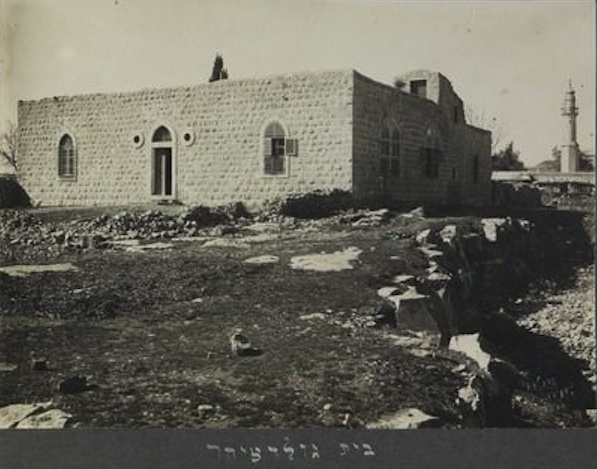
The rented “Goldziher House” in Jerusalem, album of photographs of the National and University Library, ca. 1927-1944, catalog no. ARC. 4* 793 06 01, National Library Archives.

Alas, no number of books could have achieved that. In the years that followed, Jews and Arabs collided. Efforts to appoint an Arab to the faculty never bore fruit. In 1936, during the “Arab Revolt,” Lewis (Levi) Billig, the first lecturer in Arabic literature at the Hebrew University, was shot dead at his desk by an Arab assailant. “The manuscript he was preparing,” reported the Palestine Post, “a Concordance of Ancient Arabic Literature, and a large Arabic tome on which he was working, were spattered with blood.” The murder stunned the faculty.

In 1945, the librarian who had organized Goldziher’s collection faced hostility from Arab book dealers in the Old City: “Something like this has not happened to me even in the worst of times.” Then came the 1948 war, when the library salvaged (critics have claimed, looted) as many as 9,000 Arabic volumes from homes abandoned by Palestinian Arabs who fled the fighting. “The number of books brought to the library in this way,” wrote the university’s keeper of Oriental books, “exceeds the number of Arabic books we have gathered over the entire history of the institution.”

Ideas shape history, but the physical books and libraries that contain them have always been subject to its tides.

Spirit and method

The Goldziher collection didn’t change the course of Jewish-Arab relations. But it reached Jerusalem at the right moment, as Israel prepared to establish itself in the face of Arab opposition. By the time Israel gained independence, the Israeli school of Islamic studies was well-established, largely led by scholars who, like Goldziher’s books, had migrated from Central Europe to Jerusalem.

As one such scholar, Martin Plessner, remarked, “Goldziher’s library is one of the most valuable assets of the Hebrew University. His spirit lives among us from the earliest steps of our research into Islam.” But it wasn’t just his spirit that influenced them—it was also his method. “Goldziher used to write many notes in his books,” wrote S.D. Goitein, “especially on the blank pages at the beginning and end of the books. Anyone wishing to see his handwriting and get a glimpse of the working methods of a great scholar need only request an Oriental book printed before 1914 from the library, and they will almost certainly find what they are looking for.” Goldziher’s example, reinforced by the physical presence of his books, set exacting standards for interpreting Islam and Arabic within Israel’s universities, but also far beyond them.

Goldziher’s books are now dispersed throughout the broader library collection. Over the last century, their influence likewise has spread in ways that can no longer be traced—trails left from the big bang that occurred in a drab Budapest walk-up.
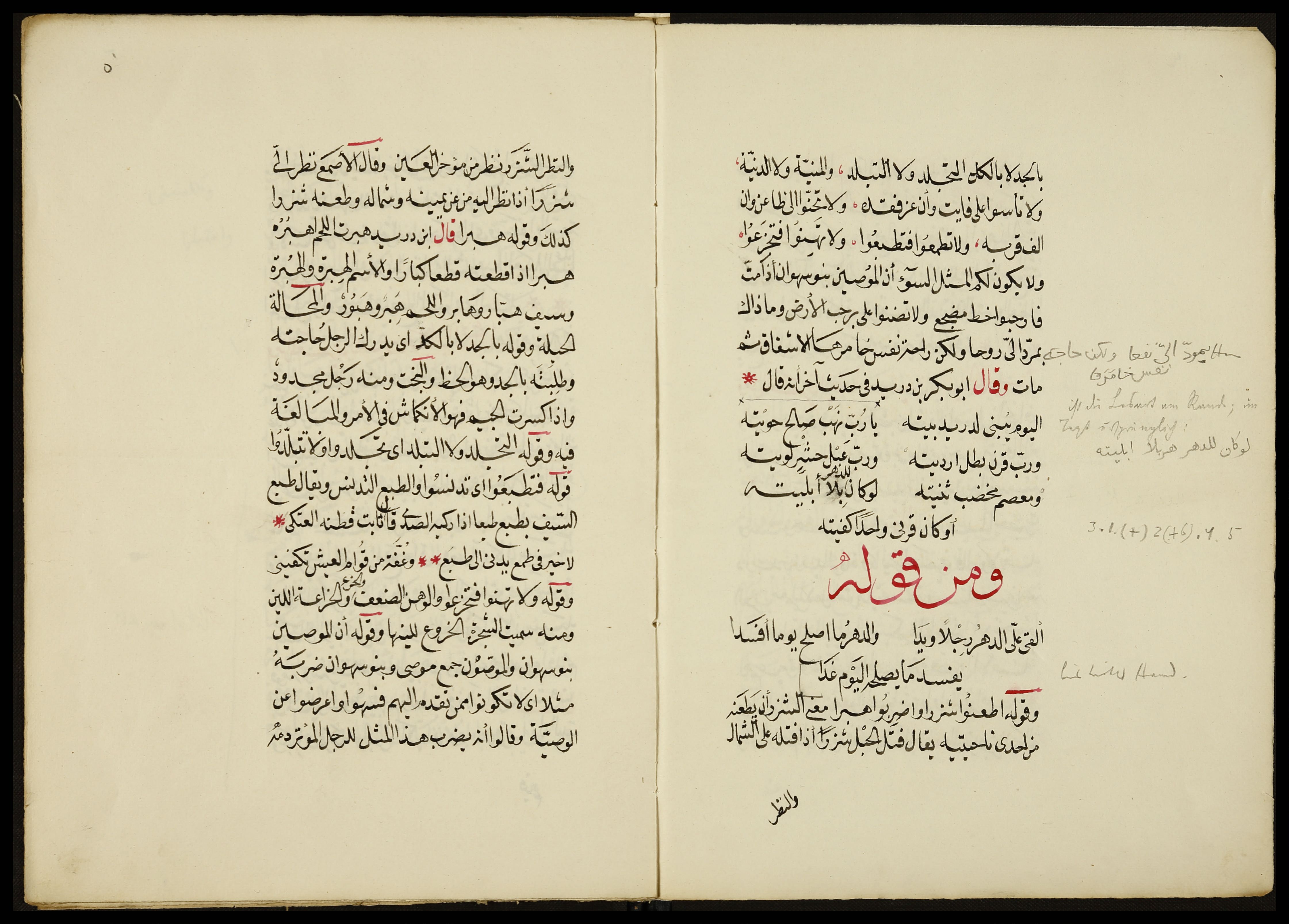
Excerpt from Al-Ghurar wa al-Durar fi al-Muhadarat by Sayyid Murtada (413 AH / 1023 CE). Manuscript copied by Muhammad Ahmad Al-Khuja (Cairo, 1310 AH / 1892 CE), with corrections by Ignaz Goldziher. National Library of Israel, Jerusalem, Ms. Ar. 2.

Endless expertise


Werner Ende (1937-2024), who passed away on August 6, was described in these words in an obituary by a former student, published in the Frankfurter Allgemeine Zeitung:

His students now work in intelligence services, media outlets, and universities: Werner Ende, who profoundly influenced modern Islamic studies in Germany, has passed away. 

In Germany, research into contemporary issues of the Middle East doesn’t have a long tradition. Philologists and cultural scholars were often too afraid of being co-opted for political purposes. For a long time, they preferred to focus on ancient manuscripts and retreat into the academic ivory tower. When the world became interested in the Islamic world after the Iranian Revolution of 1979, there was little from the Orientalist departments that could explain what was happening in neighboring regions. This has changed; today, Islamic studies as a branch of Orientalism is no longer seen as an obscure or irrelevant field. 

This shift is thanks in part to Werner Ende, a pioneer in modern Islamic studies.

It was this role that drew me to Ende, the German scholar with whom I had the closest relationship. By the time I met him in 1986, he had moved beyond his early work on Arab nationalist historiography to establish himself as a leading expert on Salafi Islam and Shi‘ism in its Arab contexts. Sunni-Shi‘ite polemics became his special field of interest, and he approached them from both sides with the factual and philological precision characteristic of the German scholarly tradition.

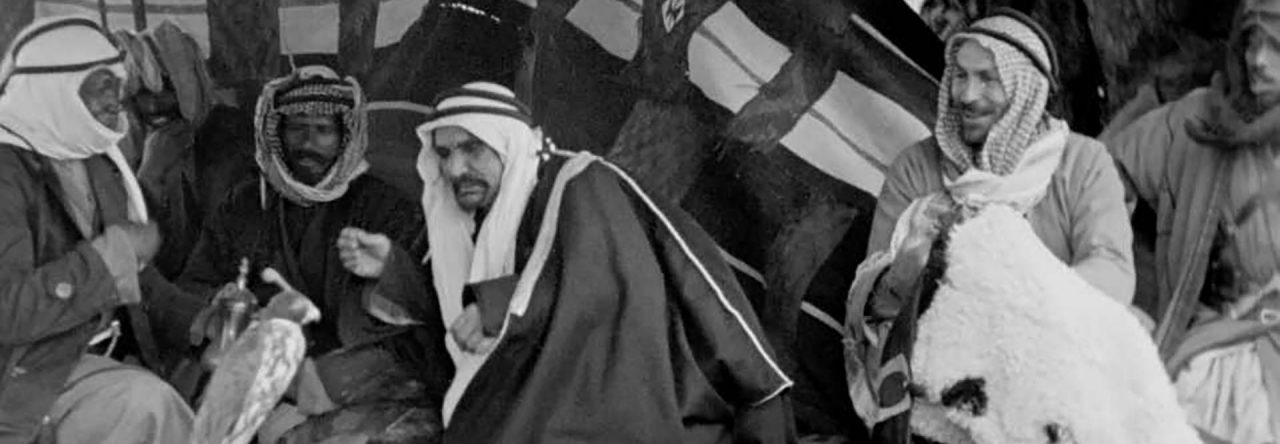
Like my mentor, Bernard Lewis, Ende insisted that the politics of Islamic movements could not be understood without a profound grasp of early Islamic history. Only Ende could explain, with absolute authority and clarity, how today’s Saudi-Iranian dispute over a cemetery in Medina encapsulated centuries of Wahhabi-Shi‘ite rivalry. His study of the Shi‘ites of modern Medina is a typical gem, all the more remarkable since, as he admitted, he had “not been able—and most probably never will be—to do research on the spot.” These deep dives into difficult texts revealed him as a virtuoso researcher, whose resourcefulness was truly astonishing.

In 1986, I went to Freiburg im Breisgau, where he held the chair in Islamic studies, to spend a month under his tutelage. Ende became my guide to many things that summer: the revival of the German Orientalist tradition after the devastation of the Second World War, Shi‘ism in Lebanon (where he had spent several years before that country’s civil war), and Wahhabi ideology. His tutorials over Kaiserstuhl wine atop Freiburg’s Schlossberg were unforgettable.

We stayed in touch; I last saw him over breakfast in Berlin in 2016. He had retired by then and moved to the reunited capital. (In his youth, he had lived in East Berlin near the Wall and escaped to the West in pursuit of freedom. Life under communism made him wary of all forms of indoctrination.) I last corresponded with him in 2023, when he told me he had fallen seriously ill and had returned to the care of family in Freiburg, where he passed away.

Ende was largely unknown outside the German-speaking world. He published some articles in English, but not a book (apart from two co-edited volumes), and he didn’t attend conferences in America. However, he exhibited a keen and mischievous curiosity about the battles over Middle Eastern studies across the Atlantic. While he kept his distance from the Arab-Israeli conflict, he did not distance himself from Israel or Israeli scholars. His most accessible summary of Sunni polemics against Iran’s revolution appeared (in English) in an Israeli conference volume—an article that is more relevant than ever today.

More important than international renown, he was a devoted mentor to many students, who attest to his lasting influence on their work and careers. They compiled a fine collected volume in celebration of his 65th birthday, the title of which takes on a different meaning today. It played on his name: Islamstudien ohne Ende (‘Islamic studies without end’). Now Islamic studies in Germany are without Ende, but hopefully not without his standards of rigorous scholarship.

In 1988, he reviewed my first book, Islam Assembled, published in 1986. I reproduce it at this link (translated from German) not because it flattered me. My book was a revised doctoral dissertation, and from my present perspective, I’m embarrassed by its flaws. It’s also true that by the time Ende wrote his review, we were already on friendly terms. But it reflected his generosity of spirit, and his emphases suggest why we connected. Rereading it now, almost forty years later, it strikes me as a model of how a senior scholar should review the work of a promising junior one. There is always fault to be found, but it should be weighed against the value of unqualified praise for someone launching a career. I shall always be grateful for his kindness.


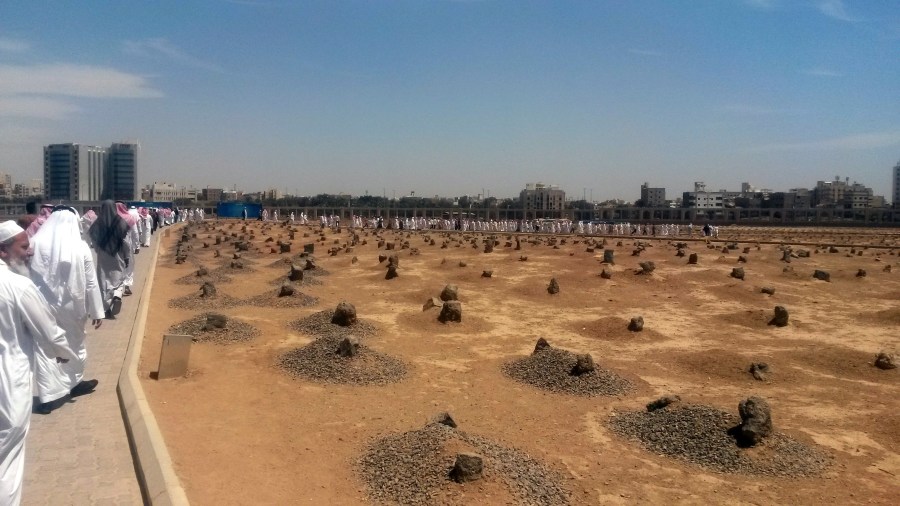
Header image: Baqi‘ cemetery in Medina. Source: Wikimedia Commons.

Islam: 1,400 years embattled

In September 1973, Egypt’s leaders were looking for a name for their plan to launch a surprise attack against Israeli forces across the Suez Canal. According to the Egyptian chief of staff, Saad El Shazly, they wanted “something more inspirational than our planning title, The High Minarets.” Once the assault was set for October 6, falling in Ramadan, “Operation Badr named itself.”

This 17th of Ramadan marks 1,400 years since the battle of Badr (624), the first military confrontation between the Muslims and their opponents—in this case, the grandees of the Prophet Muhammad’s own tribe of Quraysh. He had fled their persecution in Mecca less than two years earlier (the hijra, 622), along with his followers, in order to regroup and recruit in Medina, to the north.

At Badr, southwest of Medina, Muhammad led a contingent of 313 Muslims, outnumbered three to one, to a decisive victory over the polytheists of Mecca. The Muslims killed many, took others prisoner for ransom, and secured much booty. Angels supposedly helped out. It’s considered a turning point in the fortunes of nascent Islam, demonstrating Muhammad’s skills as a commander as well as the divine favor enjoyed by the believers.

Badr received its most memorable cinematic treatment in the 1976 epic The Message, starring Anthony Quinn and bankrolled in good part by the then-dictator of Libya, Mu‘ammar Qadhafi (watch here). The movie roughly adhered to the traditional accounts of the battle: the preliminary duels by champions, the general melee, the cut-and-thrust, and the spirit of Muslim triumph. (Quinn didn’t play Muhammad, who couldn’t be depicted on film; he played Hamza, Muhammad’s companion and uncle. Ali, the Prophet’s son-in-law and later caliph, also couldn’t be depicted; the double-pointed sword on screen is wielded by him, but you won’t see him.)

Badr did much to signal the character of Islam going forward. Bernard Lewis, historian of Islam (and my mentor), summarized that character in theses words:

The founder of Christianity died on the cross, and his followers endured as a persecuted minority for centuries…. Muhammad did not die on the cross. As well as a Prophet, he was a soldier and a statesman, the head of a state and the founder of an empire, and his followers were sustained by a belief in the manifestation of divine approval through success and victory. Islam was associated with power from the very beginning, from the first formative years of the Prophet and his immediate successors.

Thus did Islam find its validation in military success, which became its hallmark for a millennium. Its first decisive victory occurred at Badr, during Ramadan of the second year of the hijra, corresponding to March 624.

“Proven fact”

Or so I was taught. In my student days (back in the 1970s), every Islamic history syllabus started with the biography of Muhammad by a Scottish scholar, W. Montgomery Watt, in its two-volume or abbreviated version. His work, published in the 1950s, gave a coherent account that seemed well-grounded. But he achieved that only by giving the benefit of the doubt to the Muslim sources.

Why doubt? The Qur’an, the earliest source, is an opaque book of revelation, not a history. The earliest biography of the Prophet wasn’t set down until over a century after his death. The versions we have were redacted still later. The traditions regarding Muhammad were collated at about that time, and were demonstrably colored by biases and politics far removed from seventh-century Arabia. Worse still, the later the accounts, the more detailed they became, rendering them even more suspect.

Even Watt had to acknowledge that there had been “shaping” of the facts by their recorders, but he wouldn’t admit their invention: “At least the material in the early biographies is to be accepted as true,” he insisted, and “most of the background material, culled from a large number of varied works, is sound.” Otherwise, he’d never have filled two volumes.

In 1961, the French Marxist scholar Maxime Rodinson published a materialist biography of Muhammad, but he too relied on the standard Muslim sources. Consider, for example, what he wrote about Badr:

We also have certain facts upon which all the traditions are agreed. The first Arab compilers differ (slightly) as to the names of those who took part in the battle of Badr, as well as the circumstances, the preparations and the consequences of the fighting. They conflict with one another on all these points, each reflecting the party-struggles of his own day. But such disputes can only take place because everyone agrees that the battle did in fact take place, on its date (at least approximately) and with its result. We must therefore consider it as a proven fact, and endeavor to see how to place it in the total chain of cause and effect.

Just as I was finishing my studies, such “proven facts” came under a full-scale assault by revisionist historians, who insisted that the story of early Islam as told in Muslim sources was entirely spurious. Islam, they claimed, arose gradually in a setting far removed from early seventh-century Arabia; the later Muslim accounts of its birth were a kind of back-filling. As one leading revisionist historian, Patricia Crone, put it, “The entire tradition is tendentious… and this tendentiousness has shaped the facts as we have them.” My fellow grad students who’d chosen early Islam as their field had entered a maelstrom of controversy. (Not that the modern history of the Middle East was less tumultuous. All this coincided with the Iranian revolution and Edward Said’s Orientalism.)

The historicity of Badr also came in for its share of doubt. A fragment of Arabic papyrus suggested that a full century after the battle, Muslims didn’t place it in the month of Ramadan. If it had been slipped into Ramadan by late-eighth-century fixers, perhaps the whole thing was made up. This is the conclusion spread a decade ago by Tom Holland, a British writer of popular histories who took in the revisionist scholarship and sharpened its edges. The canonical account of Badr essentially duplicated

the themes that the Greek poet Homer, a millennium and a half earlier, had explored in his great epic of warfare, the Iliad. The one features angels; the other gods. Why, then, should we believe that the account of the Prophet’s first great victory is any more authentic than the legend of the siege of Troy?… What if the entire account of the victory at Badr were nothing but a fiction, a dramatic just-so story, fashioned to explain allusions within the Qur’an that would otherwise have remained beyond explanation?

Over the last fifty years, early Islamic history has been turned into just such a game of “what ifs,” without the guardrails of the traditional sources. It’s a highly technical discipline, and I don’t pretend to grasp all of the current work. It does seem that the wave of hyper-skepticism has receded; Crone, a staunch revisionist, decided that “the chances are that most of what the tradition tells us about the Prophet’s life is more or less correct in some sense or other.” But to my untrained eye, the study of earliest Islam seems to have grown ever more speculative.

The Badr of memory

Islam’s formation wasn’t the chosen specialty of my teacher, Bernard Lewis. He only touched on it in more general works, such as his 1950 overview, The Arabs in History. There he largely adhered to the consensus that the Muslim sources preserved more than a kernel of truth. “There were many disagreements among scholars as to the authenticity of this or that tradition,” he later recalled, “of this or that narrative, but the broad outline of the Prophet’s career, as also the actions and achievements of his companions and successors, was generally accepted.”

But when Lewis came to revise that book many years later, everything had changed. “In certain subjects,” he wrote in 2006, “our knowledge diminishes from year to year with the progress of scholarship and research, as one generally accepted view after another is attacked, leaving a terrain strewn with demolished or endangered hypotheses and assumptions.”

Yet Lewis still believed the Muslim sources should be taken seriously. “The past as remembered,” he wrote,

the past as perceived, the past as narrated, is still a powerful, at times a determining, force in the self-image of a society and in the shaping of its institutions and laws, even if the factual base on which this image rests is shown by historians, centuries later in distant countries, to contain more fantasy than fact.

Lewis thus shows us the relevance of Badr in our own time. In his famous 1976 article “The Return of Islam,” Lewis noted the Egyptian choice of Badr as a code name for Egypt’s 1973 war plan. Indeed, Egypt continues to this day to name large-scale military exercises after Badr. (In the Egyptian setting, that’s a double-barreled pointer, to 624 and 1973.)

But Egypt hardly has a lock on Badr. On the 21st anniversary of the 9/11 attacks, Al Qaeda drew a comparison between Badr and 9/11, which it called “Badr September.”

Truly, September 11th was a day unlike any before it. It was a day of distinction [between truth and falsehood], akin to the great [battle of] Badr, when God crushed the tyrants of disbelief of that time. Similarly, on this day in September, God crushed the head of the present era’s idol, America, and weakened its foundations through Al Qaeda’s knights of the jihad. Thus, [September 11] was a kind of Badr in one of its many dimensions and meanings…. Just as no one at the time imagined that… the final countdown of Quraysh, Persia, and Byzantium began on Friday, the 17th of Ramadan of Year Two, so no one imagined that America and its allies would begin their decline on Tuesday, September 11. But what follows will be the rise of the world’s oppressed, as is God’s unchanging law in history.

Like much in history and myth, the memory of Badr is so elastic that it’s been invoked across the entire range of contemporary politics—by Egypt’s military, the biggest Arab beneficiary of American military aid, and by Al Qaeda, America’s deadliest Arab enemy. It’s also the name of an Iranian-backed militia in Iraq, a Taliban battalion in Afghanistan, and rockets fired off by the Houthis in Yemen and the Palestinian Islamic Jihad in Gaza. To name something after Badr is to associate it with resistance and faith, the weak against the strong, the few against the many.

It’s also more evidence, if more were needed, for the consciousness of history that permeates the politics of the Middle East. When the novelist William Faulkner wrote that “the past is never dead; it’s not even past,” he intended it as a general proposition, but it particularly describes the Middle East. “The Muslim peoples,” wrote Bernard Lewis, “like everyone else in the world, are shaped by their history, but, unlike some others, they are keenly aware of it.” That’s true, even if the history isn’t.

For Muslims, this year’s anniversary of Badr isn’t special. By the Islamic lunar calendar, it’s 1,443 years to the battle, not 1,400. But the entire world now lives in an era when Badr again matters, and it’s the rest of us who need the reminder. Perhaps that’s because more battles of Badr may lie ahead.


Above: The battle of Badr from the movie The Message, directed and produced by Moustapha Akkad.