by Martin Kramer
Mosaic Magazine, December 16, 2019
It’s said that the Oslo peace process was born in that room in Jerusalem in 1992. The truth is much different.
A couple of months ago, my wife and I took a 24-hour vacation in Jerusalem, spent entirely at the historic American Colony, one of Jerusalem’s oldest hostelries. The hotel originated in a messianic Christian commune whose members had arrived from Chicago toward the end of the 19th century in anticipation of the Second Coming. While waiting, they diversified into economic activities, including hospitality. Over the last century-plus, the American Colony has hosted an A-list of dignitaries and celebrities from T.E. Lawrence (“of Arabia”) to the British rock star Sting.
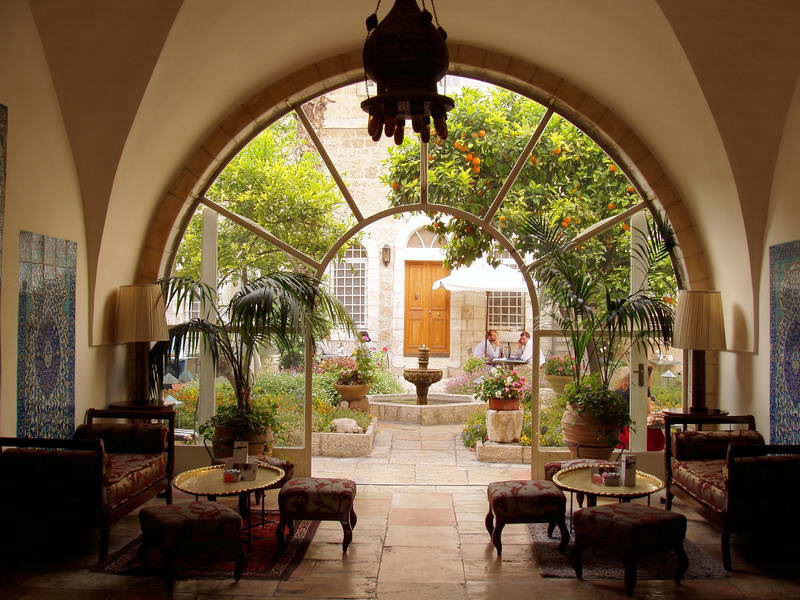
The hotel’s location, on the edge of the Arab downtown, has long facilitated its role as a neutral ground for meetings of Israelis and Palestinians; I’d dined there a few times in the distant past for just that reason. Today its old stone buildings remain charming and its many gardens enchanting—nowhere more so than where they conjoin around a bubbling fountain to form the enclosed patio of the main building.
Since ours was not a business trip but a holiday, to be devoted to rest and relaxation, the setting suited us just fine. To our delight, on check-in we received an upgrade to a suite: Room 16.
A bit of intrigue heightened our excitement. A year ago, the London Daily Mail had run a feature on “the ten best history-making hotel rooms.” It included, among others, Lenin’s room at the Hotel National in Moscow, the “Scandal Room” at the Watergate in Washington, and the Plaza Hotel suite that hosted the Beatles on their 1964 visit to New York. Tenth on the list was Room 16, “our” suite at the American Colony.
And what happened in that suite to merit such distinction? According to one telling of the story, a 1992 meeting in Room 16 was the first step in the “Oslo process” between Israel and the Palestinians that led to the accord signed at the White House in September 1993. “We concocted the start of what became the Oslo channel in Room 16 of the American Colony Hotel,” testifies Terje Rød-Larsen, the Norwegian mediator. “And the rest is history.”
Historians like myself dislike that expression, “the rest is history.” So I decided to test it.
Let’s travel back in time to mid-1992. The PLO leader Yasir Arafat is still stuck in Tunis, banished to the doghouse for having backed the Iraqi dictator Saddam Hussein after the latter’s 1990 invasion of Kuwait. But in Washington, U.S.-sponsored talks between Israel and a West Bank-Gaza delegation—talks that exclude the PLO—seem just as stuck. Meanwhile, in Israel, elections appear likely to unseat the Likud and bring the Labor party to power under Yitzḥak Rabin and Shimon Peres.
A tight clique of Norwegian officials and activists thinks there might be an opening here. They’re sending out feelers to Israelis and Palestinians. On Friday, June 19, 1992, four persons meet in Room 16.
They are: Larsen, head of an NGO with ties to the Norwegian government; Yossi Beilin, protégé of Peres and soon to be deputy foreign minister of Israel; Yair Hirschfeld, an Israeli academic who’s been nurturing ties with local Palestinian leaders; and Faisal Husseini, Arafat’s unofficial man in Jerusalem and an influential West Bank figure in his own right.
Of the figures in the room, Husseini enjoys the highest standing. The Los Angeles Times Magazine has just devoted a 6,500-word profile to this “Quiet Palestinian,” as the headline announces him, who is celebrated as “a pivotal player in the search for peace.” The article explains that Husseini hails from Jerusalem’s most notable Arab family. His grandfather and great-grandfather were mayors of Jerusalem; his father was a Palestinian hero, killed while commanding Arab irregulars who had encircled Jewish Jerusalem in 1948. Husseini is also the grand-nephew of the notorious pro-Nazi Mufti, Haj Amin al-Husseini.
The Washington Post, for its part, has described Husseini as “conspicuous in adopting more moderate positions than the PLO leadership in Tunis.” In that capacity, he has functioned as the key Palestinian figure behind the scenes of the ongoing Washington talks between Israel and the West Bank-Gaza delegation as well as the public point man in negotiations with U.S. Secretary of State James Baker. He has been characterized by Edward Said, the Columbia professor and the most prestigious Palestinian in America, as “an unaffected, unintellectual man whom it is impossible not to like,… a born leader.” The New York Times will later describe him as “the only leader in the West Bank or Gaza… considered to be on a par with the outsiders, those [with Arafat] in Tunis.” Some even dare to speak of him as a possible successor to Arafat.
As for the meeting in Room 16, it’s important to know what it isn’t. It’s not, for instance, the first time Husseini has met Beilin. To the contrary, they’ve known each other for over a decade. Husseini also knows Hirschfeld perfectly well, and in fact has even met more than once with Shimon Peres. Israelis seek him out because, although an ardent Palestinian nationalist, he talks about a two-state solution and condemns terrorism. It also helps that he speaks Hebrew, acquired during three years of on-and-off detention.
The new factor in the mix is Larsen, the Norwegian facilitator. Everyone outside the room thinks the road to peace leads exclusively through Washington. Larsen’s message: Norway could provide a discreet “back channel,” not to circumvent Washington but to supplement it.
Here now is Beilin recounting later what transpired in Room 16:
Husseini reviewed the state of the Washington talks as they currently stood, and it became clear that there had been no progress worth speaking of. He turned to the idea of the secret track proposed by Larsen, and commended it. He also expressed the hope that Rabin would indeed be the next prime minister and it would be possible to reach agreement with the minimum of delay, using a “laboratory” to be located in Oslo.
There you have it: evidence that the “Oslo process” began in Room 16. Or did it, really? Beilin continues:
This was an excellent meeting, but it was one which led nowhere: these four participants, who had agreed to work together to support the official political process, were never to meet again in the same configuration. The eventual “laboratory” was quite different from what was… designed in the American Colony.
How would that future configuration differ? The Oslo “laboratory” would include three of the four participants: Larsen, Beilin, and Hirschfeld. But Faisal Husseini would be cut out, and along with him the Palestinians of the West Bank and Jerusalem. He would be replaced by a PLO man and Arafat sidekick: Ahmad Qurei, a.k.a. Abu Ala, who’d never met an Israeli in his life. And the Oslo back channel wouldn’t support “the official process,” i.e., the Washington talks. It would bypass them altogether.
Husseini himself would play a role in making sure he would be bypassed. In October 1992, he gave Abu Ala “the first hint” that Israelis close to Peres wanted to engage with the PLO. “At the time I did not pay the matter much attention,” recalled Abu Ala, “but when I met Faisal Husseini again, in November 1992, he repeated his suggestion.”
Husseini also admitted encouraging the Israelis to meet with Abu Ala: “Mr. Hirschfeld came to me and asked me, ‘Who is Abu Ala? Do you know this person Abu Ala? Is he good?’ I said, ‘Yes, he is good, call him.’” Husseini probably didn’t think much would come of it. He and his close associate, the West Bank activist Hanan Ashrawi, reached their high mark in December during an Oval Office meeting and photo-op with President George H.W. Bush.
But in January 1993 Israel and the PLO opened the secret Oslo channel. As soon as they did, Abu Ala worked to cut out Husseini and keep him in the dark. And in this he succeeded. When Hirschfeld tried to reinsert Husseini into the picture, Abu Ala warned that doing so would “undermine the position of the PLO” (his words). And so it went, as a close associate of Husseini would later explain:
Whenever Hirschfeld made attempts to approach Husseini, Ashrawi, or any other Palestinian activist from inside the territories to pass a message or to comment on an issue, the PLO threatened the Israeli team to freeze the contacts or halt the talks.
There’s some evidence that Husseini got a whiff of the secret track, but he certainly wasn’t part of it. The Oslo agreement landed on him as a surprise.
I could end my inquiry right here. The claim for Room 16 put forward by Larsen, and by the American Colony itself, doesn’t hold water. Patently false is its most extravagant version, elaborated some years ago by the hotel’s (Israeli) CFO presumably to enhance the mystique of the establishment. Room 16, he said,
was the venue where Yossi Beilin and Shimon Peres’s assistants, and sometimes they as well, met Faisal Husseini and his assistants to negotiate the Oslo peace agreement. Of course the public agreement was signed in Oslo, but all of the negotiations leading up to it, for a period of five or six months before it, were in Room 16, which was kept as a secret.
This is obviously untrue: none of the negotiations over the terms of the accord took place in Room 16. But even the more modest claim—that Oslo was somehow conceived there—is groundless. In the many memoirs of Oslo, only Beilin mentions (and as we’ve seen, dismisses) the one meeting. Hirschfeld doesn’t mention it at all.
In fact, the real significance of Room 16 lies not in its alleged place in the run-up to the Oslo agreement but in its role leading down to the “road not taken”: namely, the road to an agreement between Israel and the so-called “inside” leadership of the West Bank and Gaza, personified by Faisal Husseini, that would have bypassed the PLO.
On this matter, the conventional view is that such a road, if it existed at all, was a dead end, since the “inside” leaders were themselves paralyzed by their subservience to the PLO. Yet Arafat certainly didn’t think so. In fact, right through the Oslo process, he remained obsessed by the prospect that he might lose the initiative to Husseini. Although Hirschfeld thought that Husseini was loyal to Arafat, Arafat himself “remained suspicious and did almost everything he could to undermine Husseini’s authority,” even by summoning him to Tunis for dressings-down.
At the same time, Arafat ordered Husseini to take intransigent positions in the Washington talks in order to ensure their failure. As an Israeli delegate to those talks later lamented, “Arafat was pushing us to negotiate directly with the PLO in Oslo by stonewalling [us] in Washington.” Arafat explained his reasoning to an associate: if Husseini’s team were to reach an agreement with Israel, “the Americans and the world community will consider them an alternative to the PLO. They will replace us and we will have to leave the party, without getting a single crumb.”
Nor, as it turns out, was this a groundless apprehension on Arafat’s part. As late as June 1993, Prime Minister Rabin thought to pull the plug on Oslo and swing back to Husseini. He had a lingering hope that Husseini would stand up straight and would, in the words of U.S. negotiator Martin Indyk, “reject Arafat’s leadership and strike a deal on autonomy.”
The PLO, Rabin observed in a “top secret” memo to Peres that June, was “an extremist element” that was “preventing the more moderate elements from making progress in the negotiations with us” in Washington:
It’s not unlikely that the Tunis people want to scuttle any chance to have meaningful negotiations with us in Washington, and compel us to talk only to them…. I request that these contacts be halted until further clarification.
As the Oslo critic Efraim Karsh has written, Rabin’s preference here “made eminent sense,” since the “inside” leaders had “a far more realistic and less extreme perspective” than the PLO.
This was perhaps the last moment when the train could have been switched back from the “outside” PLO track to the “inside” track. Indeed, the Rabin letter sent Peres and his team reeling. But then, although no knows for certain why, Rabin quickly reversed himself. Perhaps he never overcame his doubts about Husseini: too nice a guy to crush Hamas, and too timid to defy Arafat. On top of that, Husseini was actually less flexible than the PLO when it came to the status of Jerusalem. Or perhaps it was all a matter of domestic politics and Rabin mainly wanted to avoid an open clash with Peres.
In any event, the prime minister lifted his temporary hold on Oslo, and Israeli negotiations with Arafat’s men in Norway entered high gear, culminating in the September handshake on the White House lawn. The rush to agreement also skipped a stage envisioned by Beilin and his team. The original plan, according to Beilin, was for the agreement to receive prior approval in the secret track and then be turned over to the Americans who “would conduct shuttle diplomacy between Husseini and Rabin, leading rapidly to agreement between the two and subsequently to public signing of the documents.”
But that didn’t happen: Husseini was never brought into the loop, even in the final stage, and Rabin, instead of shaking Husseini’s hand on the White House lawn, wound up shaking Arafat’s.
When the news of Oslo burst, the Israeli journalist Pinhas Inbari caught a glimpse of Husseini in Orient House, the family-owned Jerusalem headquarters from which he operated. For what it may be worth, this is what Inbari reported:
I passed by the office of Faisal Husseini. This man, who had always been surrounded by people, sat utterly alone in the big and empty room, left to himself. There were tears in his eyes. He didn’t cry, but he looked as though his world had collapsed. He was the senior man in the delegation to Washington. He’d had a chance to sign an agreement with Israel, without the PLO, and he’d missed it. He didn’t dare. Perhaps he thought, mistakenly, that Israel would never go with the PLO. It was a huge blow to him. But it’s possible that fear of Arafat defeated him, and he gave up.
Arafat didn’t invite Husseini to the White House ceremony, and he didn’t think to go. But the Americans prevailed on him to attend. “His gloomy countenance in the back rows of the guests,” wrote Inbari, “gave away his dissatisfaction.”
Husseini never wrote his memoirs, but Ashrawi wrote hers, and in them she conveys something of the same despair, leavened with fear. She records that when she later complained about the Oslo terms to Mahmoud Abbas (Abu Mazen), his response was to chide her. “It’s your fault,” said Abu Mazen. “I had asked you to start secret talks in Jerusalem and you refused.” Her reply: “You know perfectly well why we could not do that. Without Abu Ammar’s [Arafat’s] approval, it would have been political suicide. Now I say maybe you were right. We should have done it.”
Could Husseini have done it? It’s an imponderable. Edward Said once wrote that without Arafat, Husseini would likely not have enjoyed whatever authority he had on the West Bank. Nor was his aristocratic lineage as powerful a credential as many outsiders believed. One American diplomat even called it an “obstacle, especially among young radical Palestinians who believed that the time of the old families and ‘notables’ had come and gone.”
Still, in 1992, a show of boldness by staking out a position independent of Arafat might have been rewarded. There might have been Israeli interest, American backing, and Saudi funding. Instead, by the time Husseini did display some gumption—he had a stormy confrontation with Arafat in mid-1993—it was already too late.
Oslo soon opened the gates of Palestine to Arafat and the PLO outsiders, who flooded in, sweeping Husseini (and Ashrawi) aside. The new regime did give him a sinecure as its representative in Jerusalem, but never admitted him to the ruling inner circle. When the two men were speaking at all, Arafat, now in the saddle, let Husseini cool his heels for hours in the waiting room. There were mutual accusations of financial improprieties.
In a last interview with an Egyptian newspaper before his death, Husseini surprised Israelis, and clouded his legacy, by reportedly asserting that Oslo was a “Trojan horse” intended to advance the “long-term goal, which is the liberation of Palestine from the river to the sea.” In fact he’d said similar things even to American audiences, but with the edges softened. Still, it was a statement rife with bitter irony—not only because Arafat’s Trojan horse had crushed Husseini, too, but also because Arafat reportedly once called Husseini himself a Trojan horse for a larger strategic plan to “cancel out” and “liquidate” the PLO.
In 2001, at the age of sixty, Husseini dropped dead of a heart attack while on a mission to repair the once-close relations with Kuwait that Arafat had wrecked through his close association with Saddam Hussein. Israel permitted a mass funeral with a huge cortege to pass from Ramallah to Jerusalem with Palestinian flags flying.
Faisal Husseini lies buried in the same grave as his “martyred” father, south of the Aqsa mosque and abutting the Western Wall. Today, except for the fact that the soccer stadium of the Palestinian national team carries his name, most young Palestinians probably have little idea who Faisal Husseini was. And aside from Ashrawi and from Husseini’s own son, who annually mark his death, no one does much to memorialize him. On the occasions when he is remembered, he is called the “Prince of Jerusalem,” and a small foundation is devoted to his legacy.
I didn’t sleep well in Room 16. At the patio restaurant, I’d indulged in a spicy dish and too much cabernet. No doubt my slumber was also disturbed by the building’s many ghosts, some of them lurking the corridors since Ottoman times.
But perhaps the most restless spirit of them all belongs to Faisal Husseini, the man who missed his moment. Twenty-seven years ago, his opportunity knocked on the door of Room 16. One can only wonder where the Palestinians and Israel would be today had he seized it.
About the Author
Martin Kramer is a historian at Tel Aviv University and the Walter P. Stern fellow at the Washington Institute for Near East Policy. He served as founding president at Shalem College in Jerusalem.
(And as a special bonus for my subscribers, go here for a look inside Room 16. The lovely woman is my wife.)





You must be logged in to post a comment.