“No Democratic president has ever strong-armed Israel”

Whenever the United States has put serious, sustained pressure on Israel’s leaders—from the 1950s on—it has come from Republican presidents, not Democratic ones…. Despite the Republican Party’s shrill campaign rhetoric on Israel, no Democratic president has ever strong-armed Israel on any key national security issue.

— Efraim Halevy, “Who Threw Israel Under the Bus?,” New York Times, October 24

Former Mossad head Efraim Halevy likes Barack Obama and dislikes Mitt Romney. He’s entitled to his opinion. What he isn’t entitled to do is make categorical statements that do violence to the historical record.

I’m teaching a graduate course this semester on relations between Israel and the United States, and one of my purposes in following a historical approach is to fortify my students against people who misrepresent the past for some present purpose. Just the other week, we spent two hours discussing how President John F. Kennedy (yes, a Democrat) put the screws on Israeli Prime Minister David Ben-Gurion and his successor, Levi Eshkol, over Israel’s nuclear end-run. The story has been told at considerable length elsewhere, most ably by Avner Cohen, Zaki Shalom, Michael Karpin, and Warren Bass, so I’ll just recap it here. It’s relevant not only as a corrective to Halevy’s erroneous claim. It’s essential background to the renewed debate over Israel’s nuclear posture that the Obama administration has helped to prompt.

When Kennedy entered the White House in January 1961, the CIA had just concluded that the facility under construction in Dimona, with French assistance, was destined to become a nuclear reactor. U.S. intelligence had been one to two years behind the curve on the pace of Israel’s nuclear program, and Kennedy was worried. He had campaigned on a promise to stop proliferation. In his third debate with Richard Nixon, he had warned that “there are indications because of new inventions, that 10, 15, or 20 nations will have a nuclear capacity, including Red China, by the end of the Presidential office in 1964. This is extremely serious.” The CIA would soon list Israel right behind China as a potential proliferator.

In May 1961, just months after his inauguration, Kennedy raised the issue of Dimona with visiting Israeli Prime Minister David Ben-Gurion, and received a boilerplate assurance that the project had a peaceful purpose. Kennedy and his advisers continued to suspect otherwise, given the size of the plant. Israel allowed informal visits, but they were far from thorough, and in May 1963, Kennedy finally decided to press the issue and insist on regular inspections. He wrote a letter to Ben-Gurion (May 18), warning that an Israeli weapon would throw open the gates of proliferation everywhere:

We are concerned with the disturbing effects on world stability which would accompany the development of a nuclear weapons capability by Israel. I cannot imagine that the Arabs would refrain from turning to the Soviet Union for assistance if Israel were to develop a nuclear weapons capability—with all the consequences this would hold. But the problem is much larger than its impact on the Middle East. Development of a nuclear weapons capability by Israel would almost certainly lead other larger countries, that have so far refrained from such development, to feel that they must follow suit.

Then came the threat. Kennedy, noting the ways the United States had assisted Israel, warned Ben-Gurion that the U.S. commitment to his country “would be seriously jeopardized in the public opinion in this country and in the West as a whole if it should be thought that this Government was unable to obtain reliable information on a subject as vital to peace as the question of the character of Israel’s efforts in the nuclear field.” Years later, Yuval Ne’eman, the physicist who helped Ben-Gurion write his replies, told a journalist that “Kennedy was writing like a bully. It was brutal.” Kennedy’s “Scylla and Charybdis-like letter,” writes Zaki Shalom, “made it absolutely clear that he wanted Israel to accede to his demands unconditionally and immediately, and a request of this sort from the pinnacle of American power, in language so blunt, left Israel no space for maneuvering.”

Within a month, Ben-Gurion had resigned. He had already been weakened politically, but there has long been a suspicion that Kennedy’s pressure contributed to his decision. (Ne’eman believed it was the main cause.) Kennedy did not relent, and after allowing Levi Eshkol ten days to settle in as new prime minister, he reissued his threat (July 5). Kennedy demanded of Eshkol that the United States be allowed to conduct visits

as nearly as possible in accord with international standards, thereby resolving all doubts as the the peaceful intent of the Dimona project…. As I wrote Mr. Ben-Gurion, this Goverment’s commitment to and support of Israel could be seriously jeopardized if it should be thought that we were unable to obtain reliable information on a subject as vital to peace as the question of Israel’s effort in the nuclear field….. It would be essential… that our scientist have access to all areas of the Dimona site and to any related part of the complex, such as fuel fabrication facilities or plutonium separation plant, and that sufficient time be allotted for a thorough examination.

Avner Cohen writes of this letter: “Not since President Eisenhower’s message to Ben-Gurion, in the midst of the Suez crisis in November 1956, had an American president been so blunt with an Israeli prime minister…. Since the United States had not been involved in the building of Dimona and no international law or agreement had been violated, Kennedy’s demands were unprecedented. They amounted, in effect, to an ultimatum.” Israeli journalist Michael Karpin writes that “no American president had ever threatened an Israeli prime minister so bluntly during political negotiations in time of peace.”

Inevitably, Eshkol agreed to the inspections. He had little choice; to borrow Halevy’s words, he had been “strong-armed.” But the change in administration following Kennedy’s assassination in November created a gap that Israel exploited. During the course of the 1960s, Israel succeeded in turning the U.S. “inspections” of Dimona into hurried affairs scheduled well in advance. Parts of the facility were concealed from American scrutiny. By 1968, the CIA had concluded that Israel had built a bomb. It was Richard Nixon (a Republican) who finally sat down with Israeli Prime Minister Golda Meir on September 26, 1969, to finalize the U.S.-Israel understanding that exists to this day. Israel would keep its capabilities under wraps—nuclear “ambiguity” or “opacity”—and the United States would look the other way. The United States would not pressure Israel to sign the Non-Proliferation Treaty (NPT). Thus was born the Israeli exception to the American rule.

Why is this relevant now? The debate over Israel’s nuclear exception is about to be renewed in full vigor. Kennedy wrote to Ben-Gurion: “Development of a nuclear weapons capability by Israel would almost certainly lead other larger countries, that have so far refrained from such development, to feel that they must follow suit.” Now Iran is cast in the role of the “larger country,” and the idea of a nuclear-free zone in the Middle East is gaining momentum. Israel would be called upon to disarm, in exchange for Iran’s disavowal of its nuclear ambitions. Obama’s own vision of a “nuclear-free world,” articulated in 2009, is the context.

An American-supported “Middle East WMD-Free Zone Conference” (with the unpronounceable acronym MEWMDFZ) may or may not take place in December as scheduled. The head of Israel’s own nuclear energy agency has described the conference initiative as “futile,” and the meeting may be postponed. But as former Shin Bet head Ami Ayalon has said, “after the U.S. elections, this issue of the Middle East as a nuclear-free zone will be back on the table.” And Israel’s leading authorities on the subject believe that in light of Obama’s commitment to non-proliferation, Israel “might face new pressure from the administration down the line.”

I’m reasonably certain that Halevy knows the history. Perhaps as a former head of the Mossad, he’s barred from discussing it. That’s understandable, but it’s inexcusable to pretend that the battle over Dimona never happened, and to do so for a purpose—playing American partisan politics—that’s unseemly for a man in his position. I’m now immersed in teaching precisely this subject, and I detect no systemic difference in the approaches of Democratic and Republican presidents to Israel. But when it comes to “strong-arming” Israel on the “key national security issue” of its nuclear posture, the unsurpassed record is held by a Democrat.
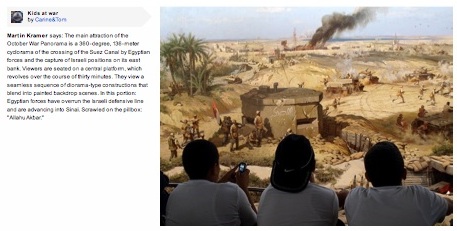
October 1973: Panorama and myopia

Another anniversary of the October 1973 Arab-Israeli war has passed. I’ve taken the occasion to experiment with a feature of the Flickr photo sharing site, allowing me to “curate” my own selection of photographs taken by others—in this instance, of the October war “panoramas” in Cairo and Damascus, which celebrate the Egyptian and Syrian “victories” over Israel. Click here.

It’s often said that the myth of the October “victory” made accommodation with Israel thinkable, by erasing the stigma of the 1967 defeat from Egyptian and Syrian consciousness. But a much more persuasive case can be made that Israel’s turning the tide of the 1973 war finally compelled Arab acceptance of Israel. Israeli forces overwhelmed Arab armies on two fronts, even from the most disadvantaged opening position. The lesson was not lost on the leaderships of Egypt and Syria, and it underpins their avoidance of war with Israel in the decades since.

In teaching the young only part of the story of 1973, these “panoramas” show much less than 360 degrees of the truth—and in some small way, erode the foundations of such peace as the Middle East enjoys. (They are also monuments to blind leader-worship, now challenged by the revolution in Egypt and the uprising in Syria.)

I’ve selected the most interesting photographs of these two attractions, put them in my preferred order, given them my own introduction, and put each image in its context. Again, to visit the gallery, click here. (Download pdf to print here.)

Israel’s national interests (not only for Chinese)

On September 7, I addressed a group of visiting Chinese international relations and Middle East experts, who had come to Israel under the auspices of SIGNAL (Sino-Israel Global Network and Academic Leadership). The topic: Israel’s national interests in the Middle East. It’s a challenge to explain the dilemmas of a small state to an audience accustomed to thinking big. Here is the text of my remarks.

Map of Israel in Chinese

I don’t intend to give you my own personal view of Israel’s national interests. My view is not especially important. I do want to suggest what I think most Israelis believe about Israel’s core national interests. These are basic things—I would call them the lowest common denominators. But they define the political center in Israel. Over time, Israeli policy doesn’t drift too far away from them.

In the Israeli national anthem, there is a phrase that expresses the purpose of Zionism and the Jewish state: our hope is “to be a free people in our land, the Land of Zion and Jerusalem.” “Free people” here isn’t a reference to democracy. It refers to the collective freedom of sovereignty. The Jews, through their state, and on their ancestral land, will gain the freedom to determine their own destiny, and not have it determined by others; to act in history, and not only be acted upon; to defend their lives, and not rely on the mercy of others.

The core national interest of the state of Israel is to preserve and enhance this freedom to act independently. How much freedom is enough? If Israel were a vast country with a large population like China, this freedom could be in rough proportion to Israel’s size. But because Israel is small in size and population, because its borders are very narrow and its population is that of one Chinese city, this is not enough. To be free, Israel must have capabilities that are disproportionate to its size and population. Otherwise it would be vulnerable to large neighbors, some of which have ten times its population and even more times its size.

A key national interest, then, is building Israel’s disproportionate power, so that Israel can remain the dominant actor in its own neighborhood—not the only actor, of course, but the dominant actor. This power is military, political, economic, and social. And Israel does have such power—partly due to the weaknesses of its neighbors, but mostly by virtue of its own ingenuity.

Another key Israeli national interest is an alliance with the most effective power of the day. Again, this is a function of Israel’s smallness in size and population. In the period before the creation of the state, this power was Great Britain, which provided the shelter in which the Jews built up their strength prior to 1948. Eventually, with Britain’s decline, Israel’s key ally became the United States. This was facilitated greatly by the fact that the United States is home to the largest number of Jews outside Israel, and the fact that Jews in America have flourished.

The U.S.-Israel relationship is complex, because no two states have identical interests. Neither is it exclusive, on either side. But Israel seeks, and will always seek, a primary relationship with the greatest power in a unipolar world, or one of the great powers in a multi-polar world. Since power ebbs and flows, even at the top level, and because great powers rise and decline, a key interest of Israel, like Zionism before it, is to anticipate such changes in advance.

Another key Israeli national interest is to prevent Israel’s enemies from forming effective coalitions against it. Israel is located in a fragmented part of the world. Although it is surrounding by hundreds of millions of people who speak Arabic and even more who profess Islam, they are divided into numerous states, sects, and tribes, many of them in conflict with one another. Israel is not the cause of these divisions—many of them are quite ancient—but it benefits from them, since these conflicts drain the power of Israel’s enemies.

The most dangerous threats lie in those ideologies that have united Israel’s enemies despite their differences. The two prime examples are Arab nationalism in its golden era of the 1950s and 1960s, and Islamism since the 1980s. The coalitions based on these ideas work to make war with Israel thinkable, despite Israel’s preponderance of power. Israel’s interest is to undermine them and highlight their internal contradictions. Israel can bring these contradictions to the surface by military operations, peace processes and treaties, and many other strategies. But the objective is the same: never to face a large number of adversaries at one time.

The same objective applies to the Palestinians, who constitute Israel’s nearest adversary. History has divided the Palestinians into many fragments—West Bank, Gaza, Israel, Jordan, refugee camps, diaspora. Were they unified, they could impinge on Israel’s own freedom to act. However, each fragment has its own interests, which prevents the Palestinians from forming a unified front. Historical circumstances have worked against Palestinian unity, as have certain weaknesses in Palestinian identity formation. Israel’s interest is to accommodate these divisions, by engaging separately with each Palestinian formation on the basis of its own distinct interests. In some instances, this engagement might be military, in others diplomatic.

Finally, a key national interest is the maintenance of a high degree of internal cohesion. Israel’s Jews constitute a very diverse population, with a large immigrant component, drawn from Europe, Asia, Africa, and America. There are other divisions as well, in approaches to modernity and religion.

It is remarkable how effective Jewish identity has been, in binding very different people to the new Israeli nation. Of course, there are many subcultures in Israel, from secular modernists to religious traditionalists, from Arabs to settlers, from the European-descended to the Ethiopian-born. It is one of the miracles of Israel—and a prime proof for the existence of the Jews as a people—that these subcultures not only coexist in peace, but cooperate at moments of war. The army itself is one of the chief mechanisms for building this solidarity, as is the democratic system.

So how has Israel performed of late in upholding its core national interests? As far as its dominance, Israel’s military and economic power has continued to grow relative to its neighbors, especially in the aftermath of the so-called Arab Spring. Arab peoples are largely turned inward, as struggles for power and resources unfold within each country. Since these revolutions are incomplete, these internal struggles will continue, with all their economic and political costs.

Iran seems to have suffered a setback in its nuclear program, which may be at least partly Israel-induced. Turkey has become more assertive, but it isn’t clear that there is an overriding Turkish national interest in playing that role. Israel, by building its strength, by its self-reliance, probably has as much freedom to act as ever.

As for Israel’s relationship with the United States, while there is no chemistry between Israel’s prime minister and America’s president, and there is some friction on strategy, the relationship remains solid, and has an expanding base in large sectors of American society. The question for Israel is whether the United States will remain the greatest power, both in absolute and relative terms. No one knows whether the present difficulties of the United States, exemplified by the debt crisis, are transitory or the beginning of a gradual decline. In any event, Israel continues to diversify its ties with rising powers (of which China is one).

The neighbors around Israel remain divided. The Arab Spring has particular potential for aggravating the Shiite-Sunni schism along an arc reaching from Lebanon through Syria and into the Persian and Arab Gulf. This would be to Israel’s advantage. But in the past, revolution has set the stage for the rise of charismatic leaders and unifying ideologies. Nasser in his day, and Khomeini in his, created ideological coalitions poised against Israel. The possibility of a populist leader emerging from the present turmoil to forge a coalition against Israel is not unthinkable. There are rising elements in each of the Arab Spring countries, including Egypt and Syria, which are hostile to Israel and linked to one another by transnational Islamism. (The Turkish leadership also has some links to them.) Israel will have to work especially hard to find the fissures in these still-weak formations and expand them.

As for the Palestinians, they remain thoroughly divided. The Palestinians have not joined the Arab Spring, and Israel has succeeded in preserving the status quo vis-à-vis each Palestinian formation Israel faces. So far, challenges to that status quo—most recently, the cross-border attacks from Egypt—have not undermined it. The statehood maneuver by the Palestinians at the UN will be another test. How that will end, one cannot predict, but so far Israel has been very agile in preventing Palestinians from coalescing in a way that would produce, for example, another intifada.

The internal cohesion of Israel has come under some stress, as a result of distortions that have accompanied Israel’s rapid economic growth. The protest movement under the slogan of “social justice” has had much momentum. But this hasn’t been as polarizing as past protest movements, because of its diffuse character. There have been much more polarized moments, from the Lebanon invasion to the Oslo Accords to the Gaza disengagement. Absent a serious peace process, it is unlikely that Israel’s internal cohesion will be tested anytime soon.

During your visit, you will hear many different views. You should understand that it is our habit to express strong opinions and debate loudly. But beneath this, there is a broad consensus on what Israel needs to survive and flourish, and a long-term record of success in creating the conditions that have made Israel the strong state you see today. I hope I have given you some understanding of those deeper considerations at play.