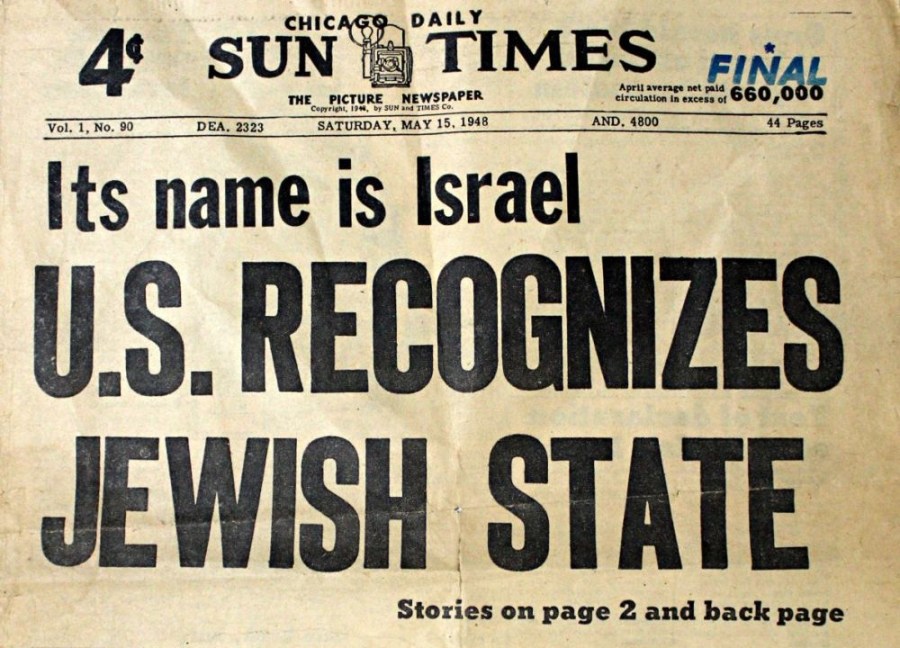
On May 14, 1948, David Ben-Gurion declared statehood in the old Tel Aviv Museum, now Independence Hall, on Rothschild Boulevard. The climax was this sentence: “We hereby declare the establishment of a Jewish state in Eretz-Israel, to be known as the State of Israel.” This was the applause line, the culmination, and the naming of the state.
Until that moment, very few people knew what the state would be called. In the various drafts of the declaration, the space for the name was left blank. When the diplomats of the Jewish Agency in Washington went to secure an advance promise of recognition for the state, they couldn’t tell the Americans what the name would be.
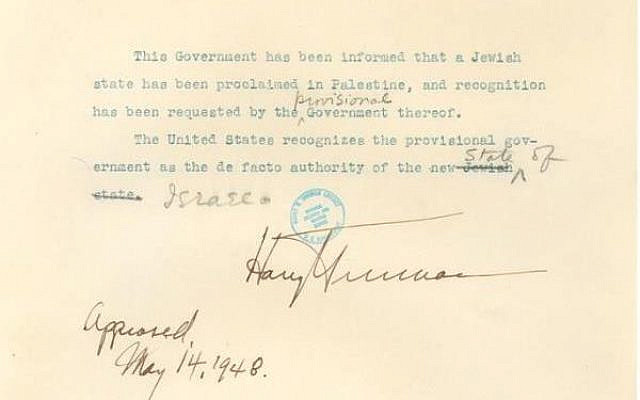
As Clark Clifford, Truman’s legal advisor, later recalled: “The name ‘Israel’ was as yet unknown, and most of us assumed the new nation would be called ‘Judaea.’” The letter prepared for Harry Truman on May 14, extending recognition, was typed as follows: “The United States recognizes the provisional government as the de facto authority of the new Jewish state.” Some hand crossed out “Jewish state” and wrote in its place “State of Israel.”
How was the name decided? By a vote in the People’s Administration, the cabinet-in-waiting, on May 12. The protocol doesn’t give the details of the debate. It simply records Ben-Gurion as saying:
We have decided that the name of the state will be Israel. And if we say state, then the State of Israel…. To this can be added every word in the grammatical construct state: army of Israel, community of Israel, people of Israel.
Ben-Gurion then put this to a vote. According to the protocol, seven voted in favor. Opposing and abstaining votes weren’t recorded. In his 1962 book Three Days, cabinet secretary Zeev Sharef wrote that this decision was taken “in the absence of any other suggestion.”
An unenthusiastic choice
But we actually know rather more about the debate that preceded this meeting from two sources: the first, what Sharef told a journalist on the first anniversary of independence; and the second, a recollection of the chief opponent of the name Israel.
This is what Sharef told that journalist in 1949. (He was Moshe Brilliant, and he published his piece on Israel’s first anniversary in what was still called, even in 1949, the Palestine Post.)
Most people had thought that the state would be called Judea (Yehuda in Hebrew). But Judea is the historical name of the area around Jerusalem, which at that time seemed the area least likely to become part of the state. Also, it applied only to a very small territory. So Judea was ruled out.
From its outset, Zionism had talked about creating a Jewish state, and so did the partition plan. As “Jewish” was a derivative of Judea, this name might have seemed a logical choice. But according to the UN partition plan, virtually all of the traditional geographic area of Judea was supposed to be either internationalized—Jerusalem and its environs—or part the Arab state. Calling a state Judea that didn’t include the geographic Judea would have been an anomaly.
But even if the state did wind up possessing a chunk of Judea, it would include much more than it—for example, the Negev. And how could the state be called Judea, when most of it was something else? It was problematic in another way. What would its citizens be called? Yehudim? How would that comport with the Arab citizens of the state, projected in the partition plan to number half a million? So Judea was ruled out.
I return to the account of Sharef via Brilliant.
“Zion” was also suggested, but Zion is the name of a hill overlooking the Old City of Jerusalem.
Here, again, we see the problem posed by the actual geography. How could a state be called Zion, when the geographic Zion wasn’t going to be a part of it?
Even the Bible refers to Jerusalem and sometimes to the entire land of Israel as Zion. It was in that sense that it was adopted by “Lovers of Zion” in the 19th century, and then by the Zionist movement.
But the creation of a sovereign Jewish state had the effect of reducing Zion once again to its specific territorial meaning. And in any case, what would the citizen of such a state be called? If he would be called a Zionist, that would create a confusion between a Zionist living in America and an actual citizen of the Jewish state. And of course, to expect Arab citizens to call themselves Zionists would have been asking rather a lot.
Back to Sharef via Brilliant.
One man proposed “Ever”—the root of “Ivri,” which means Hebrew. No one liked it.
There’s no explanation for why, and it certainly connected to the idea of the “new Jew” as a Hebrew. Presumably, the citizen of such a state would have been called an Ivri, a Hebrew. But Ever also had a geographic association, “crossing over,” and one interpretation is that it refers to that which is west of the Jordan. Possibly too limiting, and so no one liked it.
“Eretz Israel,” the Hebrew Biblical name for Palestine, was ruled out because of the dangers involved in its irredenta flavor.
Aside from the association of Eretz Israel with the Biblical past, under the British mandate it had been in the official Hebrew name of the entire country. That name was Palestina-Aleph-Yud, for Eretz Yisrael. Jews under the mandate did sometimes call themselves Eretz Yisraelim. But the UN had called for a partition of the country. While the declaration of statehood was careful not to refer to that plan as a partition plan, no one wanted openly to defy the UN either. Calling the state Eretz Israel would have sounded like an overt claim to all of mandatory Palestine. So it was ruled out also.
Back to Sharef via Brilliant:
It was Mr. Ben-Gurion who first suggested “Israel.” It seemed strange at the beginning, and the proposal was received coolly. But members tried pronouncing “Israel Government,” “Israel Army,” “Israel citizen,” “Israel consul” to see how it sounded. Most were unenthusiastic, but there were only 48 hours left and much urgent work to be done, and the matter was put to a vote. Seven of the ten members present voted for “Israel.”
There you have it. The name “Israel” came to the state by a process of elimination, because there wasn’t time to come up with anything better. A majority voted for it—unenthusiastically.
The lost case for Judea
The most cogent argument against this choice came from Yitzhak Gruenbaum, the foremost secular leader of interwar Polish Jewry, subsequent chairman of the Jewish Agency Rescue Committee during the Holocaust, and the first minister of interior of Israel.
Gruenbaum made the argument for the name Judea and against Israel, and years later explained his rationale in these words:
I opposed the name Israel. It reminded me of the name israélite [in French] used by non-Jewish sympathizers and assimilationists, instead of juif, which was considered derogatory. We Zionists embraced the derogatory “Jew,” which was the name of our people from the return from [Babylonian] exile and building of the Second Temple. The independent Hasmonean state, also after the Roman conquest, had this name. I favored the revival of this name, which the masses of the [Jewish] people accepted in their spoken languages. Another name was liable divide the state from the Diaspora.
For Gruenbaum, the name Judea had the advantage of creating continuity, from the last expression of Jewish sovereignty, Judea under the Hasmoneans, and through the 2,000 years of the dispersion of the Jews. This had been embraced by the Zionists when they campaigned for a Jewish national home and a Jewish state. A state called Judea would emphasize not only that continuity in time, but would link the new state to Jews everywhere in the present.
It’s an argument Gruenbaum lost because of the geographic counterpoint I mentioned earlier: the geographic Judea was too small, and not slated to be in the state. Gruenbaum admitted that “the majority accepted Ben-Gurion’s proposal… because the borders of our state are wider than those of the Hasmoneans.”
But then we come to Gruenbaum’s insinuation as to the real reason Ben-Gurion had come to prefer Israel over Judea. It wasn’t the geography.
I had a feeling that Ben-Gurion didn’t reveal the real reason behind his proposal, which was adopted. Unfortunately, it was realized after a few years that the name “Israel” created a misunderstanding among native-born Sabras. The Sabra began to see himself as an Israeli and not as a Jew.
Gruenbaum suspected that the real reason Ben-Gurion preferred the state of Israel over the state of Judea was that he wanted a rupture of continuity, a rupture with the Jewish, exilic past.
In that respect, Ben-Gurion wasn’t entirely different from those in France who had substituted israélite for juif, with the purpose of signaling that the Jews in France had been emancipated. Emancipation, after all, was also a rupture with the Jewish past. And Ben-Gurion didn’t want a bridge to the Diaspora, but its subordination to the new state. By the choice of the name of Israel, then, Ben-Gurion was out to create a new identity, building upon yet superseding Jewish identity.
Gruenbaum wasn’t religious. To the contrary, he was a declared secularist, and ended up in the socialist Mapam party. He didn’t want the name Judea to shackle the state to religion (or stake a claim to territory). But he wanted a name that bound the state to Jewish history, and not just Israelite antiquity.
When Gruenbaum complained that the sabra had ceased to see himself as a Jew, he was speaking in 1961, the very height of the secular wave of smug self-regard of the native-born Israelis, who thought they had transcended Jewish history.
But at that very moment, Ben-Gurion had taken a major step to remind young Israelis that they were indeed Jews. The previous year, Israel had seized Adolf Eichmann, a key figure in planning the Holocaust, and in 1961 put him on trial for crimes committed against Jews who were murdered in Europe, before the birth of Israel. The Washington Post ran an editorial claiming that Israel had no claim to represent the Jewish people. Ben-Gurion’s reply:
The Washington Post writer is perhaps unaware that on May 14, 1948, we proclaimed the establishment of a Jewish state, in accordance with the decisions of the United Nations (which were backed by the United States as well as other countries), and Israel is only the name of the Jewish state.
The essence of the state was Jewish; its name was a convenience. In Ben-Gurion’s view, the Eichmann trial should have banished any ambiguity caused by the name.
But the choice of Israel created a confusion that lingers to this day.
This post is derived from lecture three, “Identity,” of my new seven-lecture series, “Declaring Israel’s Independence.” The series, sponsored by the Tikvah Fund, is free. Enroll here.
Cross-posted at the Times of Israel.
 Martin Kramer on the Middle East
You must be logged in to post a comment.